




How Much Does It Cost to Upgrade a 6-Axis Welding Robot Later?
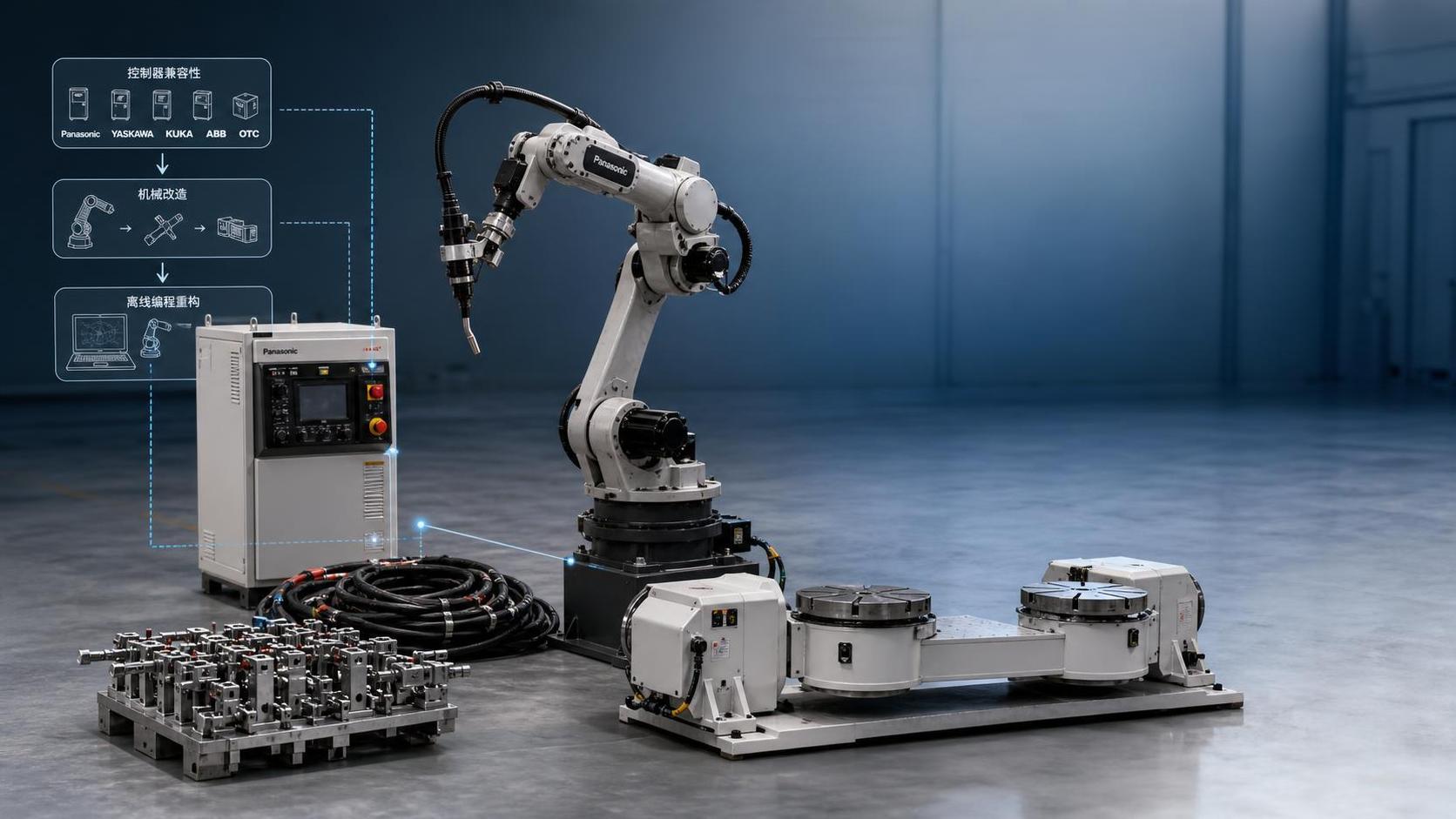
Upgrading a 6-axis welding robot to a newer model later can cost anywhere from a relatively contained retrofit expense to a near-complete cell rebuild, depending on what can be reused. The robot arm itself is only one part of the bill. In many real installations, the larger cost drivers are controller replacement, torch package changes, positioner and fixture compatibility, safety circuit modifications, offline programming updates, and the production interruption required to remove, install, calibrate, and requalify the cell.
If the original system was selected with future expansion in mind, the later upgrade may stay within a manageable range because cable routing, base dimensions, reach envelope, payload class, and communication architecture were already aligned. If the first installation used a tightly matched package with limited compatibility, the cost can rise quickly because each connected subsystem starts to move with the robot replacement.
Where the upgrade cost usually comes from
A newer 6-axis welding robot often brings changes in servo performance, controller generation, encoder systems, software licensing, and mechanical envelope. Even when two models appear similar on paper, the mounting pattern, wrist dimensions, arm interference zone, or harness path may differ enough to force surrounding modifications.
The cost typically breaks into several layers. One is the new hardware: robot arm, controller cabinet, teach pendant, cables, dress pack components, and sometimes a matching power source interface. Another is engineering work: backup, parameter migration, IO remapping, safety validation, tool center point setup, and path retouching. Then there is indirect cost, which is often underestimated: crane access, electrical downtime, shielding gas line changes, test coupons, weld procedure revalidation, and scrap generated during recommissioning.
For gas metal arc welding cells, torch neck geometry, wire feeder mounting, anti-collision mount dimensions, and liner length can affect whether the existing torch package can stay in service. For gas tungsten arc welding or specialty applications, the upgrade may also involve arc start hardware, seam tracking accessories, or coordinated motion settings that do not transfer cleanly between generations.
Controller compatibility changes the economics
When people ask, “How much does it cost to upgrade a 6-axis welding robot to a newer model later?”, the first technical question should usually be whether the newer arm can run on the existing controller generation. If it can, the upgrade may look more like a mechanical and software retrofit. If it cannot, the project often becomes a broader controls conversion.
A controller change can force replacement or reconfiguration of:
- fieldbus communication cards used for PLC handshaking,
- welding interface boards tied to the power source,
- safety relays or safety PLC mappings,
- remote I/O blocks mounted in the cell,
- operator HMI screens that call robot jobs or status bits.
Even if the new controller supports the same industrial network, signal addresses, timing behavior, and alarm handling may still differ. That means engineering time is needed to verify interlocks such as fixture clamp confirmation, part-present signals, fume extraction status, and torch cleaning cycle permissions. A robot that physically fits but does not drop cleanly into the control architecture is rarely a low-cost upgrade.
Mechanical reuse is rarely absolute
The base frame, robot pedestal, and cell fencing may appear reusable until the actual layout comparison begins. Reach and wrist articulation matter more than brochure dimensions. A newer model may have a slimmer arm but a different rear swing radius, which can interfere with guarding, cable trays, or a nearby column. In multi-station cells, even a small shift in axis motion can affect access to one side of a rotary positioner or limit torch angle at the root pass.
Base bolt patterns are another practical point. If the new robot uses a different footprint, the pedestal top plate may need adapter machining or full replacement. That introduces alignment work, grout repair in some floor-mounted installations, and fresh leveling. If the welding process depends on precise torch approach angles for fillet welds, lap joints, or tubular assemblies, any pedestal height change can cascade into fixture modification.
Tooling reuse is also conditional. A fixture designed around one robot’s approach path may still hold the part correctly yet become inefficient because the new arm reaches around clamps differently. In robotic welding, fixture geometry and robot motion are tightly linked. Saving the fixture does not always save the programming effort.
Programming and weld quality requalification take time
Many upgrade budgets focus on hardware and installation labor, but path recovery can consume a meaningful share of the total cost. A newer robot may offer better path accuracy or smoother interpolation, but existing weld points still need review. TCP calibration, user frame validation, wire stick-out settings, torch angle, travel speed, weave pattern, crater fill behavior, and arc start timing can all shift enough to require retouching.
If the old programs were built directly on the shop floor without clean offline documentation, the upgrade can become slower because the process knowledge lives inside the existing jobs rather than in organized engineering records. Backup files help, but they do not eliminate the need to test actual welds on production material.
Requalification is especially important when welding thicker carbon steel, stainless assemblies with distortion sensitivity, or aluminum parts where heat input and cleaning action have a narrow acceptable window. The newer robot may hold path better than the previous one, yet that does not guarantee the same bead profile if the welding package, torch neck, or motion tuning changes.
Downtime often costs more than expected
The direct invoice for the upgrade is only part of the answer. Production loss during shutdown can outweigh visible installation charges, particularly in cells that feed downstream machining, painting, or assembly operations. Removing an old robot, fitting the new unit, reconnecting utilities, teaching points, and proving stable cycle time is rarely a same-shift exercise unless the cell was designed for that exact migration path.
Downtime expands when access is difficult. Some cells require overhead lifting through a narrow service area, temporary removal of guarding panels, or disconnecting a positioner to create crane clearance. If the robot sits near heavy plate handling equipment, conveyors, or large jigs, moving surrounding hardware can add rigging labor and reset time.
Consumable-related delays also appear in practice. Different wrist routing may require another cable set length. A reused torch may need a new bracket or insulating parts. If the wire feeder is relocated, the liner path can change enough to affect wire feeding stability, especially with soft aluminum wire or long conduit runs.
Items that may stay in place
Not every upgrade forces a full rebuild. Some installations can retain a surprising amount of equipment if the new robot stays within a similar payload and reach class and if the original integrator left enough flexibility in the design.
- The welding power source may remain if the communication method is still supported and the process parameters can be mapped correctly.
- Fume extraction hoods, gas manifolds, and air preparation units are often reusable unless the cell layout changes substantially.
- Part fixtures can sometimes stay untouched when the torch access window remains valid and only point retouching is needed.
- Positioners usually remain only if payload, synchronization method, and work envelope still match the new robot’s motion limits.
The more of these subsystems that can genuinely remain in service, the more the project behaves like an upgrade. Once several of them need modification together, the budget starts to resemble a replacement program rather than a simple model refresh.
Software licenses and digital assets are easy to overlook
Some newer robot generations require updated software environments for programming, backup restoration, simulation, or production monitoring. That can introduce license purchases, workstation updates, and engineering time to convert archives. If the cell uses offline programming, the robot model, torch geometry, positioner kinematics, and cell layout may all need to be rebuilt or verified in the simulation package.
This part matters because inaccurate digital models cause real commissioning delays. A mismatch in tool length, mount orientation, or fixture origin can turn an apparently complete offline program into a long retouch session on the floor. If the upgrade involves coordinated motion with external axes, the conversion effort can increase further because mastering data, kinematic definitions, and travel limits must be verified carefully.
Safety changes can be small or unexpectedly broad
A newer robot model may introduce different stopping performance, safe speed functions, or controller-level safety architecture. Even if the cell guard fence remains where it is, the risk assessment may still need updating. Light curtains, interlocked gates, emergency stop circuits, and enabling devices can require rewiring or validation depending on how the new controller handles safe torque off, protective stop, or external emergency chain logic.
In welding cells, spatter shields, cable cover routing, and torch cleaning station placement also affect safety and maintainability. A modified wrist or dress pack can create new snag points or hot-surface exposure areas. These issues may not be expensive individually, but they add labor and inspection time.
Transportation, handling, and site conditions affect the final number
Robot upgrades are influenced by logistics more than many budget drafts assume. Packaging, inland transport, forklift capacity, indoor crane availability, and the condition of the installation site all shape cost. A compact robot in a clean service bay is easier to exchange than a unit located in a crowded fabrication line with limited lifting access and accumulated spatter around anchor points.
Environmental conditions matter too. In cells welding heavy structural steel, dust, grinding residue, and heat exposure may have affected cable conduits, junction boxes, or mounting hardware over time. During upgrade work, worn components often reveal themselves only after removal starts. Corroded fasteners, damaged conduit threads, or brittle hoses can add unplanned replacement items.
When an upgrade becomes a poor financial choice
Sometimes the answer to “How much does it cost to upgrade a 6-axis welding robot later?” points toward avoiding the upgrade altogether. That usually happens when the old cell has limited documentation, obsolete communication hardware, worn fixtures, inconsistent weld quality history, or a layout that already restricts throughput. In that situation, preserving legacy elements can consume labor without protecting value.
A common misjudgment is assuming that keeping the existing cell structure always lowers cost. If the old pedestal height is wrong for the new arm, if the fixture blocks proper torch angle, and if the PLC interface needs major rewriting, forcing reuse can stretch commissioning time and leave an awkward system behind. A more extensive rebuild may sometimes have a cleaner cost profile than a heavily compromised retrofit.
Questions that shape the real budget
Before estimating, it helps to define several technical boundaries clearly. Is the target a robot-only swap, a controller-and-robot package change, or a broader process refresh? Will the same wire type, shielding gas, weld schedule, and joint family remain in production? Are there external axes, seam tracking devices, torch cleaners, or vision systems in the cell? Is there a requirement to preserve existing programs, or is partial reteaching acceptable?
The answers determine whether the job is mostly mechanical, mostly controls-related, or dominated by process validation. Two cells with the same old robot model can produce very different upgrade costs because the surrounding equipment and documentation quality are different.
It also helps to separate one-time upgrade cost from future maintenance cost. A newer model may reduce spare parts risk or improve supportability, but that should be examined as a separate issue from the installation budget itself. Mixing those two questions often makes the estimate less clear.
In practical terms, later upgrade cost stays lower when the original cell uses standard interfaces, leaves physical clearance around the robot, documents fixtures and frames carefully, and avoids overly customized signal logic. When those conditions are absent, changing to a newer 6-axis welding robot can trigger enough secondary work that the robot purchase becomes only one line in a much larger project.
So the cost is rarely a single number attached to the robot model alone. It is the combined effect of compatibility, retained hardware, engineering hours, qualification effort, and downtime at the site where the machine actually welds.
search
Products Navigation
Send Us A Message