




How Welding Robots Perform in Outdoor or Humid Conditions
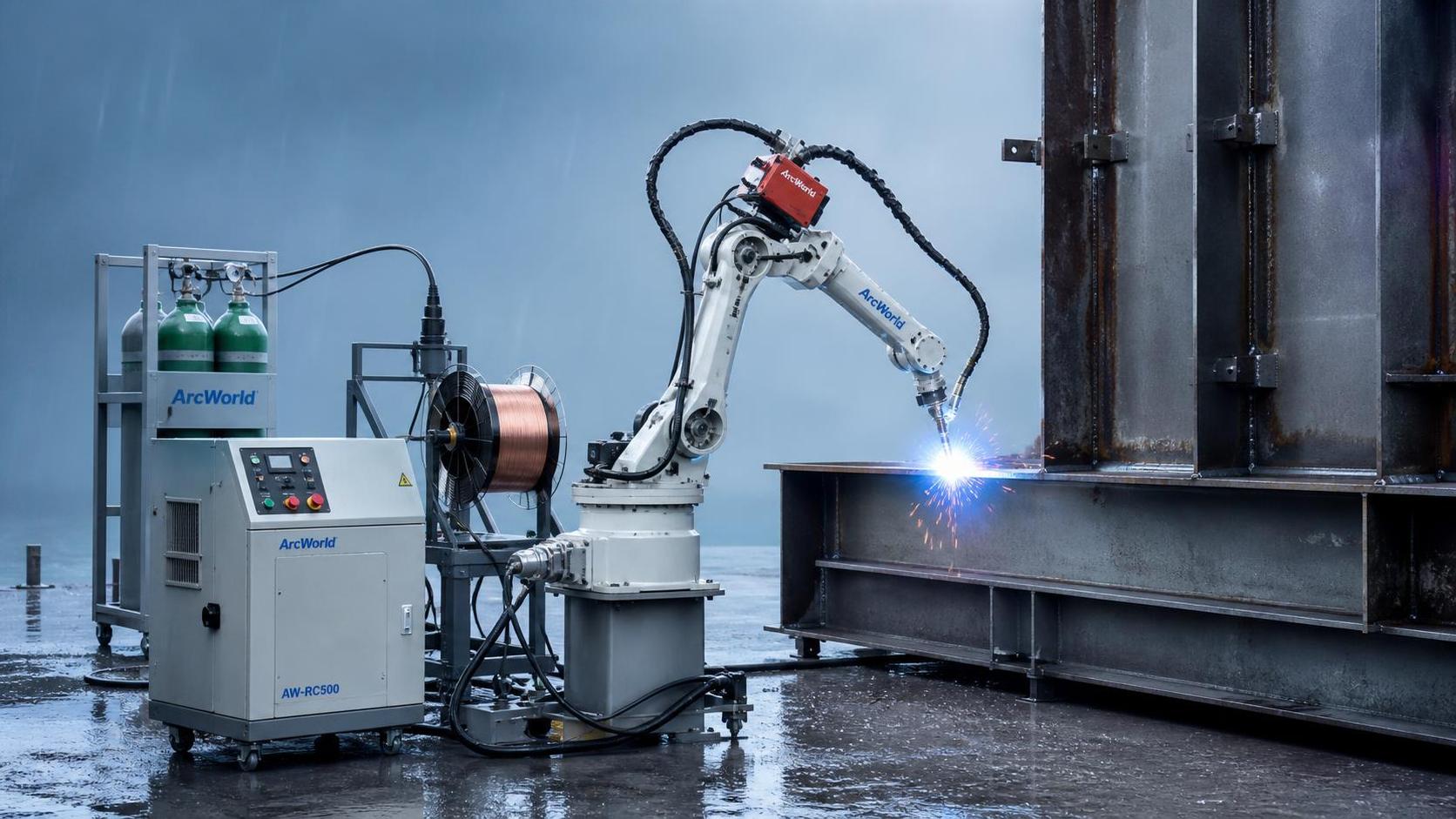
In outdoor or high-humidity construction environments, a welding robot can perform well only when the entire cell is designed for moisture, dust, temperature swing, and unstable site conditions. The robot arm itself may keep its repeatability, but weld quality depends just as much on torch sealing, cable routing, wire feeding, grounding, shielding gas protection, and the behavior of the controller under electrical noise. If any one of those parts is exposed or unstable, the result is usually inconsistent arc ignition, porosity, wire feeding trouble, or unplanned stops rather than a simple loss of robot accuracy.
Humidity affects welding in ways that are sometimes underestimated. Moist air can condense on cold metal, on the torch neck, inside connectors, and around the wire spool area. Once condensation appears, the problem is no longer only environmental discomfort. Water on the workpiece can disturb the arc and increase the chance of surface contamination. Moisture around electrical joints can create leakage paths, sensor faults, or intermittent communication errors. In carbon steel fabrication, damp plate or structural sections may also carry rust, mill scale, or residue that becomes harder to weld through consistently. On stainless steel or aluminum, the tolerance for surface contamination is usually even lower, so preparation quality matters more than in a dry indoor shop.
Protection level matters, but it is only one part of the answer
When people ask, “How does a welding robot perform in outdoor or high-humidity construction environments?” they often start by looking at the enclosure rating of the robot. That is reasonable, but incomplete. A higher protection rating may help the arm resist dust and water ingress, especially around joints and covers, yet the system includes many other vulnerable points: teach pendant connection, controller cabinet ventilation, wire feeder housing, gas hoses, cooling lines, seam tracking sensors, and external axis motors if the installation uses rails or positioners.
A robot with suitable ingress protection can still fail in wet service if the controller cabinet is placed where rainwater pools around the base, or if cable glands are poorly installed. The torch is another common weak point. Spatter, heat, and moisture together can shorten insulation life and damage consumables. In humid conditions, consumable management becomes more disciplined work. Contact tips, nozzles, diffusers, liners, and insulating sleeves need regular inspection because small deterioration at the torch end shows up immediately as poor arc stability.
Outdoor use also changes the meaning of “protected.” A unit under a roof but open to side wind will still see blown mist, airborne grit, and daily temperature shifts. A robot working near a shipyard section, bridge component, pipe spool yard, or steel structure staging area may face salt-laden air, abrasive dust, or night-to-day condensation cycles. In such settings, corrosion resistance of fasteners, cabinet hardware, connectors, and exposed brackets becomes practical rather than cosmetic.
Arc stability is usually the first performance issue to change outdoors
The robot does not create a stable weld by motion control alone. Arc behavior depends on current, voltage, inductance settings where relevant, wire extension, travel speed, torch angle, stick-out consistency, and gas shielding integrity. Outdoors, wind can disturb shielding gas before anyone notices a mechanical problem. Even a well-programmed path can produce porosity or oxidation if the gas envelope is repeatedly blown away.
This is especially important for gas-shielded processes such as GMAW and FCAW with shielding gas. Wind screens, local barriers, or semi-enclosed work zones are often needed. Without them, increasing gas flow is not always a clean fix. Excessive flow can create turbulence and pull in surrounding air, making the bead worse rather than better. The better approach is usually a combination of physical shielding, correct nozzle condition, proper stand-off distance, and parameter tuning based on the actual joint and position.
Flux-cored processes may offer more tolerance in some site conditions, but they are not immune to moisture-related trouble. Wire storage and handling still matter. If wire is exposed for long periods in a damp area, feeding quality and arc consistency may drift. The exact sensitivity depends on the wire type, packaging condition, and how the spool or drum is protected between shifts.
The workpiece condition often limits performance before the robot does
In factory demonstrations, material is usually clean, fixtured, and dimensionally consistent. Outdoor fabrication rarely stays that neat. Steel sections can arrive with variable mill scale, light rust, primer, cutting residue, oil film, or rainwater trapped in corners. Fit-up can move as temperature changes through the day, especially on long beams, frames, tanks, or pipe assemblies. A robot can repeat a programmed path very accurately, but if the joint location changes beyond the system’s sensing or tolerance range, accuracy turns into repeatable error.
That is why seam finding and joint tracking become more valuable in humid or outdoor applications. Touch sensing can compensate for part-to-part variation before welding starts, while through-arc tracking or optical systems may help the robot follow a joint that wanders during the weld. Even then, sensor choice should match the environment. Optical devices may struggle if protective windows collect condensation, smoke deposit, or spatter. Mechanical touch sensing is simpler, but slower, and its reliability depends on clean electrical contact and proper calibration.
Surface preparation remains basic but decisive. If moisture has settled on the joint, drying the weld area is often more useful than changing robot parameters repeatedly. Removing rust, primer where required, oil, and standing water gives the robot a stable condition to work with. Without that, troubleshooting tends to chase symptoms instead of causes.
Controller and electrical reliability need as much attention as welding parameters
Construction sites and open fabrication yards can expose automation equipment to unstable power, long cable runs, and interference from nearby heavy equipment. Welding robots are sensitive not only to raw voltage supply but also to grounding quality and cabinet environment. Poor grounding can lead to communication faults, arc starting irregularity, encoder issues, or random alarms that appear unrelated at first glance.
Controller cabinets are usually safer in a sheltered room or sealed enclosure than beside the work zone. If the controller must be close to the operation, filtration, internal temperature management, and condensation prevention matter. A cabinet that is sealed too tightly without thermal planning may overheat; a cabinet with inadequate sealing may inhale damp air and dust every time ambient temperature changes. In humid climates, anti-condensation heaters or controlled ventilation may be appropriate depending on local temperature swings.
Cable routing deserves careful installation. Outdoor robot cables should avoid low points where water can collect, sharp bends that stress jackets, and unsupported spans that vibrate in wind. Connector orientation also matters. A connector facing upward in a splash zone often becomes a maintenance issue much earlier than the same connector installed with drainage in mind. These are small decisions during installation, but they strongly influence long-term uptime.
Mechanical performance changes when the base and fixtures are not truly stable
Indoor robotic welding usually assumes a rigid foundation and predictable fixture behavior. Outdoor setups may be mounted on fabricated platforms, temporary foundations, rail systems, or movable skids. If the base shifts, settles, or vibrates under nearby crane traffic, the robot may remain internally accurate while the TCP no longer aligns with the real joint. That can show up as undercut on one side, inconsistent leg size on a fillet, or repeated arc-start misses at tack locations.
Large workpieces also behave differently outside. Sun exposure on one side of a long beam or frame can create thermal expansion that changes gap and alignment during the day. In heavy sections, this movement may be small but still enough to affect robotic path quality if tolerances are already tight. Positioners and clamps therefore need enough rigidity and adjustment range to keep the work inside the robot’s usable process window.
Where portable or modular robotic welding cells are used, re-leveling and reference verification should be part of normal setup after relocation. Skipping that step can waste a large amount of production time because the robot program may look correct while the real coordinate system has drifted.
Consumables and feeding systems are frequent hidden failure points
Wire feeding trouble becomes more common when humidity, dust, and temperature fluctuations are present together. The problem may begin at the spool or drum, continue through the drive rolls and liner, and finally appear at the arc as burnback or unstable deposition. In many outdoor cells, the wire feeder benefits from a better enclosure than the open arrangements often tolerated indoors.
- Drive roll pressure that is slightly too high can deform softer wire and create feeding drag, especially if the liner has picked up moisture or contamination.
- A long conduit route from feeder to torch may work in a clean shop but become less forgiving when the cable package stiffens in cold weather or gets coated with dirt and spatter.
- Water-cooled torches need extra attention where freezing risk exists, because coolant condition, hose insulation, and shutdown procedure affect reliability.
Shielding gas delivery also deserves close inspection. Hose permeability, loose fittings, wet regulators, and contaminated gas lines can all undermine consistency. If cylinders or bulk gas connections are kept in exposed areas, protecting valves and regulators from direct rain and dirty splash is a practical necessity, not a refinement.
Maintenance intervals usually shorten in damp service
A robot that performs steadily indoors may require more frequent inspection outdoors even when the weld schedule is unchanged. Humidity accelerates corrosion on unprotected metal surfaces, and airborne particles can combine with moisture to form deposits that are conductive, abrasive, or both. Preventive maintenance therefore shifts from calendar routine to condition-based observation.
Inspection points often include joint covers, cable jackets, earth connections, torch insulation, cooling circuit cleanliness, feeder compartment dryness, and cabinet door seals. Lubrication schedules may also need review because some greases behave differently in temperature swings or in areas exposed to washdown and mist. The right lubricant and sealing arrangement depend on the component design, and over-lubrication can be as harmful as neglect if it attracts grit.
Cleaning practice matters too. High-pressure water cleaning near a robot cell can force moisture past seals that would otherwise handle normal rain or humidity. A softer cleaning method, controlled air purge where suitable, and careful removal of conductive dust around cabinets and connectors usually produce better long-term results.
Process selection depends on the real environment, not just the joint drawing
Some outdoor jobs can be automated successfully with standard robotic GMAW when the work area is sheltered and fit-up is controlled. Other jobs may require a different process choice, revised joint preparation, or partial enclosure around the welding zone. Thick structural steel with variable gap may call for a process with better tolerance to site variation. Thin material exposed to drafts may be difficult to automate consistently unless the area is screened and the thermal input is tightly controlled.
Material type changes the margin for error. Aluminum is particularly sensitive to surface oxide, cleanliness, and shielding quality. Stainless steel may show immediate surface oxidation when gas coverage is disturbed. Carbon steel is often more forgiving visually, but subsurface porosity or lack of fusion can still develop if wet or contaminated conditions are ignored.
Joint position also matters. Flat or horizontal welding outdoors is usually easier to stabilize than vertical or overhead robotic work in the same environment. As position becomes more difficult, the combined effect of moisture, wind, and inconsistent fit-up becomes much harder to compensate for through programming alone.
Common misjudgments in outdoor robotic welding
One common mistake is assuming that a robot rated for industrial protection can simply be moved outside and used with the same settings, maintenance pattern, and peripheral layout as an indoor cell. Another is focusing only on the robot arm while leaving the wire feeder, gas system, and controller exposed. A third is blaming programming for defects that actually come from wet material, drifting fit-up, or poor grounding.
There is also a tendency to treat humidity as a minor issue unless visible rain is present. In practice, overnight condensation can be enough to disrupt morning production, especially on thick plate, hollow sections, stored fixtures, and torch components that cool below ambient dew point. If the first welds of the shift are erratic and later welds improve, moisture and temperature equalization are worth checking before changing the weld procedure.
Another misjudgment concerns transport and storage. Equipment shipped to a coastal or tropical location may arrive mechanically intact but still require controlled unpacking, drying time, and inspection for condensation before power-up. Long transport, warehouse transitions, and sea air exposure can affect connectors, electronic compartments, and packaged consumables before installation even begins.
A welding robot can work effectively in outdoor or humid conditions, but only when the robotic system is treated as a complete process package rather than a single machine. Stable welding in those environments comes from controlled shielding, dry and clean joint surfaces, protected electrics, reliable wire feeding, rigid mounting, and maintenance practices that match the site. When those conditions are built into the installation, robotic welding remains practical even where weather and moisture would quickly expose weak system design.
search
Products Navigation
Send Us A Message