




Can One Welding Robot Handle Both Fillet and Butt Welds?
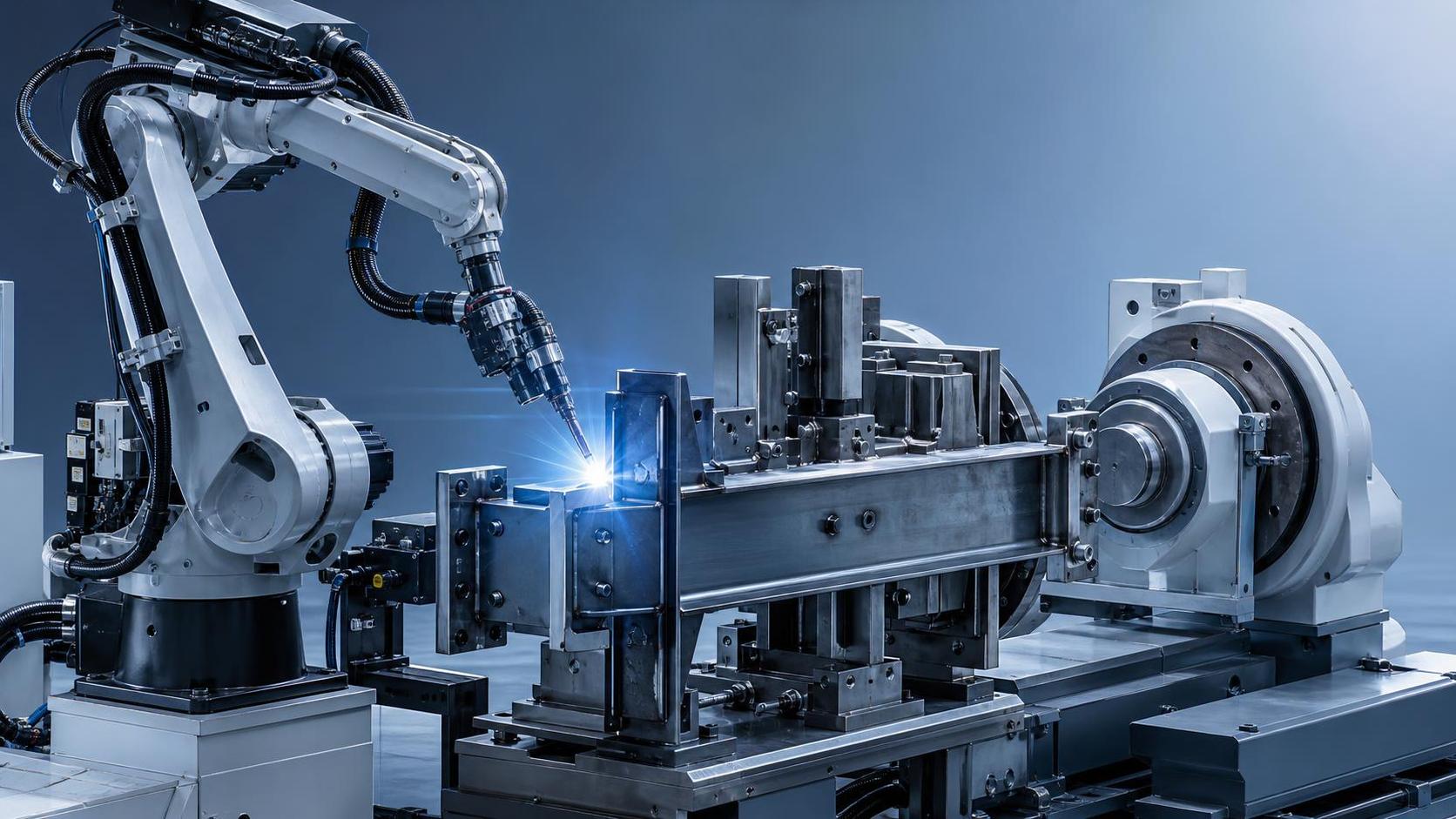
Can One Welding Robot Handle Both Fillet and Butt Welds?
Can a welding robot handle both fillet and butt welds on the same steel component? In many fabrication shops, yes—but only when the cell is built around that goal rather than assuming the robot alone will solve it.
That distinction matters. A fillet weld and a butt weld may exist on the same part, but they do not behave the same way in production. The groove condition is different, fit-up tolerance is different, torch angle is different, and the acceptable response to heat input is often different too. Shops that get good results from one robot handling both are usually the ones that have already done the unglamorous work: stable joint preparation, repeatable fixturing, sensible weld sequencing, and programming that matches the real part instead of an ideal drawing.
In steel fabrication, this question comes up often on frames, brackets, H-beam assemblies, machine bases, structural subassemblies, and sheet-to-section combinations where one component may need corner joints, lap joints, and groove joints in the same cycle. The short answer is not whether the robot is “capable.” Most modern welding robots are. The real question is whether the upstream and downstream process can support that capability consistently.
Where the challenge really sits
A fillet weld is generally more forgiving than a butt weld, especially in heavy fabrication where joint gaps can drift. The weld leg size may tolerate minor variation if the fusion and profile stay within spec. A butt weld, particularly a full-penetration or groove weld, is less forgiving. If edge prep varies, root gap changes, or part alignment moves even slightly, the robot will still run the path it was taught unless the cell includes sensing or adaptive correction.
This is why two shops can buy similar robot arms and get very different results. One has controlled cutting, beveling, tack welding, and fixture location. The other has inconsistent prep and expects the robot to compensate for it. It usually cannot—not by itself.
For manufacturers processing carbon steel components, especially medium and heavy sections, the issue is often less about arc generation and more about part variation. A robot can switch from a fillet pass to a butt joint pass in one program, but if the groove opening wanders or the tack pulls the joint out of position, that switch becomes irrelevant. The robot is precise; the workpiece may not be.
What must be in place for one robot to do both well
There are a few conditions that usually determine success.
Joint design comes first. If the butt weld requires a bevel, root face, or backing arrangement, that geometry has to be consistent from part to part. This links directly to upstream equipment such as CNC cutting machines, edge milling machines, and end face milling systems. In practice, the welding result often begins at the cutting station. Poor edge quality, dross, or inconsistent bevel angles show up later as unstable penetration or excessive rework.
Fixture accuracy is next. A robot program can only be repeatable if the part location is repeatable. This sounds obvious, but in mixed weld applications it becomes more demanding because the torch approach for a fillet weld may be relatively tolerant, while the butt weld may need far tighter joint tracking. If the same component shifts in the fixture between cycles, one weld type may still look acceptable while the other quietly fails dimensional or fusion requirements.
Then comes process selection. Many shops use gas metal arc welding for both joint types because it is easier to automate and productive across a wide range of steel fabrication tasks. But using the same process does not mean using the same parameters. Fillet and butt welds often call for different travel speed, voltage, wire feed, weaving strategy, stickout control, and sequence. Good robot integration accounts for that in the welding procedure and in the program logic.
If the part mix is broad, seam tracking or touch sensing becomes far more useful. On simple repetitive parts, it may be optional. On assemblies with variable tack-up, it can be the difference between one-pass success and expensive repair.
One component, two weld types: what changes in programming
Programming a robot for both fillet and butt welds on the same steel component is not just a matter of saving two path routines. The sequence matters because weld distortion does not respect program convenience.
A common mistake is teaching paths in a simple geometric order rather than a thermal order. On a real steel assembly, running all the fillet welds first because they are easier to access may pull the butt joint out of alignment before the groove weld is completed. In other cases, putting the butt weld first may lock in stress that makes later fit-up on smaller fillet joints less stable. The right sequence usually depends on section thickness, restraint condition, tack strategy, and final dimensional requirement.
Torch orientation also changes more than some buyers expect. A fillet weld may need a work angle and travel angle that is very different from a groove weld on the same part. If access is tight, the robot wrist and torch neck design start to matter. This is one reason cell layout should not be treated as an afterthought. Reach is not the same as usable reach.
For shops producing beam structures, fabricated frames, or machine bases, an external positioner can make a major difference because it lets the robot present each joint in a more favorable orientation. Without that, trying to force both joint types into awkward positions can lead to unstable arc behavior, undercut, spatter, or incomplete fusion risk.
The limiting factor is often not the robot
When buyers ask whether one welding robot can do everything on a part, the conversation often starts too late in the process flow. Welding quality is tied to preparation quality. If plate rolling, shearing, leveling, deburring, and edge preparation are unstable, the robot cell inherits those problems. This is especially true for butt welds, where root condition and edge geometry directly affect the arc result.
Companies working across fabrication equipment categories tend to see this more clearly. A supplier involved not only in welding robots but also in CNC cutting, H-beam production lines, edge milling, plate processing, and related machine tools usually understands that automation performance is system-dependent. Wuxi Samgins International Trade Co., Ltd, established in 2012 in Wuxi, operates in exactly that broader equipment environment. That matters because many real-world welding issues are not isolated welding issues at all; they begin with how the material is cut, prepared, and positioned before the arc starts.
This is also why compliance language such as ISO9001-based production organization or CE-aligned design practice has practical value only when it shows up as process discipline on the shop floor. A robot cell that can switch between fillet and butt welds needs that discipline more than marketing language.
When one robot is enough—and when it is not
One robot is often enough when the component family is reasonably consistent, joint access is manageable, fixturing is repeatable, and production volume justifies programming effort but not a fully dedicated multi-station line. This is common in medium-batch fabrication where the same style of steel assembly runs repeatedly with only moderate dimensional variation.
It becomes less suitable when the butt weld quality requirement is strict and the part-to-part variation is high. If groove geometry changes frequently, or if thick-section welds need multi-pass control with inspection-sensitive penetration requirements, the cell may need more sensing, more positioner support, or a separate process arrangement. At that point the question is no longer “can one robot do it?” but “what level of engineering is needed to make one robot do it reliably?”
There is also a throughput question. Even if a single robot can technically perform both weld types, cycle time may become the bottleneck if repositioning, cleaning, or parameter changes slow down the line. In some shops, splitting work between stations or cells is not about capability; it is about production balance.
A practical way to evaluate the application
If you are evaluating whether a robot should handle both fillet and butt welds on the same steel component, it helps to review the project in this order:
- Check the actual variability of cut edges, bevels, and fit-up—not the nominal drawing.
- Confirm whether the fixture can hold the part repeatably after tack welding and during heat input.
- Compare weld access for both joint types with the real torch and wrist envelope.
- Review whether touch sensing or seam tracking is needed for the butt joint.
- Model the weld sequence around distortion control, not just shortest robot path.
- Estimate whether one cell can meet takt time once cleaning, repositioning, and inspection are included.
That evaluation is usually more useful than asking for a general yes-or-no answer.
So, can one welding robot handle both fillet and butt welds? In modern steel fabrication, very often it can. But successful applications are built on controlled preparation, stable fixtures, process-aware programming, and realistic expectations about part variation. If those pieces are in place, one robot can be a practical and efficient solution. If they are not, the robot may only expose problems that were already there.
Before choosing the robot, it is worth checking the entire fabrication chain—from cutting and edge prep to fixturing and weld sequence. That is usually where the decision becomes clear.
search
Products Navigation
Send Us A Message