




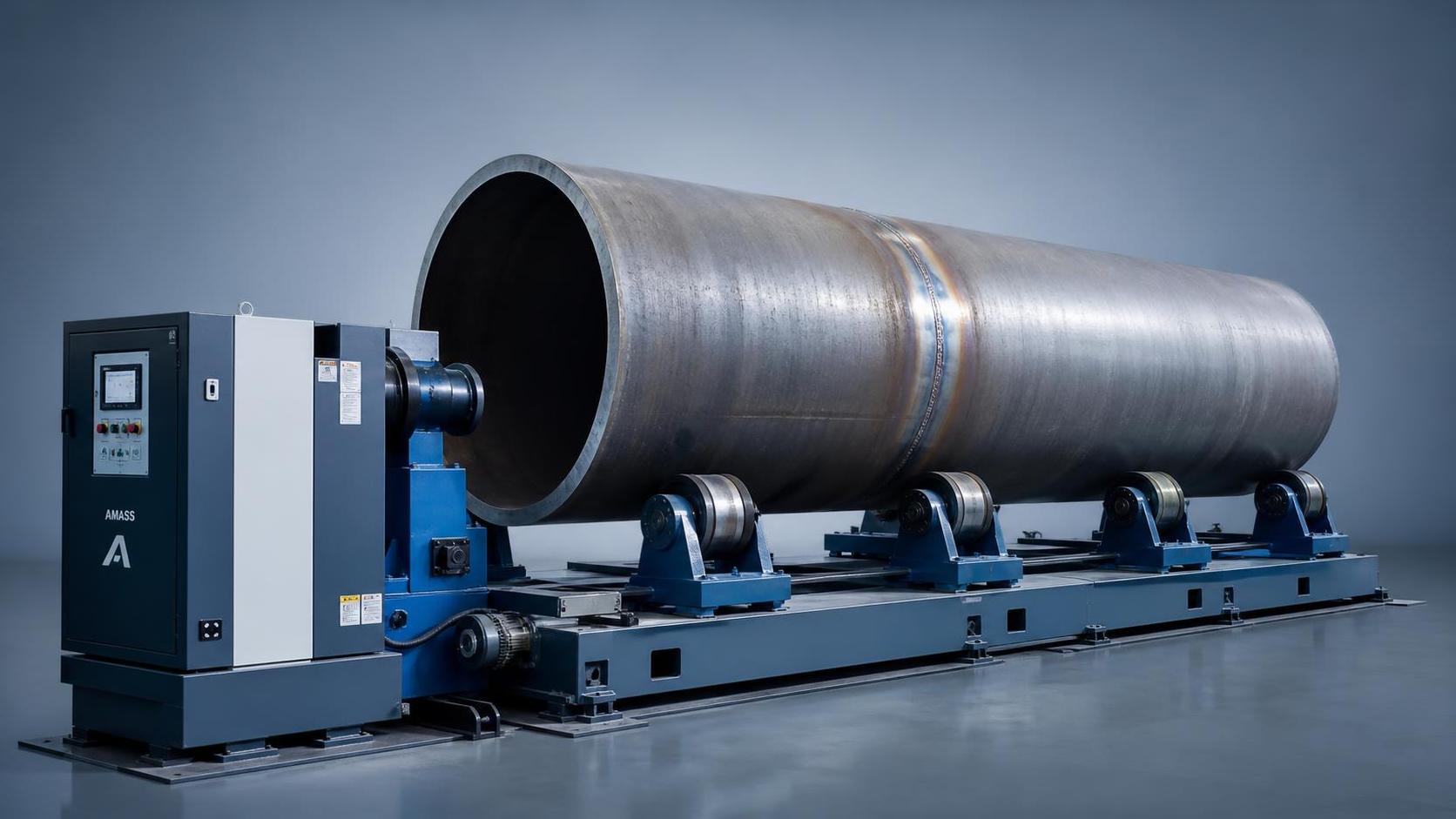
How an Automatic Pipe Welding Rotator Improves Weld Quality on Heavy Pipe
In heavy pipe fabrication, weld quality problems often do not start at the arc. Many begin with how the pipe is held, rotated, and presented to the welder or welding head. A joint that looks simple on paper can become difficult in practice when large-diameter or thick-wall pipe has to be turned smoothly, kept centered, and held at a stable travel speed. That is why an Automatic pipe welding rotator is often discussed not as a convenience item, but as a process control tool.
If you are evaluating equipment for pressure pipe, structural pipe, or other heavy-duty fabrication work, the usual concern is not only whether the pipe can rotate, but whether that rotation helps produce more consistent penetration, bead profile, and alignment from start to finish. The difference matters because poor support and uneven turning can show up later as undercut, poor fusion, inconsistent reinforcement, misalignment, rework, and wasted welding time.
Why Weld Quality Often Drops on Heavy Pipe Jobs
Heavy pipe creates a set of practical difficulties that smaller workpieces do not. The weight is higher, the inertia is greater, and the joint line has to remain stable through the full rotation cycle. In many shops, quality variation appears when the operator is doing good welding work but the workpiece itself is not moving in a controlled way. A slight speed fluctuation, an off-center load, or a support roller mismatch can change torch angle and arc behavior enough to affect the weld.
Common symptoms include uneven bead width around the circumference, visible starts and stops, inconsistent root profile, and position changes that force the welder to keep correcting posture or parameters. On thicker material, that instability can also influence heat input distribution. Even when the defect is not severe enough to fail inspection, it can still create straightness issues, more grinding, more repair welding, and slower throughput.
That is the reason an Automatic pipe welding rotator gets attention in technical evaluation. Its value is not limited to turning the pipe. It helps convert a difficult circumferential weld into a more controlled, repeatable movement where the welding process can stay within a narrower operating window.
What an Automatic Pipe Welding Rotator Actually Changes in the Process
The most important improvement is stable and predictable rotation. When the pipe turns at a controlled speed, the welding arc sees a more uniform joint presentation. This makes it easier to maintain a constant travel speed, a steady weld pool, and a consistent relationship between torch and joint. On heavy pipe, that consistency is usually more valuable than trying to compensate manually during the weld.
A second improvement is positioning. Good rotator setup keeps the pipe supported on the correct centerline and reduces unwanted movement during rotation. That matters because even small shifts can alter arc length, work angle, and contact tip to work distance. With a reliable position, fit-up quality becomes easier to preserve during tack welding, root passes, fill passes, and final cap welding.
A third benefit is process continuity. Without controlled rotation, operators may need to stop and reposition more often, especially on large workpieces. Every interruption introduces a chance for irregular tie-ins, temperature variation, and inconsistency in appearance. Automatic rotation supports smoother welding sequences, which is one reason it can improve both visual quality and process discipline.
How to Judge Whether the Rotator Is Solving the Real Problem
One common mistake is to assume that any rotating unit will improve weld quality automatically. In practice, the result depends on how well the equipment matches the pipe size, weight, and welding method. If the load range is wrong, the pipe can sit poorly on the rollers. If the control response is rough, the speed may fluctuate at exactly the point where the weld needs to stay smooth. If the frame rigidity is not appropriate for the application, vibration or instability can undermine the expected benefit.
Another common mistake is focusing only on maximum load. Load capacity matters, but so do speed control precision, synchronization between drive and idler units, roller material and contact condition, and the ability to accommodate different diameters without making setup excessively slow. For heavy pipe, the question should be: does the rotator help maintain a stable welding condition around the full circumference, not just support the weight without failure?
When evaluators compare options, they often get better answers by checking process-related criteria: how smoothly the unit starts and stops, whether it can hold low-speed rotation consistently, how easily the pipe can be centered, and whether the system supports the actual welding sequence used in the shop. These points tell you more about likely weld quality than generic catalog language.
A Practical Checklist Before Welding Starts
Before expecting better welds from an Automatic pipe welding rotator, it helps to verify the setup in a systematic way. In many situations, weld inconsistency is caused by preventable preparation issues rather than a flaw in the welding power source or wire.
- Confirm load matching: Check that the pipe weight and diameter are within the working range of the rotator, not just near its theoretical limit.
- Check roller contact: Make sure the pipe sits evenly on the rollers and does not have unstable contact caused by scale, distortion, or incorrect spacing.
- Verify centering: An off-center workpiece can create irregular rotation and affect torch position throughout the weld.
- Test low-speed stability: Run the pipe at welding speed before arc start and watch for hunting, slipping, or speed jumps.
- Review fit-up retention: Confirm that tack welds and clamps will hold alignment during turning, especially on thick-wall joints.
- Coordinate with the welding process: The rotator speed range should suit the actual process, whether MIG, TIG, SAW, or another circumferential welding method.
This kind of checklist tends to prevent the most frustrating situation in heavy pipe work: blaming the weld process when the real source of variation is mechanical handling.
Where Weld Quality Improvement Usually Becomes Visible
In real production settings, the first visible improvement is often bead uniformity. When rotation remains smooth, the weld tends to look more even around the circumference because travel conditions are not changing constantly. Operators also find it easier to keep the torch in the preferred orientation, which supports more consistent fusion and reinforcement.
The next improvement is in heat control. Heavy pipe usually requires attention to heat input, interpass discipline, and deposition behavior. Stable turning helps the welder or automated head maintain a more regular progression, reducing the tendency to dwell too long in one section or rush through another. That does not replace proper welding procedure control, but it makes the procedure easier to follow.
Another effect is reduced operator correction. If the pipe rotates reliably, the welder spends less effort compensating for motion problems and more effort monitoring the weld itself. In technical terms, that means fewer process disturbances caused by workpiece handling. In practical terms, it often means cleaner welds and fewer interruptions.
Common Misunderstandings When Comparing Equipment
A frequent misunderstanding is treating a rotator as an isolated accessory rather than part of the welding line logic. For heavy fabrication, the workpiece support system, fit-up method, welding head arrangement, and material flow all affect final weld quality. A good rotator improves results most clearly when it fits the broader process instead of being added as a stand-alone fix.
This is also why some buyers look beyond pipe-specific equipment and study how other automated welding lines manage stability, deformation control, and continuous flow. For example, in structural fabrication, systems such as Horizontal H beam line are designed around the idea that positioning, welding sequence, flipping, conveying, and monitoring should work together. Features like horizontal assembly, horizontal SAW, chain-type flipping for double-sided welding, and PLC-based coordination reflect the same process thinking that matters in pipe welding: stable movement and repeatable presentation improve weld consistency more reliably than operator correction alone.
That does not mean pipe welding and H-beam production should be evaluated the same way. The geometries and welding tasks are different. But the comparison is useful because it highlights a sound purchasing principle: weld quality improves faster when equipment selection is based on process stability, deformation control, and workflow integration, not only on headline speed or maximum capacity.
How to Integrate the Rotator Into a Better Welding Routine
If your current heavy pipe workflow already includes proper beveling, fit-up, tack sequence, and welding procedure control, the next step is to make the rotator part of a repeatable operating routine rather than a basic handling device. That usually means defining setup rules for roller spacing, pipe centering, speed presets, and pre-weld test rotation.
It also helps to separate two decisions that are often mixed together. One decision is whether the workpiece can be rotated. The other is whether it can be rotated smoothly enough to support the intended weld profile and deposition behavior. Shops that make this distinction usually evaluate equipment more effectively because they are not satisfied with simple movement; they are checking for movement quality.
Where production volume is high, standardizing these checks becomes even more important. Process lines in other fabrication segments, including the second use case for Horizontal H beam line, often show the benefit of one-click startup logic, automated material flow, and real-time quality monitoring in keeping output stable. In pipe work, the exact configuration will differ, but the lesson remains useful: repeatability is built into the routine before it appears in the weld.
When an Automatic Pipe Welding Rotator Helps Most
The strongest fit is usually in applications where pipe diameter, wall thickness, or workpiece weight make manual repositioning inconsistent or inefficient. It is also valuable where weld appearance, circumferential consistency, and reduced rework are important enough that motion control becomes part of quality control.
For small and simple jobs, a basic setup may be enough. But as pipe size and process demands increase, manual handling starts to expose its limits. That is when stable rotation becomes less of a convenience and more of a requirement. If a shop is repeatedly seeing uneven bead profile, repeated adjustment by the operator, or time loss around repositioning and correction, the rotator should be examined as part of the root cause analysis.
In other words, the equipment makes the biggest difference when weld quality is being limited by workpiece movement rather than by a missing welding parameter alone.
Frequently Asked Questions
Does an Automatic pipe welding rotator improve quality even if welding is done manually?
Yes, it often can. Manual welding still benefits from stable workpiece rotation because the welder can maintain a more consistent torch position and travel rhythm. The equipment does not replace welding skill, but it reduces mechanical variation that can disturb the weld.
Is load capacity the main factor when choosing a rotator for heavy pipe?
It is an important factor, but not the only one. Speed stability, centering behavior, roller arrangement, control precision, and compatibility with the actual welding process are also critical if the goal is better weld quality.
Can a rotator reduce weld defects by itself?
Not by itself. It reduces one major source of variation: unstable workpiece movement. Weld preparation, joint fit-up, procedure settings, consumables, and operator practice still need to be controlled. The rotator works best as part of a disciplined welding process.
What is the first sign that the setup is wrong?
A common early sign is uneven rotation before welding even starts. If the pipe hesitates, slips, or appears to run off-center, the weld is unlikely to stay consistent around the full circumference. That should be corrected before arc start.
Conclusion
For heavy pipe fabrication, better weld quality usually comes from controlling the basics more carefully, not from chasing isolated fixes after defects appear. An Automatic pipe welding rotator improves the process by keeping the pipe stable, centered, and moving at a controlled speed, which gives the welding operation a better chance to remain consistent around the entire joint.
If you are comparing equipment, the useful question is not simply whether the pipe can be turned. It is whether the turning behavior supports repeatable welding conditions under your real load, diameter, and production requirements. Evaluated that way, the rotator becomes a quality tool as much as a handling tool.