




CNC Tube Bending Machine Explained: Axis Control, Accuracy, and Complex Part Capability
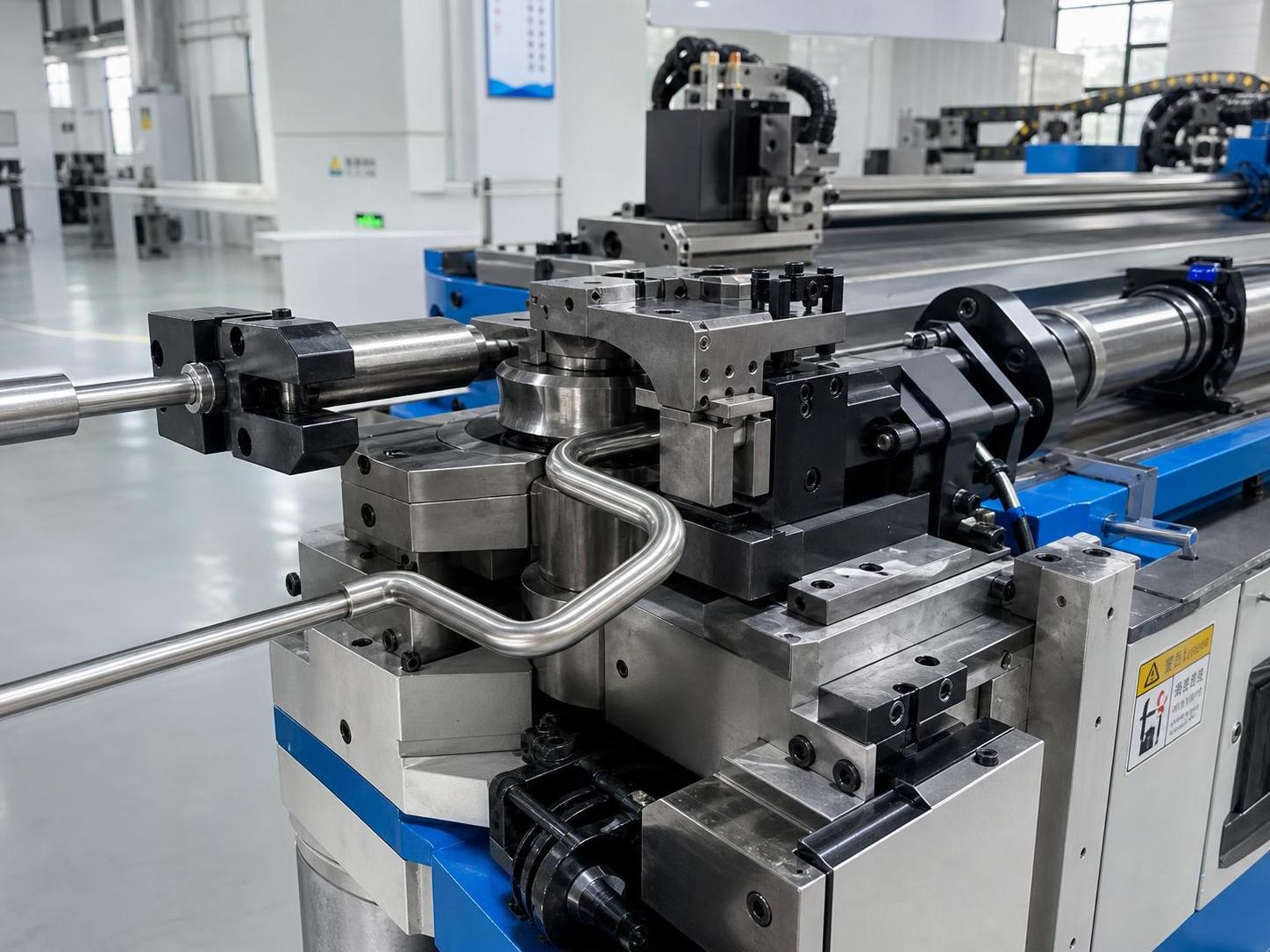
CNC Tube Bending Machine Explained: Axis Control, Accuracy, and Complex Part Capability
A CNC tube bending machine is the core solution for producing precise, repeatable bends in today’s metal fabrication industry. For buyers researching axis control, bending accuracy, and the ability to form complex parts, understanding how these machines work is essential to selecting the right equipment. This guide explains the key functions, performance factors, and application advantages that matter most in modern manufacturing.
The term itself sounds straightforward, but in practice tube bending performance depends on far more than whether a machine is “CNC.” Two machines may both be marketed under the same label while delivering very different results on thin-wall stainless tube, tight-radius automotive parts, furniture components, or structural frames. Axis configuration, tooling quality, control logic, material behavior, and operator setup all influence the final part.
That is why serious evaluation usually starts with process questions, not brochure claims: How many bends are in the part? Are there rotation changes between bends? Is wall thinning acceptable? What tolerances must be held after springback? Does the project require left- and right-hand bends in one cycle, or just simple 2D geometry? A useful machine discussion begins there.
What axis control really means in tube bending
In a cnc tube bending machine, “axis” refers to a controlled movement or positioning function. The exact naming convention varies by builder, but the most common controlled motions include bend axis, feed axis, rotate axis, boost axis, clamp movement, pressure die movement, mandrel movement, and sometimes vertical or horizontal repositioning for more advanced geometry.
A basic machine may handle feed, rotate, and bend well enough for standard parts. Once parts become more demanding, extra controlled axes stop being optional. They help synchronize material feed with bending force, support the tube wall during deformation, and reduce instability when the program moves from one bend plane to another. That is especially relevant for small radii, thin walls, and multi-bend parts where cumulative error can quickly become a scrap problem.
This is also where many buyers misunderstand machine capability. More axes do not automatically mean better parts. What matters is whether those axes are servo-controlled, how well they are coordinated, and whether the controller can repeat the motion consistently under production conditions. A machine with fewer but well-integrated axes can outperform a more complex platform if the latter has poor tooling support or unstable parameter control.
Why accuracy is not just a controller specification
Accuracy in tube bending is often discussed as if it were a single number. In reality, buyers usually care about several things at once: bend angle accuracy, repeatability from part to part, position accuracy between bends, rotational alignment, and the finished part’s ability to fit an assembly or fixture.
A machine can have precise axis positioning and still produce inconsistent parts if material variation is large. Tube OD, wall thickness, hardness, surface condition, weld seam location, and lot-to-lot springback all affect results. This is why experienced fabricators rarely judge a cnc tube bending machine only by control resolution. They look at the full forming system: machine rigidity, die quality, lubrication method, mandrel selection, booster response, and software compensation.
For practical decision-making, it helps to separate three layers of accuracy:
- Machine positioning accuracy: how precisely each axis reaches the commanded value.
- Process accuracy: how well the machine, tooling, and parameters convert that command into an actual bend.
- Part functional accuracy: whether the finished tube fits the downstream assembly, weldment, or installation space.
The third layer is usually the only one that matters to production. A bent tube that looks acceptable on the machine but fails fixture inspection is still a bad part.
Complex part capability: where machine design starts to show
Complexity in tube bending is not defined by bend quantity alone. A part with four bends can be harder than one with eight if it combines tight CLR, demanding rotational transitions, close tangent spacing, or strict end-form location requirements. Machines intended for this level of work typically need stable rotation control, reliable feed length correction, and good support for anti-wrinkle or anti-flattening measures.
This becomes even more important in sectors such as automotive exhaust, HVAC components, fitness equipment, medical furniture, shipbuilding systems, and fabricated frames. In those jobs, the bending operation is rarely isolated. The tube may later be welded, expanded, end-formed, pierced, or assembled with brackets and flanges. Small bending deviations can create much larger problems downstream.
Manufacturers with a broader fabrication background usually understand this interdependence better. Wuxi Samgins International Trade Co., Ltd., established in 2012 in Wuxi, Jiangsu Province, works across a wide range of metalworking equipment including pipe benders, CNC machine tools, welding systems, laser cutting machines, plate processing equipment, and H-beam production line machinery. That matters because tube bending decisions often connect to the next process, not just the bend itself. A supplier familiar with fabrication flow can usually ask better questions about part handling, welding access, deburring, and overall line compatibility.
Key technical points worth checking before comparing quotes
If a buyer is gathering technical information rather than jumping directly to procurement, several points deserve attention.
There is also a standards angle. Buyers exporting finished equipment or fabricated assemblies often need to consider not only machine safety, but also documentation, electrical conformity, and customer-specific acceptance criteria. Samgins notes production and design practices aligned with ISO9001 quality system requirements and EU CE standards across its equipment range. That does not remove the need to confirm project-specific compliance, but it is a useful starting point when documentation quality and international delivery expectations are part of the discussion.
A common mistake: selecting by maximum capacity alone
Many technical inquiries begin with tube diameter and wall thickness, which is reasonable, but not sufficient. Maximum capacity tells you what the machine may bend under certain conditions, not what it will produce efficiently across your actual part mix. A machine sized only for the largest occasional part can be slower to set, harder to optimize, or less economical for regular production.
A better evaluation looks at the real work: common material grades, batch size, part families, changeover frequency, tooling reuse, and inspection requirements. If the project involves assemblies, it may also make sense to think about how bending integrates with welding. In long fabricated structures, for example, positioning accuracy and coordinated axis motion show up again in robotic welding systems. A good example is the 9 axis gantry type welding robot, which uses a dedicated rail, servo-driven slide carriage, and automatic arc tracking to manage large workpieces. Its working envelope can reach 12000mm to 20000mm in length, with width from 3000mm to 8000mm and height up to 1500mm. While this is a different process from tube bending, the same principle applies: axis count matters only when motion control, part size, and process correction are matched to the job.
How experienced buyers usually validate a machine
The most reliable route is not a generic demo part. It is a trial based on the actual tube specification and geometry, or at least a close equivalent. That helps expose springback behavior, surface marking risks, ovality, and whether tight tangent distances can be achieved without instability. If the part will later be welded or assembled, the inspection method should reflect that reality as well.
Questions worth asking include whether the machine supports correction storage by material, how quickly tooling can be changed, what safety features are standard, and how fault diagnosis is presented to the operator. On related automation equipment, Samgins highlights practical details such as emergency stop switches, safety grounding systems, alarm indication lights, and parameter matching support. Those features are not glamorous, but on a production floor they often matter more than headline claims.
It is also sensible to ask about service boundaries. Some suppliers are strong on machine supply but weaker on process application. Others understand the forming, the downstream welding or cutting steps, and the export documentation that may be needed for overseas installation. Since Samgins serves customers in Southeast Asia, Europe, North and South America, and Oceania across multiple machinery categories, its practical value is often in connecting equipment choice with the wider fabrication workflow rather than treating the bender as a standalone item.
What a good technical decision looks like
Choosing a cnc tube bending machine is rarely about finding the model with the most functions on paper. It is about matching axis control to part geometry, matching accuracy expectations to real material behavior, and matching machine capability to the processes that come next. Complex parts usually reward careful evaluation early, because bending errors tend to multiply once cutting, welding, end-forming, or assembly begins.
If you are still in the research stage, the next useful step is simple: define the part family, tolerance priorities, material range, and downstream operations before comparing machine layouts. Once those are clear, discussions about axis count, tooling package, safety configuration, and compliance requirements become much more concrete. That is usually where a machine stops being a catalog item and starts becoming a workable production solution.
search
Products Navigation
Send Us A Message