




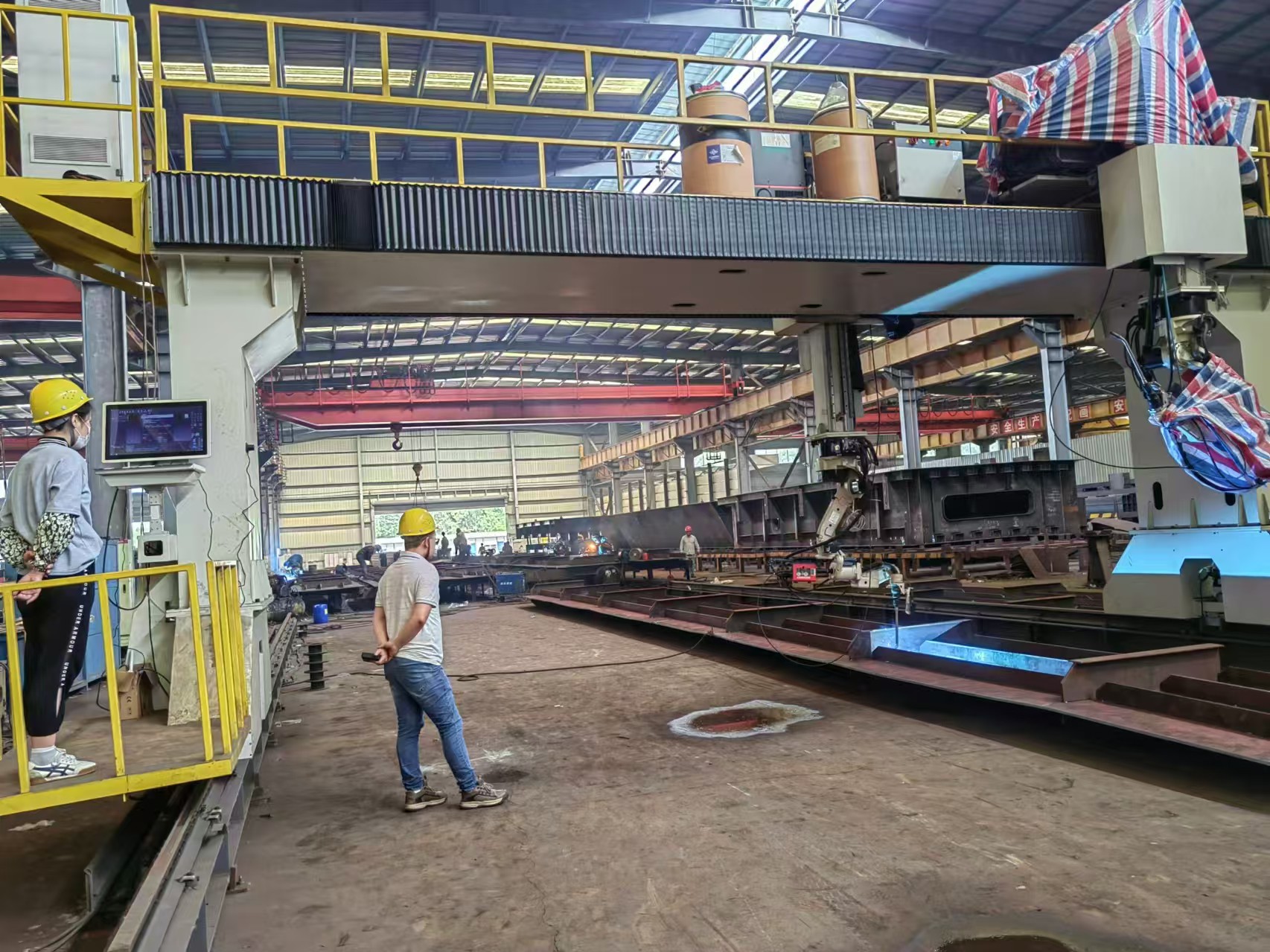
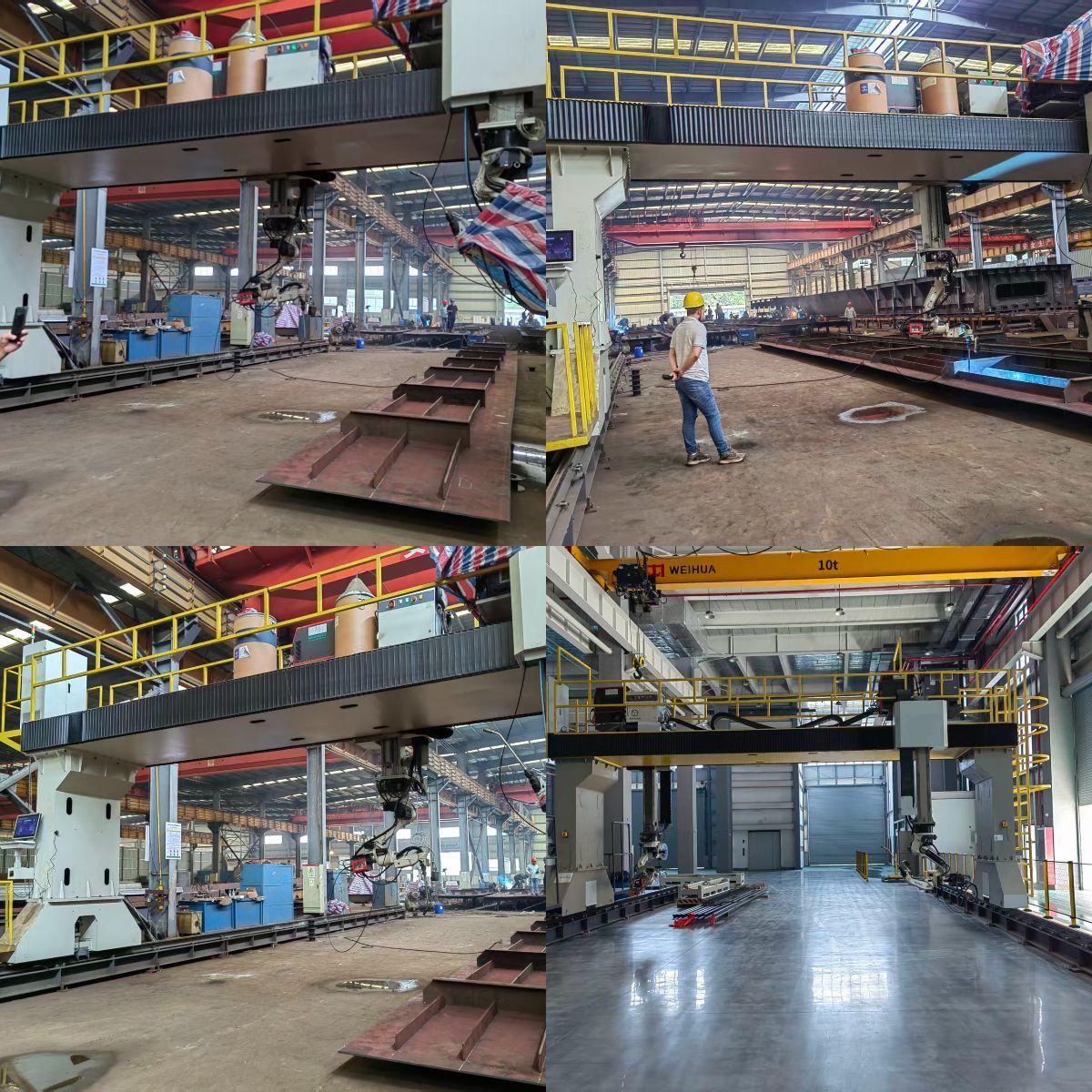
9 axis gantry type welding robot
The ground rail support is 12 meters long and one ground rail is welded. For the workpiece of more than 12 meters and less than 25 meters, two robots are used to conduct regional welding, which can greatly improve the welding efficiency.
Full-range Machinery & Customized Non-standard Solutions
Authorized Certificates & Independent R&D Patents
Over 10 Years Global Export & Worldwide Project Cases
Navigation

9 axis gantry type welding robot Description
1.Introduction for 9 axis gantry type welding robot:
1.1 System Composition
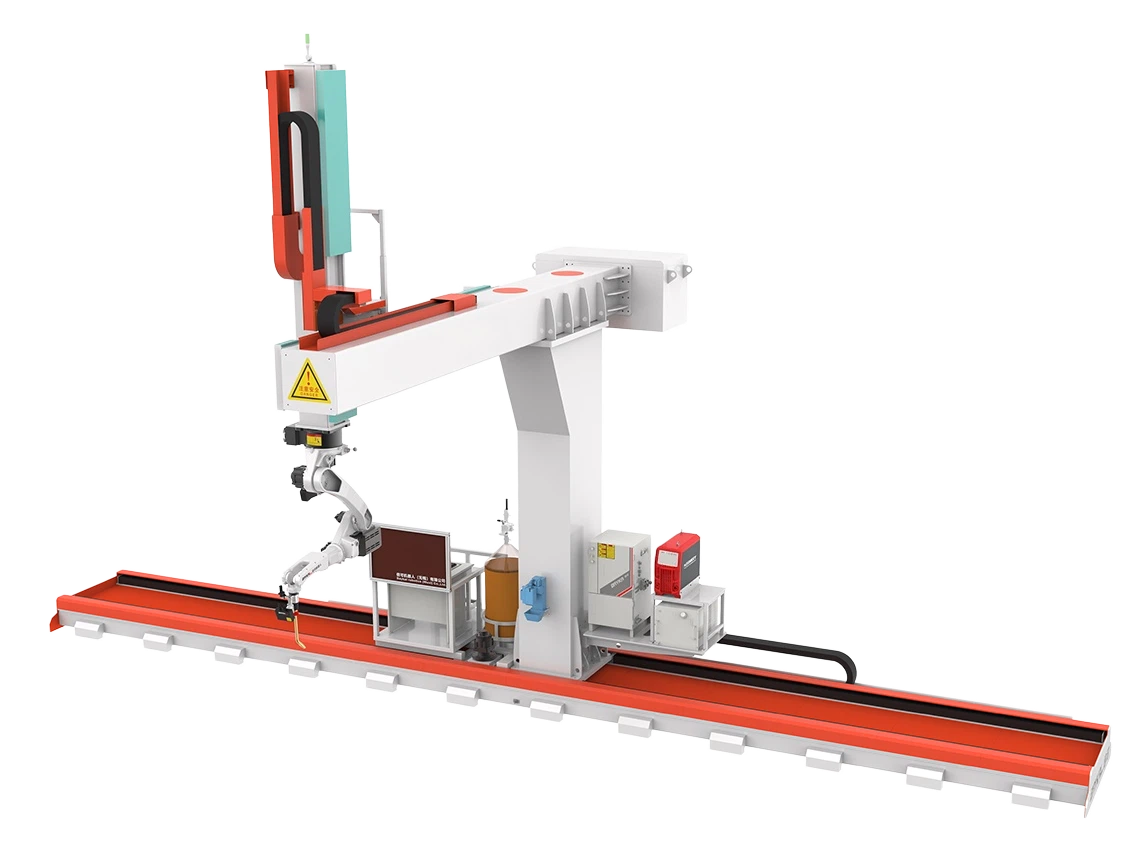
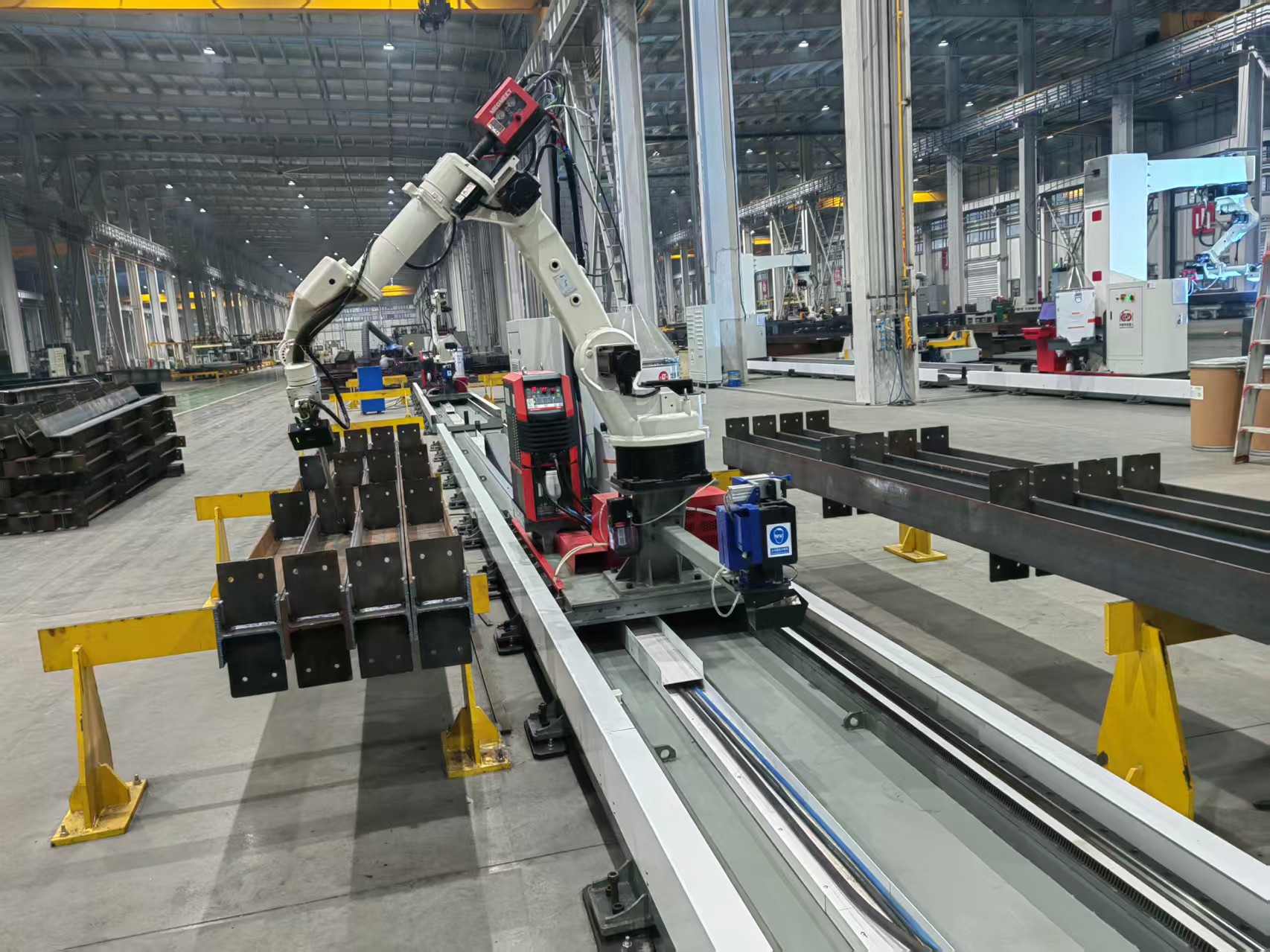
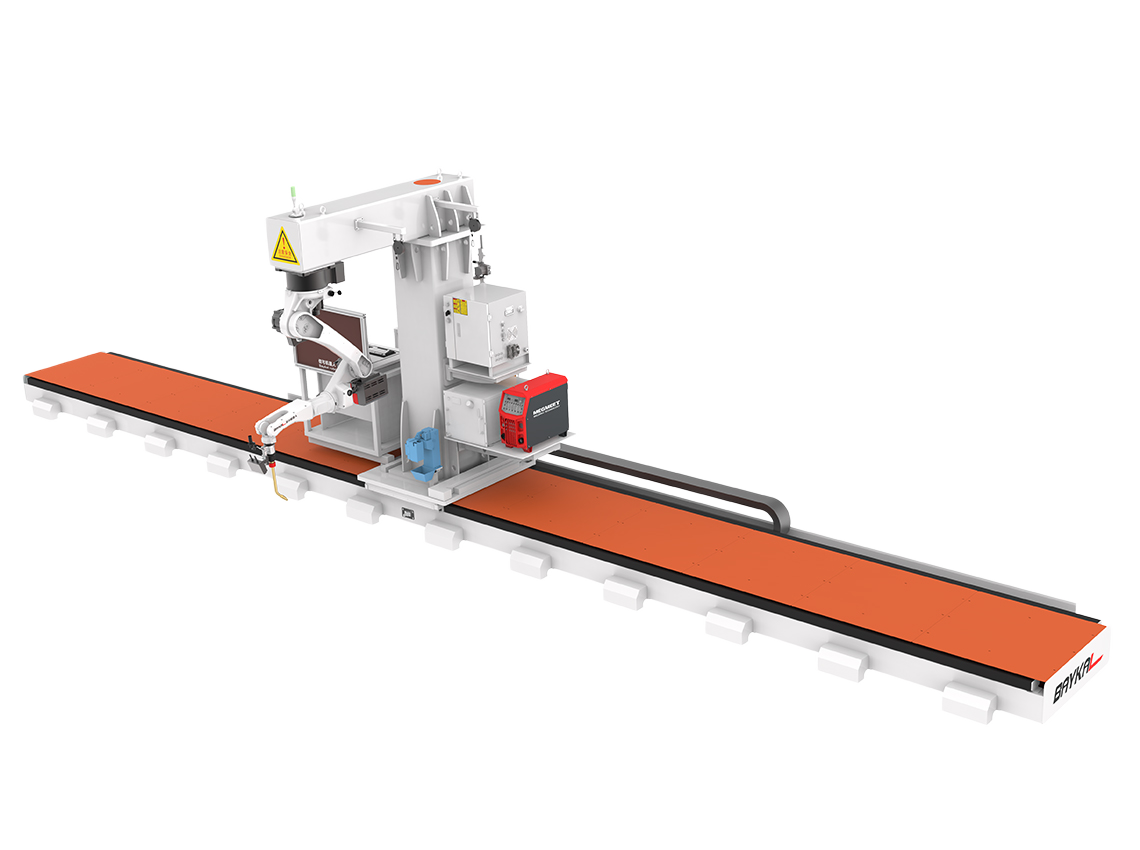
This equipment primarily comprises the following components: one dedicated robot rail, one slide carriage, one 6‑axis welding robot with its control system, one welding power supply, one torch cleaning station, and one welding torch.
1.2 Ground Rail Configuration and Multi‑Robot Welding
The ground rail support has a total length of 12 meters, accommodating one ground rail for welding. For workpieces exceeding 12 meters but less than 25 meters in length, two robots are employed to perform zone‑based welding, significantly improving welding efficiency.
1.3 Robot Installation and Status Indication
The welding robot in this workstation adopts a fixed installation mode and operates in conjunction with a servo‑driven slide carriage to complete workpiece welding. The equipment is equipped with three fault alarm indicator lights—red (equipment alarm or fault), yellow (equipment paused), and green (equipment running)—installed in a clearly visible location, allowing operators to instantly recognize the current system status.
1.4 Safety Protection Systems
The equipment features multiple emergency stop switches, enabling immediate cessation of all machine operations in emergency situations. Additionally, a safety grounding system is provided to ensure operational safety.
2.Technical parameter for 9 axis gantry type welding robot
3.Characters for 9 axis gantry type welding robot:
3.1 Position the prepared workpiece onto the welding platform using a hoist.
3.2 Import the 3D drawings into the system.
3.3 Select the welds to be processed (one‑key weld extraction is supported, with manual matching of welding parameters).
3.4 Press the Start button to activate the robot.
3.5 The robot automatically locates the workpiece.
3.6 The robot performs welding of the designated joints (with automatic arc tracking enabled for real‑time weld seam correction).
3.7 Welding is completed.
3.8 Manually remove the finished workpiece and lift it off the platform using the hoist.
3.9 For subsequent workpieces of the same type, repeat the cycle continuously from Step 3.1.4 onward.
4.Projects for 9 axis gantry type welding robot
products faq
A standard welding machine is a single power source that requires manual operation and external positioning equipment. An Automatic Welding Center, by contrast, is an integrated system that combines welding power source, wire feeder, manipulator, positioner, and PLC control into one coordinated unit. It automates the entire welding process—including torch movement, workpiece rotation, and parameter adjustment—delivering higher consistency, faster throughput, and reduced operator dependence.
Depending on the configuration, an Automatic Welding Center can support multiple processes including GMAW (MIG/MAG), GTAW (TIG), submerged arc welding (SAW), and RMD (regulated metal deposition) for root pass welding. Some advanced designs integrate up to three welding methods on a single manipulator, switchable by rotating the boom 180°, offering exceptional flexibility for diverse applications.
The system is designed primarily for cylindrical and rotational components, including pressure vessels, boiler shells, pipelines, wind tower sections, and hydraulic cylinders. It is suitable for both longitudinal seam welding and circumferential seam welding. With modular positioning accessories such as roller frames, positioners, and lifting supports, it can adapt to a wide range of diameters, lengths, and material thicknesses.
Quality is maintained through several integrated features: PLC-based parameter control ensures repeatable welding conditions; laser seam tracking (on advanced models) maintains torch alignment within ±1% tolerance; frequency converters provide stepless speed regulation for smooth motion; and real-time monitoring systems halt welding immediately if any subsystem anomaly is detected, preventing defects before they occur.
Yes. The system features user-friendly interface panels and remote control boxes for flexible operation. Setup involves basic parameter entry for the specific weld job—such as speed, current, voltage, and travel distance—after which the center executes the programmed sequence automatically. Batch program storage allows quick changeovers for mixed-product manufacturing. Operator training is typically straightforward and supported by comprehensive documentation.
Routine maintenance includes inspecting welding cables, torch consumables, and grounding connections; checking lubrication of moving parts (manipulator arms, roller drives, and linear guides); and monitoring the cooling system and wire feeder condition. The PLC and frequency drive systems are generally maintenance-free but should be kept free of dust and moisture. We recommend regular inspection schedules based on operating hours, with full technical support and spare parts available from our service team.