




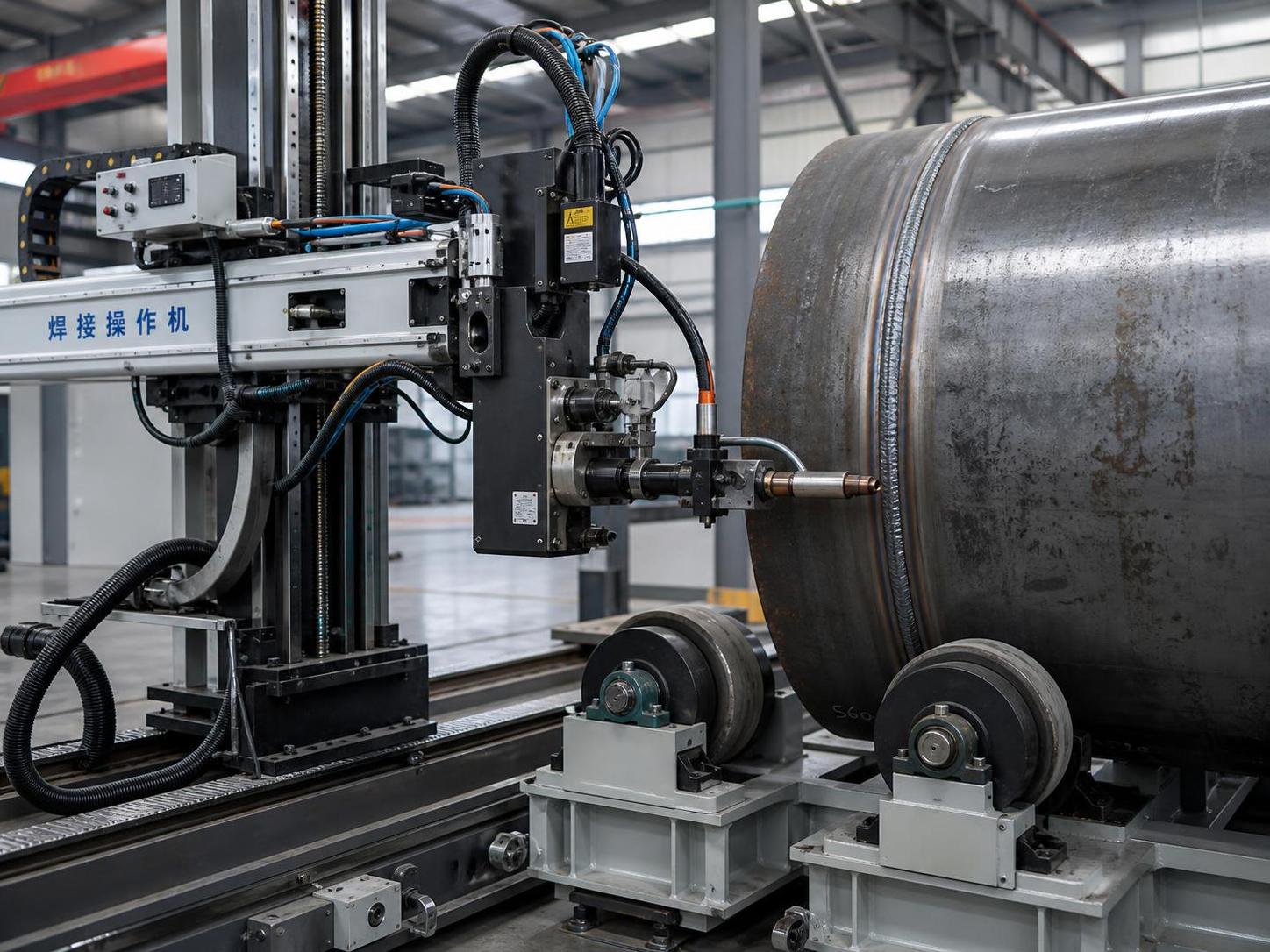
How to Evaluate a China Welding Manipulator Supplier for Vessel Welding Projects
Choosing a china welding manipulator supplier sounds straightforward until a vessel welding project starts revealing how many details actually affect delivery, weld consistency, and total cost. Many procurement teams begin with quotations, but the real difficulty usually appears later: one supplier can offer an attractive price while still being vague about load capacity, boom travel, welding integration, or export documentation.
In pressure vessel fabrication and other cylindrical welding work, the wrong equipment choice can slow fit-up, create positioning problems, and increase rework pressure on the workshop floor. A better evaluation process is less about finding the cheapest offer and more about confirming whether the supplier understands your application, can match the machine to your vessel sizes, and can support the full welding setup around it.
Why supplier evaluation becomes difficult in vessel welding projects
People often compare suppliers as if they are offering the same machine with different logos. In practice, that is rarely true. A welding manipulator used for vessel work is part of a production system, not a standalone item. Its value depends on how well it works with rotators, positioners, welding power sources, seam tracking options, and the dimensions of the actual workpieces.
A common situation is this: the purchasing side asks for a machine for longitudinal or circumferential welding, receives several quotations, and finds that each supplier describes the equipment differently. One talks about column and boom stroke, another focuses on control method, and another mostly highlights price. Without a clear checklist, it becomes hard to know whether the offers are truly comparable.
This is why evaluating a china welding manipulator supplier should start with the production task itself. For vessel projects, the key questions are usually related to workpiece diameter, length, wall thickness, welding method, deposition demand, workshop layout, and whether the equipment will run as a single station or as part of a heavier automated line.
Common buying mistakes when choosing a china welding manipulator supplier
One frequent mistake is treating technical parameters as generic. Buyers may assume that if two machines have similar boom lengths, they will perform similarly in production. That is not always the case. The rigidity of the structure, travel smoothness, speed control, and compatibility with submerged arc welding or other processes can make a noticeable difference in actual use.
Another mistake is separating the manipulator from the rest of the vessel welding arrangement. In many workshops, the manipulator does not work alone. It often needs to coordinate with rotators that support and rotate cylindrical parts. If the supplier cannot discuss that connection clearly, there is a risk of buying equipment that is technically acceptable on paper but awkward in operation.
There is also a documentation mistake that appears often in cross-border purchasing. Some buyers focus heavily on machine specification but ask too late about electrical standards, control language, installation support scope, spare parts, or CE-related documentation when the destination market expects it. Those items do not change the welding principle, but they can change the ease of commissioning and long-term maintenance.
What to check before you compare quotations
Before comparing any supplier, prepare a short technical brief. This saves time and exposes weak proposals quickly. The brief does not need to be complicated, but it should be specific enough that each supplier is quoting for the same operating condition.
- Define the vessel range: diameter, length, weight, and whether the jobs are repetitive or mixed.
- State the welding process: SAW, MIG, TIG, or another method, plus whether automatic seam tracking is expected.
- Describe the workshop arrangement: pit or no pit, rail travel needed or not, and available floor space.
- Clarify duty expectations: shift pattern, batch size, and whether the equipment is for occasional use or continuous production.
- List compliance and export requirements: voltage, frequency, language, documentation, and destination standards.
Once this information is clear, supplier replies become easier to evaluate. A serious supplier will usually respond by matching the machine configuration to the job, asking follow-up questions, and pointing out where standard design may need adjustment.
How to judge real technical capability instead of sales language
When you speak with a potential supplier, pay attention to how they explain application fit. A technically capable team usually does not rush straight to price. They ask about vessel dimensions, welding process, nozzle interference, workpiece support, and whether the machine needs to integrate with flux recovery, welding tractors, or automatic controls.
You can test this in a simple way. Ask the supplier what could go wrong if the manipulator is undersized, if the boom extension is too long for the load, or if the support system is mismatched to the vessel diameter range. Useful answers tend to be concrete. Weak answers usually stay general and avoid the actual operating conditions.
It is also worth asking how they approach related equipment. For cylindrical assembly and pressure vessel fabrication, the manipulator is often paired with a rotator. In that context, a supplier that can also discuss support rotation capacity, speed control, and workpiece diameter range is usually more helpful than one that only provides isolated machine descriptions. For example, in some workshops a Bolt adjusting welding rotator may be considered alongside the manipulator to support butt welding of large-diameter pipes or heavy cylindrical sections. That does not automatically make it the right choice, but it shows why supplier evaluation should include the full station, not only the boom and column.
Signs that a supplier understands vessel welding applications
A good supplier does more than send a brochure. They usually show that they can connect machine selection to process reality. In vessel projects, that often appears in the following areas:
- They ask for workpiece range instead of only asking for a preferred model.
- They explain how welding head movement, column rotation, and boom travel relate to seam access.
- They mention support equipment such as rotators or turning rolls where cylindrical handling is part of the process.
- They discuss control details, such as speed adjustment, remote operation, and integration with welding controls.
- They can explain what is standard and what would be customized.
These points matter because vessel fabrication usually involves a mix of structure, handling, and weld process coordination. A supplier that understands only one of those areas may still supply a machine, but the burden of system matching shifts back to the buyer.
Quality and compliance checks that are worth doing early
For procurement teams, quality checks should happen before negotiation becomes detailed. It is easier to remove an uncertain supplier early than to untangle missing requirements later. Start by asking how the supplier manages fabrication, inspection, and final machine testing. You are not looking for polished wording. You are looking for whether their process sounds organized and repeatable.
It also helps to verify whether their products are built with reference to recognized quality and export expectations. In this sector, buyers often ask about ISO9001-based production management and CE-related support for applicable markets. If a supplier mentions those points, the next step is not to assume everything is solved, but to ask what documents or scope they actually provide with shipment.
Another practical check is electrical and control standard alignment. A machine that is mechanically suitable can still create avoidable delays if the voltage, control cabinet labeling, or documentation package does not fit the destination site. That is why these details should be part of the initial comparison sheet, not an afterthought after order placement.
How to compare total cost without focusing only on unit price
In purchasing discussions, low initial pricing gets attention quickly. But with welding manipulators, a lower machine price can be offset by weak configuration, limited support, or extra adaptation work on site. The more useful comparison is total project cost over commissioning and early operation.
When reviewing offers, consider these cost drivers:
- Whether the quoted model is truly matched to the vessel range and welding process.
- Whether additional support equipment is required and included or excluded.
- Whether controls, cabling, rail travel, or welding head interfaces are standard or extra.
- Whether installation guidance, remote support, and spare parts planning are clearly defined.
- Whether the supplier has export experience that reduces documentation and shipping friction.
This is where buyers sometimes find value in suppliers that handle broader welding equipment categories rather than a single machine type. A company familiar with automatic welding equipment, cutting machines, machine tools, and related fabrication equipment may be better positioned to discuss how the manipulator fits into the wider production chain, especially when the workshop is upgrading several processes at once.
When related equipment should be part of the evaluation
For many vessel welding projects, the manipulator decision becomes clearer once workpiece handling is discussed at the same time. Cylindrical parts need stable support and controlled rotation. If the supplier can only talk about arc travel but not about the support side, there may be a gap in the proposal.
In medium and heavy-duty welding workshops, buyers often review rotator options together with the manipulator because the two systems influence welding access and consistency. For example, a bolt-adjusting type rotator may be considered where the workshop needs to handle different cylinder diameters across a broad load range. Some models in that category are used for rated loads from 2T up to 800T, with frequency conversion speed control and applications that include pressure vessel fabrication, cylinder fabrication, and large-diameter pipe welding. Features such as remote hand control, forward and reverse turning, and adjustable speed can be useful in matching rotation to the welding process. The point is not that every project needs the same setup, but that supplier evaluation improves when these supporting details are discussed openly.
A practical shortlist method for procurement teams
If you are narrowing down options, it helps to score suppliers against a few categories rather than relying on general impressions. This keeps internal discussions more objective and reduces the tendency to overvalue a polished quotation.
- Application understanding: Did the supplier ask the right questions about vessel dimensions, welding process, and layout?
- Technical completeness: Did the proposal cover manipulator structure, controls, interfaces, and related handling equipment where needed?
- Customization clarity: Did they distinguish between standard configuration and custom scope?
- Quality and export readiness: Did they explain production standards, inspection approach, and shipment documentation clearly?
- Commercial transparency: Are exclusions, delivery terms, and support boundaries easy to understand?
This method is useful because it separates marketing language from decision-relevant details. A supplier does not need to be the biggest or most expensive to score well. They need to show that they understand your application and can support a workable machine configuration for it.
FAQ
Should I ask a china welding manipulator supplier for a standard model first or provide my project details first?
Provide project details first. Standard models are a starting point, but vessel welding usually depends on diameter range, seam location, and support equipment. A supplier can only recommend correctly if the operating conditions are clear.
How important is export experience when the machine specification already looks suitable?
It is important because export experience affects documentation, electrical compatibility, packing, communication efficiency, and issue handling. A technically suitable machine can still create delays if those areas are weak.
Do I need to evaluate rotators at the same time as the manipulator?
If your work involves cylindrical vessels, pipes, or shells, usually yes. Rotation support affects weld access, positioning stability, and workflow. Reviewing both together gives a more realistic picture of the final station.
Is CE support enough to judge quality?
No. It is one useful checkpoint for some markets, but it does not replace a review of machine design, fabrication control, testing approach, and after-sales support. Compliance information should be part of the evaluation, not the whole evaluation.
What is the biggest warning sign during early communication?
A supplier who sends price quickly but asks very little about the actual vessel welding application is a warning sign. It often means the quote is based on assumptions that may not hold up during production or installation.
Conclusion
Evaluating a welding manipulator supplier for vessel projects is usually less about finding a broad promise and more about checking whether the supplier can think through your real production conditions. The best decisions come from a simple process: define the job clearly, compare technically equivalent proposals, verify quality and export readiness, and review how the manipulator will work with the rest of the welding station.
If you keep the focus on application fit, support scope, and total operating value, it becomes much easier to identify which supplier is prepared for vessel welding work and which one is only offering a generic machine.