




China Welding Manipulator Manufacturer: Key Factory Capabilities to Check Before Ordering
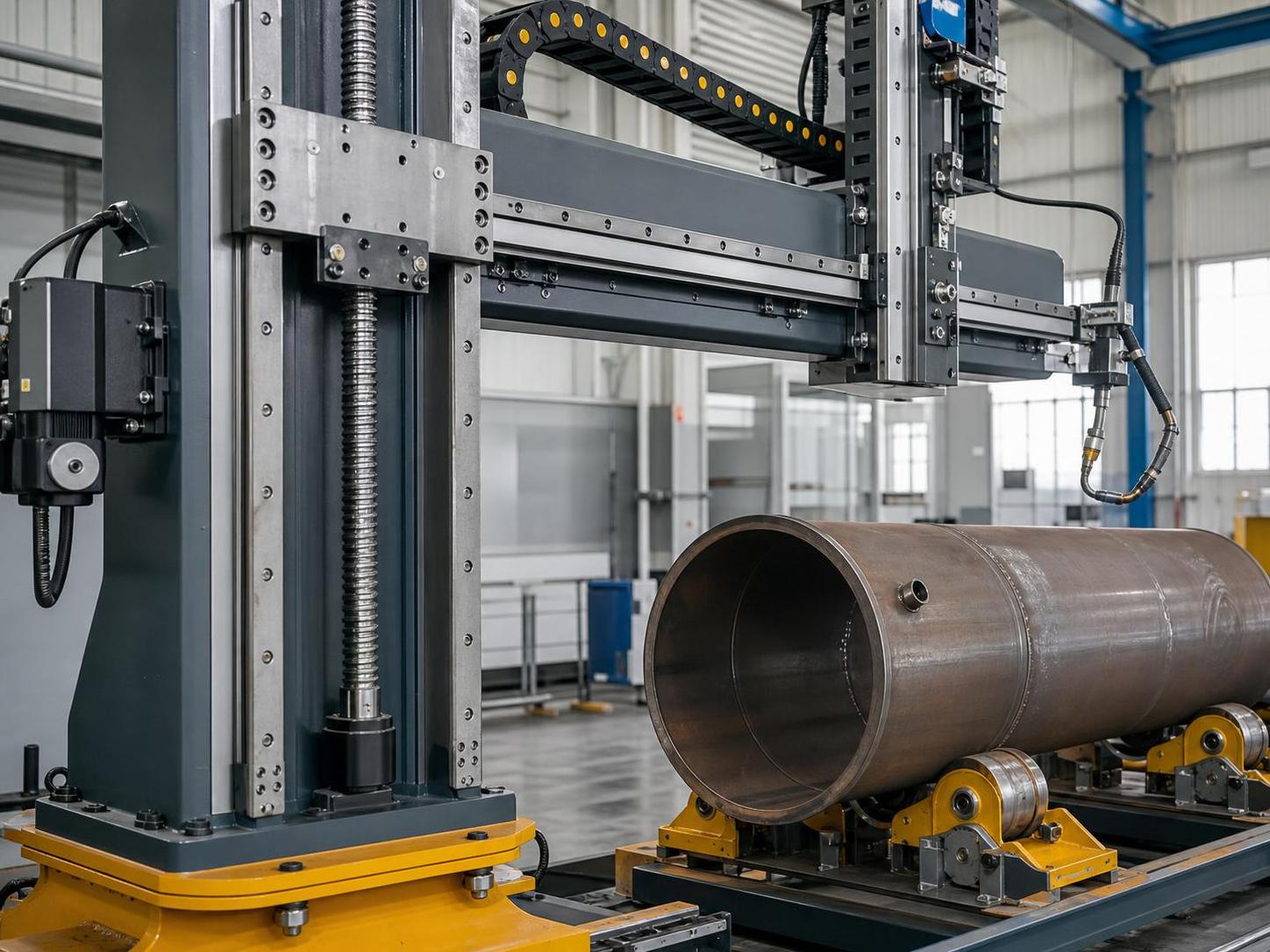
Choosing a China welding manipulator manufacturer is rarely just a sourcing exercise. For business evaluators, it is a risk-screening task that affects delivery schedules, weld consistency, downstream integration, and maintenance cost over the full life of the equipment. The common mistake is to compare quotations as if all machines with similar stroke ranges and load capacities are equivalent. In practice, they are not. Factory capability determines whether the delivered system will match the application, whether documentation will satisfy the end customer, and whether problems can be solved after shipment.
That matters even more in projects involving pressure vessels, pipelines, and steel structures, where the manipulator is part of a larger welding cell rather than a standalone machine. A supplier may show an attractive specification sheet, but if its engineering depth, quality discipline, and integration experience are weak, the hidden cost usually appears later: unstable arc tracking, poor boom rigidity, delays in commissioning, mismatched electrical standards, or insufficient spare parts support.
Why factory capability matters more than brochure specifications
In this segment, many overseas buyers search for a china welding manipulator manufacturer after seeing standard models with similar dimensions: lifting stroke from 1000 mm to 7000 mm, telescopic stroke from 1000 mm to 7000 mm, cross slide units for torch positioning, and compatibility with SAW or CO2 welding. On paper, those parameters look easy to compare. The harder question is whether the factory can build that configuration repeatedly and reliably.
A manipulator used with rotators and positioners must maintain stability across movement, load, and welding process variation. If the structural design is marginal, vibration and deflection can affect seam quality. If the electrical layout is poorly organized, field troubleshooting becomes expensive. If the supplier outsources key stages without control, consistency between one order and the next becomes uncertain. This is why commercial evaluation should focus on production capability, not just machine dimensions.
Check whether the supplier is a real manufacturer or mainly a trading organizer
Many buyers assume this point is obvious, but in China’s machinery sector the supply chain can be layered. Some companies own production facilities, some assemble outsourced structures, and some act mainly as coordinators. None of these models is automatically bad, but the commercial risk is different.
For a business evaluator, the practical questions are straightforward:
- Who fabricates the column, boom, trolley, and base frame?
- Who performs machining of critical interfaces?
- Who handles electrical cabinet assembly and wiring?
- Who is responsible for final testing and acceptance records?
- Can the supplier provide factory inspection evidence tied to the actual order?
A genuine factory should be able to explain its workflow clearly, identify which parts are made in-house, and show how it controls subcontracted components. If answers remain vague, the buyer should assume higher schedule and quality uncertainty.
Structural fabrication quality is not a minor issue
For welding manipulators, fabrication quality directly affects service life and welding stability. Business teams sometimes leave this entirely to technical colleagues, but that creates blind spots in supplier assessment. Structural process quality should be treated as a commercial concern because it influences warranty claims, site rework, and reputational exposure with end users.
What should you verify? Start with the steel fabrication process. Ask how the supplier controls deformation during fabrication of the boom and column. Ask whether stress-relief measures or annealing are used after forming and welding of major structural members. Ask how straightness, squareness, and alignment are checked before painting and assembly. These are not academic details. Poorly controlled structure manufacturing often appears later as stick-slip motion, abnormal noise, uneven travel, or torch positioning drift.
Some manufacturers highlight features such as cold-formed structural components, heat treatment to reduce internal stress, anti-fall protection on the boom, and VFD-controlled retraction movement. These are useful indicators, but only if the factory can show how they are implemented in actual production rather than just listed in a catalog.
Look beyond maximum stroke and load: assess application fit
A standard model range may look broad enough for most projects, but application fit is more nuanced. For example, a manipulator used for submerged arc welding on large-diameter pressure vessels has different demands from a unit used for lighter steel structure welding. The relevant decision variables include:
- Welding process: SAW, MIG, TIG, plasma, or mixed use
- Required seam type: longitudinal, circumferential, internal, or external
- Boom end load with accessories installed
- Need for seam tracking, flux recovery, or visual monitoring
- Travel mode: fixed, rotating, or trolley-mounted movable type
- Power supply requirements by destination market
Take a standard example from the market: machines in the LHQ1010 to LHQ7070 range often cover 1000 mm to 7000 mm vertical lifting and horizontal extension, with different boom load allowances depending on size. That sounds flexible, but the buyer still needs to confirm the real payload in the configured condition, especially when adding a welding head, wire feeder, recovery unit, cable support, and seam tracking device. Rated capacity without accessory context can mislead procurement teams.
Where suppliers present an integrated solution such as Welding manipulator systems designed to work with roller beds and positioners, the useful evaluation point is not the model list itself. It is whether the supplier can map the machine to your weld procedure, workpiece size range, and plant layout without creating custom engineering risk it cannot actually manage.
Engineering communication is often the strongest predictor of project success
The most reliable manufacturers are usually not the ones that answer fastest with the lowest price. They are the ones that ask better questions before quoting. A serious factory will want to know workpiece dimensions, welding method, expected duty cycle, whether the column rotation is manual or motorized, whether trolley travel is required, what local voltage and frequency apply, and what third-party inspection or documentation package the end user expects.
If a supplier can issue a clear technical proposal, general arrangement drawing, electrical description, optional scope list, and exclusion list before order confirmation, the commercial risk drops sharply. By contrast, when a quotation only says “customized available” without design clarification, buyers should expect later variation claims or scope disputes.
This is particularly important for export projects. Voltage options such as 220V, 380V, 480V, or 600V and frequency differences between 50Hz and 60Hz must be confirmed early. So must control language, cable standards, safety labels, and local compliance expectations. A supplier with export experience typically handles these details more systematically.
Quality control should be demonstrated, not declared
ISO 9001 claims are common across machinery suppliers, but business evaluators should not treat certification alone as proof of execution quality. The more useful check is how the quality system is applied to this product category.
Ask for evidence tied to manipulator production, such as:
- incoming inspection standards for motors, reducers, bearings, and electrical parts;
- welding procedure control for structural fabrication;
- dimensional inspection records for boom and column assemblies;
- functional test procedures for lifting, extension, limit switches, and control response;
- load or movement testing before shipment;
- traceability of purchased branded components.
A capable factory should also explain how it handles nonconformance, rework approval, and final release. This matters because manipulators often combine mechanical, electrical, and motion control elements; many field problems are caused not by a dramatic design flaw but by weak process control between departments.
Compliance and documentation can decide whether the equipment is usable abroad
For cross-border procurement, machine capability and legal usability are different issues. Buyers should verify what the supplier means when referring to CE or other international standards. CE marking, for example, is not simply a sticker; it requires conformity work and technical documentation aligned with applicable directives and standards. If the supplier says the machine is built to EU CE standards, ask what documentation is included and which components of conformity are covered. If uncertain, mark it as 【待核实】 in the internal review process until the file is checked.
Documentation quality is one of the clearest signs of factory maturity. At minimum, the supplier should be able to provide operating manuals, electrical schematics, spare parts lists, packing lists, foundation or installation guidance where applicable, and test records. For larger projects, FAT support and inspection protocols may also be needed.
Evaluate supply chain resilience, not only lead time promises
Lead time quoted at the offer stage is easy to promise and harder to protect. A buyer should ask what the factory keeps in standard stock, which components are purchased to order, and which imported electrical parts create schedule dependence. This is especially relevant if the project specifies international brands for inverters, motors, PLCs, or welding power sources.
The practical issue is not whether the supplier uses domestic or imported parts. It is whether the supply chain is stable and whether equivalent substitutions are controlled. A weak manufacturer may switch components during production to protect margin, creating inconsistency in maintenance and commissioning. A stronger manufacturer will define approved brands or equivalent ranges in advance and obtain buyer confirmation before changes.
After-sales capability is part of the procurement decision
For machinery exported to Southeast Asia, Europe, the Americas, or Oceania, after-sales support is often the difference between a manageable issue and a stalled project. Buyers should ask how troubleshooting is handled: remote video support, commissioning guidance, spare parts dispatch, wiring clarification, software parameter support, and response time commitments.
It is also worth checking whether the machine uses widely available components or highly proprietary parts. Commercially, standardization reduces downtime risk and lowers future dependency on the original supplier. If the manufacturer emphasizes internationally recognized electrical brands and common industrial components, that can be a positive sign, provided the BOM is transparent.
What usually goes wrong in supplier selection
The failures in this category are familiar:
- Choosing by nominal stroke and price while ignoring rigidity and process fit
- Assuming all “CE” claims have equal validity
- Accepting broad customization promises without approved drawings
- Not clarifying voltage, frequency, and local control requirements
- Ignoring accessory payload and only checking base machine load data
- Overlooking documentation and spare parts support
These mistakes usually do not appear during sourcing. They appear during FAT, installation, or the first production run, when correction becomes more expensive and politically harder inside the buyer organization.
How to make a more defensible supplier decision
For business evaluators, the goal is not to identify the cheapest qualified source. It is to identify the supplier whose manufacturing capability matches project risk. A defensible decision normally combines four checks: verified production competence, clear engineering communication, documented quality control, and realistic after-sales support.
If two suppliers offer similar machine ranges and both can provide options such as fixed or rotating columns, motorized trolley travel, cross-slide adjustment, and integration with seam tracking or SAW accessories, the better choice is usually the one that can explain limits as clearly as features. Factories that understand their own constraints tend to manage projects more reliably than those that promise everything.
In other words, when assessing a china welding manipulator manufacturer, price should be the outcome of capability review, not the starting point. The supplier worth shortlisting is the one that can show how it builds, tests, documents, and supports the machine in the exact operating context your project requires.
search
Products Navigation
Send Us A Message