




Welding Robot vs. Welding Manipulator: What’s the Difference for Thick Plate Work?
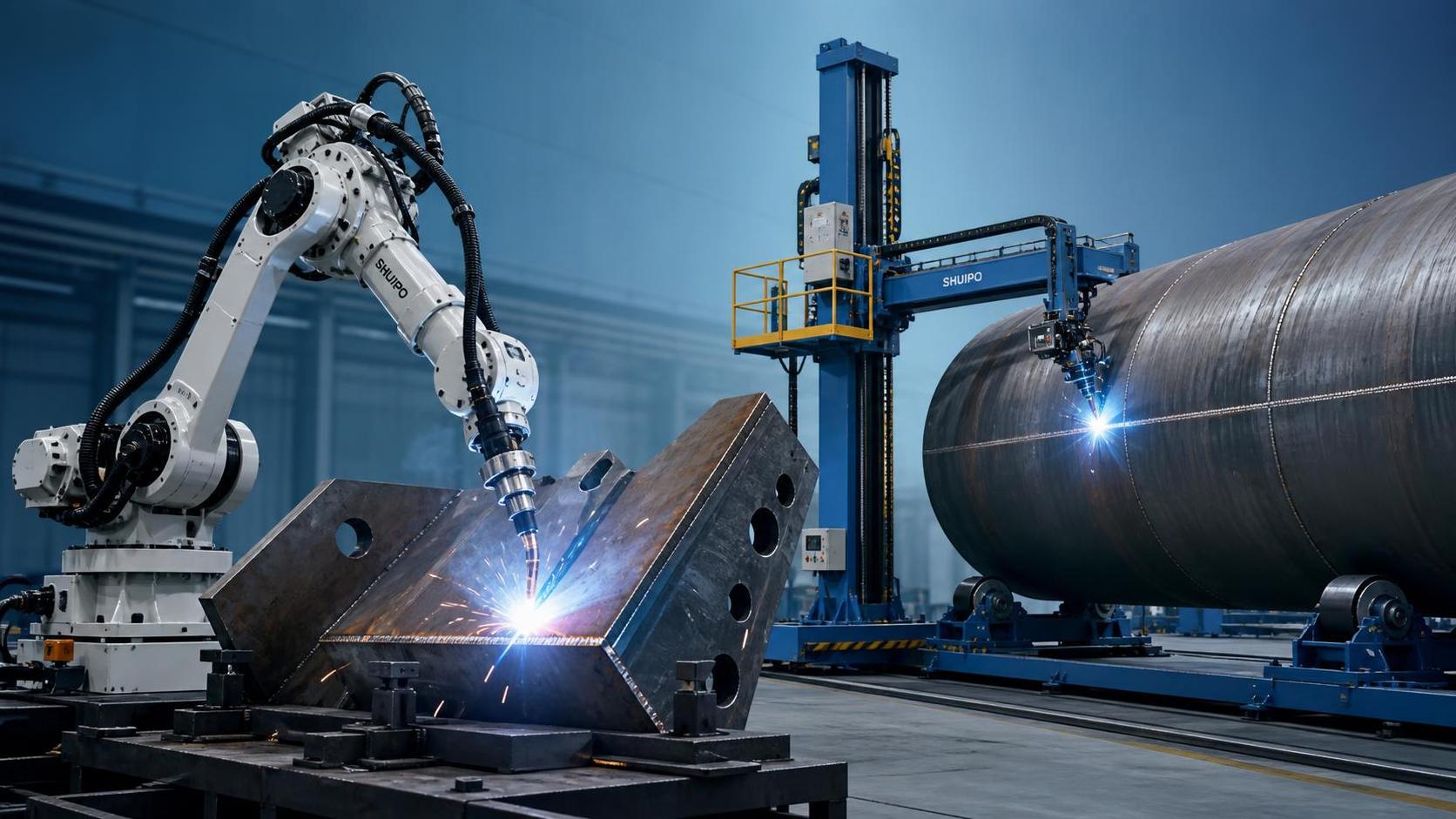
For thick plate work, the real difference between a welding robot and a welding manipulator is mechanical purpose. A welding robot is built to move a torch through changing paths and angles with high freedom of motion. A welding manipulator is built to hold and guide the welding head in a stable, repeatable envelope over large, heavy weldments. When plate thickness increases, joint preparation becomes deeper, heat input becomes harder to control, and the mass of the workpiece starts to matter as much as the arc itself. That is why the choice is usually shaped by weld geometry, deposition method, workpiece size, and how much variation exists from one job to the next.
In thick plate fabrication, the weld is rarely a simple surface bead. It may involve multi-pass groove welding on carbon steel, low-alloy steel, stainless steel, or pressure-bearing structures with bevels, root gaps, and strict interpass handling. A machine that performs well on thin sheet fillet welds may struggle when the joint needs deep penetration, wide groove filling, slag removal between passes, or a long uninterrupted seam measured in meters rather than millimeters.
How the two machines are physically different
A welding robot usually refers to an articulated multi-axis arm. It can approach a joint from different orientations, compensate for part shape changes, and execute curved, angled, or interrupted paths. For thick plate components with many joint positions in one assembly, that flexibility can be valuable. The robot can also be combined with a positioner, track, seam tracking sensor, or torch cleaning station if the process needs a larger working range.
A welding manipulator is a different type of machine structure. It typically uses a column-and-boom arrangement. The boom extends horizontally, the column lifts vertically, and the welding head travels in controlled linear motion. Rotation may come from the workpiece side through a turning roll or welding positioner rather than from the welding head itself. For circumferential seams on large shells, longitudinal seams on tanks, box structures, heavy pipes, and thick cylindrical sections, this arrangement often gives better rigidity than an articulated arm.
That structural difference matters because thick plate welding often uses heavier process packages. Submerged arc welding heads, wire reels, flux delivery units, flux recovery devices, tandem wire systems, narrow-gap heads, or oscillation devices can be substantial in weight and size. A manipulator is generally better suited when the welding package itself is heavy and the path is long, straight, or rotational. A robot can carry process equipment too, but payload, wrist torque, cable routing, and access limits become more restrictive as the process head grows.
Why thick plate changes the comparison
Once thickness moves into heavy fabrication territory, several practical issues appear at the same time. Joint fit-up is not always consistent, edge preparation affects penetration, and the number of weld passes increases quickly. Distortion control also becomes a production issue, especially on long seams or heat-sensitive assemblies. Under these conditions, the machine must do more than simply move a torch from point A to point B.
A robot is stronger when the part family has varied seam shapes: complex nodes, intersecting welds, changing torch angles, or mixed fillet and groove joints within one fixture. A manipulator is stronger when the weld path is simple but demanding: very long seams, thick-wall cylinders, repetitive heavy sections, or cases where arc stability and head rigidity matter more than path complexity.
One common misunderstanding is to assume that a welding robot is always the more advanced choice and therefore automatically better for thick plate work. In many heavy applications, the opposite may be true. If the weld path is mostly straight or circumferential and the production line depends on submerged arc welding or another high-deposition process, a manipulator may deliver a more stable setup with fewer motion variables.
Accuracy means different things on each machine
People often compare robots and manipulators by quoting positioning accuracy, but thick plate welding does not depend on one number alone. In practice, the more important question is whether the machine can hold the required torch angle, stick-out, travel speed, and arc position consistently across heat, spatter, vibration, cable drag, and long duty cycles.
For a robot, repeatability can be excellent inside its programmed working envelope. However, when the wrist is extended far from the base, or when the torch is forced into awkward orientations around large weldments, usable stiffness may become a bigger concern than nominal repeatability. Thick plate joints are less forgiving when torch angle drifts. A small orientation change can alter sidewall fusion, bead shape, or penetration profile, especially in narrow groove work.
For a manipulator, the motion is simpler, but rigidity is usually easier to maintain over a heavy process head. The machine does not need to resolve multiple simultaneous arm joints to keep the torch on path. That can make travel smoother on long weld runs. Where the seam is prepared carefully and the workpiece can be positioned well, a manipulator often gives very predictable process behavior.
Process compatibility is often the deciding factor
The welding process used on thick plate work often determines which machine makes more sense. If the work relies on submerged arc welding, the manipulator usually fits naturally because the process favors long, continuous seams, heavy deposition, and stable travel. The boom can carry the welding head, flux hopper, and recovery arrangement with less compromise. It also pairs well with turning rolls for pipes, vessels, and large cylinders.
If the process is gas metal arc welding with pulse control, tandem wire, or narrow-gap variants in assemblies with changing seam orientation, a robot becomes more attractive. It can weave through more complex joint layouts and maintain programmed access around stiffeners, flanges, gussets, and branch connections. Robotic systems are also commonly chosen when different part models share one cell and the torch path needs regular changeover.
For gas tungsten arc welding on thick sections requiring root precision before fill passes, either machine could be used depending on joint geometry. A manipulator may handle straight seams or rotating parts well, while a robot may be preferred if the root path involves difficult access or multiple welding positions in the same component.
Another detail is oscillation. Thick groove filling often benefits from controlled torch weaving or specialized narrow-gap heads. Both robots and manipulators can support this, but the implementation differs. On a manipulator, oscillation may be integrated into the welding head and isolated from the main travel system. On a robot, weaving is often produced through axis motion or auxiliary torch devices. The best arrangement depends on bead shape requirements and whether motion smoothness remains acceptable at the planned travel speed.
Workpiece handling can matter more than arm motion
When evaluating what’s the real difference between a welding robot and a welding manipulator for thick plate work, people often focus on the machine itself and overlook the workpiece support system. Thick plate components are heavy, sometimes awkward to clamp, and often too large to reposition casually. If the part can be rotated or tilted into a favorable welding position, a manipulator gains a strong advantage because the head stays mechanically simple while the workpiece presents the seam.
With a robot, the system may tolerate less ideal part presentation because the arm can reach around the structure. That flexibility has value, but it does not remove the need for sound fixturing. Poor fit-up, variable root opening, or shifting due to thermal stress can still defeat a robotic path unless seam tracking or adaptive control is included. On thick plate, adaptation is rarely optional if part variation is significant.
Installation footprint also changes. A manipulator handling long shells or beams may require clear linear space, turning rolls, rail travel, and overhead access for loading. A robotic cell may look more compact around the base, yet total cell space can grow once safety fencing, positioners, maintenance access, and part loading zones are added. The machine with the smaller arm is not always the smaller installation.
Programming and setup are not the same kind of work
A robot usually needs offline or teach-based programming, TCP calibration, path verification, singularity avoidance, collision checking, and parameter tuning for each joint family. That effort is justified when the parts are complex and repeated often enough to benefit from flexible automation. But on thick plate components with high mix and inconsistent preparation, the programming burden can become substantial. Each bevel angle change or assembly tolerance issue may force path correction.
A manipulator is simpler to set up when the seam geometry is repetitive. The main tasks shift toward aligning the workpiece, setting boom height and extension, confirming nozzle position, and controlling travel speed and welding parameters. For long production runs of similar cylindrical or linear seams, setup can be faster and less dependent on complex path programming.
This difference becomes visible during changeover. A robot can switch between part programs more easily if fixtures and reference points are stable. A manipulator can switch quickly between seam lengths or diameters when the welding logic is straightforward, but it is less suitable if the next component requires many different approach angles within one setup.
Maintenance concerns are different in daily use
Thick plate welding environments are hard on motion equipment. Spatter, flux dust, grinding debris, heat radiation, and cable wear all accumulate over time. On a robot, attention usually centers on wrist dress packs, torch alignment, cable fatigue, reaming units, and axis health under heavy thermal exposure. When the application involves large torches or sensors near the wrist, maintenance access can become awkward.
On a manipulator, the critical areas are often boom straightness, carriage movement, guide surfaces, wire feed stability over long cable runs, and the condition of travel drives or rail systems. If submerged arc welding is used, flux handling and recovery cleanliness become a maintenance issue of their own. A manipulator may look mechanically simpler, but neglected flux contamination or boom misalignment can still affect seam quality.
Installation quality also matters more than many expect. A robot base with poor anchoring or an uneven floor can introduce calibration drift. A manipulator with an out-of-plumb column or misaligned rail may create tracking issues over long seams. For thick plate work, small geometric errors become noticeable because the weld path is long and the heat cycle is extended.
Where each option usually fits better
- A welding robot generally suits fabricated structures with many joint types, changing torch orientations, and a need to move between separate weld locations inside one assembly.
- A welding manipulator generally suits large pipes, tanks, wind tower sections, pressure shell seams, box beams, and other parts where the weld path is long, repetitive, and compatible with a rigid linear head movement.
- When narrow-gap welding is planned on thick sections, the decision often depends on whether the groove path is simple enough for a manipulator or complicated enough to require robotic articulation.
- If the production route depends on very high deposition rates with heavy process hardware, the manipulator frequently has the cleaner mechanical arrangement.
There is also a middle ground. Some lines combine a manipulator for the main heavy seams and a robot for attachment welds, nozzles, brackets, or irregular joints on the same product family. Thick plate fabrication does not always favor a single universal machine.
Questions that reveal the better choice
The useful comparison is not “Which is more automatic?” but “What kind of weld path, process head, and workpiece handling does the job actually require?” If the seam runs for a long distance on a rotating shell with stable groove preparation, a manipulator often matches the task naturally. If the assembly has multiple bevel joints in constrained positions and frequent path changes, the robot usually earns its complexity.
Another useful question concerns tolerance. If plate cutting, beveling, tack-up, and clamping are tightly controlled, either system has a better chance of performing consistently. If fit-up varies from part to part, the robot may need sensing and adaptive correction, while the manipulator may need better seam guidance or more disciplined upstream preparation. Automation cannot fully mask poor edge preparation on heavy groove welds.
Transport and installation should also be weighed early. Large manipulators may ship in sections and require on-site alignment of column, boom, base, rails, and turning rolls. Robots usually arrive as more compact assemblies, but the surrounding positioners, guarding, and peripheral stations can still make commissioning extensive. Access for cranes, forklifts, and future maintenance should be considered before a machine is placed.
So, what’s the real difference between a welding robot and a welding manipulator for thick plate work? A robot gives motion freedom; a manipulator gives structural steadiness for heavy, repetitive seams. Thick plate fabrication tends to expose the limits of whichever attribute is missing. When the weld path is complicated, the robot usually stands out. When the weld is long, heavy, and process-driven, the manipulator often feels like the more appropriate tool.
search
Products Navigation
Send Us A Message