




China Manipulator Welding Machine vs Welding Positioner: Which Fits Large Cylindrical Workpieces?
When a workshop starts welding large cylindrical parts such as tanks, pipes, pressure components, or rolled shells, the equipment choice quickly stops being a small detail. A mismatch between rotation control and torch movement can slow production, increase weld defects, and make fit-up problems harder to correct during welding.
This is why many buyers comparing a china manipulator welding machine with a welding positioner get stuck at the same point: both help with circumferential or longitudinal welding, but they solve different bottlenecks. The right decision depends less on product names and more on workpiece diameter range, weld seam type, handling method, and how much process stability you need from one batch to the next.
Why this decision becomes difficult in real production
On paper, the comparison looks simple. A welding positioner rotates or tilts the workpiece, while a welding manipulator moves the welding head into place. In actual fabrication, large cylindrical workpieces often bring several variables together at once: heavy sections, long seam length, limited overhead crane time, changing diameters, tack-up deviation, and different welding processes such as SAW, MIG, or TIG. Once those variables combine, the wrong equipment can create a chain of small inefficiencies that add up quickly.
A common situation is that the team initially focuses only on workpiece weight. That matters, but it is not enough. A positioner may carry the load, yet still fail to give the torch enough reach or stability along a long seam. A manipulator may provide excellent torch travel and consistent arc position, yet still need a rotator or turning setup to keep the cylinder moving correctly. For large cylindrical workpieces, the selection should start with weld path control rather than a single headline specification.
What usually goes wrong when the equipment choice is off
If the chosen setup does not match the job, the first signs are usually operational rather than dramatic. Operators spend too much time repositioning the part, rechecking torch angle, or compensating for uneven seam presentation. Welding speed becomes inconsistent, and the process depends heavily on operator skill to maintain bead appearance and penetration.
For heavier or longer cylinders, another issue appears: access. The seam may be physically reachable, but not comfortably reachable through the full travel range. That leads to awkward torch extension, unstable wire stick-out, or poor visual monitoring of the arc zone. In submerged arc applications, this can affect flux coverage and travel consistency. In open-arc processes, it can make heat input control less repeatable.
There is also a cost issue that many evaluators notice only after setup begins. Buying one machine that seems versatile does not always reduce investment if extra handling devices, custom fixtures, or manual correction time are still needed around it. In other words, lower purchase complexity can turn into higher process complexity.
Start with the core difference: movement of the torch vs movement of the workpiece
The most useful way to compare a china manipulator welding machine and a welding positioner is to ask a basic question: which part of the welding system must move with higher precision for this job, the torch or the workpiece?
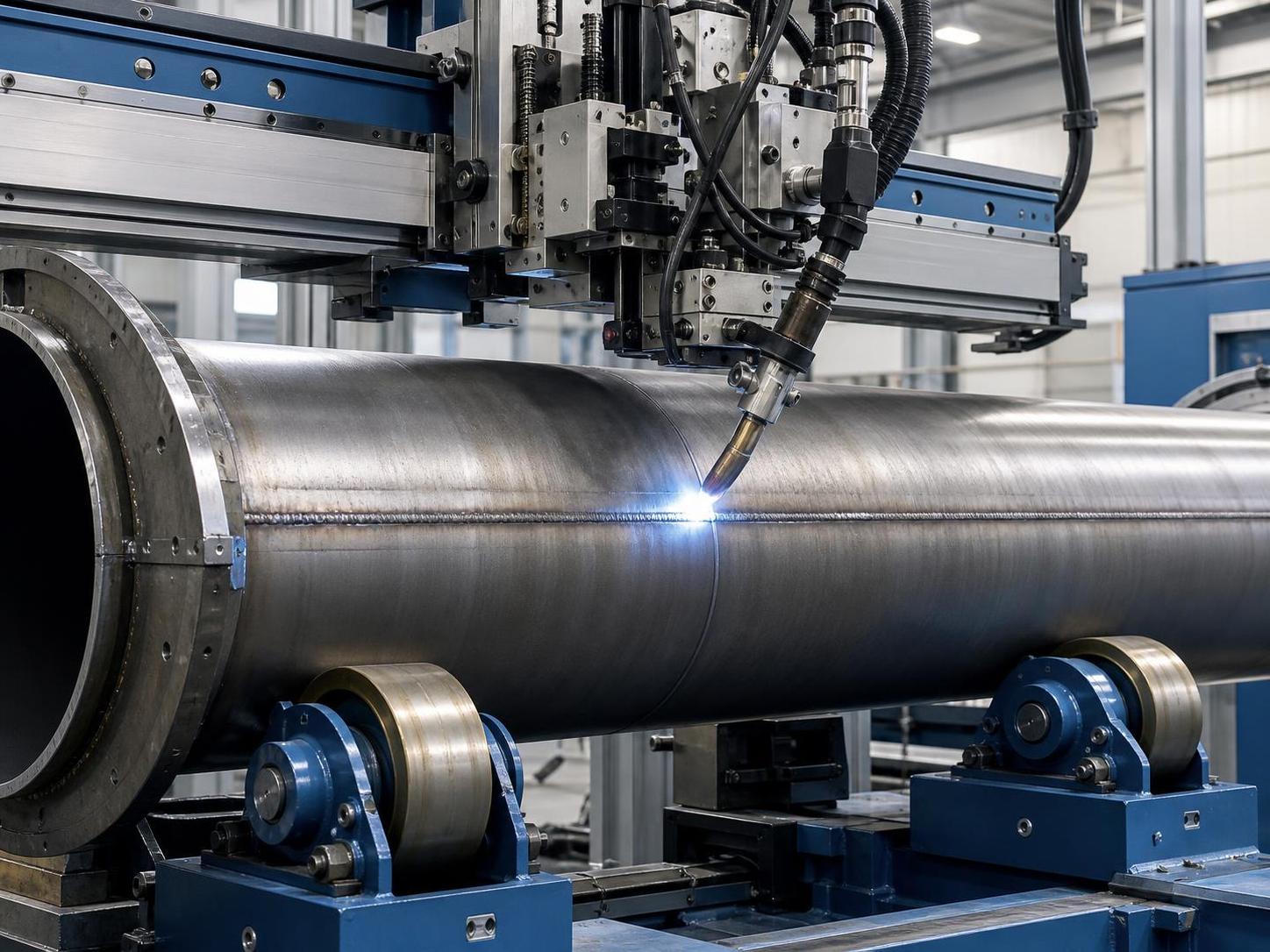
A welding manipulator is primarily built to position and guide the welding head. It typically provides vertical and horizontal travel, allowing the torch assembly to reach long seams, different diameters, and varied heights. For large cylinders, this matters when the weld seam extends over a long distance or when multiple seam locations must be covered without repeated manual adjustment. The manipulator becomes even more valuable when the welding head needs stable tracking over long runs or when it is integrated with automatic welding controls.
A welding positioner, by contrast, is mainly designed to present the workpiece at a better welding angle by rotating, tilting, or turning it. This is highly effective when the part can be safely and conveniently moved into the best welding position, especially if the goal is to keep the weld pool in a favorable orientation. For smaller or medium cylindrical parts, that can be enough. For very large cylindrical workpieces, however, the positioner may become less practical if the diameter is large, the part is long, or the center of gravity is difficult to manage.
When a welding manipulator makes more sense
A welding manipulator is usually the stronger choice when the cylindrical workpiece is too large, too long, or too awkward to reposition frequently. This applies to shells, large pipes, pressure vessel sections, and fabricated cylinders where the seam length is significant and torch stability across the seam matters more than changing the workpiece angle.
It also fits situations where automation is part of the plan. If you need controlled torch travel, fixed arc geometry, and repeatable motion over multiple similar parts, a manipulator offers a better foundation. It can work together with rotators or turning rolls so the cylinder rotates while the welding head remains accurately positioned. That combination is often more practical than relying on a positioner alone for oversized parts.
Another advantage appears in workflow planning. If upstream processes already produce large rolled sections or cut blanks that move through a predictable line, a manipulator setup often integrates more cleanly. For example, shops preparing plates with CNC equipment before rolling may prefer a process chain where blank accuracy supports later welding automation. In that context, a machine such as Steel Plate cnc fiber laser cutting machine can help improve edge quality and dimensional consistency at the cutting stage, which in turn makes fit-up and automatic seam welding easier to control. That does not replace welding equipment selection, but it is part of the broader decision if the factory is trying to stabilize the whole fabrication route.
When a welding positioner is the better fit
A welding positioner is often the better answer when the cylindrical workpiece can be rotated safely and the main objective is to place the weld in a more favorable position for manual or semi-automatic welding. If the parts are not extremely long, if the load is within the machine's practical handling range, and if operators need better ergonomic access rather than long automatic torch travel, the positioner can be the more direct and economical option.
This is especially true for shorter cylindrical assemblies, flanges, nozzles, or subassemblies that benefit from tilt and rotation more than from extended torch guidance. A positioner can reduce operator fatigue, improve visibility, and help maintain a more consistent weld pool orientation. In many shops, that is enough to raise productivity without the added footprint or system complexity of a manipulator setup.
It is also easier to justify a positioner where product variety is high but individual part size remains manageable. If each job changes often and long seam automation is not the main bottleneck, a flexible rotating table or head-tailstock style positioning system may be more useful than a larger torch-travel structure.
Practical comparison standards before you decide
Instead of asking which machine is generally better, it helps to compare both options against a short list of production questions. These questions usually expose the right direction faster than a catalog comparison.
- How large is the cylinder in diameter and length? Large diameter alone does not decide the issue, but large diameter combined with long length usually favors a manipulator plus rotating support system.
- Is the critical seam circumferential, longitudinal, or both? Circumferential seams often work well with controlled workpiece rotation. Longitudinal seams often need stable torch travel over distance.
- Will the part be easy to rotate and rebalance? If not, forcing the workpiece into a positioner-based process may create handling trouble.
- How much automation is expected? If the target is consistent automatic welding with minimal torch correction, manipulators usually provide a stronger platform.
- How often do dimensions change? A broad range of diameters and seam locations can favor equipment with wider travel and adjustment capacity.
- What is the real bottleneck today? If the delay comes from poor weld access, a positioner may solve it. If the delay comes from long seam tracking and repeated manual repositioning, a manipulator is more likely to help.
A simple way to avoid the most common selection mistake
The most common mistake is comparing only load capacity and ignoring process layout. A positioner with enough rated load can still be the wrong choice if the cylinder is long enough to become awkward during rotation or if the weld head must travel across multiple seam locations. A manipulator with generous reach can also be insufficient if there is no reliable way to rotate or support the workpiece during circumferential welding.
A better method is to map the job in sequence. Start from how the plate or pipe section enters the welding area, how it is supported, where the seam starts, how the seam moves relative to the torch, and how the part exits after welding. Once this sequence is visible, the equipment decision becomes clearer. In many cases, the answer is not either-or in a strict sense, but which machine should be primary in the system and which supporting device must work with it.
How to decide for different cylindrical workpiece scenarios
If you are dealing with very large cylindrical workpieces, especially long shells or vessels, the safer default is usually a manipulator-centered setup combined with rotators or another controlled turning method. That arrangement handles long seams more naturally and keeps the welding head in a stable, repeatable relationship with the joint.
If the parts are moderate in size and the main problem is that welders need to rotate or tilt the job into a better angle, a positioner is often more practical. It can improve working posture and weld presentation without building a larger automatic cell around the process.
If your parts vary widely and include both subassemblies and main shells, the decision may come down to which jobs consume the most time and rework. Equipment should be chosen around the highest-impact bottleneck, not around the easiest demonstration sample.
Frequently Asked Questions
Can a welding positioner handle large cylindrical workpieces on its own?
Sometimes, but only when the size, length, and balance of the workpiece remain within a practical handling range. For oversized cylinders, a positioner alone often does not provide enough convenience or control through the full welding path.
Does a china manipulator welding machine replace the need for rotating supports?
Usually no. A manipulator controls the welding head position, but large cylindrical workpieces still often need rotators, turning rolls, or another support system so the seam can be presented consistently during welding.
Which option is better for longitudinal seams on long shells?
In many cases, a welding manipulator is better suited because it provides more stable torch travel over long distances and reduces repeated manual repositioning.
Is a positioner always the lower-cost choice?
Not necessarily. The machine itself may be simpler, but total process cost depends on fixtures, handling time, operator correction, and whether the setup truly matches the seam type and workpiece geometry.
Does upstream cutting quality matter when choosing welding equipment?
Yes. Better blank accuracy and cleaner edges can improve fit-up, reduce correction time, and support more stable welding. For shops building a complete fabrication flow, upstream plate preparation can affect how successful later automation becomes.
Final Recommendation
For large cylindrical workpieces, the decision is usually less about which machine is more advanced and more about which movement needs tighter control. If the job depends on stable torch travel across long seams, broad reach, and future automation, a china manipulator welding machine is generally the stronger fit. If the job mainly needs the part rotated into a better welding angle and the workpiece remains manageable in size, a welding positioner can be the more efficient choice.
Before purchasing, evaluate the full path of the workpiece from cutting and fit-up to welding and handling. That step usually reveals whether you need torch-motion control, workpiece-position control, or a coordinated system built around both.