




Pipe Bender Factory Audit Checklist for OEM and Distributor Partnerships
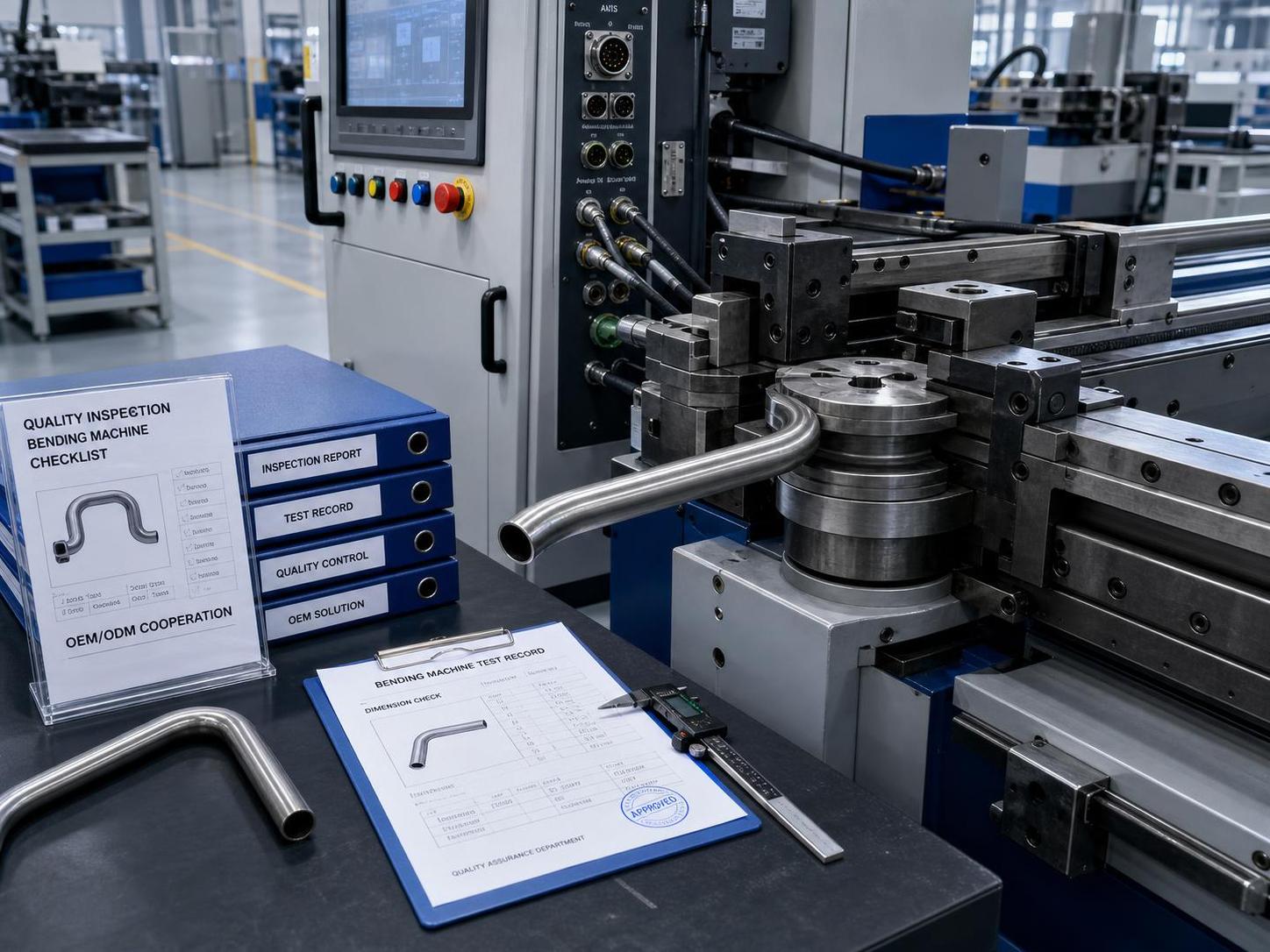
Pipe Bender Factory Audit Checklist for OEM and Distributor Partnerships
Choosing the right Pipe bender factory is a practical risk-control decision, not just a sourcing exercise. For OEM buyers, distributors, and agents, the wrong factory can create problems that only show up later: unstable bending accuracy, inconsistent electrical configurations, weak documentation, delayed spare parts, or machines that are difficult to support in the local market. A good audit is meant to reveal those issues before the first order, not after containers arrive.
That matters even more in fabricated metalworking equipment, where the machine itself is only part of the value. The rest comes from process know-how, quality discipline, export readiness, and the supplier’s ability to translate a customer requirement into a repeatable production result. In pipe bending, this usually means looking beyond catalog capacity and asking harder questions about tooling, controls, material range, repeatability, commissioning, and after-sales support.
Start with the factory’s real manufacturing role
The first audit question is simple: what does the supplier actually manufacture, and what do they integrate from outside partners? Many companies in machinery sales use the word “factory” broadly. That is not necessarily a problem, but it changes how you assess risk. If the supplier assembles, sources, and quality-controls machines through a stable network, the audit should focus on process control, subcontractor management, and technical accountability. If the supplier is a direct manufacturer, you will want to inspect in-house machining, welding, assembly, testing, and final inspection capability.
For example, Wuxi Samgins International Trade Co.,Ltd, established in 2012 in Wuxi, Jiangsu, works in a machinery cluster with convenient access to Shanghai and serves overseas markets across Southeast Asia, Europe, the Americas, and Oceania. That kind of location can be an advantage during factory audits because buyers can review not only pipe benders, but also the broader equipment ecosystem around metal fabrication, automation, and structural steel processing. In practice, a supplier with experience across welding equipment, CNC cutting, plate processing, and bending systems often understands where a pipe bender fits into a larger production line rather than treating it as a standalone sale.
Check whether the factory understands your market, not only the machine
A distributor partnership fails quickly when the supplier does not understand the end market. During the audit, ask how the factory handles differences in voltage, operator language, safety expectations, guarding, electrical components, manuals, and conformity documents. A machine that works well in one country may still be hard to sell in another if drawings are incomplete, CE-related documentation is weak, or spare parts are difficult to localize.
If a supplier says it works according to ISO9001 and EU CE standards, that is a useful starting point, but it should lead to deeper questions. Ask to see how quality procedures are documented, how revisions are controlled, and what technical file support can be prepared for export projects. Standards claims should show up in the workflow: incoming inspection, assembly checklists, test records, labeling, and shipment release. If those things are vague, the certificate alone does not tell you much.
A practical audit checklist for a Pipe bender factory
The most useful audits combine observation with document review. A clean workshop looks good, but it is not enough. What you really need is evidence that the factory can produce the same result repeatedly.
- Production scope: confirm which machine frames, tooling sets, hydraulic assemblies, electrical cabinets, and control systems are built or assembled in-house.
- Technical matching: review the supplier’s method for selecting machine type by tube diameter, wall thickness, material grade, bend radius, production volume, and tooling change frequency.
- Process capability: inspect machining tolerance control for key components such as bend arms, clamping systems, mandrel-related assemblies, and guide structures where applicable.
- Electrical and control consistency: ask whether the same PLC, inverter, servo, and HMI platforms are used across batches or changed depending on availability.
- Testing method: verify whether trial bending is part of final inspection, and whether test pieces, angle accuracy, springback adjustment, and repeatability records are documented.
- Export packaging: check corrosion protection, fixing method, electrical cabinet sealing, spare tooling protection, and shipping marks.
- Service readiness: confirm lead time for spare parts, remote support capability, installation guidance, and responsibility boundaries when local commissioning is needed.
If the audit team leaves with only brochures and a factory tour, the visit was too shallow.
Quality control: where many sourcing decisions go wrong
In bending equipment, quality problems are often cumulative rather than dramatic. A machine may run, but it may not hold angle consistency, may mark polished tubes, may require frequent setup correction, or may drift after a period of use. That is why your audit should focus on control points, not just finished appearance.
Ask the factory how it controls tooling fit and alignment. For distributors, this matters because tooling-related complaints are among the hardest to resolve remotely. Also ask how hydraulic components are sourced and how leaks, pressure stability, and heat buildup are checked. On CNC models, review whether software parameters are backed up and whether machine recipes can be standardized across units. For OEM programs, repeatability across multiple shipments is usually more important than one machine performing well during a demo.
It is also worth checking whether the supplier has experience with adjacent fabrication systems. A company active in welding, cutting, milling, and structural steel equipment often has better habits around fixture accuracy, motion control, and production-line coordination. In some cases, that broader engineering background shows up in how they approach custom projects. For instance, a supplier that can support equipment such as T type gantry h beam welding machine for steel structure fabrication may bring a more process-oriented view to machine integration, electrical consistency, and heavy-duty workshop standards. That does not automatically make its pipe bending line better, but it is relevant context during an audit.
Evaluate engineering depth, especially for non-standard requests
Many distributor relationships become difficult when customers ask for something slightly outside the standard range: unusual tube materials, tighter bend radii, automation links, special clamping surfaces, or local safety adjustments. A capable Pipe bender factory should be able to explain what is standard, what is optional, and what requires engineering confirmation.
During the audit, request a walk-through of a configuration process. How does the team move from inquiry to drawing approval to bill of materials to final testing? Who signs off on parameter changes? How are custom parts tracked? These details matter because many shipment disputes begin with unclear technical assumptions rather than obvious manufacturing errors.
You can often tell the difference between a trader-led quotation and an engineering-led quotation by the questions the supplier asks back. If they ask about tube OD, wall thickness, material, CLR, bend angle range, production takt, and downstream operation, that is a healthier sign than a quick price offer based only on diameter.
Delivery reliability is more than lead time
A promised lead time is easy to write and hard to verify. Instead of asking, “How fast can you deliver?” ask what controls that delivery. Does the factory keep standard electrical parts in stock? Are critical castings or machined components outsourced to fixed partners? What happens if a branded component becomes unavailable? Can the supplier freeze the specification for repeat orders so your market does not receive different configurations under the same model name?
This is one area where export experience really shows. Suppliers shipping regularly to multiple regions usually understand container planning, fumigation or packing requirements where needed, document accuracy, and the difference between a machine that ships and a machine that arrives ready for local commissioning. That experience can be just as valuable as the machine price.
After-sales support should be audited before the sale
Distributors often focus heavily on ex-works cost and not enough on service structure. But once the machine is installed, support quality becomes part of your own reputation. Ask who handles troubleshooting, what the expected response path is, whether electrical drawings and parts lists are delivered in a usable format, and how the supplier supports wear parts or urgent replacements.
A supplier with broader machinery experience may already have systems for remote diagnosis, documentation control, and spare parts coordination. That is one reason many buyers prefer partners that are active not only in one product category but in fabrication equipment more widely. Even outside pipe bending, equipment such as the LHB-2000 gantry or double-cantilever structural welding systems used for bridges, buildings, ships, and high-speed railway fabrication requires disciplined assembly, tracking, speed control, and export support. When those capabilities are real rather than advertised, they often carry over into service expectations across the portfolio.
Red flags that deserve extra attention
Some warning signs are easy to miss during a short visit. Be cautious if the factory cannot show stable component sourcing, if technical files appear inconsistent from one machine to another, or if testing depends too much on operator skill rather than documented procedure. Another concern is when customization is promised too easily without engineering review. In machinery, fast agreement can sometimes mean future argument.
Also watch for suppliers that are strong at demonstration but weak at handover. If manuals, wiring diagrams, spare parts lists, and acceptance criteria are treated as secondary, the burden will likely shift to the distributor after shipment.
What a good audit outcome looks like
A useful audit does not end with a simple pass or fail. It should tell you what kind of partnership is realistic. Some factories are suitable for standard models with limited localization. Others are better for OEM programs, private labeling, or market-specific electrical and compliance requirements. A few may be strong enough to support bundled fabrication projects where pipe bending is part of a broader equipment package.
If you are narrowing down a supplier list, ask for the next step in evidence, not just another quote: a sample acceptance plan, a draft documentation package, a spare parts commitment, or a technical review against your target applications. That approach makes it easier to judge whether the Pipe bender factory can support your business after the order is placed, which is where distributor partnerships are really tested.
The strongest sourcing decisions usually come from this combination: a factory that can explain its process clearly, document quality consistently, adapt to export requirements without improvisation, and stay technically accountable when application details get more demanding. That is the checklist worth using before you commit to a long-term OEM or distribution agreement.
search
Products Navigation
Send Us A Message