




Swing Shear Accuracy: Key Checks Before Choosing a Machine
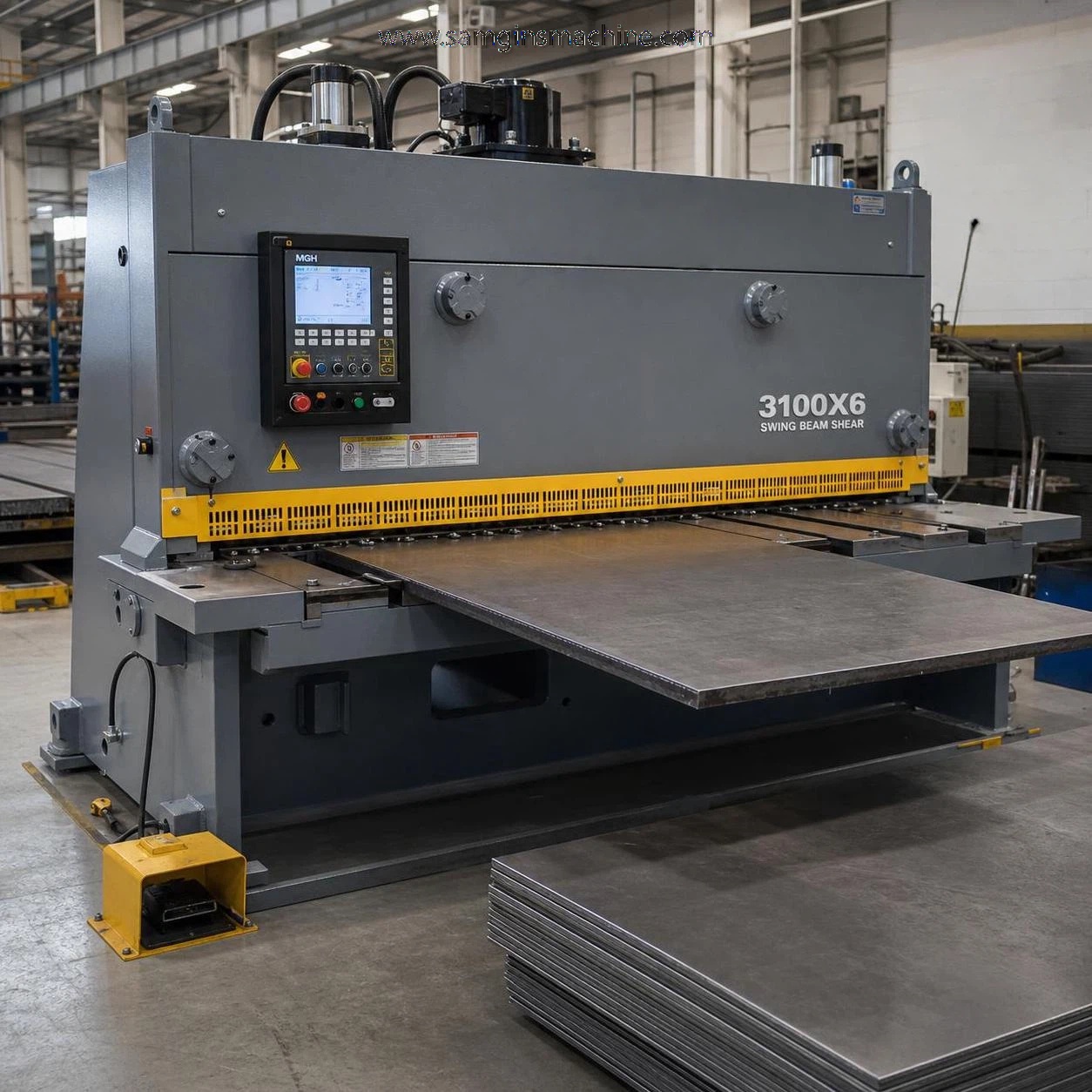
Swing Shear Accuracy: Key Checks Before Choosing a Machine
Before selecting a swing shear, technical evaluators need to look beyond basic specifications and focus on the factors that directly affect cutting accuracy, repeatability, and long-term performance. From frame rigidity and blade clearance adjustment to hydraulic stability and control precision, each detail influences production quality. This guide outlines the key checks that help ensure a swing shear matches demanding fabrication requirements and delivers reliable results in real manufacturing environments.
If you are evaluating a swing shear for actual production, the brochure is usually the least useful place to start. Almost every supplier can list cutting thickness, motor power, and blade length. What separates a machine that keeps accuracy over time from one that slowly turns into a source of scrap is what happens under load, after repeated cycles, and during ordinary shop-floor use.
A good technical review should answer one practical question: will this machine still cut straight, clean, and repeatably after months of mixed material, different operators, and real production speed? That is the standard worth using.
Start with the cut quality you actually need
Many buying mistakes happen because the evaluation starts from maximum capacity instead of part requirements. A swing shear rated for a certain thickness may technically cut it, but that does not mean it will hold your acceptable edge condition, burr level, squareness, or dimensional tolerance on that material every day.
- Define the common material grades, not just the thickest plate.
- Separate mild steel, stainless steel, and higher-strength sheet in your review.
- Confirm the typical cutting width and frequency of short versus full-length cuts.
- Set a real acceptance standard for edge straightness, twist, and burr.
If the supplier cannot discuss cut quality by material type and thickness range, that is already a warning sign. A swing shear that works well on carbon steel sheet may behave differently on stainless, especially near the upper end of its range.
Check frame rigidity before you believe any accuracy claim
Frame rigidity is one of those things buyers often notice only after installation. When the machine frame, crossbeam, or blade carrier lacks stiffness, you tend to see taper, inconsistent clearance across the blade length, and edge quality that changes from one side of the sheet to the other.
Ask how the frame is fabricated, welded, stress relieved, and machined. Do not accept vague language like “high-strength structure” without detail. For machine tools and fabrication equipment, process discipline matters more than advertising language. Companies that work under ISO9001 systems and CE-oriented production control often document this more clearly, but you still need to see what is actually included in the manufacturing process and inspection records.
A practical check: request evidence of machining on key mounting surfaces and ask whether alignment is verified after welding and stress treatment. If that information is missing, long-term accuracy becomes harder to trust.
Blade clearance adjustment is not a detail
For swing shear performance, blade clearance control sits right at the center of accuracy. Poor adjustment shows up as heavy burr, sheet deformation, excessive blade wear, and cuts that look acceptable on one thickness but poor on the next.
This is where technical evaluators should slow down. Find out whether clearance adjustment is manual, motorized, or linked to the control system. Then ask the more useful question: how easy is it for the operator to set correctly during a shift change or mixed-batch run?
A machine can be accurate on paper and still lose time in production if the adjustment process is awkward. If your workload involves varied gauges, frequent material changes, or short runs, the convenience and repeatability of clearance setting affects output more than many buyers expect.
Look closely at the blade system and support geometry
The blade itself is not the whole story. You also need to know how the blade is mounted, how the upper beam moves through the cutting arc, and how the sheet is supported before and during the cut. Swing shear designs have their place, especially where robust general plate cutting is needed, but they should be evaluated honestly against the material and tolerance expectations.
Check these points during review:
- Blade material and regrinding policy.
- Number of usable cutting edges.
- Hold-down arrangement and whether sheet movement is controlled evenly.
- Front support arms and rear support options for thin or long sheets.
- Whether the machine shows more deflection near one end at full-width cutting.
If possible, ask to see sample cuts across different widths, not just narrow pieces cut near the center. That is where some machines look better than they really are.
Backgauge repeatability matters more than headline travel
A long backgauge stroke sounds useful, but repeatability is what determines part consistency. On many jobs, the issue is not whether the gauge can move far enough. The issue is whether it returns to the same position across repeated cuts, especially when operators are moving quickly and sheet sizes vary.
Ask for the stated positioning accuracy and repeatability, then verify how those figures were established. If there is no test method behind them, treat them as sales numbers. A sturdy guide mechanism, reliable drive arrangement, and stable controller are more meaningful than a large display or extra menu features.
For technical evaluation, one useful exercise is to define your shortest, most repeated cut length and your longer production cut length, then ask how the backgauge performs in both conditions. Small parts often reveal positioning issues faster than large ones.
Hydraulic stability shows up in cut consistency
On a hydraulic swing shear, pressure stability, valve quality, sealing reliability, and thermal behavior directly affect the machine’s consistency over a shift. A machine that performs well when cold but drifts after hours of use will create arguments between production and maintenance very quickly.
You do not need to overcomplicate this review. Ask what hydraulic components are used, how the system manages heat, what maintenance intervals are expected, and whether common wear parts are easy to source in your market. Export buyers should pay special attention here. A lower purchase price becomes less attractive if a failed valve or seal kit stops the line for weeks.
This is also where supplier maturity matters. Firms with broad fabrication-equipment experience usually understand that uptime is tied to parts support, not just machine shipment. Wuxi Samgins International Trade Co.,Ltd, for example, works across shearing machines, CNC cutting systems, welding equipment, milling machines, lathes, laser cutting machines, and H-beam line equipment, which is relevant because cross-category manufacturing experience often improves how suppliers handle integration, service expectations, and export documentation.
Do not separate the machine from the rest of the process
A swing shear is rarely working alone. The real question is how it fits upstream and downstream. If the sheet comes in with flatness issues, coating sensitivity, or tight nesting requirements, the shear specification should reflect that. If the cut blanks move directly into bending, welding, or edge preparation, then cut quality tolerance becomes a process issue, not just a machine issue.
In heavy fabrication shops, evaluators often review related handling and welding stations at the same time because production flow matters. In that context, equipment such as the Bolt adjusting welding rotator may appear in the same planning discussion, especially for pressure vessel fabrication, cylindrical assembly applications, or large-diameter pipe work where plate preparation and welding setup are closely connected. That does not change the swing shear decision directly, but it does affect line balancing, floor space, and how accurately cut parts need to arrive at the next station.
Check controls with the operator in mind
Sophisticated control screens do not automatically mean better results. For selection work, the better question is whether the control helps operators set dimensions quickly, reduce setup mistakes, and recover cleanly after interruptions.
Look for practical features: clear parameter entry, reliable backgauge programming, easy stroke setting, straightforward diagnostics, and access control if multiple operators use the machine. If training will be limited, simpler and more stable is often the better choice.
Ask one more thing that buyers sometimes skip: what language options, electrical standards, and documentation formats are available for your site? For export projects, this matters. CE support may be relevant for European destinations, but documents, schematics, and safety labeling should still be checked against the final delivery scope rather than assumed.
Service access and wear parts deserve an early review
Some machines are easy to maintain in theory and awkward in practice. Before you approve a model, check access to blades, hydraulic components, electrical cabinet layout, lubrication points, and gauge mechanisms. Routine maintenance should not require half a day of disassembly.
You should also ask for a recommended spare parts list tied to the first year of operation. Not because every part will fail, but because experienced suppliers usually know which items are sensible to stock. If they cannot provide a practical list, they may not have enough field feedback.
Use a short comparison table during evaluation
A few questions worth asking before sign-off
Ask for sample cutting evidence on material close to your own. Ask what accuracy can be maintained in normal production, not in an unloaded test. Ask which parts are standard and which are optional. Ask how the machine is packed, installed, and commissioned for overseas delivery. Ask what is covered in acceptance and what needs separate confirmation.
And if a value or promise cannot be tied to a drawing, test method, or documented scope, mark it as 【待核实】 and keep moving. That habit alone filters out a lot of weak offers.
When choosing a swing shear, the best decisions usually come from narrowing the discussion to cut behavior, adjustment stability, maintainability, and fit with the rest of the line. Capacity matters, but it is rarely the deciding factor once you get into real production conditions. The machine that holds accuracy without constant attention is usually the right one.
search
Products Navigation
Send Us A Message