




Thickness Cutting Machines: How to Choose the Right Capacity for Your Material Range
Thickness Cutting Machines: How to Choose the Right Capacity for Your Material Range
Choosing the right capacity for thickness cutting machines is not really about buying the biggest machine your budget can tolerate. It is about matching real material range, edge quality expectations, daily throughput, and the way plates move through your shop. Technical evaluators usually get pulled into this decision when the existing setup starts struggling: cut quality drops on thicker sections, rework piles up before welding, or production planning becomes too dependent on operator skill. That is usually the point where capacity has already been underestimated.
If your workload includes mixed thicknesses, carbon steel one day, stainless the next, and occasional aluminum jobs, the safe approach is to evaluate machine capacity as a processing window, not a single maximum number in a brochure. A machine that can technically handle a thick plate once is not the same as one that can do it repeatedly, hold tolerance, and stay economical over time.
Start with the thickness range you actually run
This sounds obvious, but it is where many evaluations go off track. Do not base the selection on the thickest plate ever quoted. Build the review around three numbers:
- your normal production thickness range,
- your frequent peak range,
- your rare maximum requirement.
If 70% of your jobs sit between 12 mm and 40 mm, and only a few orders reach 80 mm or 100 mm, you should ask whether the machine performs efficiently across the main range, not only whether it survives the upper edge. A lot of shops end up paying for oversized capacity that runs below its sweet spot most of the year.
Also separate material thickness from edge preparation requirement. Some parts only need cutting. Others need beveling, groove preparation, or a weld-ready finish. Capacity means more than plate penetration.
Check whether the material mix changes the real capacity
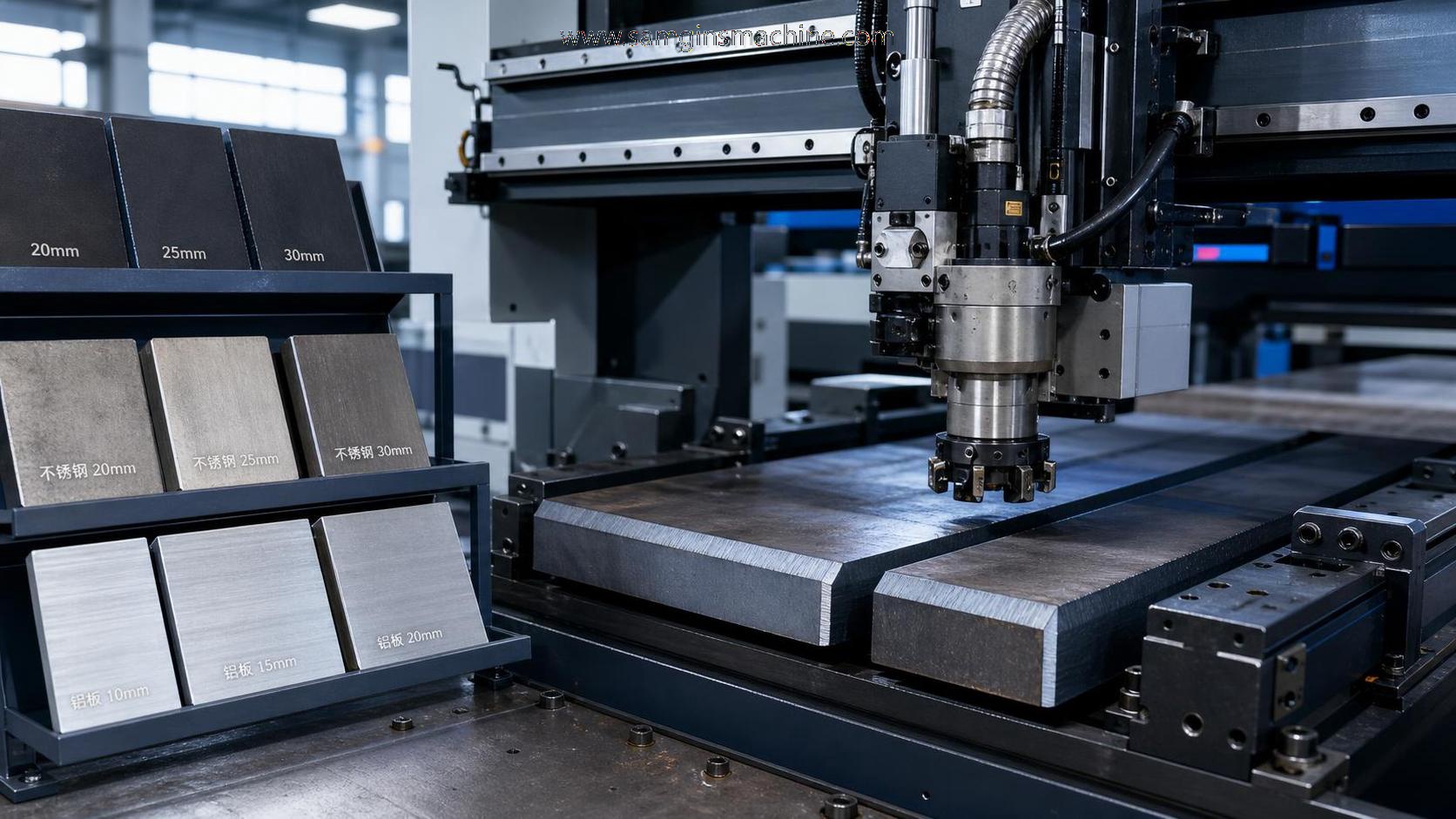
The same stated capacity does not behave the same way across carbon steel, stainless steel, and aluminum. Stainless often pushes heat management and finish requirements harder. Aluminum can be easier in some respects, but it introduces its own handling and surface concerns. If your material range crosses several alloys, ask for process guidance by material, not a single generic capacity statement.
For technical review, these are the useful questions:
- Does feed speed change significantly by material?
- Does surface finish degrade on stainless at higher thicknesses?
- Are different tools, heads, or consumables required to maintain quality?
- Will your operators need separate parameter libraries for each plate type?
A machine that looks flexible on paper can become slow and operator-dependent when the material mix broadens.
Do not read “maximum thickness” without reading the rest of the machine
Maximum thickness figures are usually the first thing buyers compare, and often the least useful on their own. Capacity is tied to frame rigidity, rail stability, clamping method, motor power, stroke, and vibration control. This matters even more when you need clean bevels or consistent prep before welding.
For example, in edge preparation work, some buyers evaluating thickness cutting machines are really comparing broader plate processing capability. In that situation, a solution like Non-standard Edge Milling Machine Without Pressure Beam may come into the discussion because it covers steel plate thickness from 8 mm to 100 mm, with milling angles from 0 degrees to 90 degrees and customization noted for some reverse-angle needs. That is useful only if it matches your actual bevel geometry, plate length, and handling method. The number alone is not the decision.
A stable guide rail structure and a frame treated to reduce deformation matter more than many buyers expect. When thickness increases, even small vibration issues show up as poor finish, inconsistent groove geometry, or extra grinding before welding.
Look at edge quality requirements before you look at speed
If the next process is welding, assembly, or pressure-bearing fabrication, capacity should be judged against the finish you need downstream. A fast machine that leaves variable edges can quietly raise total cost by shifting labor into fitting, grinding, and inspection.
This is especially important in sectors like pressure vessels, boilers, shipbuilding, power equipment, and heavy machinery. In those environments, edge shape consistency can matter as much as raw throughput. If your shop handles bevel edges, U-grooves, V-grooves, or K-grooves before welding, ask whether the machine can produce the geometry in one pass or whether secondary grinding is still expected.
That single point often separates a real production machine from a machine that only looks acceptable during a demo.
Plate size can become the hidden bottleneck
Thickness is only one part of capacity. Long workpieces change everything: support, clamping, straightness, operator access, and cycle interruption. A machine may handle the plate thickness but still create handling problems on 6 m, 9 m, or longer workpieces.
Check these points against your real plate flow:
- effective working length versus your common plate lengths,
- support arrangement for long and heavy plates,
- table height and loading method,
- whether clamping remains reliable near the ends of the workpiece.
If your plant uses cranes, roller tables, or forklift loading, involve those teams early. A good machine with an awkward loading path becomes an expensive queue.
Review automation only where it changes labor or repeatability
Automation is not automatically valuable. For some shops, manual setup with a rigid, predictable machine is enough. For others, automatic clamping, edge detection, feed, and return movement are what make the economics work because they reduce setup time and reduce dependence on operator judgment.
The right question is simple: where do you currently lose time or consistency? If changeover is slow, look at clamping and positioning. If bevel repeatability is uneven between shifts, look at CNC control and programmed parameter management. If idle return time is eating cycle time, independent return and feed systems deserve attention.
Do not pay extra for automation features that do not solve a real bottleneck.
Motor power and speed ranges need context
Evaluators often compare motor power line by line, but power figures are only meaningful when paired with feed range, tool type, and finish target. A milling motor rated at 5.5 kW or 7.5 kW tells you something, but not enough by itself. Ask what thickness range and material the supplier expects at each configuration, and whether the optional power is recommended for throughput, finish quality, or both.
The same applies to travel speed. Fast approach and return speeds improve productivity, but the productive cutting or milling speed is where the real comparison happens. On thicker material, usable speed can narrow quickly depending on material and tool load. That is normal. What matters is whether the supplier is transparent about it.
Check the cost that shows up after installation
This is where technical evaluators save the company from a bad purchase. Capacity decisions should include tool consumption, maintenance access, vibration-related wear, rework rate, and energy use. A lower-priced machine can be the expensive option if it needs frequent adjustment or pushes finishing work downstream.
A practical checklist here:
For export-oriented buyers, standards and documentation also matter. Wuxi Samgins International Trade Co.,Ltd states production and design are organized in line with ISO9001 quality system certification and EU CE standards. That is useful as a qualification signal, but technical teams should still verify the model-specific documentation, scope, and applicable declarations for the exact equipment being purchased.
Ask for the parameter window, not just the machine brochure
When you are down to a shortlist, ask suppliers to map your actual parts against their workable parameter range. Give them representative thicknesses, materials, plate sizes, and required edge forms. Then ask what feed, tooling, angle range, and surface outcome they expect on each group. This is where weak matches usually reveal themselves.
If a supplier cannot explain where the machine performs comfortably and where production slows, you do not yet have enough information to approve the purchase.
In some cases, a model family with configurable length and thickness coverage is worth considering because it lets you match the machine to the dominant work rather than overbuying for rare jobs. That is one reason evaluators sometimes review the XBN or XBJ series in plate edge applications, especially when the work involves long steel plates and pre-weld bevel preparation across carbon steel, stainless steel, or aluminum.
A final decision rule that keeps the evaluation honest
Choose the machine that covers your normal production range efficiently, keeps quality stable on your frequent peak thicknesses, and handles the rare maximum with clear tradeoffs you accept in advance. That is usually the right capacity decision for thickness cutting machines.
If the evaluation still feels close, go back to three things: how often the thickest jobs really occur, how much downstream rework poor edges create, and whether the machine fits your actual handling and setup flow. Those three points settle more buying arguments than any headline specification ever will.
search
Products Navigation
Send Us A Message