




Two Axis Thread Rolling Machine Trends in Fastener Production
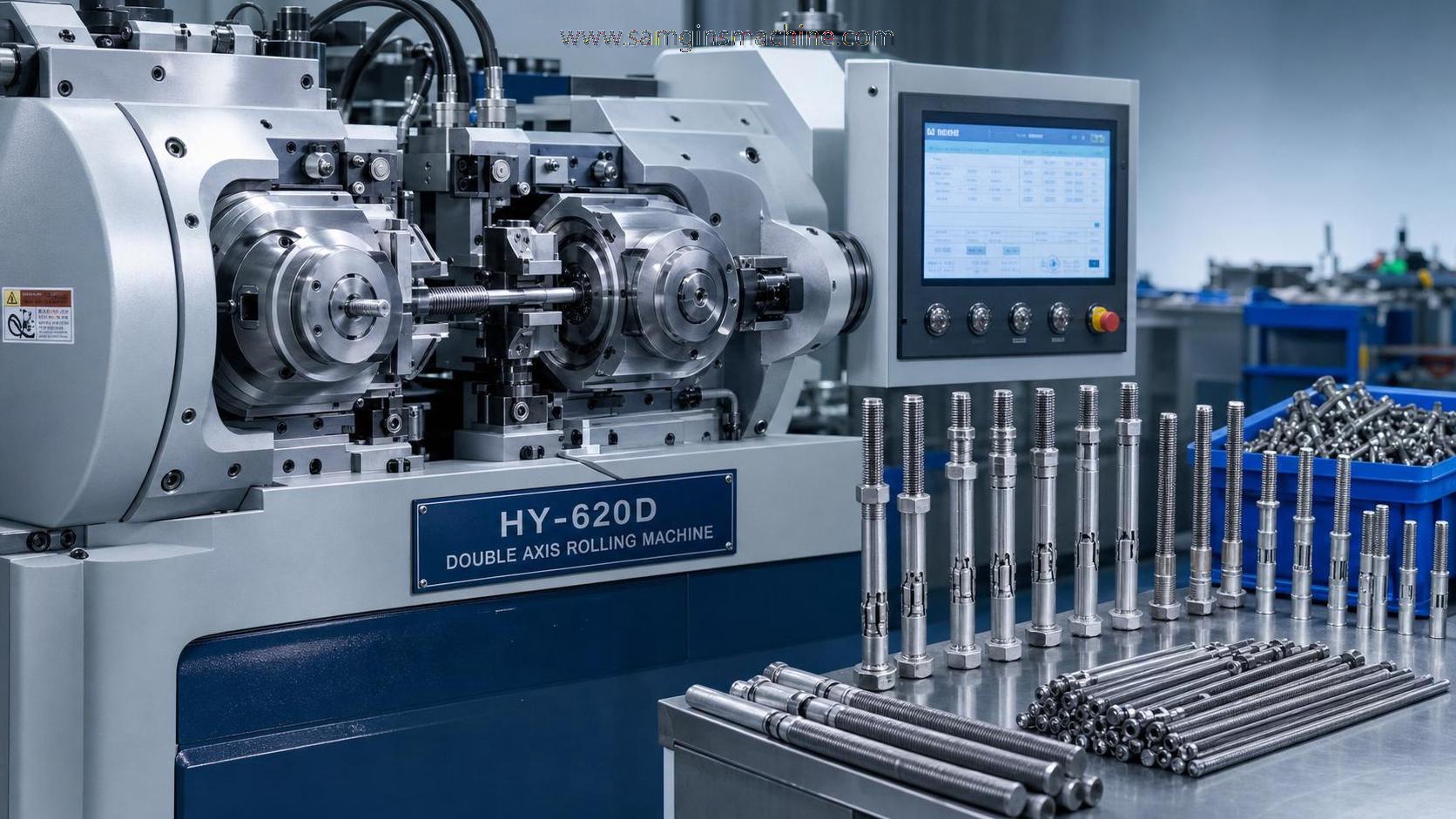
Why this machine category is gaining attention
Fastener production is under pressure to deliver tighter tolerances, faster cycle times, and better cost control at the same time.
In that environment, the Two axis thread rolling machine has moved from a niche forming solution to a practical production priority.
Its appeal is straightforward.
It forms threads efficiently, supports stable output, and helps reduce material waste compared with many cutting-based processes.
That matters across automotive fasteners, construction hardware, industrial connectors, and export-oriented standard parts.
For companies building equipment portfolios, this trend also reflects a wider shift in manufacturing and processing machinery.
Buyers are no longer comparing machines only by headline price.
They are weighing output consistency, automation readiness, serviceability, energy use, and suitability for regional market demand.
What a Two axis thread rolling machine really does
A Two axis thread rolling machine creates external threads by cold forming rather than removing material.
Two rolling dies apply pressure to the workpiece and shape the thread profile through controlled extrusion.
This forming method preserves continuous metal fibers.
That is one reason rolled threads often show better fatigue strength, wear resistance, and surface finish than cut threads.
In practical terms, the machine is valued for three things.
- Stable thread accuracy across repeat batches.
- Higher throughput for large-volume parts.
- Lower scrap and cleaner production flow.
These advantages explain why the Two axis thread rolling machine remains relevant even as other forming and CNC processes improve.
The main trends shaping fastener production
The first trend is tighter quality control.
Export markets increasingly expect traceable performance, stable dimensions, and compliance with recognized production standards.
A capable Two axis thread rolling machine supports this by producing uniform threads with less variation between shifts.
The second trend is broader material coverage.
Fastener lines now process carbon steel, alloy steel, and selected non-ferrous metals for different industrial sectors.
Machines with wider process flexibility fit this demand better than single-purpose equipment.
The third trend is automation compatibility.
Manual operation still has value for short runs, but semi-automatic and automatic modes are becoming more attractive for volume production.
A modern Two axis thread rolling machine is increasingly judged by how easily it integrates into stable, repeatable workflow.
The fourth trend is energy and resource efficiency.
Cold rolling avoids chip generation, improves material utilization, and often reduces total processing cost over time.
Where the business value becomes clear
In fastener production, machine value is rarely limited to the threading step alone.
The real business effect appears across output planning, finished part quality, after-sales confidence, and line expansion potential.
A Two axis thread rolling machine can help shorten processing time on common external thread applications.
It also supports repeatable production of high-strength standard parts, anchor bolts, and T-screws.
For larger thread pitches, the right configuration becomes even more important.
This is where a model such as ZC28-6.3 thread rolling machine becomes relevant in discussion.
It is designed for radial cold roll forming of precision external threads on carbon steel, alloy steel, and non-ferrous metals.
With a maximum rolling pressure of 200KN and a rolling diameter range of Φ20-80mm, it addresses more demanding workpiece sizes.
Its multi-mode operation also matches mixed production environments where manual adjustment and automated rhythm may both be needed.
What channel decisions usually depend on
How to read the specification beyond the headline
Not every specification line has equal commercial value.
Some parameters directly indicate what kinds of fasteners can be processed efficiently and consistently.
Rolling pressure is one of them.
Higher pressure capacity supports stronger forming performance on tougher materials and more demanding profiles.
Diameter range matters just as much.
It defines whether the machine fits standard fasteners only or can also cover larger industrial parts.
Axis inclination, feed speed, and die dimensions also deserve attention.
These factors influence forming stability, setup flexibility, and productivity during changeovers.
For example, a spindle inclination of ±6° and an active spindle feed speed of 20mm/s can expand usable threading conditions.
Surface quality should not be overlooked either.
When surface roughness can reach Ry 0.1-0.8 μm and precision meets GB197-63 Grade 2, the machine becomes easier to position for quality-focused projects.
Supplier background also affects machine selection
Equipment selection is not only about the machine body.
It also depends on design discipline, production control, and the supplier’s broader manufacturing understanding.
Wuxi Samgins International Trade Co.,Ltd operates from Wuxi, Jiangsu Province, with convenient access to Shanghai and international logistics channels.
Since 2012, the company has focused on mechanical equipment and related products across metalworking and fabrication categories.
That range includes CNC cutting machines, milling machines, lathes, welding robots, laser cutting systems, H-beam production equipment, and thread rolling machines.
This matters because thread rolling rarely exists in isolation.
It often sits inside a wider processing chain that includes cutting, shaping, handling, and finishing.
A supplier familiar with that chain can usually discuss machine matching more realistically.
The company’s export experience in Southeast Asia, Europe, the Americas, and Oceania also suggests awareness of varied compliance and market expectations.
Its alignment with ISO9001 practices and EU CE standards adds another layer of reference when evaluating consistency and documentation discipline.
Common application directions in today’s market
The Two axis thread rolling machine is not limited to one narrow fastener category.
Its current demand is shaped by several application directions.
- Standard external threads for industrial and construction fasteners.
- High-strength parts where rolled fiber continuity supports better performance.
- Anchor bolts and long workpieces requiring stable forming over extended length.
- T-screws and parts with larger thread pitches.
- Projects needing cleaner production and less material loss.
Machines built for unlimited workpiece length and minimum thickness of at least 2mm can be especially useful in these scenarios.
That expands commercial relevance beyond small standard fasteners.
Practical checkpoints before moving forward
A good evaluation usually starts with actual part requirements rather than catalog ranking.
The following points help build a clearer comparison.
- Match thread type, diameter range, and pitch demands to machine capacity.
- Confirm whether the process material stays within the recommended hardness range, such as not exceeding HRC37.
- Review structural rigidity, die compatibility, and changeover efficiency.
- Check hydraulic, main drive, and cooling power against production rhythm.
- Ask how manual, semi-automatic, and automatic modes are handled in real operation.
- Look at part quality targets, not only machine speed claims.
If the target market values durability and finish, a Two axis thread rolling machine with proven consistency will usually outperform a lower-cost option with weaker process control.
That is also why machines like the ZC28-6.3 thread rolling machine are often assessed through application fit, not specification headlines alone.
A sensible next step
The current trend is clear.
The Two axis thread rolling machine is becoming more central to fastener production where quality, throughput, and material efficiency must work together.
The best next step is to map target applications against real processing conditions.
That includes part size, material type, pitch range, expected output, and required quality grade.
With those points clarified, it becomes much easier to compare machine configurations, assess supplier fit, and decide where the strongest market opportunities are likely to appear.
search
Products Navigation
Send Us A Message