




What Are the Common Failure Modes of Welding Robots in Continuous Production?
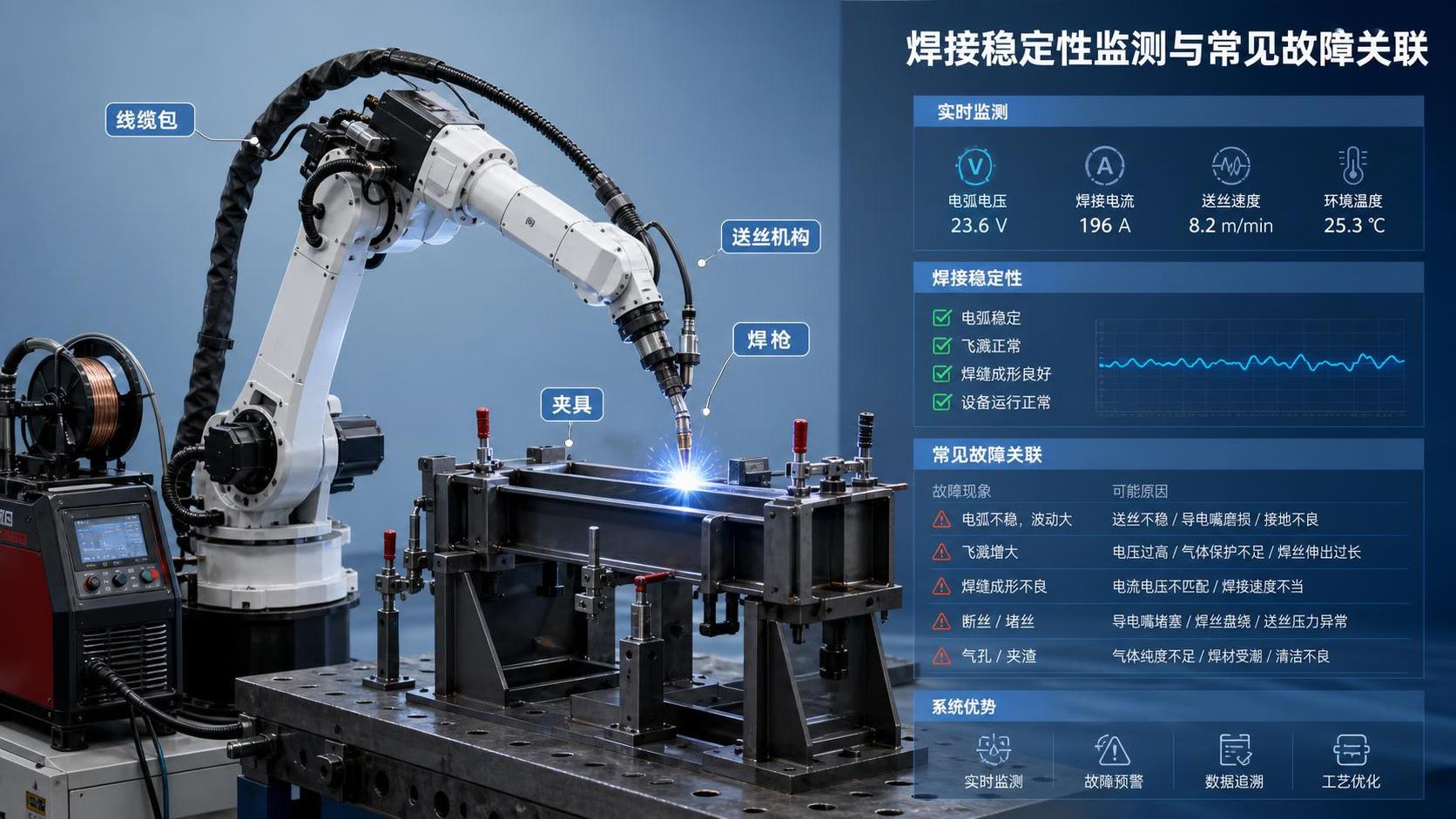
What are the common failure modes of welding robots in continuous production environments? It sounds like a straightforward maintenance question, but on a real shop floor it is rarely just about a broken part. In continuous production, a welding robot may still move normally while weld quality is already drifting, cycle time is stretching, or rework is quietly increasing. By the time a hard alarm appears, the actual problem may have started hours or even days earlier.
That is why experienced manufacturers do not look at robot failure only as “robot stops” events. They watch the full welding system: robot arm, torch, wire feeder, power source, grounding, fixtures, sensors, cables, software logic, and upstream material consistency. In heavy fabrication, sheet metal welding, structural steel, or H-beam line applications, these weak points show up differently, but the pattern is familiar. A stable cell usually fails first at the interfaces, not at the brochure-level specifications.
Companies working with automatic welding equipment across different markets often see the same thing. The issue is not whether welding robots are reliable—they generally are—but whether the production system around them is designed and maintained for continuous duty. Suppliers with broad exposure to fabrication equipment, such as welding robots, CNC cutting machines, laser cutting machines, and H-beam production line equipment, tend to recognize these cross-process links early because welding quality often depends on what happened before the arc was even struck.
Torch and consumable wear is still the first place to look
In long production runs, the most common failure mode is not a dramatic servo failure. It is gradual wear in the torch body and consumables: contact tips, nozzles, diffusers, liners, insulating parts, and anti-spatter protection. These components live in heat, spatter, vibration, and repeated motion. Even when the robot path is correct, a worn tip can change arc stability and wire contact enough to create undercut, porosity, inconsistent bead shape, or burnback.
This gets worse when maintenance teams replace consumables on a fixed calendar without checking actual wear patterns. A high-duty robotic MIG cell welding carbon steel all day does not consume tips the same way as a lighter aluminum application. If the nozzle is partially blocked by spatter, shielding gas flow may become uneven before anyone notices. Operators then blame the program, while the real cause is mechanical and very ordinary.
A practical habit is to inspect removed consumables, not just replace them. Their wear tells a story: eccentric hole wear can point to misalignment, excessive spatter may suggest unstable parameters, and repeated burnback often indicates feeding resistance or incorrect stickout control.
Wire feeding problems cause more disruption than many teams expect
Wire feed faults are classic in continuous production because they sit between electrical, mechanical, and consumable issues. A robot can be perfectly programmed and still produce poor welds if the wire does not feed smoothly. Common triggers include liner contamination, drive roll wear, wrong roll pressure, bent conduit routing, spool drag, poor-quality wire surface condition, or even inconsistent copper coating on the filler wire.
These problems often appear as intermittent arc instability rather than complete stoppage. The line keeps running, but with more spatter, more starts and stops, or occasional lack of fusion at seam entry. In a continuous environment, intermittent faults are actually more expensive than clear failures because they hide inside accepted output until inspection catches them.
When troubleshooting wire feed, it helps to separate symptoms from root causes. If the feeder motor alarms, that is one thing. If the bead profile changes with no alarm, check drag, contamination, liner length, and torch cable routing before rewriting the welding program.
Cable fatigue and dress pack damage are common on high-cycle cells
On paper, robotic cable packages are designed for motion. In practice, continuous production exposes every weakness in bend radius, clamping position, and routing logic. Over time, power cables, control cables, gas hoses, and water lines can twist, rub, crack, or fatigue internally. The robot may not show a major fault at first. Instead, you get random sensor errors, unstable arc starts, communication drops, or a water-cooled torch that starts running hotter than expected.
This is especially common after a cell modification. Someone changes a torch, adds a reamer, adjusts a fixture, or shortens a path, and the dress pack starts moving differently. Six weeks later, there is unexplained downtime. The connection between those events is easy to miss.
A good maintenance routine includes observing the robot through a full cycle with guarding-safe methods, not just checking static cable condition. Many failures only show up at full extension or during tight wrist rotation.
Teaching drift, collision damage, and positional inaccuracy
One of the more frustrating failure modes is when the robot still runs, but weld placement slowly moves off target. In continuous production, this can come from minor collisions, TCP shift, fixture wear, loose mounting hardware, or deformation in the workpiece itself. Shops sometimes assume robot repeatability has failed, when the real problem is that the process reference has changed.
Collision events deserve extra attention, even if the robot resumes operation afterward. A small impact may bend the torch neck, shift the TCP, or affect the anti-collision device. That change may be just enough to miss a joint root on a fillet or produce inconsistent leg size. The robot did what it was told; it was just no longer holding the same geometry.
In structural fabrication and larger assemblies, fixture condition matters just as much. Clamps wear, stops loosen, and thermal distortion accumulates. Continuous production amplifies these effects because tiny locating errors repeat across every part.
Sensors fail quietly before they fail completely
Arc seam tracking, touch sensing, through-arc sensing, and part presence detection can significantly improve robotic welding reliability, but only if they remain calibrated and clean. Sensors rarely go from perfect to dead in one step. More often they drift. Spatter buildup, electromagnetic interference, damaged connectors, dirty lenses, poor grounding, and software tolerance settings can all reduce sensor accuracy.
This is where continuous production becomes unforgiving. A few millimeters of tracking error on thin sheet metal may cause burn-through. On heavier sections, the weld may still look acceptable from outside while penetration becomes inconsistent. If the production team only monitors machine uptime, this kind of failure can run too long before anyone reacts.
The useful question is not “does the sensor work?” but “is it still making correct decisions under actual shop conditions?” That includes heat, spatter, vibration, and material variation—not just clean commissioning conditions.
Power source and grounding issues often masquerade as robot faults
A welding robot depends on a stable welding power source, proper grounding, and clean electrical integration. If grounding is poor, contact points are oxidized, return current paths are unstable, or the power source has internal issues, the symptoms may look like a robot problem: inconsistent arc starts, excess spatter, unexplained alarms, or weld defects that move around without a clear pattern.
This gets more complicated in plants where several automated machines share utilities. Power fluctuations, compressed air quality, and cooling system performance can affect welding consistency in indirect ways. Teams that work with integrated fabrication lines—cutting, forming, deburring, and welding—usually learn that process stability depends on the whole production environment, not one machine in isolation.
Controller, software, and communication faults are less frequent but more disruptive
Pure controller failures are not the most common issue, but when they happen they tend to stop production immediately. Communication faults between robot, PLC, welding power source, positioner, or safety system can create deadlocks that are difficult to diagnose under time pressure. Sometimes the hardware is fine and the problem sits in signal timing, handshake logic, firmware mismatch, or recovery sequence design.
A line that restarts poorly after a minor interruption will always underperform in continuous production. That is not a glamorous engineering topic, but it matters. Good cell design includes predictable fault recovery, clear alarm hierarchy, and access for maintenance without creating new calibration risks.
Upstream material variation is an underrated cause of robotic welding failure
Not every welding problem originates in the robot cell. Poor edge preparation, inconsistent cut quality, burrs, mill scale, oil contamination, variable gap, and part distortion from previous operations can all push a robotic welding process outside its tolerance window. This is why shops that also run CNC cutting, plate processing, deburring, bending, or end-face milling often see a direct connection between upstream discipline and robot performance.
For example, if laser or thermal cutting leaves variable edge condition, the robot may need wider process tolerance than the current parameters allow. If fixtures were designed for nominal parts but real incoming variation is larger, the robot becomes the first place where that mismatch becomes visible. Blaming the robot in that situation is common and usually not productive.
How to reduce failures without overcomplicating the cell
The best prevention methods are usually not exotic. They are disciplined.
- Track consumable life by actual process behavior, not only by calendar intervals.
- Inspect wire path, liner condition, and drive settings whenever weld stability changes.
- Check TCP and fixture references after any collision, torch replacement, or maintenance intervention.
- Treat sensor cleaning and calibration as production tasks, not occasional troubleshooting steps.
- Audit grounding, cable routing, and utility stability before changing weld programs.
- Link robot maintenance records with quality data, because many failures show up in weld results before they show up in alarms.
It also helps to choose equipment and cell layouts that are practical to maintain. Manufacturers and integrators with broad equipment experience often emphasize this point for a reason. A welding robot inside a production system should be accessible, logically routed, and matched to the real duty cycle. Standards such as ISO9001-based quality control and CE-oriented design discipline are useful frameworks, but daily reliability still comes down to execution on the floor.
Wuxi Samgins International Trade Co., Ltd., established in 2012 in Wuxi near Shanghai, works across a wide range of fabrication and processing equipment, from welding robots and automatic welding equipment to CNC cutting machines, lathes, milling machines, laser cutting machines, and H-beam production line equipment. That kind of product range reflects a practical truth in manufacturing: robotic welding performance is rarely independent from cutting accuracy, forming quality, part preparation, and line integration. When equipment is selected and supported with that full-process view, continuous production becomes much easier to stabilize.
If a welding robot cell is failing repeatedly, the right question is not “which component is bad?” but “where is the process losing stability first?” In many plants, the answer turns out to be small and fixable—consumables, feeding resistance, fixture wear, grounding, or sensor drift. Catch those early, and the robot usually does exactly what it was purchased to do: run consistently, for a long time, without becoming the bottleneck.
search
Products Navigation
Send Us A Message