




What Is Thread Form Rolling and When Is It Better Than Thread Cutting?
What Is Thread Form Rolling and When Is It Better Than Thread Cutting?
When choosing a threading method, small process details can change part quality, cycle time, and total cost.
That is why thread form rolling deserves close attention in modern metalworking.
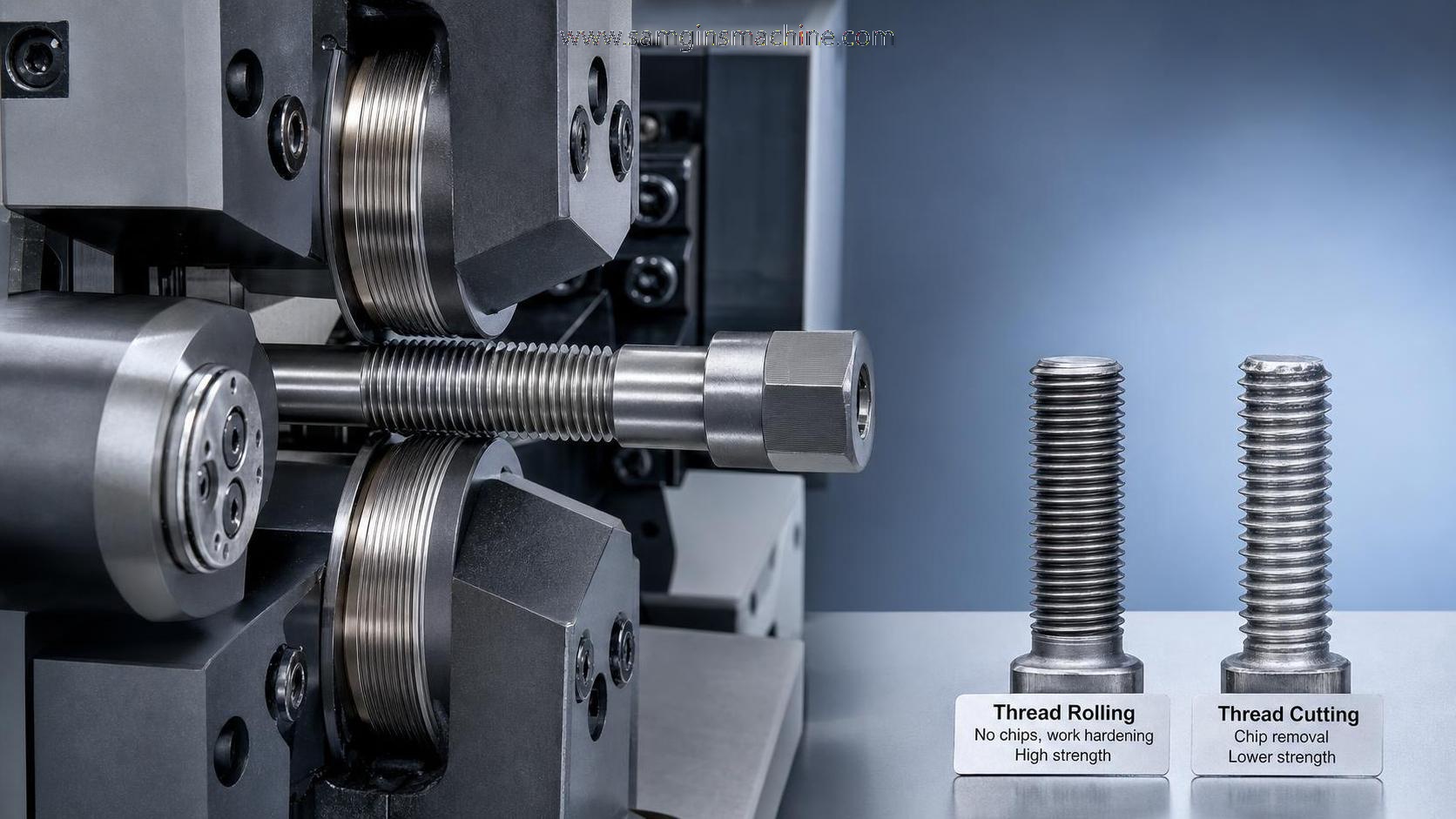
Unlike thread cutting, thread form rolling does not remove material to create a thread profile.
Instead, it displaces the material under pressure, shaping the thread by plastic deformation.
This difference may sound simple, but it affects strength, finish, tool life, and production speed.
In many shops, thread form rolling is preferred for high-volume work and demanding fastener performance.
Still, it is not automatically the best answer for every component, material, or geometry.
The practical question is not which method is newer or more advanced.
The real question is when thread form rolling creates measurable value over thread cutting.
How Thread Form Rolling Works
Thread form rolling uses hardened dies or rolling heads to press the workpiece surface into a thread shape.
As the dies move, metal flows into the thread form instead of being cut away as chips.
This creates continuous grain flow along the thread contour.
That continuous structure is one reason rolled threads often perform better under fatigue loading.
The process can be done on dedicated thread rolling machines or integrated production systems.
It is commonly used on bolts, studs, shafts, pipe-related parts, and automotive components.
By comparison, thread cutting removes material with taps, dies, lathes, or thread milling tools.
Cutting is flexible and familiar, but it interrupts grain flow and generates chips.
That also means more waste handling and, in some cases, more finishing work.
Main Advantages of Thread Form Rolling
The most discussed benefit of thread form rolling is stronger thread performance.
Because material is compressed and reshaped, the finished thread usually has improved fatigue resistance.
That matters in parts exposed to vibration, repeated loading, or impact service.
Another clear benefit is surface finish.
Rolled threads are often smoother than cut threads, which can reduce friction and crack initiation points.
Production efficiency is also a major reason buyers compare thread form rolling with cutting methods.
For large batches, rolling is usually faster and more repeatable.
Since no chips are produced, cleanup is easier and material loss is lower.
This can improve both shop housekeeping and downstream process stability.
- Higher thread strength in many applications
- Better surface finish and lower roughness
- Faster output in volume production
- Less scrap and no chip generation
- Long-term cost advantages in stable production runs
When Thread Form Rolling Is Better Than Thread Cutting
Thread form rolling is usually the better choice when strength and speed matter at the same time.
A good example is fastener production for transport, heavy machinery, or structural assemblies.
These parts often need durable threads and dependable consistency across large quantities.
It is also attractive when the base material has enough ductility for controlled deformation.
Low and medium carbon steels, some alloy steels, aluminum, and certain stainless steels are common candidates.
Another strong case appears when manufacturers want to reduce secondary handling and waste.
Chipless production simplifies the line and supports cleaner, more efficient throughput.
In actual factory planning, this can influence labor use, coolant maintenance, and machine uptime.
More broadly, process selection often follows the same logic used in plate preparation and edge finishing.
For example, equipment like Non-standard Edge Milling Machine Without Pressure Beam is valued because it improves precision, finish, and workflow efficiency before welding.
The same purchasing mindset often supports thread form rolling over thread cutting.
Buyers are not just comparing process names.
They are comparing part integrity, output rhythm, and total manufacturing efficiency.
When Thread Cutting Still Makes More Sense
Thread form rolling is not universal, and thread cutting remains essential in many situations.
If the material is too brittle, rolling may cause cracking or unstable thread quality.
Very hard materials can also be difficult or uneconomical to roll.
Short runs are another case where cutting can stay competitive.
If the production volume is low, setup cost may outweigh the speed benefit of thread form rolling.
Complex custom geometries may also favor cutting.
In repair work, prototype work, or unusual thread sizes, cutting often provides more flexibility.
Internal threads also need separate evaluation because rolling options differ from external thread processes.
So the better method depends on more than speed alone.
It depends on material behavior, tolerances, quantity, and part design.
Key Factors to Evaluate Before Choosing
A practical decision starts with material properties.
If the workpiece can deform without damage, thread form rolling becomes more attractive.
Then review the required mechanical performance.
If fatigue life, surface integrity, or vibration resistance is critical, rolled threads often provide an advantage.
Next, consider batch size and takt time.
High-volume production usually supports investment in thread form rolling equipment and tooling.
Dimensional requirements matter too.
Preform diameter must be correct because rolling displaces material and changes the final profile shape.
Lubrication, die condition, and machine rigidity also affect results.
These points are often underestimated during supplier comparison.
- Check material ductility and hardness range.
- Define the required thread strength and service life.
- Estimate annual production volume realistically.
- Review tooling cost, machine capability, and maintenance needs.
- Confirm whether thread form rolling fits current line layout and quality control.
A Quick Comparison Table
What Buyers and Engineers Should Watch Closely
In supplier discussions, the best signal is not a broad claim about better productivity.
Ask how thread form rolling performs on your material, diameter range, and output target.
Request data on thread accuracy, die life, lubrication needs, and expected maintenance intervals.
It is also worth checking how the equipment supports upstream and downstream operations.
Manufacturers with broad equipment experience often understand this integration better.
Wuxi Samgins International Trade Co.,Ltd supplies mechanical equipment for fabrication and machining workflows across global markets.
Its portfolio covers welding, cutting, milling, plate processing, CNC machine tools, and thread rolling machines.
That matters because thread production rarely stands alone inside a real plant.
It is usually part of a larger manufacturing route that depends on stable, coordinated equipment performance.
The same logic applies in plate bevel preparation.
For sectors like pressure vessels, boilers, shipbuilding, electric power, and heavy machinery, a solution such as the XBN or XBJ series can process carbon steel, stainless steel, and aluminum plates efficiently.
Those machines can handle plate thicknesses from 8 mm to 100 mm, with milling angles from 0 degrees to 90 degrees.
That kind of process control reflects the same industrial preference behind thread form rolling.
The goal is better finish, higher consistency, and less rework.
Final Takeaway
Thread form rolling is often better than thread cutting when the job calls for stronger threads, smoother finish, and faster repeat production.
It becomes especially valuable in high-volume manufacturing and fatigue-sensitive applications.
Thread cutting still has an important role in low-volume, brittle-material, and highly customized work.
So the best decision comes from matching the process to the part, not forcing the part to fit the process.
If thread form rolling is under consideration, compare real production data, not just basic specifications.
That approach usually leads to better equipment choices, better thread quality, and a more reliable return on investment.
search
Products Navigation
Send Us A Message