




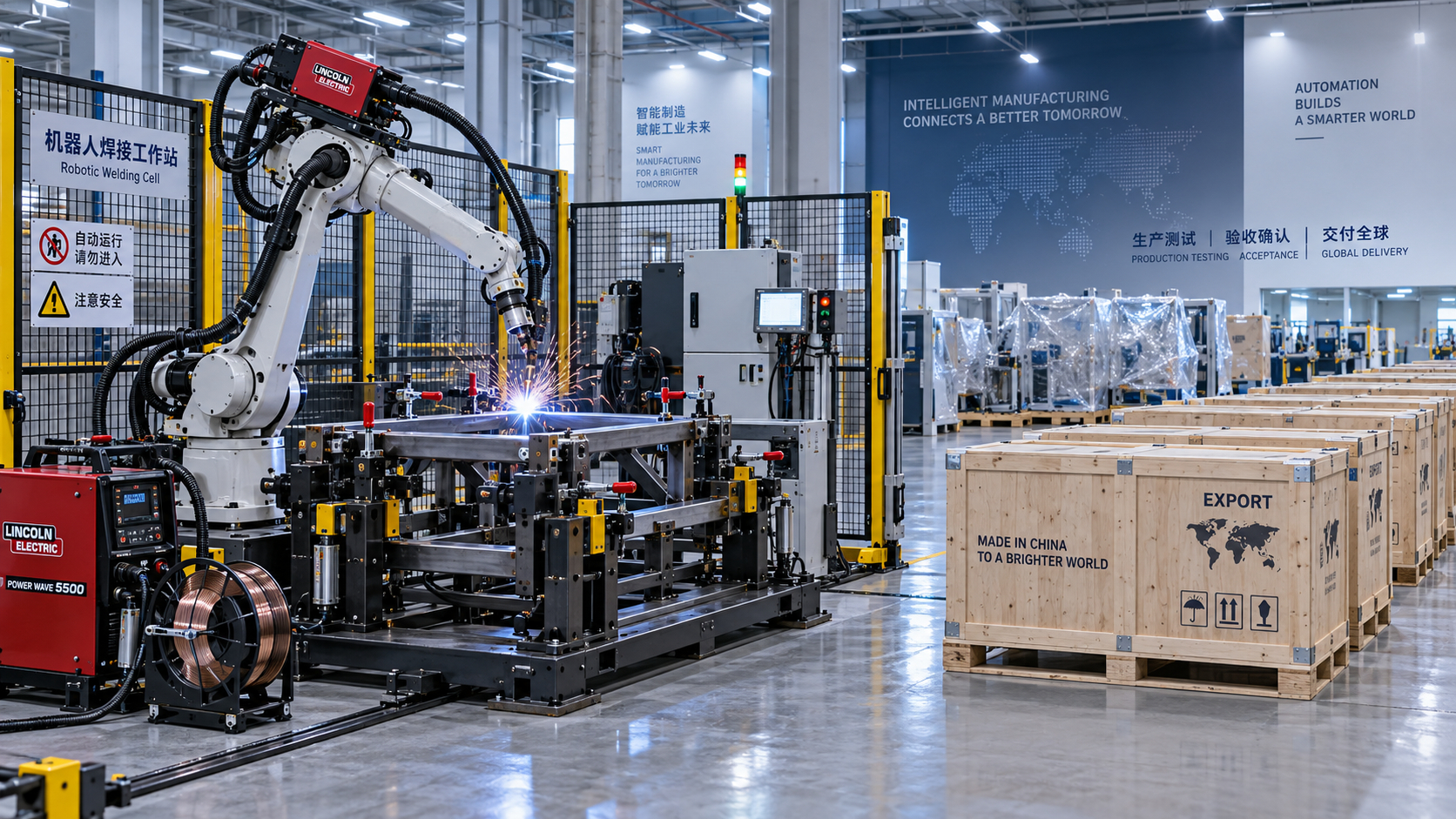
Delivery Time for Wuxi Samgins Welding Robots: What Buyers Should Expect
When planning an automated welding project, delivery time can be just as important as the Ltd welding robot price. Wuxi Samgins Welding Robots are supplied through an experienced manufacturing equipment provider in Wuxi, China, with lead times influenced by robot configuration, welding requirements, order quantity, and shipping destination. This guide explains the key factors affecting delivery schedules and how buyers can plan a smooth, efficient purchase.
The Short Answer: Delivery Depends on Configuration and Project Scope
For a standard Wuxi Samgins welding robot cell, buyers should generally allow several weeks for production preparation, testing, packing, and export shipping arrangements.
Ready or lightly configured equipment may move faster, while customized robotic welding systems usually require additional engineering, fixture design, integration, and acceptance testing time.
The most accurate delivery commitment is therefore not based on a catalog description alone. It should follow confirmation of the welding process, workpiece details, robot model, and destination.
Buyers comparing an Ltd welding robot price should evaluate lead time together with technical scope. A lower quoted price can become expensive if essential tooling, commissioning work, or shipping preparation is excluded.
For most industrial buyers, the practical question is not simply, “How fast can the robot ship?” It is, “When can our team begin stable production?”
That distinction matters because a robot may leave the factory before fixtures, welding consumables, power connections, safety equipment, or operator training are ready at the customer site.
Why Welding Robot Lead Times Are Not Always Fixed
Robotic welding equipment is often a production system rather than a single machine. Its lead time reflects both equipment availability and the engineering needed for a reliable application.
A basic six-axis robot package, controller, welding power source, wire feeder, torch, and safety enclosure can follow a relatively standard supply process.
However, a cell designed for a specific tank, frame, pipe, structural component, agricultural implement, or fabricated assembly requires more detailed preparation before production begins.
The supplier needs to understand material grade, thickness range, joint geometry, welding position, cycle-time expectation, and part-loading method before finalizing the system.
Incomplete technical information is one of the most common reasons delivery schedules change. It can lead to repeated drawing revisions, fixture adjustments, or changes in selected welding parameters.
Buyers can reduce this risk by providing drawings, sample parts, welding procedure requirements, production volumes, and site-layout information at the quotation stage.
A well-defined project usually moves faster because engineering decisions are made once, instead of being revisited after fabrication has already started.
Standard Robots Usually Have the Fastest Delivery Path
Standard welding robot packages are normally the fastest option because their major components, control systems, and common accessories follow established technical configurations.
These systems are suitable for buyers with straightforward MIG, MAG, TIG, or similar arc-welding applications where workpieces do not require highly specialized positioning.
A standard cell may include a robot arm, controller, welding source, wire feeder, torch package, cable set, safety fence, and basic operating controls.
Delivery timing still depends on component inventory. The robot brand, welding source model, torch specification, and electrical standard can affect procurement requirements.
For example, a customer requesting a commonly used configuration may receive a shorter schedule than a buyer requiring a less common voltage, cable length, or software option.
Standard equipment can be a sensible choice when the buyer has internal engineering capability and can prepare workholding, loading arrangements, and production integration independently.
It may also help companies begin automation with a lower initial Ltd welding robot price, especially when their first objective is proving the welding process.
Custom Fixtures and Positioners Usually Add the Most Time
Custom fixtures are frequently the biggest variable in a welding robot project schedule because they must locate parts accurately, withstand repeated use, and support safe robotic access.
A fixture design may need clamps, pneumatic components, locating pins, anti-spatter protection, grounding points, sensors, and quick-change features for different product models.
Even seemingly simple welded assemblies can require careful fixture planning when tolerances vary, heat distortion is significant, or multiple components must be assembled before welding.
Rotary positioners, headstock-tailstock systems, L-type positioners, turning rolls, and track-mounted robots can also extend delivery because they require mechanical and electrical integration.
These additions are often worthwhile. Proper part positioning improves weld access, reduces operator handling, supports consistent quality, and can reduce the robot cycle time substantially.
Buyers should avoid treating fixtures as minor accessories. In many applications, the fixture determines whether a robotic welding cell delivers repeatable production results.
When requesting a delivery estimate, ask whether fixture design, fabrication, assembly, trial fitting, and factory testing are included in the stated schedule.
How Order Quantity Affects Production Scheduling
A single robotic welding cell and a multi-station automation project are scheduled differently. Larger orders require more coordination across mechanical assembly, electrical wiring, programming, and quality inspection.
For multiple cells, customers should ask whether production will occur in parallel or sequentially. Parallel assembly can shorten the overall project timeline when capacity permits.
Multi-unit orders may also require standardization decisions before manufacturing begins. Using identical robots, welding sources, fixtures, and electrical specifications can simplify purchasing and commissioning.
Where each cell has different workpieces or process requirements, engineering lead time increases because every station needs separate fixture drawings, robot paths, and test procedures.
Buyers with phased expansion plans should discuss this early. A supplier may be able to design the first cell with future stations, shared utilities, or common controls in mind.
This approach can improve long-term return on investment, even when the first-order Ltd welding robot price is not the lowest initial quotation.
Clear production priorities also help. If one product line is urgent, the supplier can focus project resources on the first operational cell before completing later equipment.
Factory Acceptance Testing Can Protect Your Schedule
Factory acceptance testing, often called FAT, is an important delivery stage for customized welding automation. It confirms that the equipment operates according to agreed technical requirements before shipment.
During testing, the supplier may check robot movement, welding quality, safety interlocks, fixture operation, wire feeding, positioning accuracy, cycle time, and alarm functions.
For a custom project, FAT may involve sample workpieces supplied by the buyer. This gives both parties a practical reference for weld appearance and system performance.
Skipping or rushing acceptance testing may appear to save time, but it can transfer avoidable troubleshooting work to the customer site after installation.
It is usually more efficient to resolve programming, cable routing, clamp interference, and fixture-access issues before export packing, when technical staff and manufacturing resources are available.
Buyers should agree on acceptance criteria before production starts. Useful criteria can include weld dimensions, bead appearance, penetration requirements, cycle time, and repeatability expectations.
A realistic delivery plan includes time for this validation stage rather than treating it as an optional final task.
Shipping Time Depends on Your Country and Chosen Transport Method
Once factory testing is complete, international logistics becomes the next major timing factor. Shipping duration depends on destination, transport mode, customs procedures, and local delivery arrangements.
Sea freight is often the most economical method for complete robot cells, large safety fences, positioners, and heavy fixtures. It generally requires more transit time than air freight.
Air freight can reduce transit time for urgent components or compact equipment, but it may significantly increase total project cost because robotic systems include heavy mechanical parts.
Rail, road, and multimodal routes may be practical for certain regions. The right option depends on cargo dimensions, local infrastructure, customs conditions, and budget priorities.
Export packing also deserves attention. Welding robots, controllers, power sources, and precision accessories should be securely packed to reduce transport-related damage and moisture exposure.
Ask the supplier which Incoterms apply to the quotation. EXW, FOB, CIF, CFR, DAP, and DDP arrangements place different responsibilities on the buyer and supplier.
A complete landed-cost analysis should include freight, insurance, duty, taxes, customs clearance, inland transport, unloading equipment, and possible local installation support.
Questions to Ask Before You Accept a Delivery Estimate
A useful delivery estimate should identify where the schedule starts. Some suppliers count from deposit receipt, while others count from final technical confirmation or approved drawings.
Ask whether the quoted lead time covers only manufacturing or also includes robot programming, factory acceptance testing, export packing, and delivery to the named port.
Confirm the status of critical purchased components. Robot arms, controllers, welding power sources, reducers, positioners, safety devices, and PLC components may have different availability periods.
Request a milestone schedule for significant projects. It can show drawing approval, fixture fabrication, assembly, electrical integration, testing, packing, shipment, and expected arrival stages.
Buyers should also ask what customer actions are required before shipment. Delayed approval of drawings, samples, welding parameters, or payment documents can affect the planned completion date.
For international purchases, clarify whether export documentation is included. Commercial invoices, packing lists, bills of lading, certificates, and customs-related documents may be necessary for clearance.
These questions create a more meaningful comparison than a single delivery number, particularly when evaluating suppliers offering a similar Ltd welding robot price.
How Buyers Can Shorten the Overall Project Timeline
The best way to shorten delivery is to make technical decisions early. Send accurate part drawings, material information, expected output, welding requirements, and photos of current manual operations.
Where possible, provide representative samples for weld trials. Real parts allow the supplier to check access, distortion behavior, joint fit-up, and likely fixture requirements.
Standardize components when practical. Selecting common robot models, established welding sources, and proven torch packages can reduce sourcing uncertainty and simplify future maintenance.
Approve drawings promptly, but carefully. A fast approval is valuable only when the production, maintenance, and quality teams have confirmed that the design supports actual factory needs.
Prepare the installation site while equipment is being built. Electrical supply, compressed air, ventilation, welding fume extraction, floor space, foundations, and safety zoning should be ready in advance.
Plan operator and maintenance training before the machine arrives. This reduces the delay between installation and productive use, especially for companies new to robotic welding.
Assign one internal project owner who can coordinate technical communication, document approval, logistics, and site preparation with the supplier and internal departments.
Lead Time Should Be Evaluated Alongside Total Business Value
Fast delivery is valuable, but it should not be the only purchasing criterion. A robotic welding system must fit the product, production volume, quality standard, and workforce plan.
For many manufacturers, the business value comes from more stable weld quality, reduced dependence on skilled manual labor, improved throughput, and better production predictability.
The right equipment can also improve workplace safety by reducing direct exposure to welding fumes, heat, sparks, repetitive motions, and awkward workpiece handling.
However, automation is most successful when workpieces are reasonably consistent and upstream fabrication processes provide reliable cut quality, bending accuracy, and fit-up conditions.
A low initial Ltd welding robot price may not represent the best investment if the system lacks suitable fixtures, safety equipment, service support, or capacity for future product changes.
Conversely, an engineered solution with a longer lead time may produce a faster payback when it reduces rework, increases arc-on time, and allows stable multi-shift production.
Decision-makers should evaluate delivery time as part of a complete operational case rather than as an isolated procurement target.
Working With Wuxi Samgins on a Realistic Delivery Plan
Wuxi Samgins International Trade Co., Ltd supplies mechanical equipment and related industrial products, including automatic welding equipment, welding robots, CNC cutting machines, and fabrication machinery.
Located in Wuxi, Jiangsu Province, the company can support buyers sourcing equipment from a major Chinese manufacturing region with convenient links to Shanghai logistics channels.
For welding robot projects, the most productive first step is a technical discussion focused on the actual part and process rather than a generic equipment request.
Buyers should share drawings, photos, material specifications, daily output targets, weld types, available floor space, preferred power supply, and required destination port or delivery location.
Based on this information, the supplier can recommend an appropriate system scope and provide a delivery estimate that reflects real engineering and logistics conditions.
Equipment designed and organized according to ISO9001 quality-system practices and relevant EU CE requirements can also support buyers who need structured quality and compliance documentation.
Clear communication before ordering helps both sides establish realistic expectations for price, production scope, delivery milestones, testing, export packing, and after-sales coordination.
Conclusion: Plan for Production Readiness, Not Only Shipment Date
The delivery time for Wuxi Samgins welding robots depends mainly on whether the system is standard or customized, the complexity of fixtures and positioners, order size, testing, and shipping destination.
Buyers seeking the fastest route should choose proven configurations, provide complete technical information early, approve designs promptly, and prepare their factory before equipment dispatch.
For customized automation, allowing time for engineering and factory acceptance testing is usually a sensible investment because it reduces installation uncertainty and production-startup risk.
When reviewing an Ltd welding robot price, compare the full project scope, delivery milestones, technical support, logistics terms, and expected operating value rather than focusing only on the initial number.
A well-planned robotic welding purchase gives manufacturers a clearer path from quotation to installation, stable production, improved quality control, and measurable long-term automation benefits.