




How Is the Price of a Wuxi Samgins Welding Robot Determined?
What Determines the Quoted Price?
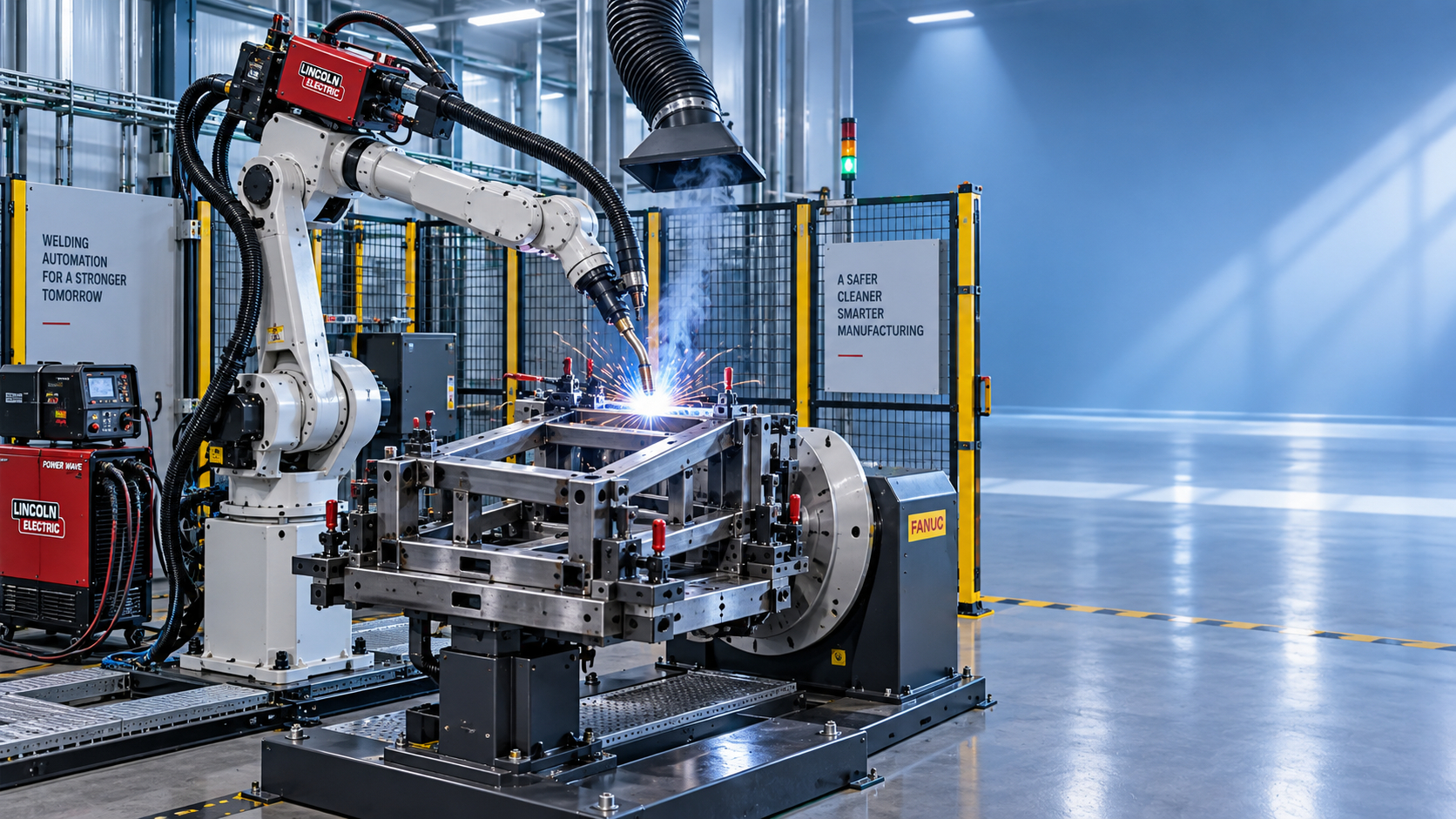
A Wuxi Samgins welding robot is not priced as a single, fixed commodity. The figure on a quotation usually represents a combination of robot hardware, welding equipment, cell design, safety measures, programming work, commissioning, and support. Two systems described simply as “welding robots” can therefore carry very different prices while both are technically suitable for arc welding.
For a buyer, the most useful question is not “What is the robot’s unit price?” but “What complete level of automation is included, and what production problem will it solve?” A low equipment price can become a costly purchase if the cell cannot handle part variation, requires extensive manual repositioning, or arrives without the fixtures and safeguards needed to run it on the shop floor.
The price is generally determined by four connected areas: the welding task, the robot and power-source configuration, the workcell scope, and the supplier’s delivery and support responsibilities. Understanding these areas makes it easier to compare quotations that initially appear similar.
The Welding Task Sets the Starting Point
The geometry and consistency of the workpiece have more influence on system cost than many first-time buyers expect. A robot welding a repeatable bracket on a simple fixture is a different project from one welding large fabricated frames, variable sheet-metal assemblies, pipes, or structural members with multiple seam types.
Before a supplier can configure a meaningful system, the buyer should define the workpiece family as clearly as possible. Useful information includes material type and thickness, joint design, component dimensions, weld position, required output, acceptable cycle time, and the degree of variation between parts. Without this information, a quotation may be based on assumptions that later require expensive changes.
Part size affects reach, payload, track requirements, positioners, and safety-cell dimensions. A compact six-axis robot may be adequate for small components held in a fixed jig. Larger assemblies may require a robot with a longer arm, a gantry arrangement, a linear track, or a rotating positioner that brings welds into an accessible position. Each addition improves the usable welding envelope but also adds mechanical, electrical, and installation cost.
Joint accessibility matters as much as size. If every weld is presented consistently and can be reached with a standard torch angle, programming and fixture design remain relatively straightforward. If the system must navigate tight corners, deep channels, complex assemblies, or changing gap conditions, the solution may need special torch components, more sophisticated path planning, seam tracking, or process development.
Production volume also changes the business case. A robot cell intended for intermittent work may be configured differently from a cell expected to support continuous production. Higher throughput targets can require faster part handling, dual-station fixtures, automated loading interfaces, improved fume extraction, or redundant tooling arrangements. The equipment price rises, but so can the portion of labor and handling time removed from each part.
Robot Capacity Is More Than Payload
Robot payload is often treated as the headline specification, yet it should not be considered in isolation. The relevant load includes the welding torch, cable package, wire-feeding components where applicable, sensors, mounting hardware, and any process accessories carried by the robot. The robot must also maintain adequate speed, reach, and path accuracy while carrying that load through the required welding positions.
A larger robot is not automatically a better purchase. Oversizing may increase capital cost, floor-space requirements, and operating complexity without improving weld quality. Undersizing creates a more serious problem: limited reach, restricted torch angles, lower useful speed, and little flexibility if the product mix changes. Buyers should ask suppliers to demonstrate the reach study against representative parts rather than accepting a payload figure as proof of suitability.
The controller and software package also influence the quotation. Basic teach-pendant programming may be sufficient when a shop runs stable parts in repeat batches. More demanding applications can require offline programming, coordinated external axes, data interfaces, adaptive welding functions, or vision and seam-tracking options. These tools can reduce setup effort or address variation, but they should be specified because of a clear production need, not added simply because they are available.
Welding Process Equipment Has a Direct Effect on Cost and Results
The robot arm creates motion; it does not determine welding quality by itself. The welding power source, wire feeder, torch package, process controls, and supporting gas arrangement form the other half of the system. Their suitability depends on the material, thickness range, joint type, deposition needs, and finished-weld requirements.
A straightforward MIG/MAG robotic setup for repeatable carbon-steel fabrication will have a different cost profile from a system configured for aluminum, stainless steel, thick multi-pass welds, or processes requiring especially controlled heat input. Pulse-capable power sources, specialized torches, cleaning stations, wire-cutters, and torch reaming units can add to the initial quote. In the right application, they may reduce spatter, improve arc stability, limit rework, and preserve cycle time. In the wrong application, they are unnecessary complexity.
Consumable management should be included in the price discussion. A quotation may cover the main robotic equipment while leaving out items such as spare contact tips, liners, nozzles, torch consumables, wire drums, and gas-control components. These are ordinary operating costs, but their availability and compatibility affect uptime. Buyers exporting equipment or installing it far from the supplier should pay particular attention to standardization and lead time for wear parts.
Fixtures, Positioners, and Handling Often Explain Price Differences
Many comparisons fail because one quotation includes only a robot package while another includes the means to present parts consistently. In welding automation, a robot can only repeat a good path when the component is repeatedly located in the same place. That is the function of the fixture.
A basic manual fixture may be enough for stable, low-complexity parts. More elaborate work may require pneumatic or hydraulic clamping, poka-yoke location features, quick-change tooling, or multiple fixture sets. These items can represent a significant part of the project price, particularly where components are large, flexible, or produced in several variants.
Positioners deserve similar scrutiny. Turning a part so that welds can be made in a favorable position often improves access, speed, and quality. But a positioner must be matched to the assembly’s size, center of gravity, clamping method, and required rotation. A quote that includes a positioner should state its load capacity, usable working envelope, control integration, and whether fixtures are included.
Loading and unloading assumptions should also be explicit. Some cells are designed for an operator to load a part, start a cycle, and unload the finished component. Others include conveyors, turntables, dual stations, or interfaces for adjacent automation. Buyers should not assume that “automatic welding” means automatic material handling. The labor content left outside the cell can materially affect the return on investment.
Safety and Compliance Are Part of the System, Not Optional Extras
A welding robot installation needs a defined safety concept. Fencing, interlocked doors, safety controllers, emergency stops, arc-flash protection where appropriate, and clear operator access arrangements are normally central elements of a production-ready cell. Fume extraction may also be needed depending on the process, material, workplace layout, and local requirements.
These items are sometimes treated as secondary because they do not appear to add welding capacity. In practice, they determine whether the equipment can be installed and operated responsibly. A lower quote may omit parts of the safety perimeter, extraction connection, electrical distribution, or site integration. That does not necessarily make the supplier’s offer unsuitable, but it means the buyer must budget and assign responsibility for those items elsewhere.
For equipment intended for international shipment, buyers should identify the standards and documentation required in the destination market before finalizing the order. ISO 9001-based quality management and CE-oriented equipment design may be relevant indicators in a supplier assessment, but neither should be treated as a substitute for confirming the exact compliance obligations of the planned installation.
Installation, Programming, and Acceptance Scope Change the Real Investment
The equipment arriving at a factory is only one stage of a welding automation project. Installation, electrical connection, robot teaching, weld parameter development, operator training, and production acceptance all require time and technical responsibility. The price can vary substantially depending on whether these services are performed at the supplier’s facility, remotely, or at the buyer’s plant.
A complete quotation should make the boundary clear. Buyers should establish who supplies site power, compressed air, shielding gas connections, extraction ducting, foundations if needed, lifting equipment, freight, customs handling, and local installation labor. They should also ask how many representative part programs are included and what happens if the supplied parts differ from the samples used during quotation.
Acceptance criteria deserve special attention. “Robot welding completed” is not a useful acceptance standard. A practical agreement identifies the sample part, weld locations, visual-quality expectations, dimensional requirements where relevant, cycle-time target, and the conditions under which the test is carried out. This protects both sides: the supplier has a defined technical target, and the buyer can evaluate the system against the intended process rather than an ambiguous promise.
How to Read Ltd Welding Robot Reviews
Searches for Ltd welding robot reviews often reflect a sensible concern: buyers want evidence that a supplier can deliver more than a catalog specification. Reviews can be useful, but they should be read for context rather than treated as a rating score.
The most informative comments tend to mention the type of application, scope of supply, installation experience, response to technical questions, availability of documentation, and support after commissioning. A positive statement with no details may indicate satisfaction, but it does not show whether the reviewed machine resembles the buyer’s proposed cell.
Likewise, a limited online review footprint does not prove that equipment or support is poor. Industrial welding systems are typically purchased through technical discussions, project-specific quotations, and direct references rather than high-volume retail-style review channels. A stronger due-diligence process combines public information with practical questions:
- Ask for a detailed equipment list rather than a single all-inclusive price.
- Request a reach layout or simulation for representative parts.
- Confirm which fixtures, positioners, safety devices, and auxiliary units are included.
- Review warranty coverage, remote-support arrangements, spare-parts availability, and response procedures.
- Clarify the commissioning and training scope in writing.
- Where appropriate, request references for applications that are technically comparable, not merely for any robot sale.
Comparing Quotes on a Like-for-Like Basis
When several offers are available, place them in a comparison table before focusing on the final number. The purpose is to expose differences in scope that can otherwise remain hidden.
The lowest quotation can be the right choice when the production task is simple and the buyer has the internal ability to complete tooling, installation, and programming. It is a weaker choice when the buyer expects a ready-to-run cell but the offer covers only core hardware. Conversely, a higher-priced package may be justified if it includes robust fixtures, proven process configuration, commissioning, and support that reduce the risk of delayed production.
The final price of a Wuxi Samgins welding robot should therefore be judged against the completed welding cell and the intended part family. A precise scope, representative workpieces, and measurable acceptance criteria provide a far better basis for investment than comparing robot-arm prices alone.
search
Products Navigation
Send Us A Message