




When Does a Custom Welding Robot Outperform a Standard Automation Cell?
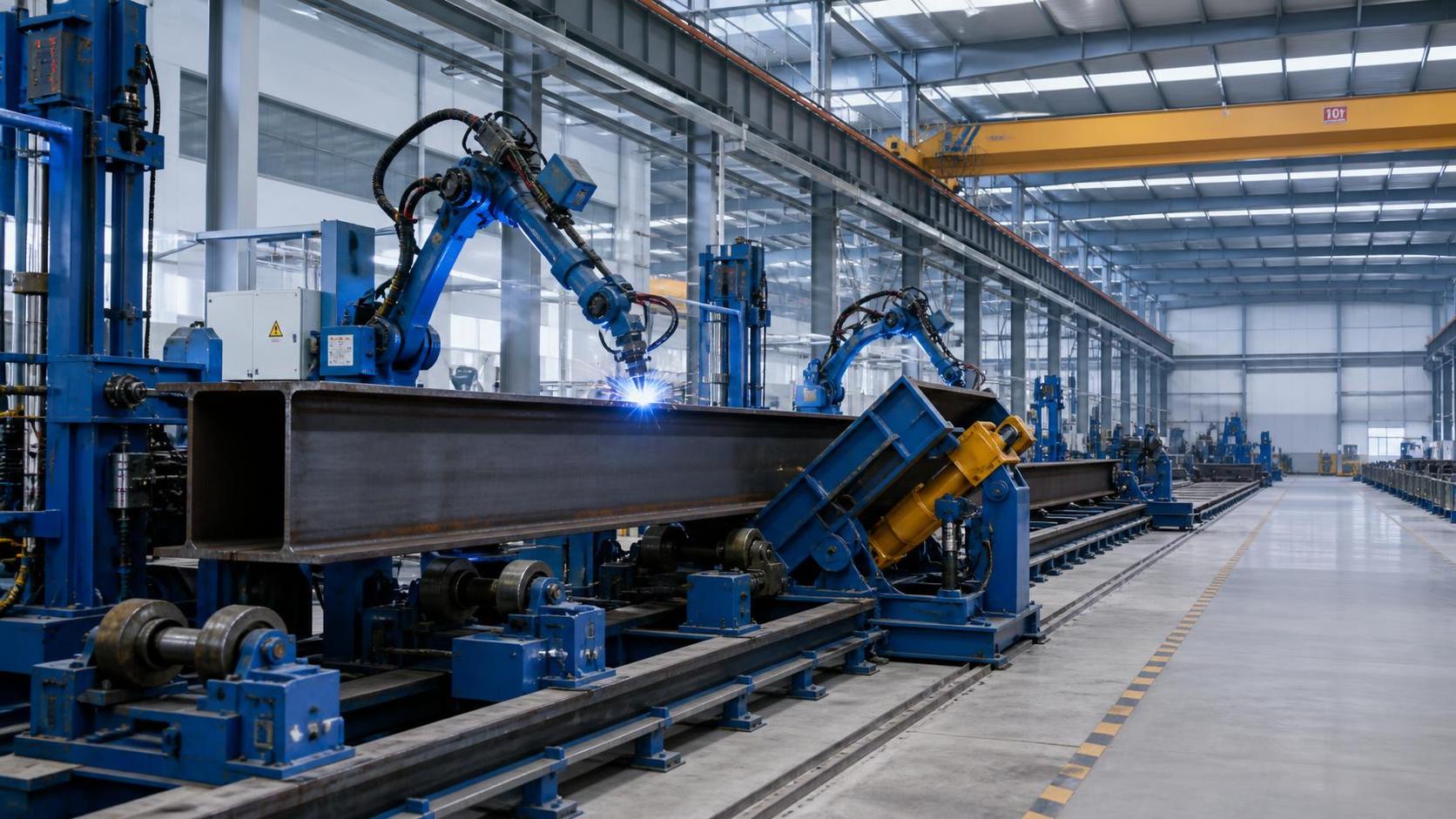
A fabrication line can look well suited to automation on paper and still become difficult the moment the first mixed batch arrives. A standard cell may weld the first set of parts smoothly, then lose time when an operator must reposition a fixture, adjust torch access, manage a new part length, or correct distortion after an awkward sequence. The problem is rarely that automation itself was a bad decision. More often, the original system was selected around an ideal part rather than the parts that actually occupy the workshop over a full production cycle.
This becomes especially visible in structural steel, heavy equipment frames, fabricated assemblies, and beam work. A team may be under pressure to increase output while also reducing crane movements, manual handling, fit-up corrections, and rework. If the chosen cell accepts only a narrow range of dimensions or joint locations, every exception becomes an interruption. In that situation, the question is not simply whether a robot can weld faster. The more useful question is whether a custom welding robot can control the real sources of delay better than a standard automation cell.
The point where a standard cell starts creating workarounds
Standard automation cells are not inherently limited. They are often a practical option for stable products with repeatable joints, predictable tolerances, and consistent part presentation. If the same brackets, plates, frames, or subassemblies are produced in large quantities, a standardized cell can be easier to specify, install, and operate. The welding path is known, fixtures can be dedicated, and material flow is straightforward.
Difficulty begins when the work does not stay within those boundaries. Common warning signs include frequent fixture changeovers, operators adding temporary supports, manual tack welding to compensate for variable fit-up, or repeated requests to “make the robot reach just one more location.” These are not minor inconveniences. They affect cycle planning, labor allocation, safety planning, and the ability to quote future work with confidence.
A standard cell can also become restrictive when part geometry changes from one contract to another. A robot may have enough reach for a nominal workpiece but not enough clearance once clamps, turning equipment, or safety guarding are included. Likewise, a conventional positioner may handle the nominal part weight but become unsuitable when a longer beam creates an unfavorable center of gravity.
When these constraints are addressed through manual workarounds, the process can slowly drift away from the original automation concept. The robot handles only the easiest welds, while the difficult joints remain dependent on manual handling and skilled welding. That may still be acceptable for low-volume work. It is less acceptable when the same interruptions repeatedly affect output and delivery planning.
Start with variation, not with robot reach
Many equipment evaluations begin with robot brand, payload, axis count, or welding power source. Those are important details, but they should not be the first decision point. The initial review should focus on variation: variation in workpiece dimensions, material thickness, joint type, incoming fit-up, production sequence, and downstream finishing requirements.
For example, a fabrication operation may process H-beams with changing heights, widths, lengths, web thicknesses, and flange thicknesses. The technical challenge is not only the weld itself. It is the controlled movement of a long, heavy workpiece through assembly, welding, turning, straightening, and secondary operations without creating unnecessary crane dependence.
A custom approach is more likely to be justified when variation affects the physical arrangement of the system. This includes situations where the beam must be conveyed, shifted sideways, turned through multiple angles, presented to a cantilever welding machine, and then transferred to later operations. In these cases, the robot or welding unit is only one element of the production logic. Material handling, locating, clamping, turning, sensing, and sequence control must work together.
Questions worth answering before requesting a proposal
Rather than asking suppliers to quote a robot cell immediately, define the production reality in usable terms:
- Which part families account for most production time, rather than merely the highest number of pieces?
- How often do workpiece dimensions change during a normal month?
- Which joints are inaccessible unless the part is turned or repositioned?
- Where do operators currently wait for overhead crane availability?
- Which fit-up conditions require manual correction before automatic welding can begin?
- Do welds need to be completed before straightening, drilling, face milling, blasting, or painting?
- Are future product drawings expected to introduce larger, heavier, or more complex members?
The answers reveal whether the automation problem is mainly a welding problem or a process-flow problem. A standard cell may be sufficient for the former. A tailored system is often more appropriate for the latter.
When customization has a clear operational purpose
A custom welding robot should not be selected simply because a workpiece is large or because the production team wants more flexibility. Customization adds engineering decisions, integration work, and commissioning responsibilities. It earns its place when specific design changes remove recurring constraints that would otherwise remain in the process.
One strong reason is variable geometry. If a line must accommodate a broad range of beam sizes, fixtures and handling devices need to adapt without lengthy manual rebuilding. Another reason is complex orientation management. Long structural members often need to be turned 45 degrees, 90 degrees, or 180 degrees to expose welding surfaces safely and consistently. If those movements are not integrated, operators may rely on cranes and improvised handling methods between stages.
Joint variability is another trigger. A standard setup can perform well on a simple continuous fillet weld in a fixed location. It becomes less effective when the program must manage changing seam positions, stiffeners, end plates, intermittent welds, or different access angles across a part family. In these conditions, custom fixtures, controlled part referencing, and coordinated movement can matter as much as robotic path programming.
Customization is also relevant when welding must connect cleanly with upstream and downstream operations. A line that includes strip processing, T-beam or H-beam assembly, welding, flange straightening, end-plate welding, sawing, face milling, drilling, shot blasting, and painting cannot be evaluated as a stand-alone welding island. Each handoff can create queues, damage risk, or loss of positional reference.
For heavy structural work, an integrated option such as the Heavy automatic h beam line illustrates the type of process scope that may need consideration. Its stated working range includes H-beam heights from 160 to 1500 mm, widths from 150 to 800 mm, lengths from 4000 to 15000 mm, web thicknesses from 6 to 50 mm, and flange thicknesses from 6 to 60 mm. More importantly for selection, it combines conveying, horizontal movement, beam turning, assembly, cantilever welding, straightening, and secondary processing functions into a connected workflow.
Do not confuse flexibility with unlimited capability
A common mistake is to assume that a custom system can process every possible future job. It cannot, and it should not be specified that way. An overly broad requirement often leads to unnecessary complexity, higher cost, longer setup time, or a machine layout that does not perform efficiently on the work it was meant to handle most often.
The more disciplined approach is to separate three categories of work. The first is the core family: the parts that should run automatically with minimal intervention. The second is the manageable exception family: parts that can run with a controlled adjustment, alternate fixture, or revised program. The third is the manual or specialist family: parts that are too unusual, too infrequent, or too difficult to justify designing into the main system.
This distinction protects the project from two opposite errors. One is buying a standard cell that only serves a narrow portion of actual work. The other is designing a highly customized line around rare exceptions that may not recur. The right solution is usually the one that automates the highest-value work reliably while providing a sensible path for exceptions.
Compare the two options through the entire work sequence
When reviewing quotations, comparing robot specifications alone can be misleading. A useful comparison follows the part from receiving or assembly through welding and downstream finishing. This is where hidden labor and handling requirements become visible.
The purpose of this comparison is not to declare one option universally superior. A standard cell can be the lower-risk choice when the product range is narrow and the workflow around it is already stable. A custom system becomes more compelling when the cost of repeated handling, setup, correction, and disconnected operations is larger than the cost of integrating those functions properly.
Validate the process before locking the layout
Before approving a custom welding robot concept, review representative drawings rather than a single ideal component. Include the parts that create the most handling difficulty, require the most repositioning, or generate the highest level of weld correction. It is also useful to map the actual sequence followed by operators, including temporary storage locations and crane movements. These activities often expose constraints that are absent from a simple process diagram.
Pay close attention to datum strategy. Automated welding depends on knowing where the workpiece is, not where it is assumed to be. If incoming parts vary, the system may require better locating surfaces, measuring routines, seam tracking, or fit-up controls. A robot program cannot fully compensate for inconsistent assembly conditions unless the sensing and process design support that level of variation.
Welding sequence deserves the same attention. On long beams and fabricated frames, sequence affects distortion, access, cycle time, and straightening needs. If the workpiece must be turned midway through the sequence, the turning method should preserve secure support and accurate repositioning. The proposed system should make it clear when a beam is clamped, released, moved, turned, and ready for the next operation.
It is also worth asking who will manage program changes. A flexible system is valuable only if routine changes can be controlled by trained personnel using documented procedures. If every minor adjustment requires external intervention, the expected flexibility may not appear in daily production.
Budget decisions should include the cost of interruptions
Initial equipment price is visible. Lost time caused by waiting for lifting equipment, repeated setup, manual turning, weld repair, and material queues is less visible, but it can shape the real return on an automation project. The review should therefore include the labor and operational impact around the weld station, not only arc-on time.
For heavy assemblies, reduced dependence on overhead cranes can be a meaningful design objective. It may improve flow and reduce the number of manual coordination points, provided the integrated conveying and turning equipment is suitable for the intended beam range. Similarly, automatic straightening and controlled transfer to secondary processing may reduce unnecessary handling, but only when the line arrangement reflects the actual order of work.
A custom solution is not automatically the lower-cost option over its life. It requires careful definition, reliable installation planning, maintenance access, spare-part planning, and operator training. However, where production variation is persistent and material movement is complex, a narrowly specified standard cell can become expensive through continual workarounds.
A practical decision rule
Choose a standard automation cell when most workpieces are similar, joints are consistently accessible, fixtures remain stable, and the surrounding workflow does not require frequent turning or special transfer equipment. It is often the sensible route for repeatable production where the goal is to automate a clearly bounded welding task.
Consider a custom welding robot when the operation must manage broad dimensional ranges, frequent orientation changes, difficult material flow, variable joint locations, or close coordination with assembly and finishing stages. The strongest justification is not “more automation.” It is the removal of recurring production constraints that are currently handled through manual intervention, crane dependence, or repeated setup changes.
The final selection should be based on the work that creates the most delay and uncertainty, not simply the easiest weld to automate. If the proposed system can handle that work with clear references, controlled movement, realistic changeovers, and a maintainable process sequence, customization may provide the more dependable route. If those issues are absent, a standard cell may deliver the better balance of simplicity and performance.
search
Products Navigation
Send Us A Message