




What CE Certification Means When Buying a Welding Robot for European Projects
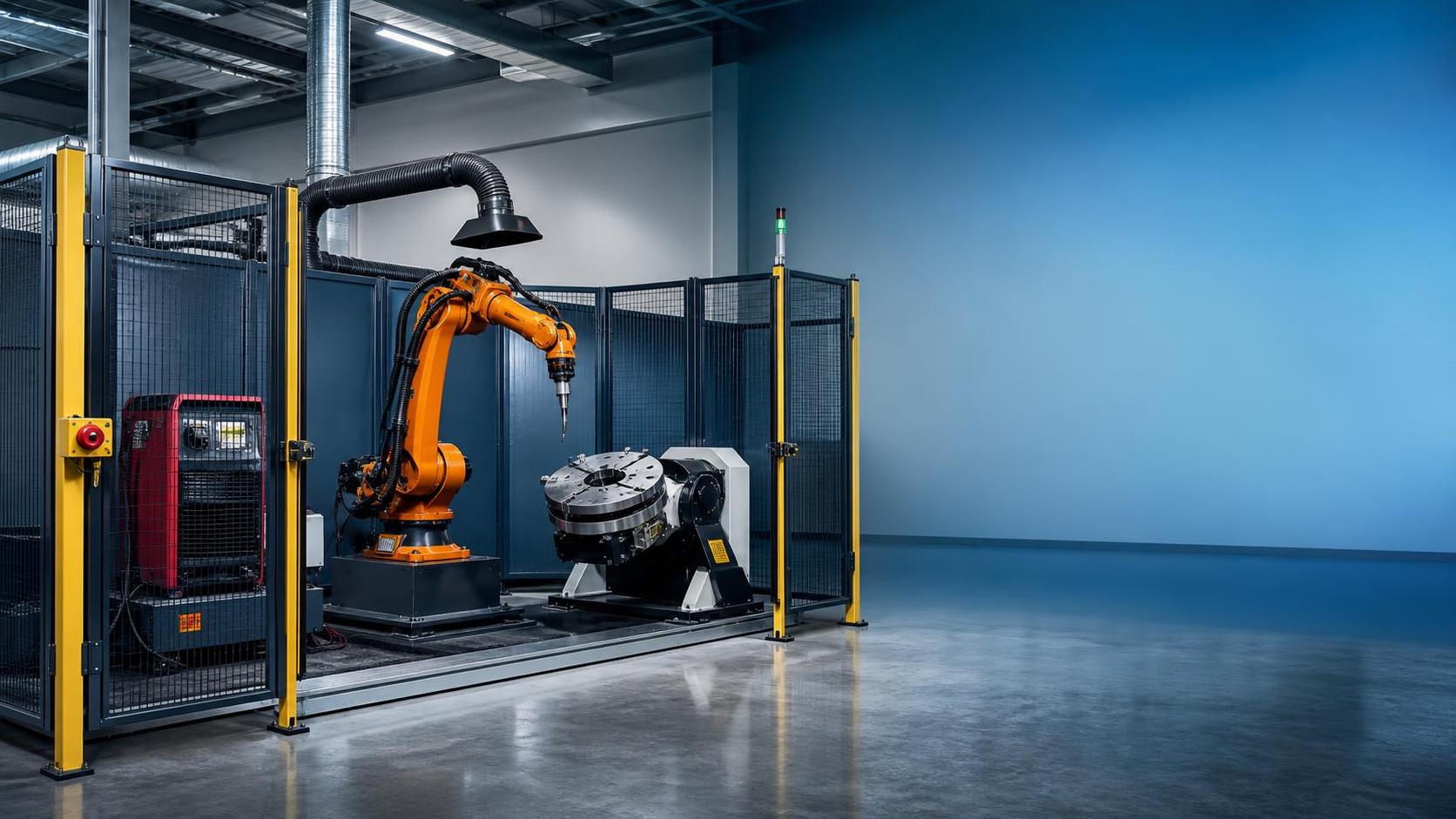
CE marking is often treated as a simple supplier-selection requirement: the robot has a CE label, a declaration is available, and the purchase can proceed. That approach creates avoidable exposure on European projects. A CE marked welding robot may be compliant as a standalone machine, but the final welding cell can still be non-compliant after a positioner, safety fence, torch-cleaning station, fume extraction interface, workpiece handling equipment, or site controls are added.
The practical question is not whether a supplier can show a CE certificate. In most cases, there is no official EU “CE certificate” for a standard industrial welding robot. The meaningful question is whether the economic operator responsible for placing the completed machinery on the EU market can demonstrate a valid conformity-assessment process, documented risk reduction, and traceable evidence for the configuration actually delivered and installed.
This distinction matters especially in robotic welding, where the robot arm is only one element in a system containing motion, electrical energy, welding current, compressed gases, heat, optical radiation, fumes, sharp workpieces, and sometimes collaborative operating modes. CE marking is therefore a system-control issue, not merely a document-control issue.
What CE marking actually represents
CE marking is the manufacturer’s legal declaration that a product complies with applicable EU legislation. It is not a quality award, proof of manufacturing consistency, a guarantee of performance, or an approval issued automatically by a European authority. A machine can carry a genuine CE mark and still be unsuitable for a particular plant if its intended use, safety functions, installation conditions, or integration boundaries have not been properly defined.
For machinery placed on the EU market before 20 January 2027, the principal legal framework remains the Machinery Directive 2006/42/EC. The EU Machinery Regulation (EU) 2023/1230 will apply from 20 January 2027, replacing the Directive. Projects with delivery dates, commissioning dates, or multi-year framework agreements spanning this transition should establish which legal regime governs each machine placement on the market rather than assuming one document will remain sufficient indefinitely.
A welding robot system may also fall within the scope of other legislation, depending on its design and supplied equipment. Common examples include the EMC Directive 2014/30/EU for electromagnetic compatibility and, where relevant, the Radio Equipment Directive 2014/53/EU for wireless communication functions. Electrical equipment used within machinery is often assessed through the machinery framework, which already includes electrical safety objectives for machinery; the applicable-directive analysis should be stated clearly in the EU Declaration of Conformity rather than guessed from the presence of a control cabinet.
The words “CE certified welding robot” are therefore useful as a sourcing shorthand, but they can obscure the central compliance fact: CE marking must correspond to the machine or assembly being supplied, its declared intended use, and the legal responsibilities of the party applying the mark.
The robot, the welding package, and the completed cell are not the same thing
Industrial automation projects often involve three different conformity positions.
A complete robot may be supplied as machinery with its own CE marking, EU Declaration of Conformity, instructions, and defined operating limits. The robot manufacturer is responsible for the conformity of that product as delivered.
Partly completed machinery may be delivered for incorporation into another machine or a larger assembly. In that case, it is not ready to perform a specific application independently. It should normally be accompanied by a Declaration of Incorporation and assembly instructions, not presented as a fully CE-marked final machine. The final assembler must complete the conformity process before the assembly is put into service.
A completed welding cell includes the robot, welding power source, wire feeder, torch, fixtures, positioners, guards, gates, safety controls, interlocks, control logic, and potentially loading or unloading equipment. Whoever combines these elements into an operational unit and makes it available under its name may become the manufacturer of the assembly in legal terms. That party must assess the risks created by the interfaces, prepare or retain the technical documentation, issue the correct declaration, and apply CE marking to the final cell.
This is where many procurement files become weak. They contain CE paperwork for a robot and a welder, but no documented analysis of the hazards created when the robot moves a part near a rotating positioner, when a guard door is opened during a welding cycle, or when a fault in a peripheral device prevents a safety stop from reaching the full system.
Documents worth checking before release
A supplier’s CE claim should be tested through a coherent document set. The documents do not need to disclose every proprietary engineering detail, but they should allow the buyer to determine what has been assessed, by whom, and for which equipment boundary.
- EU Declaration of Conformity: Confirm the legal name and address of the manufacturer or authorised representative, product identification, applicable legislation, relevant standards where used, signer identity, date, and signature. The model, serial-number scope, and product description should correspond to the delivered equipment.
- Declaration of Incorporation: If a component is partly completed machinery, this is not a defect by itself. It is a signal that final CE responsibility remains with the cell builder or integrator. The project file should identify that responsible party.
- Operating and installation instructions: These should cover transport, assembly, anchoring, electrical connection, safeguarding, permitted use, foreseeable misuse, maintenance, residual risks, and required competency. A generic brochure is not an instruction manual.
- Risk assessment and safety concept: Request the relevant summary or safety validation evidence. It should identify significant hazards and show how risks have been reduced through design measures, safeguarding, control measures, and information for use.
- Electrical and control documentation: Electrical schematics, pneumatic diagrams where applicable, safety circuit architecture, device lists, and software or parameter-management arrangements are necessary for acceptance and future modification control.
- Safety-function validation: A safety relay or safety PLC is not proof that a safety function performs as required. The project should document the required performance level or safety integrity target, the implemented architecture, verification, and validation testing.
- Component-level evidence: Guard interlocks, emergency-stop devices, light curtains, laser scanners, safety controllers, welding equipment, and protective devices should have suitable documentation. Component compliance does not replace final-cell conformity.
The technical file itself is generally retained by the manufacturer and need not be handed over in full. However, a buyer should not accept that limitation as a reason to receive only a CE logo and a one-page declaration. The supplier should provide enough evidence for commissioning, verification, maintenance, and incident investigation, while retaining the required technical documentation for the statutory period.
Standards are useful evidence, not substitutes for engineering judgment
Harmonised standards can provide a presumption of conformity with relevant legal requirements when applied correctly and within their scope. They do not eliminate the need for a machine-specific risk assessment. In welding automation, the standards commonly encountered include EN ISO 12100 for risk assessment and risk reduction, EN ISO 10218-1 and EN ISO 10218-2 for industrial robots and robot systems, EN 60204-1 for electrical equipment of machines, and EN ISO 13849-1 and EN ISO 13849-2 for safety-related control systems.
Other standards may be relevant for fixed guards, interlocking devices, safety distances, emergency stop functions, and welding equipment. The exact editions cited in the declaration should be checked against the applicable harmonised-standard references at the time the machine is placed on the market. A standard number in a quotation is not enough; the project team should understand which hazards it addresses and which hazards remain site-specific.
Collaborative welding deserves particular caution. A robot described as “collaborative” is not automatically safe to operate without perimeter safeguarding. Welding introduces hazards that normally remain unacceptable for unrestricted human-robot coexistence: arc radiation, hot surfaces, spatter, pinch points, sharp edges, welding fumes, moving workpieces, and unexpected motion caused by process faults. Any collaborative claim should be supported by a task-specific assessment, including tool geometry, end-effector forces, part presentation, speed limits, operating modes, and the effectiveness of protective measures.
Welding hazards often sit outside the robot supplier’s claimed boundary
Robotic welding projects are frequently delayed because the machine’s CE file is reviewed while process hazards are treated as a separate facilities matter. In reality, the boundary between machinery safety and workplace safety needs to be managed explicitly.
Fume extraction is a typical example. A robot cell may be fitted with extraction connections, but the supplier’s declaration may cover only the cell-side duct interface, not the plant’s extraction performance, discharge arrangements, filtration, fire risk, or compliance with local occupational-exposure requirements. The same issue arises with shielding-gas supply, cylinder storage, power distribution, earthing arrangements, and fire controls.
Arc-flash protection, welding curtains, enclosure viewing panels, noise, and hot-work controls also require site-level verification. If the cell processes galvanized, coated, oily, or contaminated material, the emissions profile and maintenance requirements may differ substantially from a standard mild-steel welding application. The declaration of conformity does not remove the employer’s duty to control workplace risks under national implementation of EU occupational-safety rules.
Workholding deserves equal attention. Fixtures and positioners are often selected late, even though they can create crushing, entanglement, ejection, and drop hazards that fundamentally change the cell risk assessment. A robot safety fence that is adequate for arm movement may be inadequate once a long workpiece sweeps through the same envelope on a rotating positioner.
The acceptance test should prove the delivered safety functions
Factory acceptance testing and site acceptance testing should include safety verification, not only weld quality and cycle-time demonstration. The project specification should state who witnesses the tests, which conditions are tested, how deviations are recorded, and what evidence is required before production release.
Tests should normally cover emergency stops, protective-stop functions, guard-door interlocks, prevention of unexpected restart, mode selection, reduced-speed teaching operation, safety scanner or light-curtain response where installed, reset logic, loss and restoration of power, welding-source fault response, and safe behaviour of peripherals such as positioners and clamps. It is important to test credible fault conditions, not merely normal sequence operation.
Safety distance measurements and stopping-time data matter when presence-sensing safeguards are used. A scanner may detect intrusion reliably, yet still be positioned too close if the robot, positioner, or moving workpiece cannot stop before a person reaches the hazard zone. Changes to payload, speed, tooling, or part dimensions can invalidate assumptions used during the original calculation.
The acceptance file should also include serial-number traceability, software version records, parameter backups, calibration or setting records where relevant, and a list of open actions. These controls are essential when a future incident, modification, or audit requires the organisation to establish what configuration was accepted.
Do not transfer CE evidence between different machines
Fabrication projects commonly purchase several machines from one supplier or from a linked supply chain: cutting tables, welding cells, handling systems, and finishing equipment. Documentation must remain equipment-specific. CE evidence for a plasma cutting machine does not validate a robotic welding cell, even if both machines use CNC controls, safety enclosures, and similar electrical components.
For example, a Table type cnc plasma cutting machine may include non-contact arc ignition, automated torch-height control, dust extraction, and optional underwater cutting. Those functions create their own safety and emissions considerations, including electrical isolation, fume capture, arc-light protection, material handling, and safe access for maintenance. Its declaration, instructions, and risk assessment must be assessed as a separate machine or as part of a documented integrated line where common control and material transfer create additional hazards.
The same principle applies when downstream cut parts are loaded into a welding robot. Sharp edges, residual heat, unstable nesting remnants, and changes in part geometry may not originate in the robot system, but they can affect safe loading, fixture integrity, and operator exposure within the welding process.
Common warning signs in a CE submission
Several recurring issues justify escalation before an order is released or equipment is commissioned:
- A “CE certificate” issued by an unfamiliar private organisation, with no corresponding EU Declaration of Conformity or clear legal basis.
- Declarations that name only the robot arm while the commercial offer describes a complete welding cell.
- One declaration covering multiple unrelated models with vague descriptions and no serial-number traceability.
- Instructions that do not identify intended use, residual risks, required safeguarding, or limitations on integration.
- Safety drawings that differ from the physical layout, including changed gate positions, removed guards, or added conveyors.
- Claims of collaborative operation without a task-specific risk assessment and verified protective measures.
- Uncontrolled site changes to robot programs, safety PLC logic, guards, positioners, or access points after acceptance.
A CE mark can be lawfully applied only after the relevant conformity assessment has been completed. Applying it early to support a shipment deadline, then promising to “complete the documents later,” reverses the correct compliance sequence.
Managing modifications after commissioning
Conformity is not frozen on the day a cell enters service. Changes to robot reach, tooling, fixtures, guarding, throughput, process parameters, safety logic, or operating mode can alter the risk profile. The legal effect of a modification depends on its nature and applicable national enforcement practice, but substantial changes may require a new risk assessment and can shift manufacturer-like responsibilities to the organisation making the change.
A disciplined change-control process should require a documented description of the modification, review of affected hazards, safety-function verification, drawing and software updates, operator retraining, and a decision on whether revised conformity documentation is necessary. This is especially important when productivity improvements are introduced after initial commissioning, since higher speeds, larger payloads, or shortened access times can undermine original safeguarding assumptions.
For European welding projects, CE marking should be treated as the evidence trail behind a safe engineering decision. The strongest purchasing outcome is not a supplier that simply says its robot is CE certified. It is a defined system boundary, a credible declaration from the responsible manufacturer, traceable technical evidence, validated safety functions, and controlled integration from factory acceptance through site operation.
search
Products Navigation
Send Us A Message