




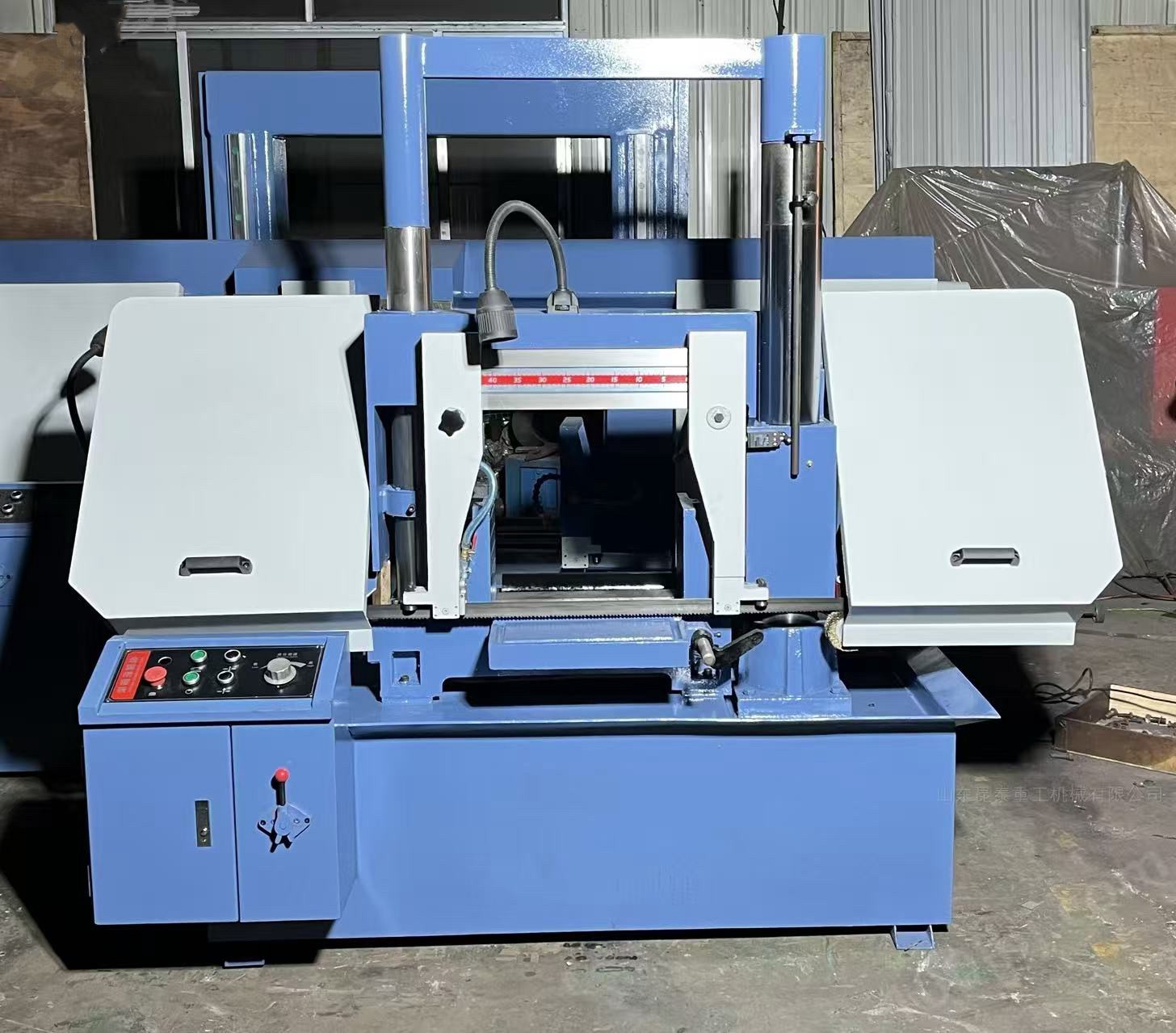
Band Saw Machine
Based on cutting tools and structural configuration, band saws can be divided into three main categories: circular saws, band saws, and bow saws.
CNC band saws are equipped with computer numerical control systems. They can automatically control parameters such as motion trajectory and feed speed according to preset programs, thereby achieving higher precision and automated production.
Full-range Machinery & Customized Non-standard Solutions
Authorized Certificates & Independent R&D Patents
Over 10 Years Global Export & Worldwide Project Cases
Navigation
Related products

Band Saw Machine Description
1.Introduction for Band Saw Machine:
1.1 Core Definition and Usage
Sawing machines belong to the field of mechanical engineering and are primarily used for cutting bars, tubes, and other profiles. They achieve the cutting process through the continuous or reciprocating movement of the saw blade or sawing disc, combined with a feed motion. As such, they are important cutting equipment in mechanical processing.
1.2 Main Classification
Based on the cutting tool and structural configuration, sawing machines can be classified into three main categories.
1.2.1 Circular Saw Machine
This type uses a rotating circular saw blade as the cutting tool. Depending on the feed direction, it can be divided into horizontal (horizontal feed), vertical (vertical feed), and oscillating (swing feed around a pivot point) types.
1.2.2 Band Saw Machine
This type employs a ring-shaped saw blade that is tensioned between two saw wheels and driven by them for cutting. It is mainly divided into vertical and horizontal types. Horizontal band saw machines are further classified into scissors type, double-column type, and single-column type. Based on the level of automation, they can be categorized as manual, automatic, and fully automatic (numerically controlled) types.
1.2.3 Bow Saw Machine
In this type, the saw bow carrying the saw blade moves back and forth to perform cutting. The movement trajectory of the saw blade can be either straight-line or arc-shaped. Modern bow saw machines predominantly adopt the more efficient arc movement mode.
1.3 Evolution of Automation
CNC sawing machines are equipped with computer numerical control systems. They can automatically control parameters such as motion trajectories and feed speeds according to preset programs, enabling higher precision and automated production.
2.Technical parameter for Band Saw Machine
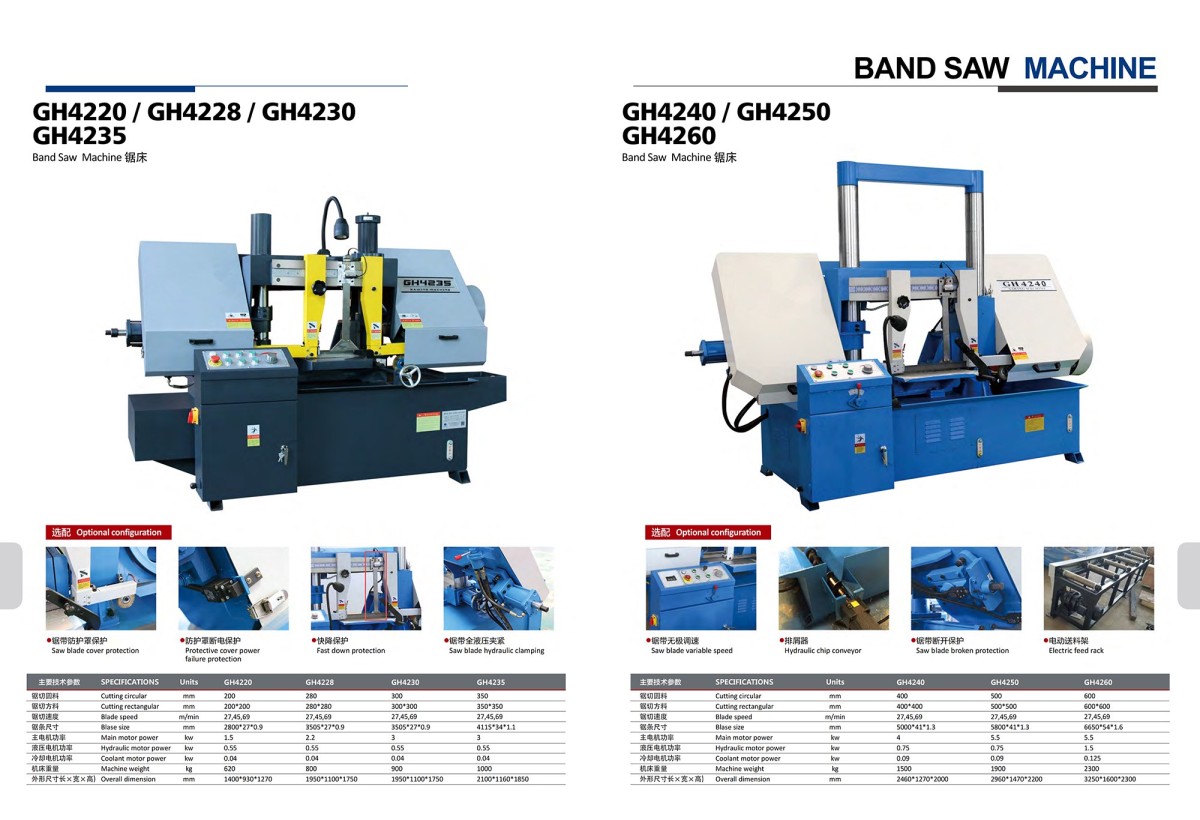
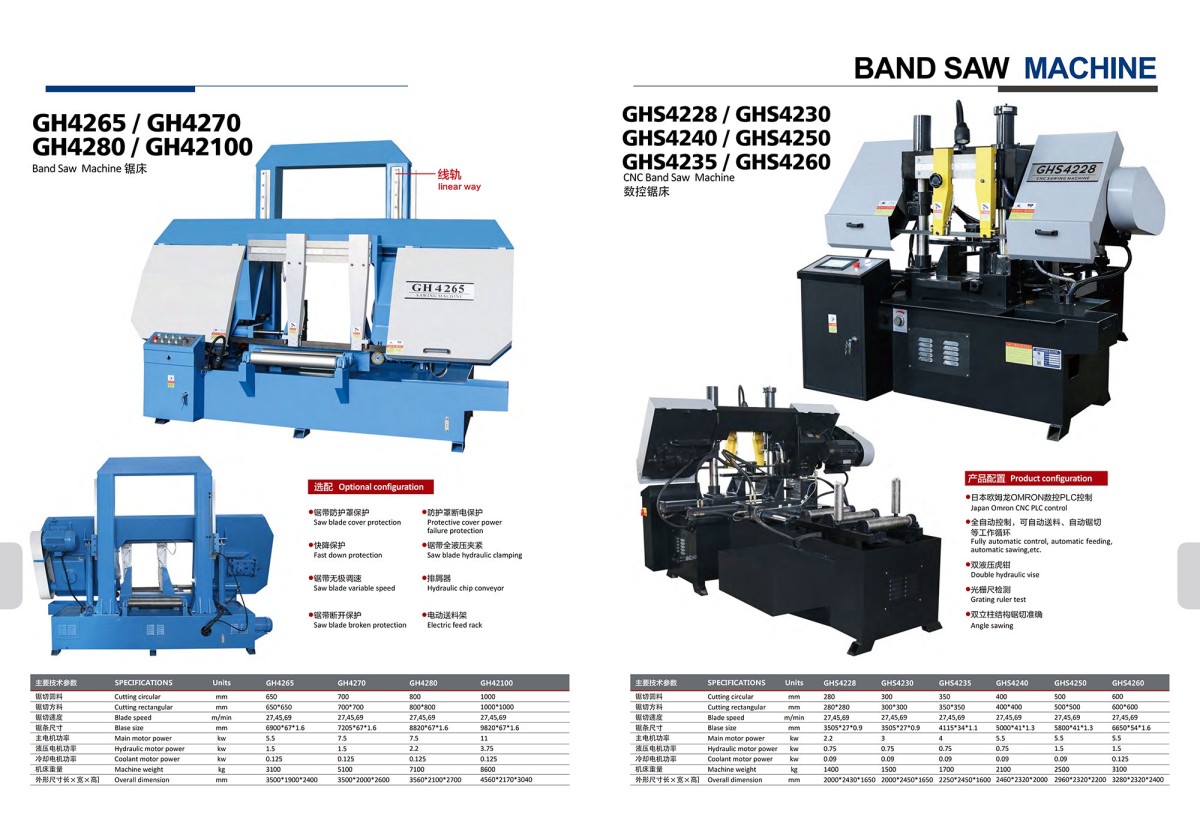
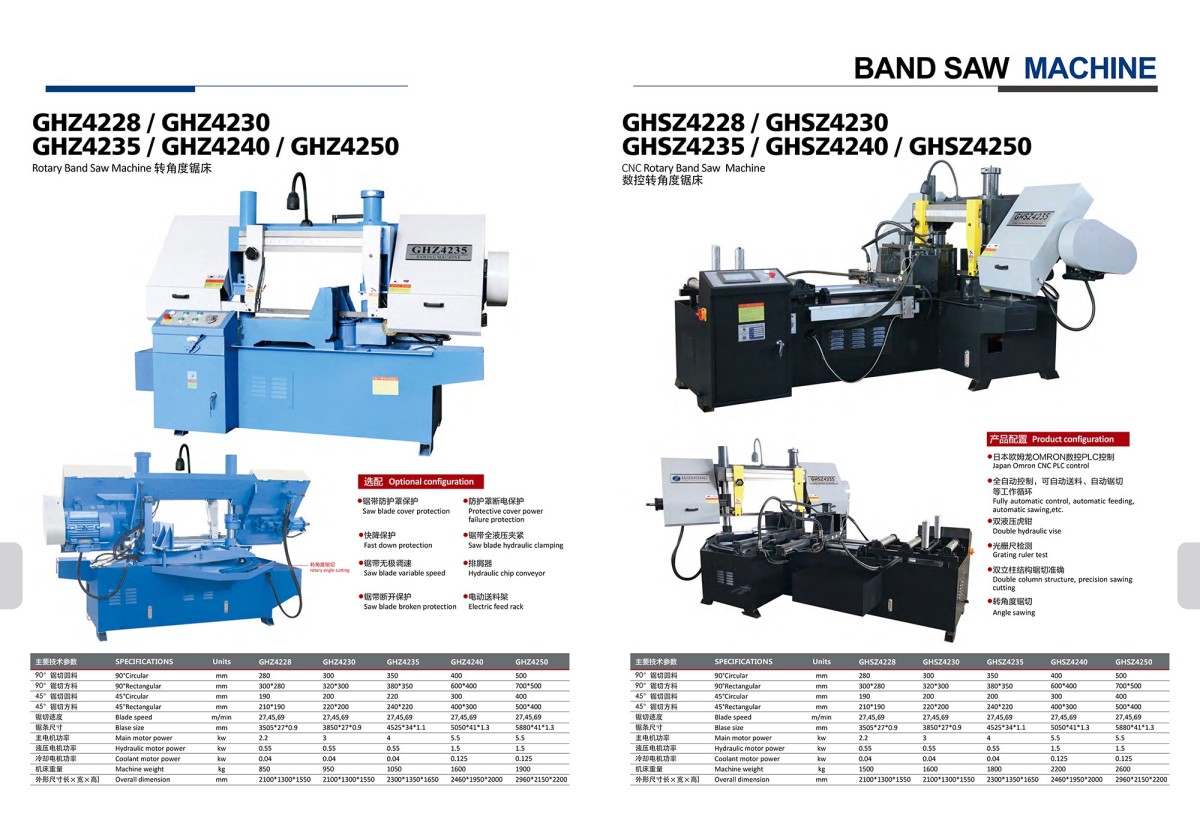
3.Characters for Band Saw Machine:
3.1 Working Principle: The working principles of different types of sawing machines vary.
3.1.1 Band Sawing Machine: The machine drives the ring-shaped saw blade to rotate continuously through the driving wheel and the driven wheel, and the rotational motion is combined with the feed motion of the machine to complete the sawing.
3.1.2 Circular Sawing Machine: The circular saw blade performs a cutting motion while also moving forward with the sawing tool box.
3.1.3 Bow Sawing Machine: The saw bow drives the saw blade to move back and forth for cutting.
3.2 Core Mechanical Structure: A typical sawing machine (such as a horizontal band saw machine) mainly consists of the following components.
3.2.1 Base and Bed Frame: The base is usually a box-shaped structure made of steel plates welded together, and the bed is a cast iron component used to fix and support other components.
3.2.2 Saw Frame and Transmission Mechanism: The saw frame is an arched box with strong rigidity, and saw wheels, tensioning mechanisms, etc. are installed inside or on the sides. The transmission system is usually driven by a motor and is driven by mechanisms such as belts and worm gears to move the saw wheels or saw blades.
3.2.3 Guidance and Clamping Devices: The guidance device ensures that the saw blade is perpendicular to the worktable, reducing vibration; the clamping mechanism (usually a hydraulic vise) is used to fix the workpiece.
3.2.4 Hydraulic and Electrical Systems: The hydraulic system realizes the lifting of the saw frame, the clamping of the workpiece, and the stepless speed adjustment; the electrical control system coordinates all actions to work in a programmed cycle.
products faq
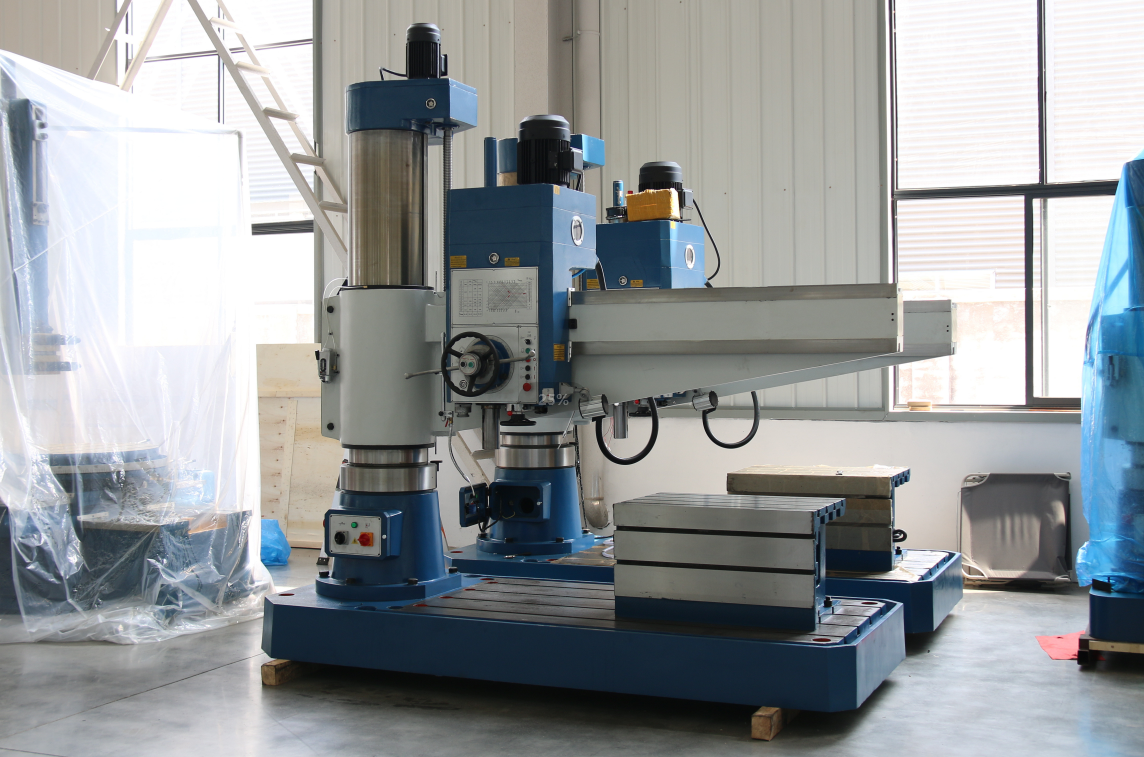
A Radial Drilling Machine features an adjustable arm that can rotate and move vertically around a fixed column, with the drill head sliding horizontally along the arm. This allows the spindle to be positioned over any point on a large or heavy workpiece without moving the workpiece itself. This is particularly valuable for oversized components such as structural beams, flanges, and machinery frames, where repositioning would be difficult and time-consuming.
Band saws are available in various capacities—from small models cutting 200mm round bars to large units handling up to 800mm diameters or 600×600mm rectangular sections. They can process a wide range of materials including carbon steel, stainless steel, aluminum alloys, brass, copper, and plastics. With appropriate blade selection and cutting parameters, clean, precise cuts are achievable across different material types and sizes.
Yes. With appropriate tooling, the Radial Drilling Machine supports multiple operations including reaming, tapping, counterboring, and spot facing. Variable spindle speeds and feed rates allow operators to optimize parameters for each specific operation and material, making it a versatile machine for hole-making and finishing tasks.
A horizontal band saw is primarily used for cut-off operations—cutting bars, pipes, and structural sections to length. The blade moves horizontally, and the workpiece remains stationary while the blade descends. A vertical band saw features a blade that moves vertically, and the workpiece is manually guided on a table—ideal for contour cutting, irregular shapes, and fabrication work. Horizontal models are better for straight, repetitive cuts, while vertical models offer flexibility for custom shapes and one-off parts.