




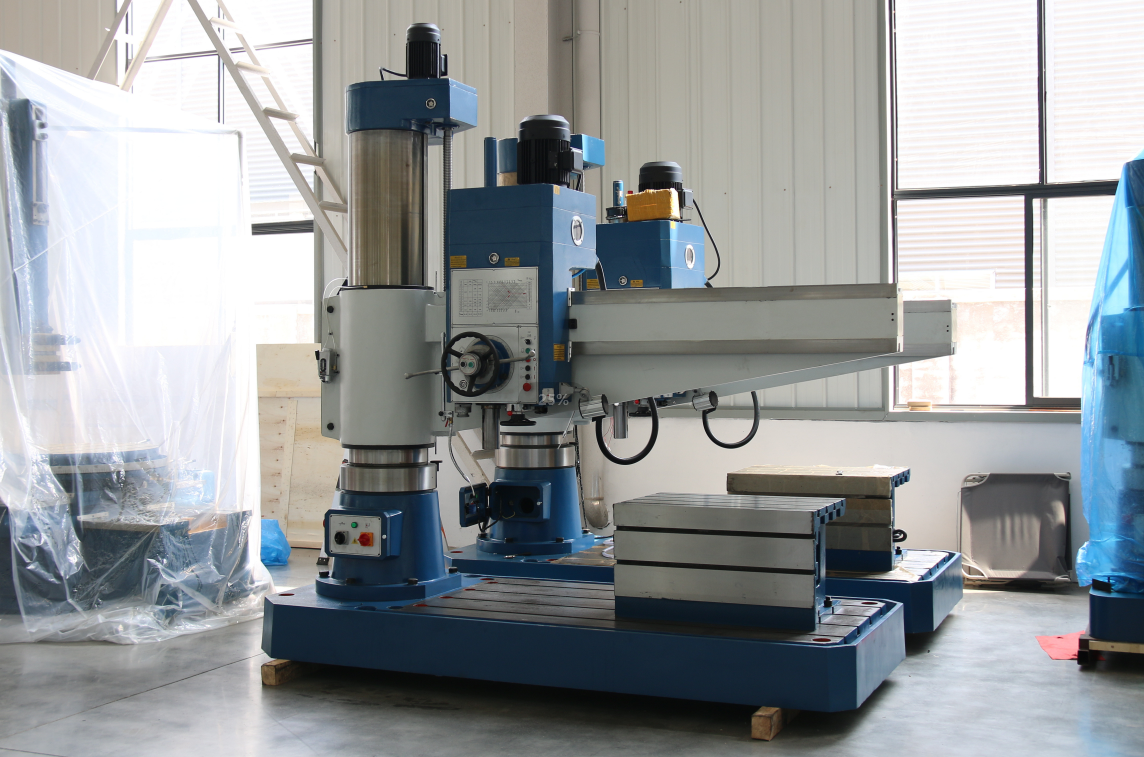
Radial drilling machine
Full-range Machinery & Customized Non-standard Solutions
Authorized Certificates & Independent R&D Patents
Over 10 Years Global Export & Worldwide Project Cases
Navigation
Related products

Radial drilling machine Description
1.Introduction for Radial drilling machine:
1.1 The swivel drill is designed for drilling, reaming, planing, and tapping threads on medium and large-sized metal parts. Its main functional movements are controlled via handles and buttons located on the spindle box.
1.2 The outer column drives the swivel arm to rotate ±180° around the inner column.
1.3 The swivel arm moves up and down along the outer column.
1.4 The spindle box moves left and right along the guide rail of the swivel arm.
1.5 Spindle Box: The spindle box is responsible for spindle rotation, feed, and operation. The spindle speed range is 25–2000 r/min, with 16 available levels, selectable by rotating the centralized operation handle (equipped with a speed pre-selection button). The spindle feed range is 0.04–3.2 mm/r, also with 16 levels, controlled by rotating the same handle (with feed pre-selection button).
1.6 Swivel Arm Lifting and Clamping: The lifting of the swivel arm is powered by a motor located at the top of the column, driven by a screw-nut mechanism. A safety nut is integrated into the lifting nut to prevent sudden dropping. Clamping of the swivel arm is hydraulically driven via a rhombic block, which self-locks after clamping. Once the lifting or lowering action is completed, the arm automatically clamps, controlled by an electrical switch mounted on the oil cylinder.
1.7 Spindle Box and Column Clamping: Clamping of both the spindle box and the column is hydraulically driven using rhombic blocks. These two actions can be performed either simultaneously or independently. The selection is made via a knob on the spindle box panel (spindle box-column clamping state selection knob): the middle position is for clamping, the left position releases the column only, and the right position releases the spindle box only. The release and clamping operations are executed using the corresponding buttons on the spindle box panel.
2.Technical parameter for Radial drilling machine
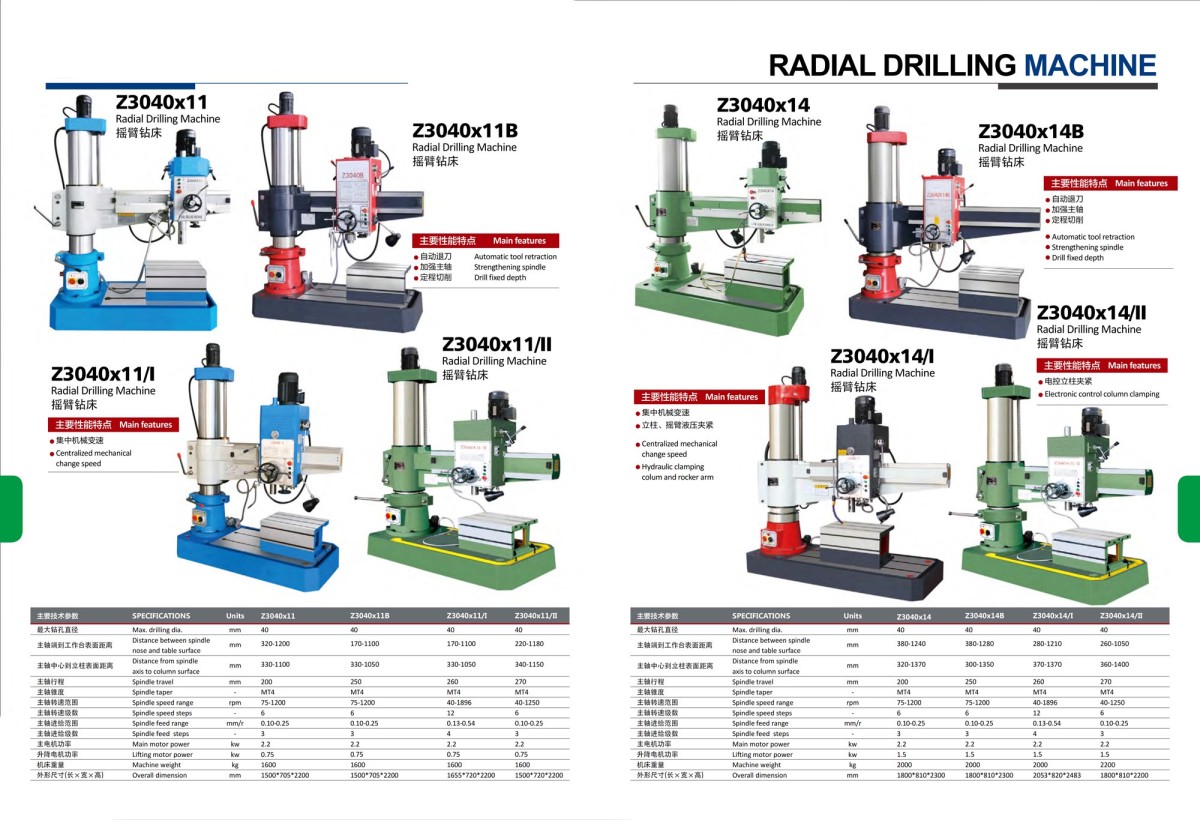
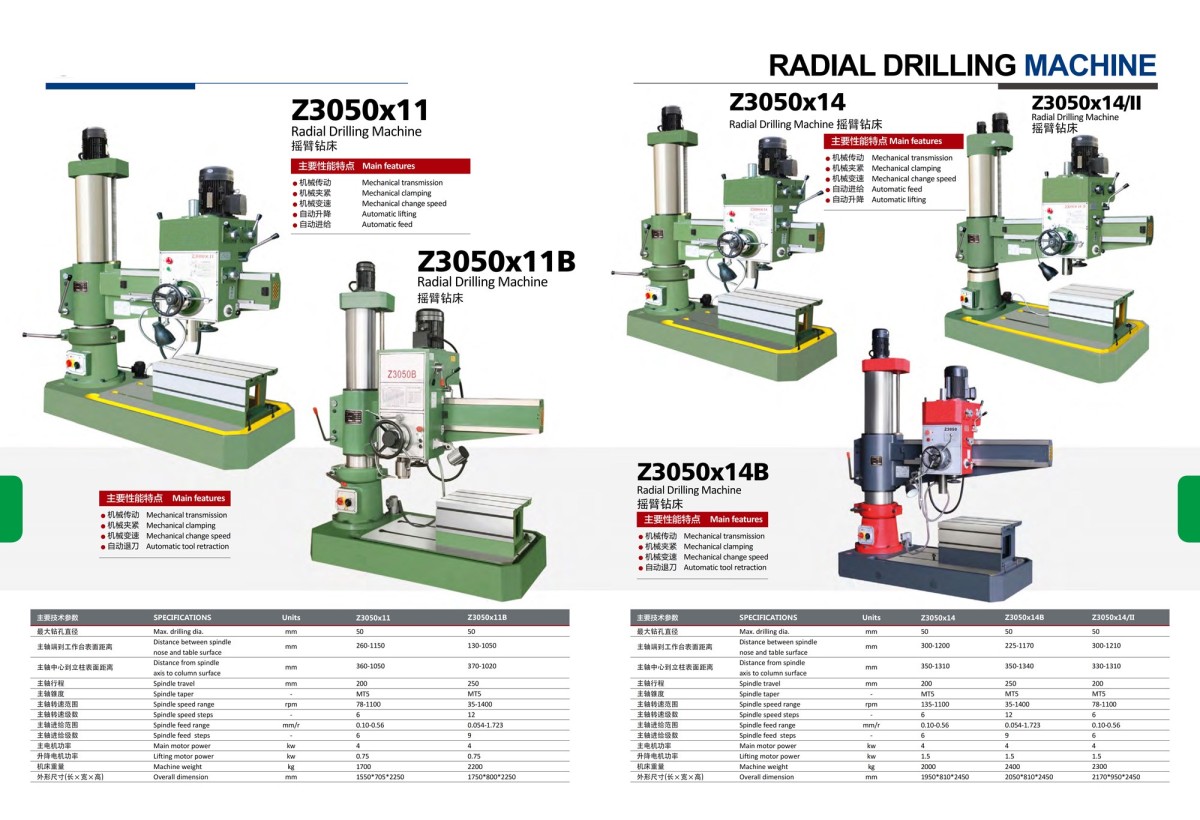
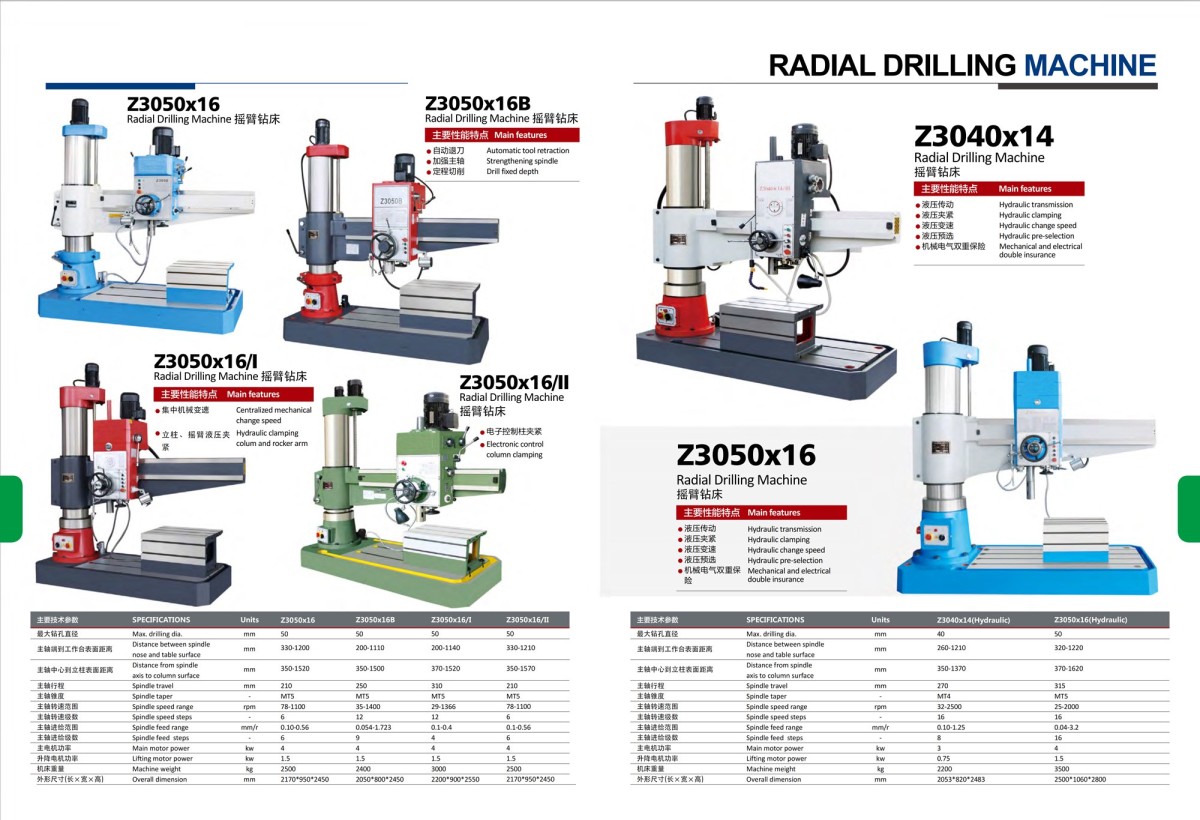
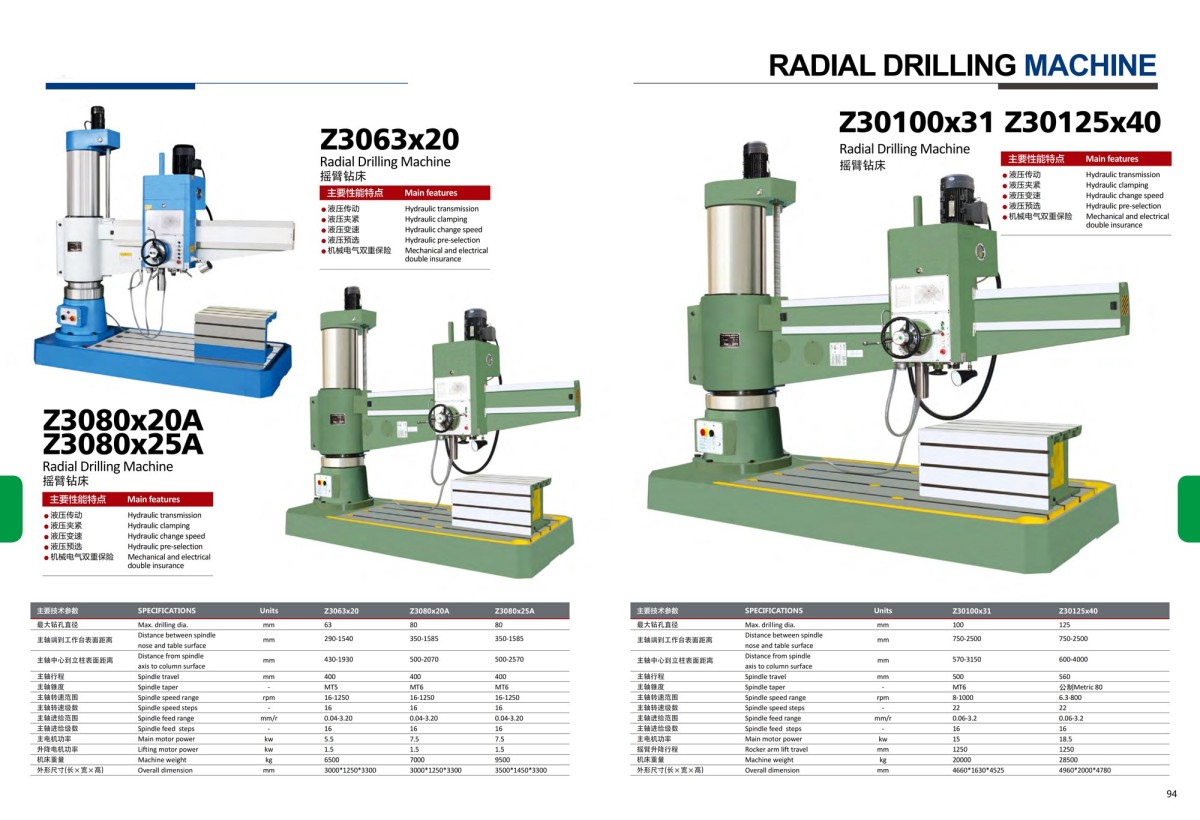
3.Characters for Radial drilling machine:
3.1 Flexible Structure with Wide Processing Range
The swivel arm can rotate 360° around the column and move up and down along the outer column. The spindle box moves horizontally along the swivel arm, allowing the drill bit to align with any hole position on the workpiece with ease.
3.2 High Versatility
This machine is ideal for processing medium and large-sized parts in single-piece or small-batch production. It can perform multiple operations including drilling, reaming, tapping, planing, thread tapping, and boring.
3.3 Advanced Clamping Method
Hydraulic clamping is the mainstream configuration, utilizing a hydraulic-driven rhombic block clamping mechanism to securely lock the spindle box, swivel arm, and column. The hydraulic system supports pre-selected speed changes. A single handle controls spindle reversal, speed change, braking, and neutral gear, significantly improving operational efficiency.
3.4 Safety and Precision Assurance
Key components—such as the swivel arm guide rail, spindle sleeve, and column surface—undergo heat treatment to enhance wear resistance and maintain long-term accuracy. The machine is equipped with mechanical-electrical dual safety protection, emergency stop buttons, limit switches, automatic lubrication, and cooling systems to ensure safe and reliable operation.
3.5 Multi-Motor Drive for Simplified Transmission
A typical configuration includes separate motors for the spindle, boom lifting, hydraulic pump, and cooling pump. Each motor is independently controlled, facilitating easy maintenance and operation.
3.6 Wide Model Range and Comprehensive Parameters
Common models include Z3032, Z3040, Z3050, Z3063, Z3080, etc., where the numbers indicate the maximum drilling diameter (in mm). The spindle speed range is generally 20–2000 r/min, the feed rate is 0.04–3.2 mm/r, and the spindle stroke can reach 120–500 mm, covering a broad spectrum of processing requirements.
products faq
A Radial Drilling Machine features an adjustable arm that can rotate and move vertically around a fixed column, with the drill head sliding horizontally along the arm. This allows the spindle to be positioned over any point on a large or heavy workpiece without moving the workpiece itself. This is particularly valuable for oversized components such as structural beams, flanges, and machinery frames, where repositioning would be difficult and time-consuming.
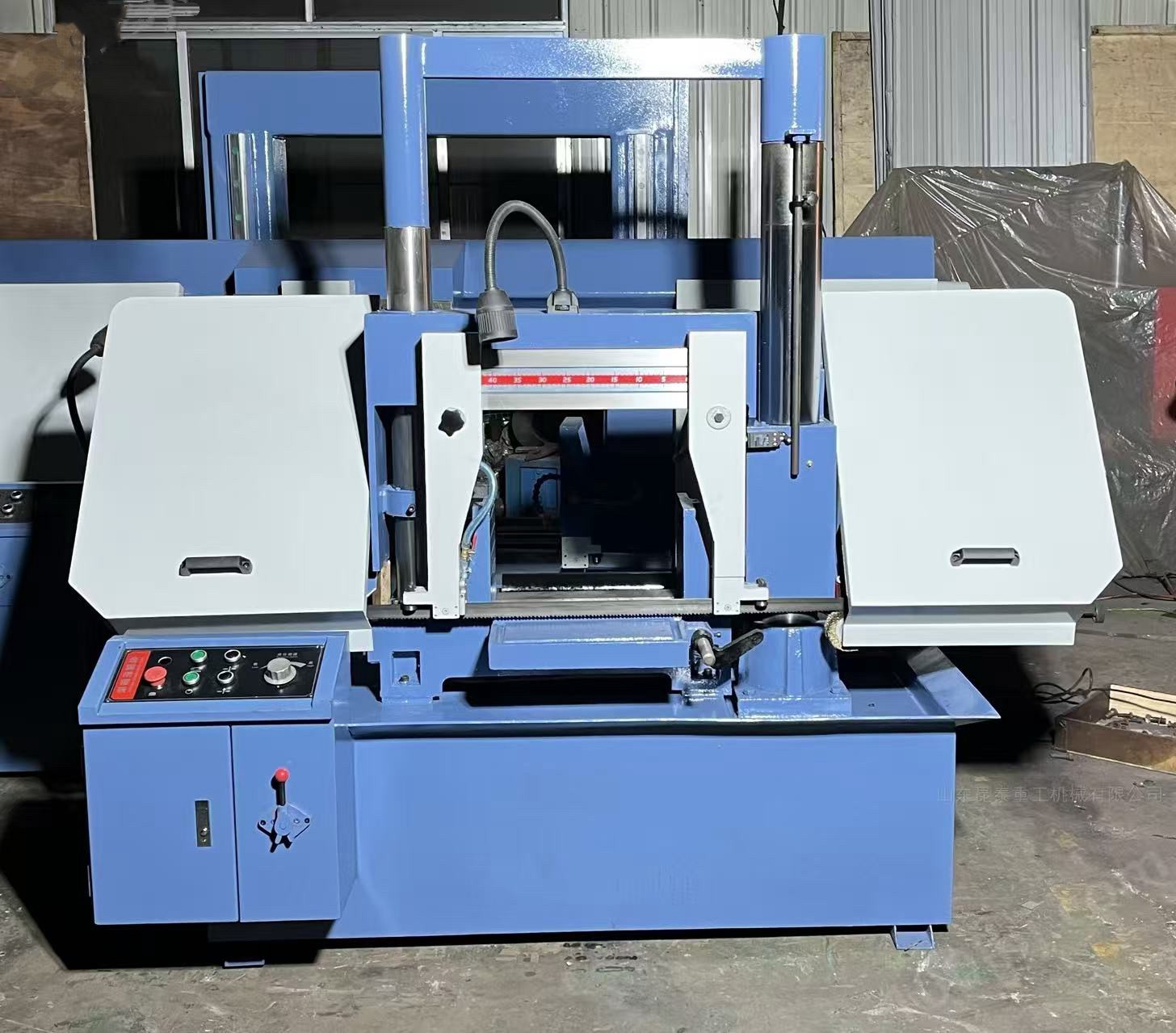
Band saws are available in various capacities—from small models cutting 200mm round bars to large units handling up to 800mm diameters or 600×600mm rectangular sections. They can process a wide range of materials including carbon steel, stainless steel, aluminum alloys, brass, copper, and plastics. With appropriate blade selection and cutting parameters, clean, precise cuts are achievable across different material types and sizes.
Yes. With appropriate tooling, the Radial Drilling Machine supports multiple operations including reaming, tapping, counterboring, and spot facing. Variable spindle speeds and feed rates allow operators to optimize parameters for each specific operation and material, making it a versatile machine for hole-making and finishing tasks.
A horizontal band saw is primarily used for cut-off operations—cutting bars, pipes, and structural sections to length. The blade moves horizontally, and the workpiece remains stationary while the blade descends. A vertical band saw features a blade that moves vertically, and the workpiece is manually guided on a table—ideal for contour cutting, irregular shapes, and fabrication work. Horizontal models are better for straight, repetitive cuts, while vertical models offer flexibility for custom shapes and one-off parts.