


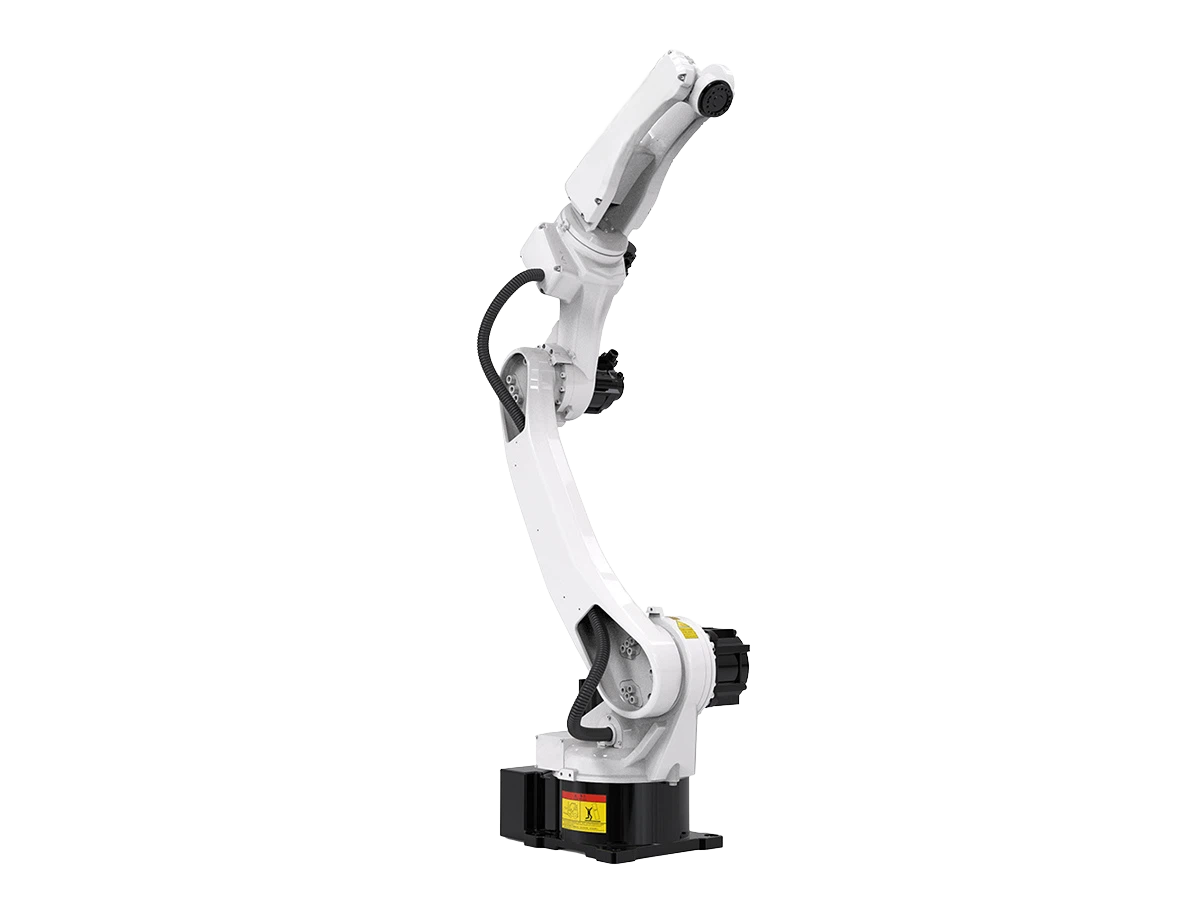
Multipurpose Handing Robot BR20iB-18
Multipurpose Handing Robot BR20iB-18
Full-range Machinery & Customized Non-standard Solutions
Authorized Certificates & Independent R&D Patents
Over 10 Years Global Export & Worldwide Project Cases
Product Description
Scope of work and installation diagram
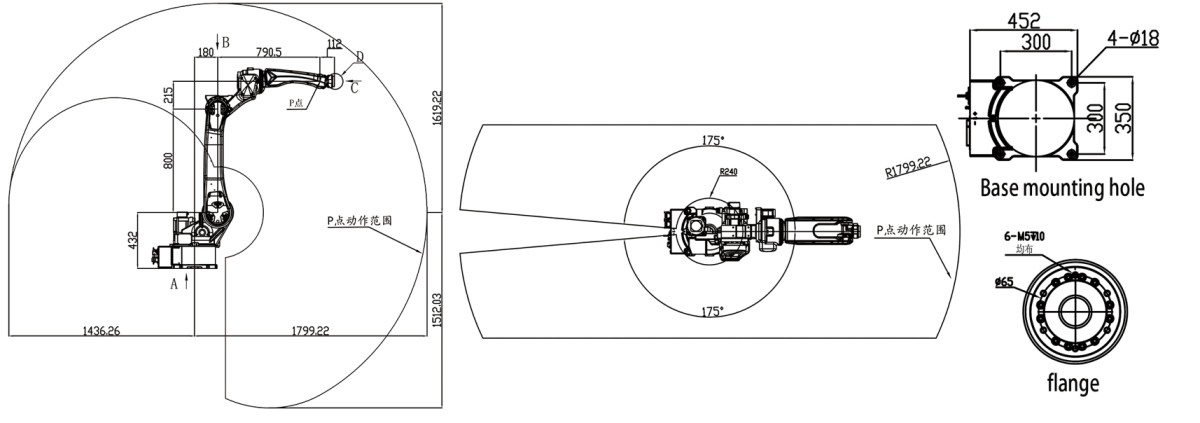
Detailed Product Description
Built for manufacturers that require dependable motion control across different production tasks, the Multipurpose Robot BR20iB-18 offers a practical balance of accuracy, flexibility, and process adaptability. It is designed to support handling, welding, and cutting applications within modern industrial environments where consistency, floor-space efficiency, and process stability are central to output quality. With its 6-axis structure, the robot can execute complex movements that are often required in cells where part orientation, tool access, and variable working angles must be managed without compromising repeatability.
A major strength of this robot lies in its ability to serve more than one function within automated production planning. Instead of limiting deployment to a single repetitive duty, it can be considered for operations that involve transferring components, performing weld paths, or carrying out cutting routines that demand controlled movement. For production managers, this creates greater freedom when designing or upgrading automated lines. For integrators, it helps simplify the selection of a robot platform that can align with changing process needs over time.
Core Functional Advantages
The 6-axis motion system allows broad positional freedom, making the robot suitable for applications where straight-line movement alone is not enough. In handling tasks, this means smoother access to fixtures, pallets, conveyors, or machine tools. In welding and cutting environments, it supports more precise path control around parts with varying contours and hard-to-reach joints. The stated repeatability of ±0.08 mm is especially relevant in processes where consistent positioning affects product quality, cycle stability, and downstream assembly fit.
Supports handling operations that benefit from repeatable part movement
Adapts to welding tasks requiring stable tool paths and orientation control
Performs cutting applications where accurate, repeatable motion is essential
Improves automation flexibility through a 6-axis articulated design
Fits diverse layout requirements thanks to flexible installation options
Flexible installation adds practical value in real-world factory planning. Production spaces are rarely ideal, and equipment often needs to fit around existing lines, safety structures, tooling, or material flow routes. A robot that can be installed more freely gives engineers and plant teams more options when configuring a workcell. This can support better use of available space and may also simplify integration into new or retrofitted automation projects.
Where It Delivers the Most Value
The Multipurpose Robot BR20iB-18 is well suited to manufacturers seeking a reliable automation asset for medium- to high-consistency operations. In handling applications, it can contribute to smoother part transfer between stations, helping reduce variation linked to manual positioning. In welding, its repeatability supports process consistency, which is critical for joint quality and production uniformity. In cutting, controlled movement can improve path accuracy and support cleaner, more repeatable execution.
Recommended Application Scenarios
Material handling between conveyors, fixtures, and machine stations
Welding cells that require accurate torch positioning and repeatable motion
Cutting processes involving consistent path tracking across defined part geometries
Integrated production lines where installation flexibility is a planning advantage
Automation upgrades in facilities with limited floor-space or layout constraints
Operational Benefits for Industrial Teams
From an operations perspective, the value of the Multipurpose Robot BR20iB-18 is not only in what it does, but in how it supports a more stable production environment. Reliable repeatability helps maintain process consistency over long runs. Its multi-application capability can reduce the need to source separate robot types for different tasks in similar work areas. For engineering teams, this can support more standardized automation planning. For production supervisors, it can contribute to predictable output and easier process control.
Another benefit is adaptability. Industrial demand rarely remains static, and equipment that can support different applications often provides stronger long-term utility. A robot used initially for handling may later be integrated into a welding or cutting cell, depending on tooling, programming, and system design. This operational flexibility is one of the reasons multipurpose robots remain attractive in facilities focused on scalable automation investment.
products faq
A welding robot is an automated system consisting of a robotic arm, welding power source, wire feeder, and control unit. It follows pre-programmed paths to position the welding torch and execute welds with high precision. The robot can perform various welding processes including MIG/MAG, TIG, and plasma welding, with motion controlled by a PLC or CNC system that ensures repeatable accuracy.
Welding robots offer several key benefits:
Consistent quality – eliminates human error and fatigue
High productivity – operates continuously with minimal downtime
Labor savings – reduces dependence on skilled welders
Safety – removes operators from hazardous environments (fumes, heat, arc flash)
Precision – achieves repeatable accuracy within ±0.1mm
Welding robots are highly versatile and can handle a wide range of workpieces, including:
Structural steel components (H-beams, columns, frames)
Pipe and tube assemblies
Pressure vessels and tanks
Automotive and machinery parts
Custom fabricated assemblies
The robot can be equipped with positioners, rotary tables, and tracking systems to accommodate complex geometries and large components.
Modern welding robots feature user-friendly programming interfaces, including:
Teach pendant – operators guide the robot through the weld path, which is then stored as a program
Offline programming – allows programming from a computer without interrupting production
Intuitive software – simplifies parameter setting for speed, voltage, current, and weave patterns
Operators with basic welding knowledge can typically become proficient after short training.
Routine maintenance includes:
Checking and replacing welding consumables (contact tips, nozzles, liners)
Inspecting cables, hoses, and connections for wear
Lubricating robotic arm joints and gearboxes
Cleaning protective glass and sensors
Updating software and backing up programs
Regular preventive maintenance schedules help ensure long-term reliability and minimize production downtime. Our service team provides comprehensive technical support and spare parts availability.