




Aluminum Tube Bending Machine Selection Guide for Lightweight Frame Production
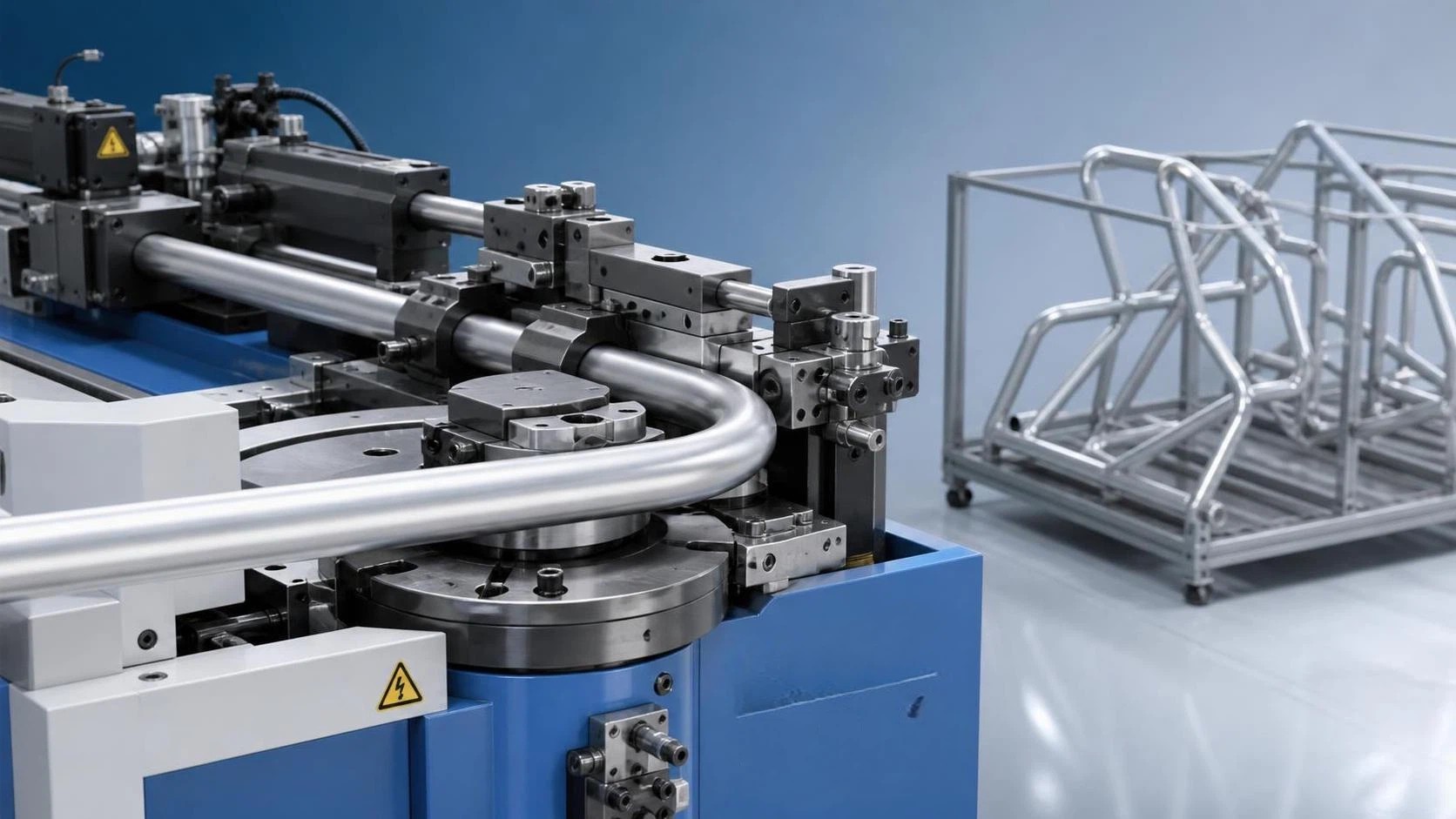
Choosing the right aluminum tube bending machine is rarely a matter of comparing catalog specifications alone. In lightweight frame production, bending quality directly influences assembly accuracy, weld fit-up, cosmetic consistency, and long-term structural performance. A machine that looks adequate on paper can still become a bottleneck if it cannot control springback, prevent wall thinning, or switch efficiently between frame geometries. For companies evaluating equipment for bicycles, mobility products, furniture, automotive substructures, display systems, or other aluminum tubular frames, the real task is to match bending capability to the material behavior and production rhythm of the line.
That is why technical evaluation should begin with the part, not the machine. Aluminum behaves very differently from carbon steel in bending. It has lower elastic modulus, more visible springback, and a greater tendency toward wrinkling, flattening, or surface marking if tooling and clamping are not appropriate. In lightweight frame applications, these defects are not minor cosmetic issues. They can affect downstream welding, jigs, coating quality, and dimensional stability of the finished assembly.
What makes lightweight aluminum frame bending difficult
The complexity comes from the combination of thin walls, tight radii, and strict repeatability requirements. Many frame producers work with 5xxx or 6xxx series aluminum tubes, often with varying temper conditions. Even when the outer diameter remains similar, the actual bending response can change significantly depending on wall thickness, extrusion consistency, heat treatment state, and surface finish.
In practical terms, the machine must control five things at the same time:
- dimensional accuracy of the bend angle and radius,
- ovalization and wall thinning,
- surface protection, especially on visible frame sections,
- repeatability across batches and shifts,
- changeover efficiency for different frame models.
If one of these is weak, the cost often appears later rather than at the bending station itself. A tube with slightly excessive flattening may still pass initial inspection, but it can create fixture instability during welding or lead to inconsistent load paths in the final product. That is why a technical evaluator should not judge an aluminum tube bending machine only by maximum capacity or CNC axis count.
Start with the bending method, not the brand list
For lightweight frame production, rotary draw bending is usually the reference process because it offers the best control for tight-radius and appearance-sensitive parts. Compression bending may be acceptable for simpler geometries or larger radii, but it is usually less suitable where dimensional repeatability and cross-section preservation are critical. Roll bending serves a different purpose and fits large-radius forming rather than compact frame sections.
When comparing machines, the first screening question should be whether the machine architecture matches the part family:
- Single-radius, tight-tolerance frame members: rotary draw bending is typically preferred.
- Multi-bend complex spatial geometries: CNC multi-axis control becomes important.
- High-mix, low-to-medium volume production: programming simplicity and tooling change speed matter more than absolute cycle speed.
- High-volume standardized production: automation integration, feeding stability, and repeatability become the dominant factors.
A common mistake is to specify a highly automated machine for a product mix that changes every few weeks. In that case, setup losses and tooling costs may erase the expected productivity benefit.
The core specifications that actually affect decision quality
Several technical parameters deserve closer scrutiny because they correlate directly with process capability.
Tube diameter and wall thickness range. This seems obvious, but the issue is not whether the machine can physically bend a tube of that size. The issue is whether it can do so while maintaining acceptable deformation on your actual alloy and temper. Ask for sample trials on representative materials, including the thinnest wall and smallest bend radius you intend to run.
Centerline radius capability. Minimum bend radius is one of the most misunderstood specifications. Supplier claims may reflect ideal conditions, not stable production conditions. Technical evaluation should distinguish between “possible in demonstration” and “repeatable in production without excessive scrap.”
Mandrel and wiper die compatibility. For thin-wall aluminum tubes, internal support and wrinkle control are often decisive. Machines that support robust mandrel positioning and stable pressure die assistance are usually better suited to lightweight structural parts.
Bend angle accuracy and repeatability. Published accuracy values are useful, but they do not fully describe real production performance. Ask how the machine compensates for springback and whether correction can be stored by material grade, wall thickness, and tool set.
Boost and pressure control. Proper boost assistance helps reduce thinning and maintain shape in demanding bends. Machines with better control over clamp, pressure, and boost parameters usually offer a wider process window for aluminum.
CNC axis configuration. More axes do not automatically mean better output. They matter when parts require rotation, variable lengths between bends, and 3D geometries. For simple two-dimensional frame parts, excessive complexity may only increase maintenance and training burden.
Why tooling matters almost as much as the machine
In aluminum tube bending, the machine and tooling should be evaluated as one process system. A technically strong machine paired with generic tooling can still produce unstable results. Surface marking, slippage, and inconsistent springback often originate from tooling design, material selection, and finish quality rather than from the base machine alone.
Points worth checking include:
- tooling material and hardness matching for aluminum surfaces,
- quick-change design if product variation is frequent,
- availability of custom mandrels for thin-wall sections,
- wiper die geometry for tight-radius work,
- lubrication approach and contamination control.
Frame manufacturers producing visible consumer products should pay particular attention to surface protection. Minor tooling marks may be acceptable on hidden industrial tubing, but they become a rejection issue for anodized or powder-coated frame components.
Production efficiency is not just cycle time
Many evaluations focus too heavily on bends per minute. In lightweight frame production, total effective output is more strongly shaped by setup stability, first-pass yield, and part-to-part consistency. A faster machine that requires frequent manual correction can lose to a slower but more stable platform.
Technical evaluators should look at efficiency across the full production loop:
- programming time for new parts,
- tool change duration,
- scrap rate during startup,
- need for operator intervention during long runs,
- integration with cutting, end forming, and welding steps.
This last point matters more than many buyers expect. Tube bending quality affects fit-up in downstream assembly, especially where robotic welding or precision fixtures are used. If bent parts arrive with unstable geometry, welding automation loses effectiveness. In some fabrication environments, handling and positioning equipment such as a Lead screw welding rotator is used downstream for cylindrical welding applications, where repeatable upstream forming supports better alignment and workflow continuity. The lesson is broader than the product itself: bending machine selection should be judged within the logic of the whole fabrication line, not as an isolated purchase.
Controls, software, and compensation logic deserve close review
For technical teams, the control system is often the dividing line between a usable machine and a difficult one. Aluminum production benefits from software that allows quick compensation based on observed springback and stores parameter sets by material and part number. A machine with strong mechanical structure but weak interface design can slow down process development significantly.
Look for practical questions rather than generic CNC claims:
- Can operators easily edit bend sequence and correction values?
- Does the controller support material-specific compensation libraries?
- Is simulation reliable enough to reduce trial pieces?
- Can production data be exported for quality tracking?
- Does the supplier provide remote diagnostics and software support?
If the operation runs multiple SKUs with frequent recipe changes, these software capabilities may have more economic value than a marginal difference in rated power or maximum diameter.
Quality verification should be built into machine evaluation
Acceptance standards should be defined before procurement, not after installation. For aluminum frame parts, evaluation criteria typically include bend angle tolerance, length accuracy between bends, cross-section deformation, surface condition, and consistency across repeated runs. If possible, run a supplier trial using your own tube material and an actual part geometry rather than a simplified sample.
It is useful to inspect not only the finished shape but also process stability indicators:
- variation between first and fiftieth part,
- sensitivity to lubrication changes,
- repeatability after tool reinstallation,
- performance across different tube batches,
- operator dependence.
A machine that produces a good demonstration sample under supplier-controlled conditions may still struggle in routine factory use if process robustness is narrow.
Compliance, service, and supply reliability are part of technical risk
For export-oriented manufacturers or plants serving regulated customers, CE-related documentation, electrical conformity, and safety integration should be reviewed carefully. Claims should be checked against actual machine documentation rather than marketing material. Where standards or local compliance obligations are relevant beyond CE, those should be verified case by case as requirements vary by market and application.
Service capability is another technical issue disguised as a commercial one. Aluminum bending often requires process tuning during commissioning. If spare parts, tooling support, or control troubleshooting are slow, the machine’s theoretical capability becomes irrelevant. This is especially important for buyers working across borders, where language, time zone, and parts logistics can affect ramp-up risk.
Common selection mistakes in lightweight frame projects
Several patterns appear repeatedly in unsuccessful purchases.
One is overspecifying for future possibilities while neglecting current production reality. A plant may buy an advanced multi-stack system even though 80% of its parts are simple and batch sizes are moderate. The result is higher investment, longer training, and underused capability.
Another is underestimating material variation. Technical teams sometimes validate the machine on one aluminum grade and then discover unstable bending after switching suppliers or temper conditions. If sourcing flexibility matters, evaluation trials should include the realistic spread of incoming material.
A third mistake is treating tooling as an afterthought. In thin-wall aluminum work, process success often depends on the correct mandrel, wiper, clamp design, and lubrication setup. A lower-cost machine with well-developed tooling support can outperform a more expensive platform with poor application engineering.
The last is failing to connect bending capability with downstream yield. If the factory relies on automated welding, precise fixturing, or appearance-grade finishing, then bending variation will multiply costs later in the process. This systems perspective is often what separates a sound technical decision from a merely acceptable machine purchase.
How to make the final decision
A sound selection process for an aluminum tube bending machine should narrow the decision to three questions.
First, can the machine repeatedly produce your most difficult frame geometry using your real material, with acceptable cross-section quality and surface condition?
Second, can it do so at a practical total production cost once setup time, scrap, tooling life, and operator dependency are considered?
Third, can the supplier support commissioning, parameter development, and long-term parts availability at the level your operation requires?
If one of these answers is weak, the purchase risk rises sharply. In lightweight frame manufacturing, the best machine is not the one with the broadest specification sheet. It is the one that delivers a stable bending window for your aluminum tubes, fits the production mix you actually run, and supports the quality level expected by downstream assembly and end customers.
That is the standard technical evaluators should use when comparing options. The right choice will usually be the machine that reduces uncertainty across the process, not simply the one that promises the highest headline performance.
search
Products Navigation
Send Us A Message