




What Makes a Round Tube Bending Machine Suitable for Furniture and Auto Parts?
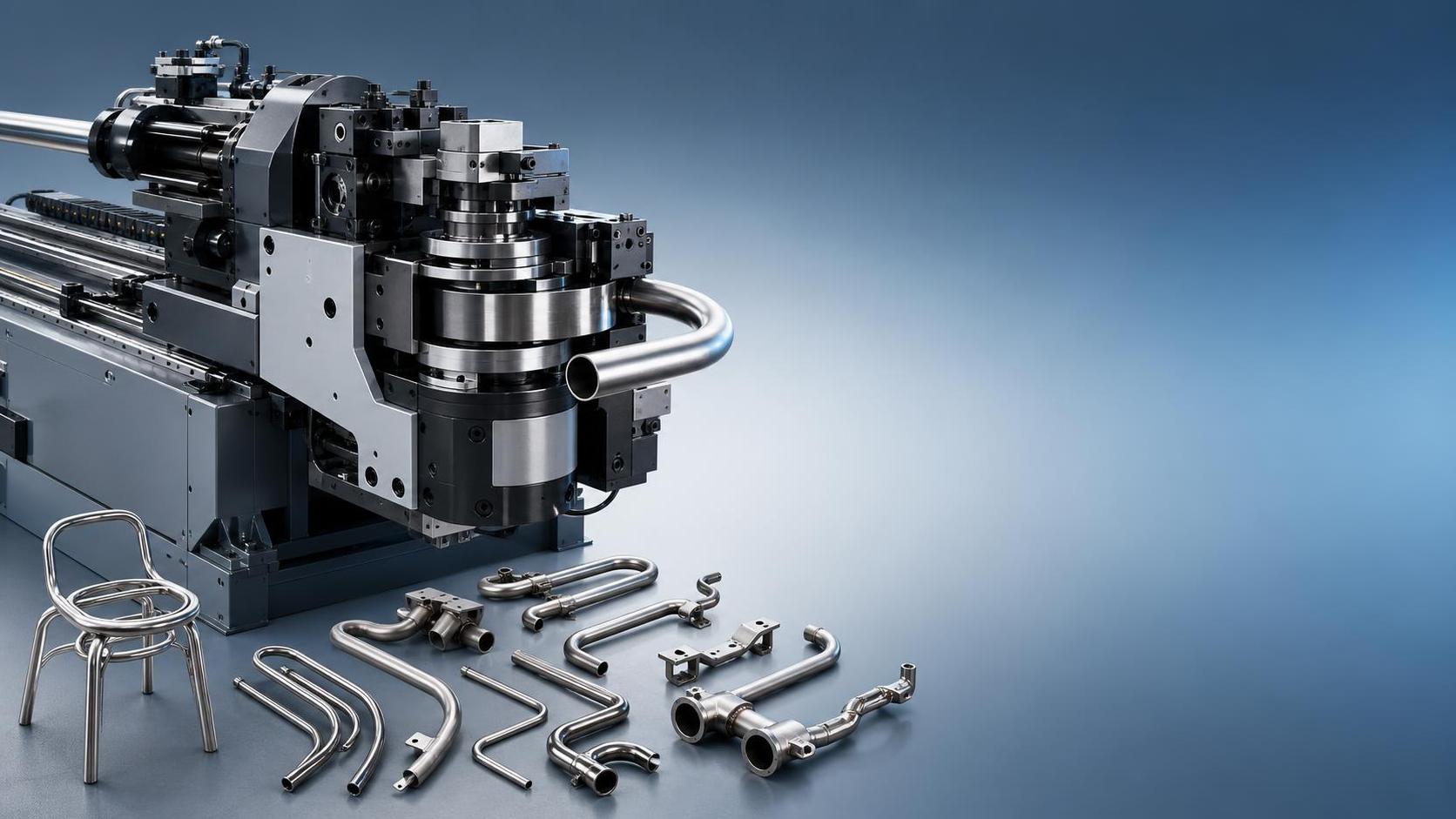
What Makes a Round Tube Bending Machine Suitable for Furniture and Auto Parts?
For project managers and engineering leaders in furniture and auto parts manufacturing, choosing a round tube bending machine is rarely just about whether the machine can bend a tube. The real question is whether it can do so repeatedly, at the required speed, within the allowed tolerance, and without creating downstream problems in welding, assembly, coating, or final fit-up. A machine that looks capable on paper may still struggle when the part mix includes tight radii, cosmetic surface requirements, thin-wall tubing, or frequent changeovers.
That is why suitability has to be judged in context. Furniture manufacturers often care about appearance, smooth curvature, and flexible production for different models. Auto parts producers usually place more weight on dimensional consistency, process traceability, and compatibility with larger production systems. In both sectors, the right round tube bending machine helps reduce scrap, shorten setup time, and keep the project plan realistic rather than optimistic.
The application changes the definition of “suitable”
A chair frame, a bed structure, a headrest support, an exhaust-related tube assembly, and a bracket tube for vehicle systems may all be made from round tube, but they do not place the same demands on equipment. Furniture components often use thinner wall sections and exposed surfaces, so wrinkling, flattening, or tool marks can become rejection points even if the bend angle is technically acceptable. Auto parts, by contrast, may tolerate less visible imperfection in appearance but demand tighter positional accuracy between multiple bends because the part has to fit fixtures, weldments, or adjacent assemblies.
This is where many projects go wrong. Teams compare machines mainly by maximum bending capacity, yet capacity alone says little about actual process stability. A machine may bend the largest tube diameter in your drawing, but if it cannot control springback well, support thin-wall material, or repeat compound bends consistently, it may not be suitable for either industry.
Key technical traits that matter in real production
A suitable round tube bending machine for these sectors usually needs a balanced combination of rigidity, control accuracy, tooling compatibility, and production practicality.
Machine rigidity matters because tube bending is not only about force; it is about controlled force. If the frame, bending arm, or clamping system lacks stiffness, variation shows up across the shift. That may first appear as small angle deviation, but later it affects assembly dimensions and rework rates. For auto parts, this can quickly become a fixture issue. For furniture, it often becomes a visual consistency issue between left-hand and right-hand parts.
Control system capability is equally important. CNC control is not automatically better unless it matches the job complexity. When a plant runs multiple part numbers with different bend angles, lengths, and sequences, programmable control reduces manual adjustment and lowers setup risk. If the production plan includes frequent model changes, the machine should store programs reliably and allow operators to switch jobs without rebuilding every parameter from scratch.
Tooling support is another practical divider. A project may involve several tube diameters, bend radii, or material grades. The machine should accommodate different tooling sets without turning every changeover into a maintenance event. In furniture production, this flexibility helps when product design changes seasonally. In auto parts work, it becomes critical when one line supports several platforms or variants.
Accuracy is not one number
When buyers ask for “high precision,” they often mean different things. In practice, bending accuracy includes bend angle repeatability, straight length control between bends, rotation accuracy, and the machine’s ability to keep tube deformation within an acceptable range. A suitable machine has to perform across all of these, not just one.
For furniture, angle repeatability affects symmetry and appearance. A slight mismatch between parts can be visible after powder coating or chrome finishing. For automotive components, cumulative error across multiple bends can shift end locations enough to cause assembly interference. That is why engineering review should include not only a sample bend result, but also how the machine behaves over repeated cycles and different material batches. Springback compensation, tooling quality, and operator interface all influence that outcome.
Material variation should not be underestimated either. Stainless steel, carbon steel, aluminum, and coated tube do not respond the same way. A machine suitable for one program may need different control response or support tooling for another. Usually, the more varied the material mix, the more valuable a stable control system and experienced setup process become.
Why cycle time alone can be misleading
Project teams often focus on parts per hour, especially when comparing quotations. That is understandable, but cycle time without context can distort the decision. A faster machine that requires lengthy setup, frequent correction, or skilled manual intervention may deliver less usable output over a week than a slightly slower but more stable machine.
For furniture plants with mixed production, changeover time can matter as much as bending speed. For auto parts programs, uptime and repeatability often outweigh peak theoretical output. This is especially true when the bending station feeds welding cells, assembly fixtures, or downstream inspection. One unstable upstream process can slow an entire line.
A more useful evaluation includes three questions: how long it takes to switch jobs, how many parts are accepted without correction, and how easily operators can maintain stable output across shifts. These questions are less exciting than top-speed claims, but they usually reflect the true production cost.
The surrounding process matters more than many buyers expect
Tube bending rarely stands alone. The part may be cut, end-formed, welded, polished, coated, or assembled afterward. A bending machine is suitable only if it fits that chain. For example, if bent parts move directly into robotic welding, repeatability and positional consistency become critical. If the part has an exposed decorative finish, surface protection during clamping and bending matters just as much as geometry.
This broader view is one reason many manufacturing teams prefer working with suppliers that understand more than a single machine category. Wuxi Samgins International Trade Co., Ltd, established in 2012 in Wuxi, Jiangsu Province, supplies a wide range of fabrication equipment including pipe benders, CNC machine tools, welding robots, laser cutting machines, deburring equipment, shearing machines, and plate processing systems. For project planning, that kind of equipment background can be useful because bending decisions often affect cutting, welding, and finishing choices at the same time. The company states that production and design are organized according to ISO9001 quality system certification and EU CE standards, which is often relevant for buyers reviewing export or compliance requirements, though final project suitability still needs to be checked against actual application details.
Even in tube-focused projects, sheet metal often appears in the same assembly. A furniture frame may include brackets or side plates; an automotive subassembly may combine tubes with formed sheet parts. In such cases, related equipment like Electro-hydraulic synchronize cnc press brakes can support thin sheet bending with a full steel welded structure, stable mechanical stop block design, and wedge-type deflection compensation for higher bending accuracy. That does not replace tube bending capability, of course, but it reflects a practical reality: many buyers are evaluating line compatibility, not a single isolated machine.
Common failure points during selection
One common mistake is underestimating tooling. The machine body gets attention, while dies, clamps, mandrels, and support tooling are treated as accessories. In reality, tooling quality and fit can determine whether a machine handles thin-wall or cosmetic-grade tube well.
Another issue is evaluating samples made under ideal conditions instead of production conditions. A successful trial on one material lot and one bend pattern does not prove stable performance across a real schedule. If your part family includes multiple radii, different wall thicknesses, or demanding end-location tolerances, the acceptance review should reflect that mix.
There is also a tendency to separate machine buying from operator reality. If the interface is cumbersome or manual adjustment points are excessive, output may depend too heavily on a small number of experienced people. That can be risky for plants managing labor turnover, multi-shift production, or expansion into new product lines.
What to confirm before moving forward
Before deciding that a round tube bending machine is suitable for furniture or auto parts work, it helps to confirm a short list of points against actual drawings and production plans:
- Tube diameter range, wall thickness, and material types
- Minimum and standard bend radii required by the part family
- Number of bends per part and whether rotation between bends is needed
- Allowed deformation, flattening, and surface marking limits
- Target output in real working conditions, not only in ideal test mode
- Tooling change frequency and setup time expectations
- Downstream process sensitivity, especially welding, coating, and assembly
- Compliance, electrical standards, and documentation requirements for the destination market
That last point is easy to leave until late in the project, but it can delay acceptance or import procedures. Companies shipping to Southeast Asia, Europe, North and South America, and Oceania often face different practical expectations around documentation, machine configuration, and service coordination, so these details usually need early confirmation rather than assumptions.
A suitable machine solves production problems, not just bending tasks
The best round tube bending machine for furniture and auto parts is not simply the one with the biggest specification or the most aggressive sales claim. It is the one that matches the material, geometry, finish requirement, output plan, and process chain with the least friction. In furniture manufacturing, that often means protecting appearance while staying flexible across designs. In auto parts production, it usually means maintaining repeatability under volume and fitting smoothly into a broader controlled process.
If a machine can hold its accuracy over time, support the required tooling, reduce avoidable setup loss, and fit the rest of the fabrication flow, it is probably suitable. If it cannot, even an impressive specification sheet will not save the project. The most practical next step is usually to review part drawings, material information, bend sequences, and downstream requirements together before finalizing the machine configuration.
search
Products Navigation
Send Us A Message