




Can a Welding Robot Adapt to Different H-Beam Sizes?
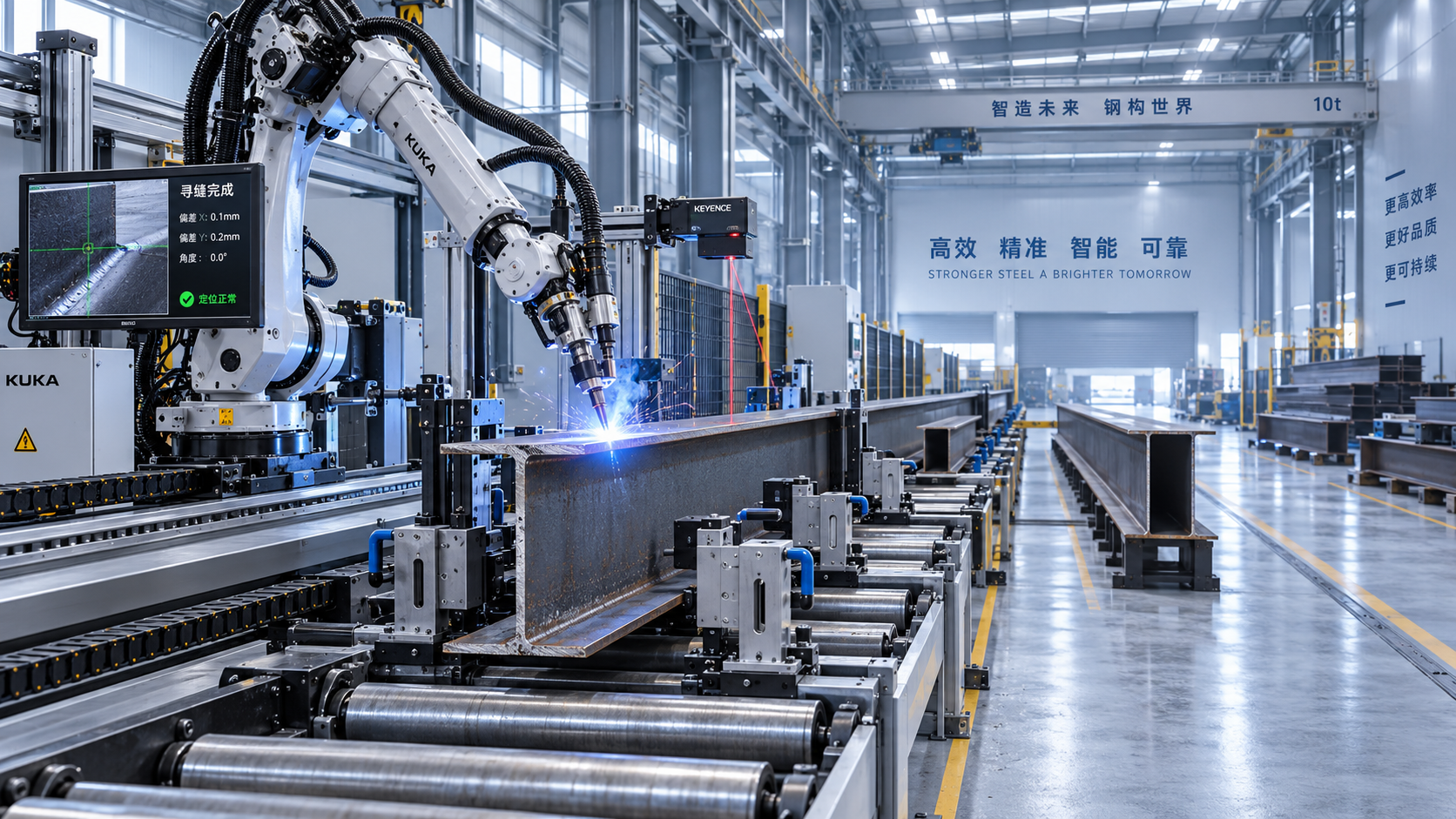
Can a Welding Robot Adapt to Different H-Beam Sizes?
H-beam fabrication rarely stays uniform for long. A workshop may weld compact beams for one structural project in the morning and much heavier sections for a bridge, plant platform, or warehouse frame later in the week. That variation often creates hesitation around automation: can a welding robot truly adapt to different H-beam sizes, or does it only make sense for repetitive, identical parts?
The short answer is yes—modern robotic welding systems can be designed to handle a range of H-beam dimensions. The important qualification is that flexibility does not happen by accident. It depends on the robot’s reach, positioner design, fixture adjustability, seam-tracking capability, welding power source, and programming strategy. A properly configured system can move between different flange widths, web heights, beam lengths, and weld specifications with much less disruption than many fabricators expect.
For companies considering automation, the question is often connected to a second concern: What production volume justifies buying a welding robot? The answer is not defined by one universal monthly output figure. Instead, it depends on the mix of beam sizes, labor availability, weld length per part, quality requirements, setup time, and how consistently the shop can keep the robot supplied with work.
Different H-Beam Sizes Require a Flexible Cell, Not Just a Robot
A welding robot is only one part of the solution. When fabricating H-beams, the surrounding equipment determines whether the system can change from one profile to another efficiently. A robot with a wide operating envelope may physically reach the weld seam, but it still needs the beam to be placed accurately, clamped securely, and presented at the correct angle.
For variable H-beam production, the cell commonly includes adjustable supports, movable clamping units, roller conveyors, turning devices, or coordinated positioners. These components allow the equipment to accommodate changes in beam length, web depth, and flange dimensions without building a completely new fixture for every job.
For example, a fabricated beam with a relatively narrow flange may require clamps to move inward, while a wider section needs additional lateral support. A longer beam may require more support points to prevent deflection during welding. If the workpiece shifts, twists, or sags, even a carefully programmed robot may produce inconsistent results. Good fixturing is therefore not a minor detail; it is the foundation of repeatable robotic welding.
In practical terms, the most adaptable systems are usually designed around a defined size range rather than an unlimited range. Before selecting equipment, a manufacturer should identify the smallest, largest, heaviest, and most frequently produced H-beams. This information guides the choice of robot arm span, track length, load capacity, fixture travel, and material-handling arrangement.
Where the Adaptability Comes From
Robotic welding of H-beams is often associated with high-volume, standardized production lines, but the technology has become far more configurable. Several features allow one system to serve a mixed fabrication schedule.
Programmable Welding Paths
Once an H-beam’s dimensions and weld requirements are known, the robot can use a stored program or a newly generated program to follow the required seam path. For recurring beam families, operators can save parameter sets for different flange and web combinations. Changing from one beam type to another may involve selecting the correct job recipe, adjusting fixtures, confirming the workpiece position, and running a verification cycle.
This is particularly useful for fabricators that repeatedly produce variations of a standard design. The robot does not need to be treated as a machine for only one part number. With organized programming and reliable setup procedures, it can become a flexible production resource.
Adjustable Fixtures and Servo-Controlled Positioning
Manual fixture adjustment is suitable for lower-mix operations where changeovers are not frequent. However, if a shop changes H-beam sizes several times per shift, motorized or servo-controlled fixtures can reduce setup effort and improve positioning repeatability. Some systems can move clamps, supports, or workpiece positioners according to the selected program.
The level of automation should match the real production pattern. Fully automated changeover equipment is not always necessary. A fabrication shop producing several beam sizes in medium batches may gain more value from robust manual adjustment points, clear reference stops, and easy-to-use digital setup instructions than from an overly complex cell.
Seam Finding and Adaptive Welding Functions
Steel sections are not always perfectly consistent. Material tolerances, tack-weld variation, heat distortion, and fit-up conditions can change the actual seam location. Touch sensing, laser seam tracking, arc sensing, or other adaptive technologies can help the robot identify and follow the joint more accurately.
These functions are especially valuable when beam sizes vary or when the work includes long fillet welds between the flange and web. They should not be viewed as a substitute for proper preparation. Poorly assembled beams, excessive gaps, contaminated surfaces, or unstable tack welds can still create problems. But sensing technology adds useful tolerance and reduces dependence on ideal conditions.
Multiple Welding Recipes
Different H-beam sizes may require different welding parameters. A heavier section can demand a different wire feed speed, current, voltage, travel speed, torch angle, or number of passes than a lighter section. The robot controller can store these recipes and apply them consistently once the correct job is selected.
This repeatability matters when weld quality must remain stable across long seams and multiple production shifts. It also reduces the risk of relying on individual operator memory for every material thickness or joint configuration.
What Production Volume Justifies Buying a Welding Robot?
There is no single production volume that automatically makes a welding robot the right choice. A company manufacturing a few hundred simple beams each month may benefit from automation, while another company producing a much larger number may not—particularly if its parts are highly irregular and require constant manual intervention.
A more useful way to assess the investment is to examine how much repeatable welding work exists in the production flow. Robotic welding becomes increasingly attractive when the business has a stable stream of similar joints, long weld lengths, recurring H-beam designs, or a continuing need for consistent output.
Consider the following questions instead of focusing only on unit volume:
- How many welding hours are spent on H-beams each week?
- Are the same beam profiles or joint types produced repeatedly?
- Is the business struggling to recruit or retain qualified welders?
- Do delivery schedules depend on maintaining output across multiple shifts?
- Are weld consistency, appearance, and traceability becoming more important to customers?
- Can upstream cutting, fit-up, and material handling keep a robot supplied?
- How much time is currently lost to rework, grinding, inconsistent travel speed, or operator fatigue?
A robot is generally easier to justify when it has enough productive arc-on time. If it spends most of the day waiting for beams to be assembled, moved, measured, or clamped, the expected return will be weaker. In contrast, a shop with a steady queue of prepared H-beams can use robotic welding to create a more predictable flow.
Production volume also needs to be considered alongside labor cost and labor risk. In many fabrication environments, the challenge is not simply the hourly cost of manual welding. It is the difficulty of scheduling skilled welders for repetitive work, managing quality variation over long shifts, and maintaining throughput when experienced staff are unavailable. A robotic cell can take over repetitive seam welding while skilled welders focus on complex assemblies, repairs, inspection-sensitive work, and tasks that require human judgment.
High Mix Does Not Always Mean “No Robot”
A common misconception is that robotic welding only suits large batches of identical parts. High product variety does make automation more demanding, but it does not automatically rule it out.
The key distinction is between high mix with no repeatability and high mix with recurring families of parts. If every H-beam is a completely new one-off design with different geometry, irregular attachments, and unpredictable fit-up, manual welding may remain the more practical choice. Programming and setup time can outweigh the robot’s productivity.
However, many structural steel and machinery fabricators have a more balanced reality. They may produce dozens of beam dimensions, yet the joints themselves are similar: flange-to-web fillet welds, stiffener welds, end plates, brackets, or repeated reinforcement details. In this situation, a flexible welding robot with modular fixtures and reusable programs can still deliver meaningful benefits.
The objective is not necessarily to automate every beam that enters the factory. It may be more sensible to identify the 20% of work that consumes the majority of repetitive welding hours. Those parts provide a logical starting point for automation.
Factors That Limit H-Beam Size Flexibility
Although welding robots can be highly adaptable, every system has practical boundaries. Being realistic about these limits during planning prevents disappointment later.
Beam Weight and Handling Capacity
The workpiece may be too heavy for the selected positioner, conveyor, or rotating mechanism. A robot can weld a large beam only if the handling equipment can safely support and move it. Beam weight, center of gravity, and deflection under its own mass should all be reviewed.
Beam Length and Robot Travel
Long H-beams may require the robot to travel on a linear rail or require the workpiece to move through the welding station. A stationary robot is often sufficient for smaller structures, but long seams demand a layout that maintains torch access across the full beam length.
Access to the Weld Joint
Attachments, stiffeners, plates, and complex assemblies can block torch access. This issue is not solved simply by selecting a larger robot. The fabrication sequence, workpiece orientation, torch configuration, and positioning strategy all influence whether the joint can be welded efficiently.
Fit-Up Consistency
Robotic welding performs best when parts arrive with repeatable fit-up. Variations in flange alignment, web position, root gap, and tack weld location can increase sensing requirements and cycle time. Improving cutting accuracy and assembly discipline often produces as much value as the robot itself.
Choosing the Right Level of Automation
For a company entering robotic H-beam welding, the best solution is not always the largest or most automated line. The right configuration should reflect the actual job mix and growth plan.
A compact robotic welding cell may suit fabricators handling shorter beams and repeatable subassemblies. A robot mounted on a rail with adjustable supports can provide a broader working range for longer members. For continuous structural steel production, an integrated H-beam production line may combine assembly, welding, conveying, straightening, and downstream processing in a more connected workflow.
Wuxi Samgins International Trade Co., Ltd supplies welding robots, automatic welding equipment, CNC cutting machines, and H-beam production line equipment for manufacturers seeking to improve fabrication capacity. When evaluating a system, the most useful starting point is not a generic machine specification. It is a review of real drawings, beam size ranges, material thicknesses, required welds, expected output, available floor space, and handling methods.
This approach helps avoid two costly mistakes: buying a system too limited for future work, or investing in excessive automation that does not match the shop’s production reality.
A Practical Checklist Before Investing
Before deciding whether robotic welding is appropriate for variable H-beam production, collect production data for a representative period. Include beam dimensions, quantities, welding time, joint types, material grades, changeover frequency, and rework causes. It is also wise to record how long parts wait between cutting, assembly, welding, and inspection. Those waiting periods often reveal bottlenecks that are not visible from welding time alone.
Then separate the work into three groups: parts that are highly repetitive and easy to automate, parts that may become suitable with better fixtures or standardized fit-up, and truly complex one-off work that should remain manual. This creates a more realistic automation plan than trying to force every product through one cell.
Training should be included in the decision as well. Operators need to understand fixture setup, program selection, consumable checks, basic recovery procedures, and daily maintenance. A robot does not eliminate the need for welding knowledge; it changes where that knowledge is applied.
Final Perspective
A welding robot can adapt to different H-beam sizes when the system is designed around a clear dimensional range, repeatable fixturing, appropriate handling equipment, and sensible programming. It is not limited to a single beam profile, nor is it automatically suitable for every custom fabrication job.
When asking, “What production volume justifies buying a welding robot?”, look beyond the number of beams produced. The stronger indicators are repeatable welding hours, stable part families, labor pressure, quality expectations, and the ability to organize upstream preparation. For many fabricators, the practical path is to automate the recurring work first, build confidence in the process, and expand the system as production demands become clearer.
search
Products Navigation
Send Us A Message