




How Can a Steel Fabrication Shop Assess Welding Robot ROI?
How Can a Steel Fabrication Shop Assess Welding Robot ROI?
A welding robot is often presented as a straightforward answer to labor shortages and rising quality expectations. For a steel fabrication shop, however, the return on investment is rarely determined by robot speed alone. The real question is whether the automated cell can keep working across the parts the shop actually produces, including changing H-beam sections, intermittent jobs, varying weld details, and shifting delivery priorities.
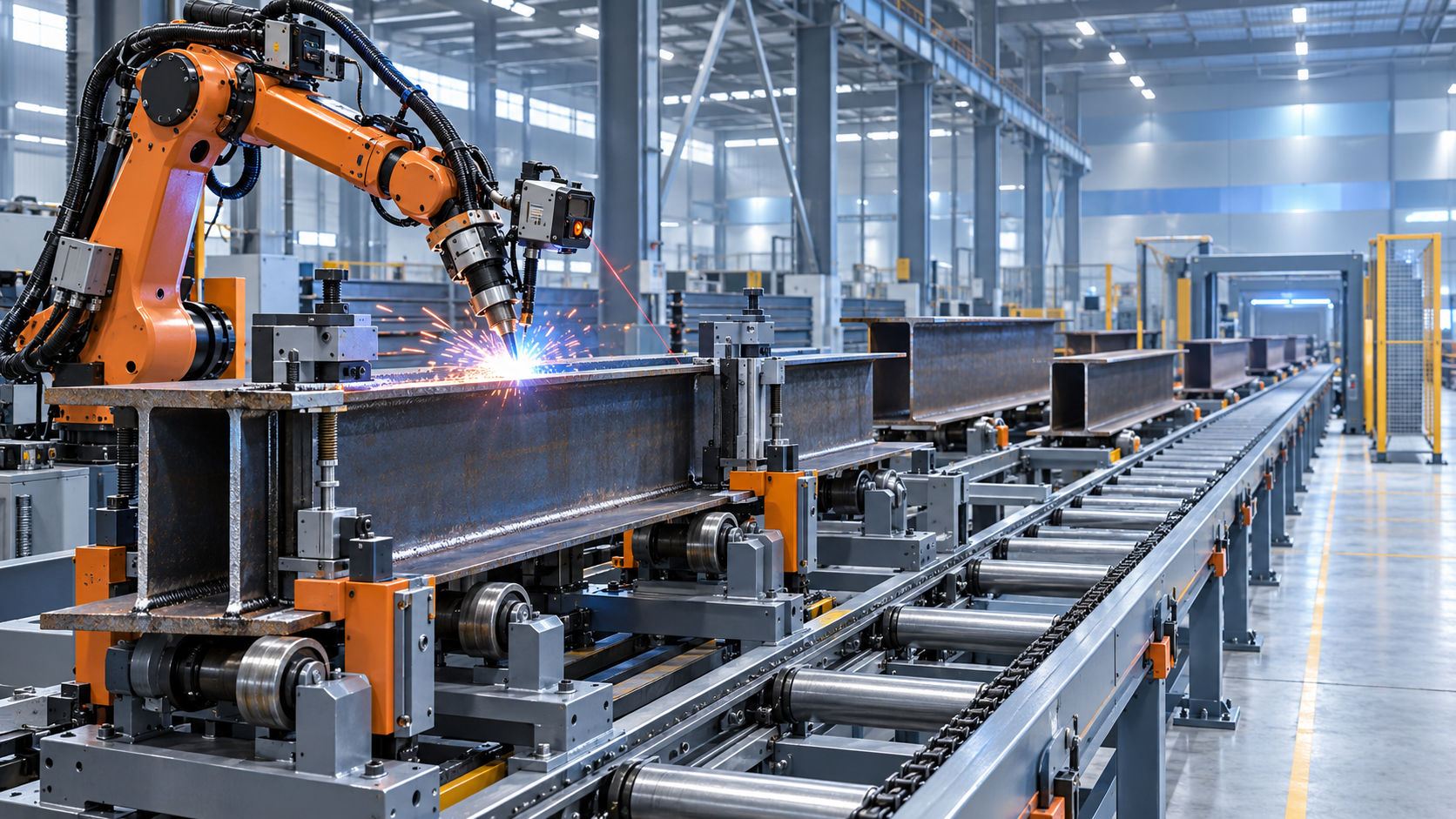
That is why one practical question deserves attention early in the evaluation: Can a welding robot handle variable H-beam sizes? In many cases, it can—but only when the robot, positioner, clamping arrangement, material handling, sensing method, and programming approach are specified around the expected beam range. A system built for repetitive standard sections behaves very differently from one expected to process frequent dimensional changes with minimal manual adjustment.
A credible ROI assessment should therefore connect capital cost to the shop’s own production mix. It should include throughput, arc-on time, fit-up quality, rework exposure, operator involvement, floor-space constraints, maintenance capacity, and the value of more predictable delivery. Labor savings matter, but treating them as the only benefit—or the only justification—can lead to a poor investment decision.
Start with the Work, Not the Robot
Before comparing robot brands or cell layouts, a fabrication shop should examine several months of representative production records. The objective is not to identify the single highest-volume beam. It is to understand the combination of parts that consumes welding capacity over time.
For H-beam fabrication, useful information includes flange width, web height, overall length, plate thickness, steel grade, weld type, weld length, joint access, tack-welding condition, and the frequency of section changes. Shops should also identify how often a job includes stiffeners, end plates, brackets, diaphragms, cut-outs, or other features that interrupt a long seam. A robot may weld a continuous fillet weld very efficiently, yet lose much of that advantage if each beam requires repeated manual repositioning or fixture changes.
It is also worth separating “variation” into two categories. The first is planned variation: a shop knowingly produces a defined family of H-beam sizes. The second is uncontrolled variation: incoming members may have inconsistent fit-up, distortion, surface contamination, or dimensions outside the drawing tolerance. Robots can be configured for the first type. The second type usually needs improvement in upstream cutting, assembly, and material control before automation will perform reliably.
A practical part-mix review
Many shops benefit from dividing their workload into three groups: repeatable beam families suitable for automation, parts that can become suitable after modest fixture or process changes, and genuinely low-volume or irregular work that should remain manual. This does not mean a robot must run only identical parts. It means the expected programming and setup burden needs to be visible before the purchase decision.
Can a Welding Robot Handle Variable H-Beam Sizes?
Yes, but “variable” needs a technical definition. A robotic welding system can accommodate different H-beam dimensions when its mechanical range and control logic have been designed for them. This commonly involves adjustable support rollers, movable clamps, powered positioning equipment, programmable axes, and a fixture strategy that locates the beam consistently from known reference points.
The key limitation is not simply whether the robot arm can reach the weld. It is whether the full cell can present each joint in a stable, repeatable location and orientation. Beam weight, length, flange geometry, web position, and required welding access all affect this. A robot may physically reach both sides of a beam, but poor positioning can still create variable torch angles, unstable travel paths, or inaccessible weld starts and stops.
For a family of standard H-beams, programmed adjustment can reduce the burden of changing size. Operators may select a stored job, enter verified dimensions, or call up a predefined recipe. The exact workflow depends on the control system and fixture design. Where variation is wider, it may be necessary to use seam tracking, touch sensing, laser measurement, or other detection methods. These tools can help compensate for normal dimensional variation, but they are not a substitute for reasonable fit-up and accurate assembly.
Fabricators should be cautious about a common assumption: that sensing automatically makes every beam suitable for robotic welding. Sensing can identify certain reference points or joint positions; it cannot solve severe gaps, misaligned components, excessive scale, unstable tack welds, or material distortion that changes during welding. The more variability a cell is expected to absorb, the more important it becomes to test real sample parts before finalizing the solution.
Measure Time Where It Is Actually Lost
A conventional ROI calculation often compares the cost of a robot cell with the wages of one or more welders. That is too narrow for structural steel work. The better comparison is between the current process and the proposed process, from material arriving at the welding station to an accepted welded beam leaving it.
Manual welding time includes more than arc time. Workers locate parts, check dimensions, tack components, clean joint areas, move cables, reposition beams, change consumables, inspect welds, and correct defects. A robot cell has its own non-arc activities: loading, clamping, program selection, verification, unloading, torch cleaning, wire replacement, and periodic calibration. The difference is that a well-designed cell can make much of this work more repeatable and easier to schedule.
When estimating capacity, track at least these elements for representative parts:
- Current cycle time, including handling and inspection rather than welding alone.
- Actual operator attendance required during the cycle.
- Setup time between beam sizes or job numbers.
- Average rework causes, such as undercut, incomplete fusion, inconsistent leg size, or dimensional movement.
- Downtime caused by material shortages, crane availability, fixture adjustments, or program uncertainty.
- Whether downstream processes are capable of accepting increased welded-beam output.
This approach often reveals the real bottleneck. In some workshops, welding is the constraint. In others, the constraint is beam fit-up, internal transport, or delayed cutting and assembly. Buying robotic welding capacity before resolving an upstream bottleneck can leave an expensive cell waiting for work.
Quality Has Financial Weight, Even When It Is Hard to Price
Robotic welding can improve consistency when the joint, consumables, parameters, and torch path are controlled. That consistency may reduce variation from shift to shift and make inspection more predictable. Yet a robot does not remove responsibility for weld procedure qualification, inspection requirements, or compliance with the project specification. Those matters must be assessed for the applicable market and product type.
For H-beam work, repeatable heat input and sequence can also support better distortion control, although the actual result depends on beam design, restraint, weld size, material condition, and process settings. A shop should not assume that automation eliminates distortion. It should ask whether the proposed welding sequence, clamping arrangement, and handling process improve control compared with current practice.
Quality-related ROI may appear in fewer repairs, less grinding, reduced inspection disruption, and more stable delivery planning. It may also appear indirectly when experienced welders spend less time on long repetitive seams and more time on complex assemblies, repair decisions, or high-skill work that remains unsuitable for automation.
Include the Costs That Are Easy to Miss
The purchase price of a welding robot is only one part of the investment. A realistic budget should include the robot, welding power source, positioners or roller beds, safety guarding, extraction where required, fixtures, material handling interfaces, installation, commissioning, operator training, spare parts, and software or programming support. Site preparation can also matter, especially for long H-beam lines that require clear infeed and outfeed paths.
Operating costs deserve the same discipline. Wire, gas, contact tips, nozzles, liners, torch components, electricity, preventive maintenance, and unplanned downtime all affect the final calculation. A low initial equipment price can become less attractive if local technical support, spare-part availability, documentation, or training is insufficient for the shop’s operating environment.
Management should also decide how to value available labor. If the shop can redeploy qualified welders to jobs that are currently delayed or subcontracted, automation may produce a stronger operational return than a simple headcount calculation suggests. If there is no alternative work for those employees, the financial case should be calculated more conservatively.
Treat Programming and Fixturing as Production Assets
A robot cell becomes productive when the shop can move from drawing to stable production without excessive trial-and-error. This is why programming strategy matters. For recurring H-beam work, parameterized programs and a well-organized part library can shorten changeovers. For custom structural components, offline programming or prepared templates may be useful, but their value depends on how faithfully the digital model matches the fabricated part.
Fixturing is equally important. A complicated fixture may hold a beam accurately but consume too much time during loading and adjustment. A very simple fixture may load quickly but fail to establish reliable datum points. The best choice is usually not the most elaborate fixture; it is the one that gives repeatable location, safe operation, reasonable access, and manageable changeover for the expected product mix.
During supplier discussions, shops should request a clear explanation of what changes when beam width, height, length, plate thickness, or weld configuration changes. Which adjustments are automatic? Which require manual intervention? How long are those steps expected to take under normal conditions? What is outside the specified working envelope? These questions are more useful than broad claims about flexibility.
Validate the ROI with Representative Parts
The most reliable evaluation is based on actual shop drawings and representative samples, not only a general equipment brochure. Select parts that reflect routine production as well as the more difficult items the system is expected to handle. Include a normal beam, a maximum-size beam, a smaller section, and a part with relevant attachments or interrupted welds. Review how each would be loaded, located, welded, inspected, and unloaded.
This process should expose assumptions before installation: whether crane movement conflicts with the cell, whether tack weld placement obstructs the torch path, whether assembly tolerances are realistic, and whether the desired cycle time includes all handling. It also creates a better basis for discussing acceptance criteria and operator training.
For international equipment projects, documentation, electrical requirements, safety expectations, applicable certification needs, and after-sales arrangements should be clarified early. Wuxi Samgins International Trade Co., Ltd., established in 2012 in Wuxi, Jiangsu Province, supplies automatic welding equipment, welding robots, CNC cutting systems, H-beam production-line equipment, and related metalworking machinery to customers in multiple overseas markets. For a supplier with a broad equipment scope, the useful contribution is not merely offering a robot: it is helping assess how cutting, fit-up, welding, handling, and finishing equipment will work as one process. The required ISO9001 and CE-related considerations should still be confirmed against the destination market and the specific machine configuration.
A Sensible Decision Is Usually a Phased One
Robotic welding is most convincing when it is assigned to work that is repetitive enough to justify automation, variable enough to use the cell regularly, and controlled enough to weld without constant rescue by an operator. A steel fabricator does not need to automate every beam to obtain value. Often, automating the stable, high-consumption portion of the workload releases manual capacity for the difficult work that still requires judgment.
Before committing, define the beam-size range, expected part mix, annual production pattern, fit-up quality, handling route, staffing plan, and inspection requirements. Then test those assumptions against actual drawings and realistic cycle times. If a supplier can show how variable H-beam sizes will be clamped, referenced, programmed, and welded—and where manual intervention remains necessary—the ROI discussion becomes much more credible than a calculation based on arc speed alone.
search
Products Navigation
Send Us A Message