




Is a Welding Robot Worth the Investment for a Steel Fabrication Shop?
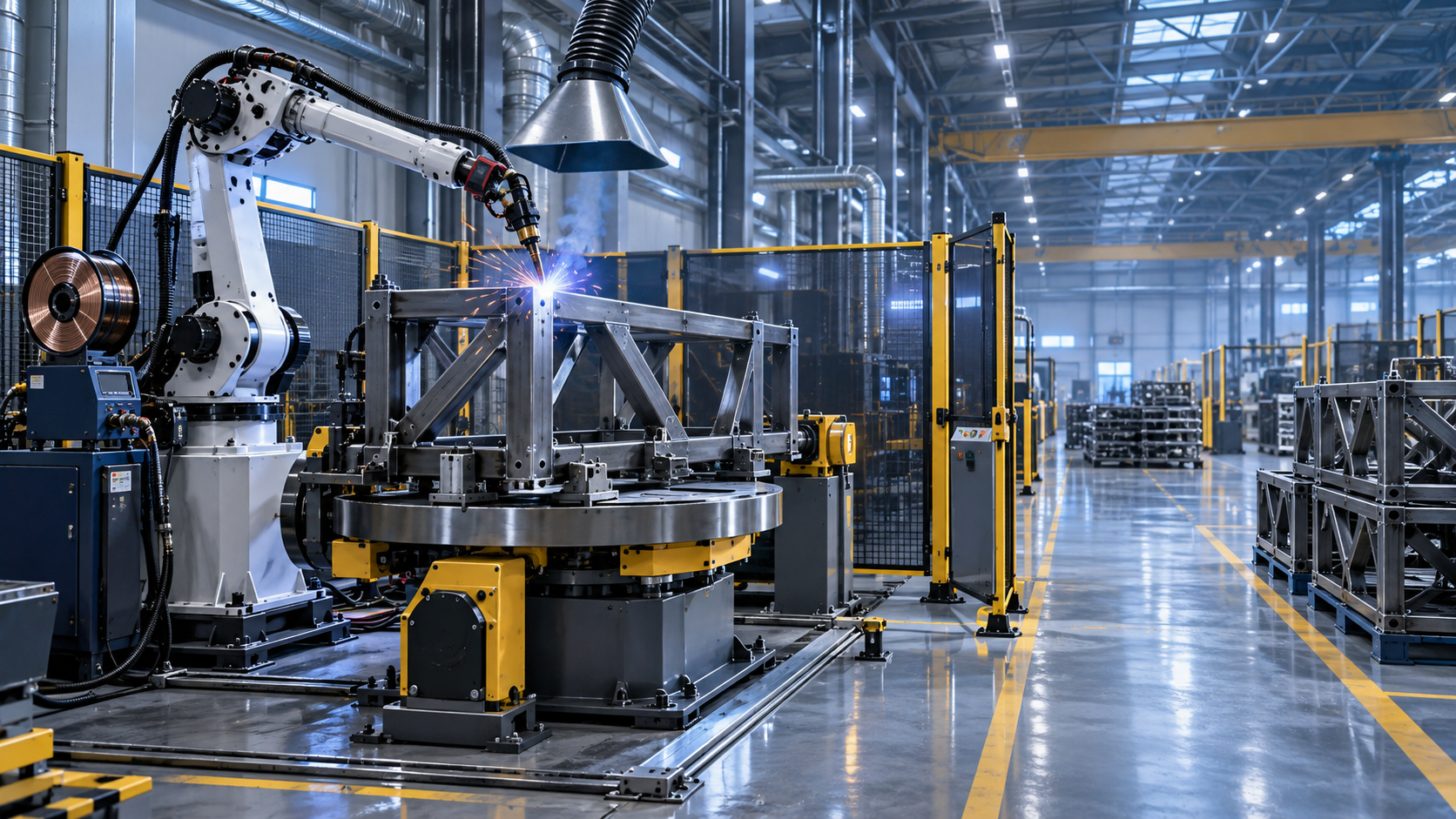
A welding robot can be a sound investment for a steel fabrication shop, but only when the shop has enough repeatable work to keep the cell productive and enough process discipline to support it. For a fabricator running recurring brackets, frames, structural subassemblies, tanks, or standardized assemblies, robotic welding can improve output consistency, reduce dependency on scarce welding labor, and make delivery planning more reliable. For a job shop dominated by one-off repairs, frequently changing designs, and poor part fit-up, the same investment may spend too much time waiting, being reprogrammed, or compensating for upstream variation.
The purchase decision should therefore begin with the work mix, not with the robot's stated arc-on capability. A robot does not make an unstable fabrication process stable by itself. It repeats what it is given: good joints, poor joints, accurate fixturing, or inconsistent parts. Shops that see automation as a complete replacement for skilled welders often underestimate the preparation required. Shops that treat it as a controlled production tool tend to get a clearer return.
Start with the parts, not the robot
The first question is whether a meaningful share of the shop's welding work is repeatable. Repeatability does not mean every part must be identical forever. It means the cell can run similar parts or part families with limited changes to fixtures, programs, wire, shielding gas, and welding parameters.
Steel fabricators are more likely to benefit when they produce recurring assemblies with predictable joint locations and stable annual demand. Examples include equipment bases, agricultural implements, trailers, support frames, railings made from standard modules, structural steel subassemblies, and fabricated components supplied to an OEM. A short run can still make sense when parts share locating principles and programs can be adapted efficiently, but very low-volume custom work demands more engineering time per welded piece.
Part geometry matters as much as production volume. Straight seams, accessible fillet welds, regular joints, and assemblies that can be held rigidly are generally well suited to robotic welding. Large or awkward components are possible, especially with positioners, tracks, or gantry arrangements, but the workholding and material-handling scope grows quickly. A robot that must reach around clamps, navigate inconsistent corners, or weld surfaces that vary from assembly to assembly will lose much of its advantage.
Before requesting quotations, a shop should review several months of production records and identify the parts that consume the most welding time. The best candidates are rarely chosen simply because they are the most difficult to weld. They are usually the parts with a combination of recurring demand, stable design, sufficient weld content, and frequent scheduling pressure.
- How many times is each assembly produced over a year?
- How much manual welding time is involved per unit?
- Are the joints accessible from a repeatable torch angle?
- Can parts be loaded into a fixture consistently?
- How often do drawings, material thicknesses, or weld specifications change?
- Does the job require frequent manual intervention for gaps, distortion, or missing components?
If the highest-volume work changes substantially from batch to batch, a collaborative or flexible robotic system may still be useful, but the return calculation must include programming and setup labor. The relevant comparison is not manual welding time alone. It is the total labor and delay removed after loading, fixturing, programming, inspection, rework, and changeover are included.
Arc time is where the economics are won or lost
A welding robot is worth considering when it can spend a substantial portion of scheduled time producing acceptable welds. This is often described as arc-on time, but a practical evaluation should look beyond the arc itself. Loading parts, unloading completed assemblies, turning fixtures, changing consumables, recovering from faults, cleaning spatter, and inspecting welds all affect the output of the cell.
Manual welding has unavoidable interruptions as well: fitting parts, repositioning work, waiting for cranes, changing leads, taking measurements, grinding starts and stops, and managing fatigue. Automation can reduce some of those interruptions, particularly when a positioner presents the joint in a favorable orientation and allows an operator to load one side while the robot welds the other. It does not eliminate them automatically.
For that reason, a simple calculation based on the robot's hourly operating rate is incomplete. The financial case should compare the current cost of producing a defined set of parts with the expected cost after automation. Include direct welding labor, rework, consumables, production supervision, fixture building, programming, cell maintenance, floor space, utilities, safety equipment, and financing or depreciation. The analysis should also reflect realistic utilization rather than assuming the robot will run continuously.
A cell that saves labor but creates a new bottleneck in part loading may still be valuable, though the expected capacity increase should be adjusted accordingly. In some shops, the more realistic gain is not a dramatic reduction in headcount. It is the ability to hold output steady when experienced welders are difficult to recruit, absent, or assigned to work that cannot be automated.
Consistency can matter more than raw speed
Steel fabrication buyers often focus first on speed. Speed matters, especially when delivery dates are tight, but weld consistency can be the more durable commercial benefit. A properly developed robotic procedure can repeat travel speed, torch angle, wire feed, voltage, weave pattern, and sequence with far less variation than a manual process over a long production run.
That repeatability can reduce variation in weld appearance and heat input, help control distortion, and make inspection more predictable. It can also reduce the amount of grinding and touch-up required on parts where appearance matters. For components subject to documented welding procedures or customer inspection requirements, stable robotic parameters can support a more controlled production process.
There are limits. Robots do not remove the need for qualified welding procedures, appropriate filler metal selection, sound joint design, cleaning, or inspection. They also do not automatically solve weld defects caused by poor fit-up, contaminated material, or dimensional drift in cut and formed parts. In fact, a robotic cell may expose those weaknesses faster because it expects parts to arrive in a consistent condition.
A fabricator considering automation should trace defects backward through the current workflow. If frequent weld repair comes from inconsistent gaps after bending, inaccurate coping, warped plates, or rushed tack welding, those issues should be addressed before expecting the robot to deliver stable quality. Upstream equipment and processes such as CNC cutting, beveling, bending, machining, and assembly fixtures may require attention alongside the welding cell.
Fixturing is often the underestimated investment
The robot arm is the visible part of the system, yet fixturing often determines whether the system performs well. A robust fixture locates components accurately, controls movement during welding, gives the torch adequate access, and allows operators to load parts without excessive effort. It also needs to accommodate tolerances in incoming material without turning every load cycle into a fitting exercise.
Weak fixtures create several problems at once. Operators spend longer loading parts. Weld locations shift relative to the programmed path. Clamps block access to seams. Heat distortion moves the assembly during the cycle. The robot may need extra sensing or manual correction, reducing output and adding complexity. A fixture that appears inexpensive at the start can become expensive through lost production time.
This does not mean every job needs a highly dedicated fixture. Modular fixture systems and adjustable locating methods can serve lower-volume product families. The tradeoff is straightforward: greater flexibility generally brings longer setup time and more opportunity for positioning error. Dedicated fixtures make more sense where part volume and design stability justify them.
Part presentation deserves the same scrutiny. A cell may require an operator, a rotating positioner, a turntable, a conveyor, a forklift interface, or overhead lifting. Large structural assemblies can have long cycle times simply because moving them safely into the cell takes time. A realistic layout review should map how material enters the area, where parts are staged, how finished work exits, and how an operator can work without reaching across a hazardous zone.
What a robot changes in the welding team
Robotic welding changes the mix of skills required; it does not remove the need for welding knowledge. The shop still needs people who understand joint preparation, welding procedure requirements, heat effects, consumable condition, and the difference between a minor process adjustment and a quality issue that should stop production.
Depending on the system and workload, responsibilities may be divided among fixture designers, robot programmers, welding engineers or supervisors, operators, maintenance staff, and inspectors. In a smaller fabrication business, one or two people may cover several of these functions. That can work well when training, documentation, and backup coverage are planned. It becomes risky when the entire cell depends on one programmer who is unavailable or when no one has authority to correct a process problem.
Operators should not be viewed as simple part loaders. They are often the first people to notice changes in fit-up, wire feeding, gas coverage, consumable wear, or spatter accumulation. Building a repeatable daily routine for checks, cleaning, and verification is more valuable than assuming the cell can be left unattended for long periods.
When the investment is usually hard to justify
A welding robot is less compelling when annual volume is low and designs change constantly, particularly if parts require extensive hand fitting before welding. It is also difficult to justify where welds are located in highly variable positions, assemblies arrive with uncertain tolerances, or the shop cannot allocate time for fixture development and program proving.
Another warning sign is an unresolved upstream bottleneck. If the fabrication department is waiting on cut parts, bending capacity, machining, material handling, or approvals, adding robotic welding may improve only one isolated operation. The robot can then spend substantial time idle while the real production constraint remains elsewhere.
Some work should remain manual even in a highly automated shop. Repair welding, urgent prototypes, very large one-off fabrications, highly irregular assemblies, and jobs requiring frequent judgment calls may be better handled by experienced welders. A useful automation plan separates repetitive production work from the variable work where manual flexibility has greater value.
A practical way to decide before buying
Rather than beginning with a broad specification request, select a small set of representative assemblies and study them in detail. Include a high-volume part, a moderately variable part, and a part that currently causes quality or delivery problems. Record the existing cycle from prepared components to accepted welded assembly. Include fit-up, tack welding, welding, repositioning, inspection, rework, and handling.
Then assess what must change for robotic production: fixture design, joint tolerance, tack location, part identification, welding sequence, positioner capacity, safety guarding, fume extraction, and operator access. This exercise frequently reveals whether the proposed cell will serve a large enough portion of production to justify its cost.
It is also sensible to ask prospective integrators or equipment suppliers to address the complete application, not just the robot model. The discussion should cover representative part sizes and weights, joint types, material range, expected changeovers, fixture concept, torch access, welding process, programming approach, safety design, training, spare parts, local technical support, and acceptance criteria. A quotation that omits these practical details may understate the real implementation effort.
For a steel fabrication shop with repeatable assemblies, disciplined fit-up, and a sustained welding bottleneck, a robotic cell can become a productive part of the operation rather than a showcase machine. For a shop built around constantly changing work, the better first investment may be in cutting accuracy, forming consistency, fixture capability, workflow control, or manual welding capacity. The useful question is not whether robotic welding is advanced enough. It is whether the shop can feed it stable work often enough for its consistency and capacity to matter.
search
Products Navigation
Send Us A Message