




What Determines the Cost of a Complete Welding Robot Cell?
What Determines the Cost of a Complete Welding Robot Cell?
A welding robot is easy to price in isolation. A complete robotic welding cell is not. The robot arm may be the most visible item in the quotation, but it is rarely the only major cost driver. Once a project includes workpiece handling, welding power source integration, safety guarding, fixtures, fume extraction, programming, commissioning, and operator training, the real investment becomes highly dependent on the production task.
That is why the question, “How much does a complete welding robot cell cost?”, does not have one useful universal answer. A compact cell for repetitive brackets is fundamentally different from a system built to weld long steel beams, variable H-beam assemblies, pressure-related fabrications, or large structural frames. The lowest purchase price can also be the most expensive decision if the cell cannot accommodate the next product revision, creates excessive loading time, or requires frequent manual touch-up.
The practical way to compare robotic welding proposals is to examine what is included around the robot—not merely the robot brand, arm payload, or quoted cycle time.
The robot itself is only one part of the capital cost
Most welding cells start with a six-axis industrial robot, a controller, a welding package, and a torch. The cost changes with reach, payload, required repeatability, cable routing, and whether the robot must carry a heavy torch package, wire feeder, seam-tracking sensor, or other process equipment. A standard robot may be sufficient for short, accessible welds. Large fabricated parts often require a longer-reach robot, rail-mounted robot, overhead arrangement, or dual-robot layout.
The welding process has an equally strong effect. MIG/MAG robotic welding is common for structural steel and general fabrication, but wire feed stability, torch cooling, anti-collision devices, cleaning stations, and spatter management still need attention. TIG automation may require more precise joint preparation and slower travel. Submerged arc welding, laser welding, or specialized processes bring a different set of equipment, guarding, and process-control requirements.
Buyers sometimes compare a robot-only offer with a complete-cell offer and assume one supplier is simply more expensive. In reality, the two quotations may not cover the same scope. One may include a robot and basic torch only; another may include fixtures, positioners, interlocked safety fencing, control integration, installation support, and acceptance testing. A meaningful comparison begins with a line-by-line scope review.
Workpiece size and handling usually shape the final configuration
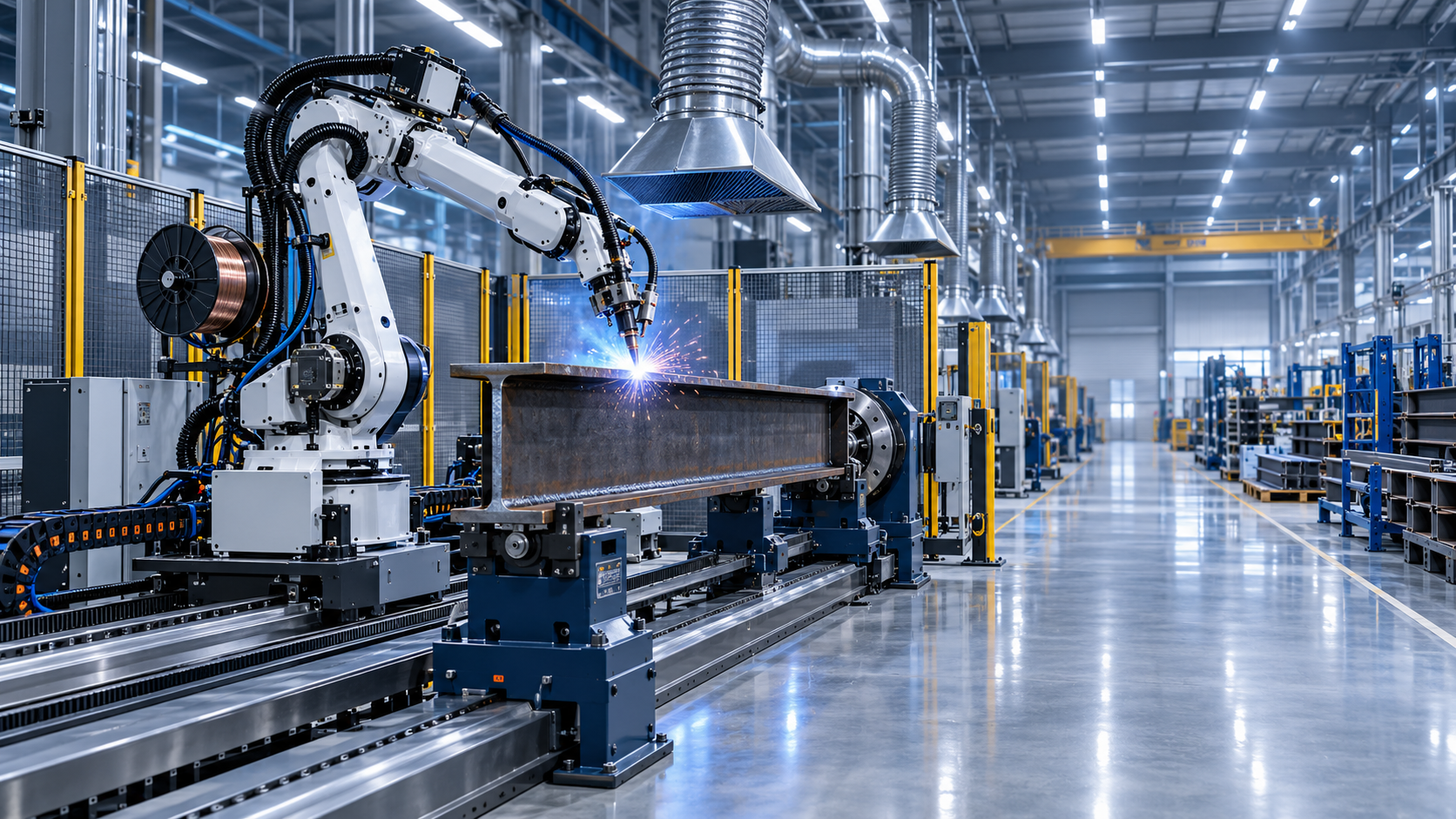
The largest cost differences often come from the part rather than the weld. Small components can be loaded onto a simple two-station turntable or manually placed in dedicated fixtures. Large assemblies may require headstock-tailstock positioners, a longitudinal travel system, powered rollers, a gantry, or customized support structures. The system must not only hold the part; it must hold it safely and accurately throughout welding.
Positioners are valuable because they bring weld seams into a favorable flat or horizontal position. This can improve arc stability, reduce difficult vertical or overhead welding, and allow the robot to maintain more consistent torch angles. However, a positioner adds mechanical complexity: load capacity, center-of-gravity calculations, rotation clearance, grounding, guarding, cable routing, and synchronization with the robot all need engineering attention.
For a shop producing one stable part family in high volume, dedicated fixtures may be sensible. For mixed production, overly specialized tooling can become a burden. A fixture that clamps a beam perfectly but takes too long to adjust may erase the gains from robot welding. Good cell design balances repeatability with changeover time.
Which welding robot configuration is best for long steel beams?
For long steel beams, the right answer depends on whether the beam is a standardized product or a highly variable fabricated assembly. A fixed-base robot can work when the weld zone is limited and the workpiece can be repositioned efficiently. It becomes less practical when seams run over a long distance, when the beam is too heavy to rotate easily, or when manual repositioning interrupts production.
A robot traveling on a linear rail is often a logical option for long straight welds and repeating structural work. The rail expands the working envelope without forcing the fabricator to move a large beam repeatedly. A gantry-style arrangement may be considered when access from above is important or when the product is too large for a conventional enclosed cell. For dedicated H-beam fabrication, a purpose-built H-beam production line can be more appropriate than adapting a general robot cell.
The important comparison is not simply rail versus no rail. Ask how the beam will enter the station, how it will be supported, whether it must be turned, how tack welds are controlled, and how joint variation will be handled. Long members can deflect. Flanges may not remain perfectly consistent. Heat input can introduce distortion. If the process depends on tight fit-up but upstream cutting and assembly are inconsistent, advanced robotic hardware alone will not solve the problem.
A practical long-beam system often includes coordinated material supports, reference points for locating the part, accessible maintenance space, and a welding strategy that considers distortion sequence. In some applications, seam tracking or touch sensing may be justified. In others, better fixture design and improved tack-welding discipline deliver more value than adding sensors.
Customization is normal—but it should be purposeful
Can a welding robot be customized for my factory layout? In most projects, yes. A robotic welding cell can be configured around available floor space, crane access, material flow, loading direction, ceiling restrictions, existing equipment, and required safety separation. Customization may involve changing the guard shape, placing the robot on a rail, designing fixtures for existing product families, adding operator stations, or linking the cell with upstream cutting and downstream grinding operations.
But customization should not mean building every element from scratch. Excessive one-off design can complicate service, prolong commissioning, and make later modifications harder. The strongest projects generally use proven standard components—robot, welding source, safety devices, positioner principles, electrical architecture—while customizing only the parts that genuinely depend on the customer’s workpieces and layout.
Before approving a layout, measure more than the open floor area. Include forklift turning paths, overhead crane travel, door widths, access for wire drums and gas cylinders, maintenance clearance, electrical supply, compressed air, fume extraction routes, and the space needed to safely load long material. It is surprisingly common for a robot cell to fit on a drawing but create an awkward bottleneck once real material starts moving through the shop.
Safety, compliance, and integration are not optional extras
A complete cell needs a safety concept suited to its operating method. This may include fixed guards, interlocked doors, safety scanners, emergency stops, safety-rated controls, and defined procedures for setup and maintenance. The right arrangement depends on the cell’s size, loading method, hazard zones, and applicable local requirements. Safety should be designed at the beginning, not added as an afterthought when the equipment is already in the factory.
Where equipment is supplied internationally, documentation, electrical practices, safety components, and compliance expectations should be reviewed for the destination market. Manufacturers commonly ask about ISO 9001-controlled production practices and CE-related requirements for equipment intended for relevant markets, but the final compliance responsibility and documentation scope should always be confirmed for the specific project and installation location.
Integration also affects cost in quieter ways. Does the cell need to exchange signals with a conveyor, positioner, PLC, extraction system, or production management system? Will it use barcode-based recipe selection? Is remote support expected? Are spare parts and consumables locally available? These questions may not change the robot arm selection, yet they can materially affect installation effort and long-term uptime.
The hidden cost is often process preparation
Robots repeat what they are given. If incoming parts vary in length, hole position, bevel geometry, or tack condition, the cell must either detect that variation or the fabrication process must reduce it upstream. This is why robotic welding projects should be reviewed together with cutting, milling, edge preparation, bending, rolling, and assembly operations.
For example, a beam with inconsistent edge preparation may require more manual correction before welding. A frame that is clamped against unreliable datum surfaces may look acceptable in the fixture but shift during welding. A robot can deposit a visually consistent bead on a poorly fitted joint; that does not automatically mean the weld meets the intended quality requirement. Joint design, weld procedure qualification where required, consumable selection, and inspection expectations all need to be defined before programming begins.
This is one reason suppliers with broader fabrication-equipment experience can be useful during early planning. Wuxi Samgins International Trade Co., Ltd., established in 2012 in Wuxi, Jiangsu Province, supplies welding robots alongside CNC cutting machines, H-beam production equipment, milling machines, machine tools, bending machines, rolling machines, and other metalworking equipment. Looking at the upstream process as well as the welding station helps identify whether the real limitation is robotic capacity, part preparation, or material handling.
How to compare quotations without choosing the wrong “low-cost” option
Request a clear scope rather than a single total price. A supplier should be able to state what is included in the robot package, welding equipment, fixtures, positioners, safety system, extraction interface, controls, installation, programming, training, documentation, and commissioning. If a component is excluded, it should be visible—not buried in a note.
It is also worth asking what assumption supports the cycle-time estimate. Was it calculated from arc-on time only, or does it include loading, clamping, turning, wire cutting, cleaning, inspection, and unloading? For a high-mix workshop, changeover time can matter more than a few seconds saved during a weld pass. For a stable production line, the reverse may be true.
- Provide drawings, material grades, weld symbols, part weights, annual volume, and representative samples where possible.
- Identify the heaviest, longest, and most difficult part—not only the ideal production piece.
- Separate required automation from desirable future options, such as seam tracking or automated loading.
- Confirm who will prepare fixtures, approve weld quality, operate the cell, and maintain the equipment after commissioning.
- Ask how additional part programs will be created when new product variants are introduced.
A well-chosen robotic welding cell is not necessarily the one with the highest automation level. It is the one that fits the actual product mix, creates a manageable workflow, and has enough flexibility for the work likely to arrive next year. For long steel beams, that often means giving equal attention to travel, support, fit-up, and handling as to the robot itself. For compact repeat parts, a simpler cell with well-designed fixtures may be the more sensible investment.
The most reliable starting point is a technical review based on real parts and real production constraints. Once those are clear, the cost of a complete welding robot cell becomes far easier to judge—and far less likely to produce expensive surprises after delivery.
search
Products Navigation
Send Us A Message