




How Much Does a Complete Welding Robot Cell Cost in 2026?
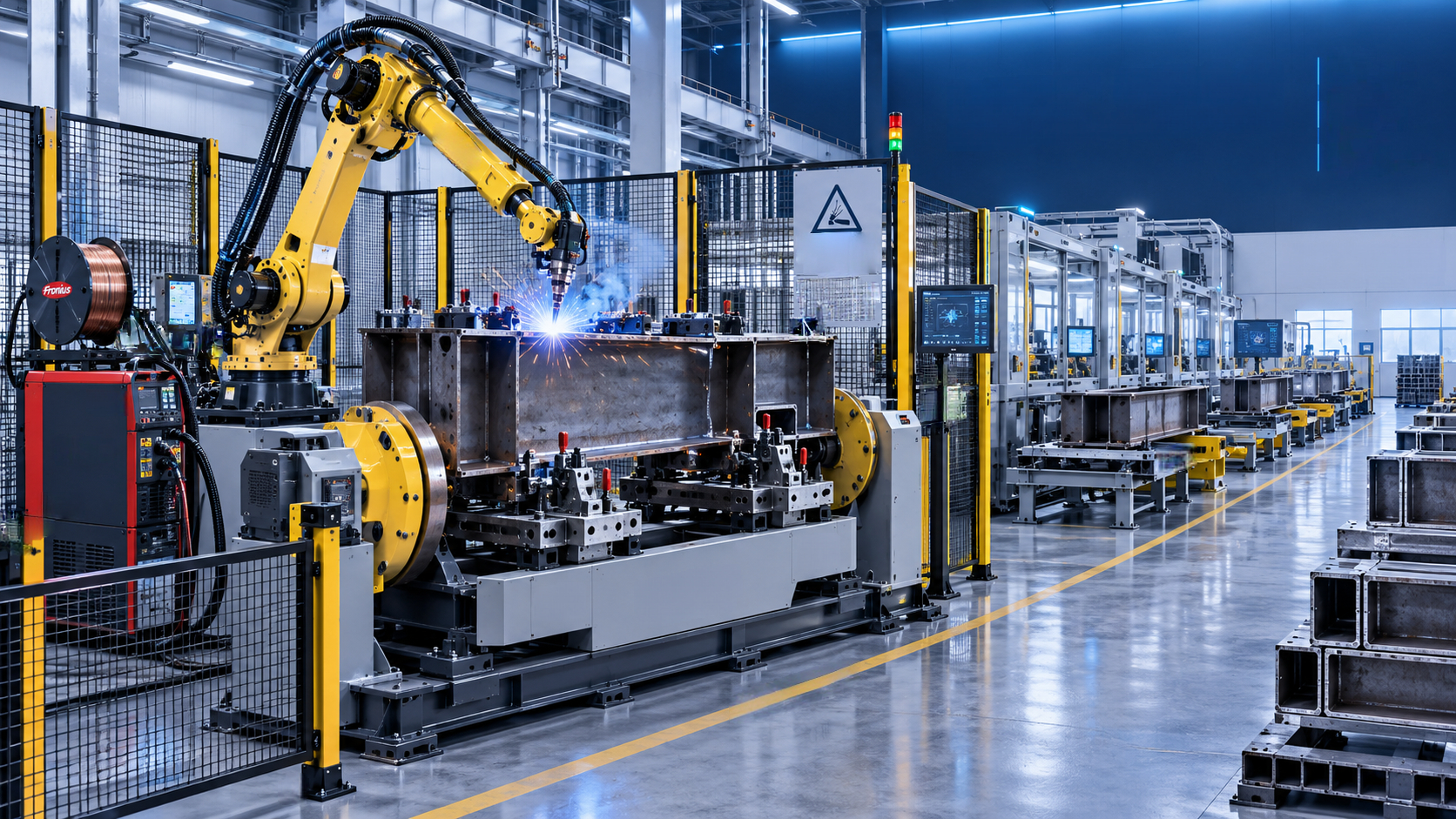
How Much Does a Complete Welding Robot Cell Cost in 2026?
Planning a robotic welding upgrade in 2026 requires more than comparing robot prices. A complete welding robot cell includes the robot, welding power source, safety guarding, positioners, fixturing, programming, installation, and ongoing support—each affecting total investment and ROI. Can a welding robot be customized for my factory layout? Absolutely, and layout customization is often essential for achieving efficient material flow, consistent weld quality, and scalable production.
The difficult part is that two cells with the same six-axis robot can have very different prices and very different production value. One may be a compact station for repetitive small brackets. Another may handle large structural assemblies, multiple product variants, external axes, automated loading, and traceability requirements. Calling both “a welding robot” hides most of the engineering that determines cost.
For most manufacturers, the right question is not simply, “What is the cheapest robot cell?” It is: “What level of automation matches our parts, batch sizes, quality requirements, floor space, and available operators?”
A practical 2026 budget range
There is no universal price because welding processes, payloads, workpiece dimensions, local safety requirements, and commissioning scope vary substantially. Still, early-stage planning often benefits from broad budget bands. The ranges below are best treated as indicative project-planning figures in USD, not fixed quotations. Freight, import charges, local installation work, and destination-country compliance needs can materially change the final number.
A lower figure may cover equipment supply but not a fully commissioned production system. A higher figure may include meaningful value: tailored fixtures, offline programming, weld trials, positioners, guarding, operator training, installation supervision, and a defined acceptance process. When comparing proposals, the scope matters more than the headline number.
Where the money actually goes
The robot arm is only one line item. Its reach, payload, wrist torque, repeatability, and brand ecosystem affect price, but it is rarely the sole driver. For arc welding, the selected power source and package are equally important. The package can include a wire feeder, torch, cable dress-out, torch cleaning station, wire-cutting function, seam-tracking capability, and interfaces between the robot controller and welding equipment.
Tooling is often underestimated. A robot cannot compensate indefinitely for inconsistent part location. If incoming components vary because of cutting, bending, machining, or fit-up tolerances, the fixture must locate the critical welding datums reliably. Clamps, locators, quick-change elements, anti-spatter provisions, and access for the torch all belong in the fixturing discussion. A simple welded frame may need only one fixture; a product family with many variants may require modular tooling or a carefully designed changeover approach.
Positioners can add a significant portion of the project cost, yet they are frequently the difference between a robot that waits and a cell that produces. A two-station headstock-tailstock arrangement, for example, lets an operator unload and reload one side while the robot welds on the other. The correct positioner capacity is determined not just by workpiece weight. Fixture weight, center of gravity, offset loading, rotation speed, cable routing, and safety margins must all be considered.
Then come the less visible but essential elements: perimeter guarding, interlocked access doors, safety PLC functions, extraction interfaces, electrical panels, foundations or anchoring, site utilities, and documentation. These are not optional extras inserted to inflate a quote. They are part of making a robotic welding station safe, maintainable, and suitable for real factory operation.
Can a welding robot be customized for my factory layout?
Yes—and customization should begin with material flow, not with a robot model. A factory may have a narrow bay, a column that cannot be moved, an overhead crane route, limited door clearance, or a requirement to feed parts from an existing cutting and fabrication line. These constraints shape the cell arrangement.
A practical layout review asks where parts arrive, where operators prepare them, how finished weldments leave the cell, and whether the welding station creates a bottleneck downstream. It also asks whether maintenance staff can reach the controller, torch cleaner, wire drum, and power source without entering a hazardous area or disrupting production.
Customization may involve changing the robot base position, selecting a longer-reach robot, using a floor-mounted or rail-mounted configuration, adding a turntable, or designing a compact single-station enclosure. For larger fabrications, the answer may be a robot on a linear track with multiple work zones. For parts that need welding on several faces, a coordinated positioner often provides a better result than trying to reach every joint from fixed workpiece orientation.
Customization does have a cost, but poor layout decisions cost more over time. A cell that forces operators to walk around barriers, wait for crane access, repeatedly reposition parts, or make awkward manual tack welds will not achieve its expected utilization. The goal is not to fit the robot into the last available empty corner. It is to create a work sequence that operators can repeat safely throughout a shift.
What determines whether automation will pay back?
Robotic welding is strongest when the work has repeatable geometry, enough volume to justify setup effort, and weld quality requirements that benefit from consistent parameters and torch paths. It can also be valuable where skilled welders are difficult to recruit or retain. But a robot is not a cure for uncontrolled incoming variation, poor joint design, or a product mix that changes every few units.
The relevant cost comparison includes more than direct welding labor. Manufacturers should consider manual fit-up time, rework, spatter removal, consumable usage, inspection failures, production interruptions, and the time spent moving heavy parts. At the same time, the robotic option must include programming time, fixture maintenance, consumables, training, planned preventive maintenance, and the likelihood of product changes.
Arc-on time is a useful reality check. If an operator spends much of the shift loading, unloading, grinding, finding components, or waiting for the next job, installing a robot alone will not solve the throughput issue. A two-station system, better part presentation, or upstream improvements to CNC cutting and bending may have greater impact than a more expensive welding package.
The hidden cost of choosing the wrong level of complexity
Over-specification is a real risk. Seam tracking, vision systems, automated loading, multi-robot coordination, and advanced data collection can be justified in the right application. They should not be added simply because they appear on a technology checklist. Every additional system introduces integration work, maintenance responsibility, and more conditions that must be understood by the production team.
Under-specification creates a different problem. A low-cost cell with insufficient reach, an undersized positioner, poor fixture access, or no allowance for the next likely product size may become difficult to use after the first production change. It is usually wise to define reasonable growth expectations early: new part dimensions, expected weight range, planned production volume, and whether more than one product family may enter the cell.
The best projects are not necessarily the most automated. They are the ones where the equipment, parts, operator tasks, and floor layout have been designed as one system.
Questions to settle before requesting a quotation
A meaningful proposal needs more than a photograph of the workpiece. Prepare drawings, material grades and thicknesses, joint types, target weld sizes, current cycle times, annual or monthly volume expectations, and representative part samples where possible. Identify the heaviest and largest parts, not only the average ones. If multiple variants are involved, show the whole family rather than the easiest component.
It is also useful to clarify whether parts arrive tack-welded, whether final weld appearance matters, what inspection method is used, and whether post-weld grinding is expected. Site information should include available electrical supply, compressed air, shielding gas arrangements, extraction provisions, floor loading, crane use, and space around the proposed location. Local machine safety and electrical requirements must be reviewed for the installation country rather than assumed from a generic equipment specification.
Wuxi Samgins International Trade Co., Ltd., established in 2012 in Wuxi, Jiangsu Province, works across welding automation, CNC cutting equipment, machine tools, H-beam production equipment, and other fabrication machinery. That broader equipment perspective is useful when a welding cell must connect with upstream cutting, bending, rolling, or machining processes rather than operate as an isolated purchase. Its products have been supplied to markets across Southeast Asia, Europe, the Americas, and Oceania, where delivery documentation and applicable requirements may differ by destination. Production and design are organized with reference to ISO9001 quality-system practices and EU CE standards where applicable to the project.
Buying a cell, not a robot
In 2026, a complete welding robot cell may begin around the cost of a well-equipped manual welding station fleet and rise into a far larger capital project when heavy parts, multiple stations, automation, and custom integration are involved. The price is important, but the real decision lies in what the quoted system will weld reliably, how operators will use it, and how easily it can adapt when production changes.
Before committing, ask for a layout concept, clear scope boundaries, fixture assumptions, cycle-time logic, safety inclusions, commissioning responsibilities, and a list of exclusions. A supplier should be able to explain not only what equipment is included, but why that configuration suits the part flow. That is the basis for comparing welding robot cell costs on something more useful than the lowest initial price.
search
Products Navigation
Send Us A Message