




Gantry, Rail-Mounted, or Fixed-Base Robots for Long Steel Beams?
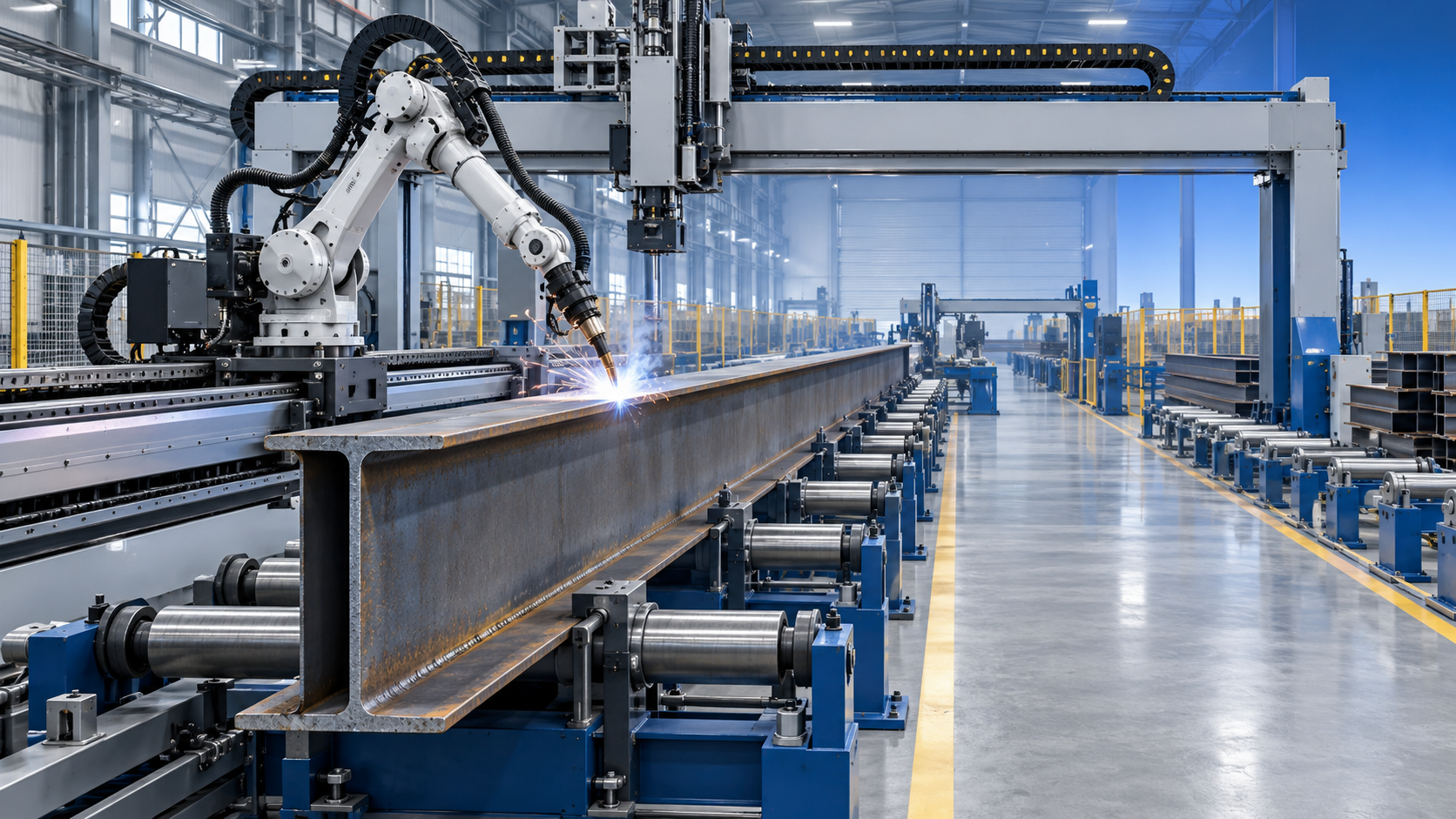
Gantry, Rail-Mounted, or Fixed-Base Robots for Long Steel Beams?
Choosing a welding robot for long steel beams is not simply a matter of selecting a robot with enough reach. The motion system around the robot often determines whether the cell is practical: whether it can access both sides of a beam, maintain a stable torch angle, fit into the available bay, and keep producing when beam sizes change. For structural steel fabricators, H-beam line builders, and manufacturers of heavy welded assemblies, the real decision is usually between a gantry system, a rail-mounted robot, and a fixed-base robot cell.
Cost naturally enters the discussion early. Buyers often ask, “How much does a complete welding robot cell cost?” There is no responsible single-number answer for a long-beam application. The robot itself is only one part of the investment. Tracks, gantries, beam turning equipment, clamping, seam-tracking, power sources, fume extraction, safeguarding, controls, installation, and commissioning can materially change the final scope. More importantly, the cheapest layout on paper can become expensive if operators spend too much time repositioning beams or correcting poor access at the weld.
The right configuration depends on beam length, beam section range, joint type, production mix, welding process, and the way material already moves through the workshop. A robot cell should follow the production flow, not force the fabrication shop to reorganize around a brochure layout.
Start with the Beam, Not the Robot Brand
Long steel beams create problems that are less visible in compact robotic welding cells. A beam may be straight when it enters the station but distort as heat accumulates. It may need fillet welds along both sides of a web, welds around stiffeners, end-plate connections, or intermittent attachments at changing locations. Heavy members also require reliable loading and support; a robot cannot compensate for a beam that shifts during welding.
Before comparing configurations, define the real envelope. That includes the longest and shortest beam, maximum weight, flange and web ranges, number of weld zones, allowable loading method, and whether the workpiece will be rotated. Shops often focus on the maximum beam length but overlook the minimum length. If short beams cannot be clamped or referenced efficiently on a long line, the system may lose much of its advantage on everyday production.
It is also worth separating repeat production from job-shop work. A fabricator producing similar H-beams or built-up girders day after day can justify more dedicated positioning and automation. A workshop handling varied structural members, brackets, trusses, and repair work may value flexibility more than the highest theoretical arc-on time.
Fixed-Base Robots: Sensible for Localized Work, Limited for Full-Length Seams
A fixed-base robot is installed on the floor, a pedestal, or occasionally beside a positioner. It is usually the most straightforward configuration to deploy when the welding area is compact and the workpiece can be presented consistently. For end plates, short beams, repeated bracket welding, and subassemblies, a fixed robot can be a very sound choice.
The limitation appears when a weld runs far beyond the robot’s useful working envelope. Extending the robot’s reach is not always the answer. At the outer edge of its reach, torch orientation, stiffness, cable routing, and access can become less favorable. A system may technically reach the seam but still produce awkward programming and inconsistent results, especially around flange-to-web joints or obstructed stiffeners.
Fixed-base cells work best when the beam is moved, indexed, or rotated to the robot rather than expecting the robot to cover the entire member. That can be practical where overhead cranes and transfer stations are already part of the operation. It becomes less attractive when each beam needs multiple stops, because every repositioning step adds handling time and introduces another opportunity for reference error.
This approach is often underestimated for mixed fabrication. A fixed-base cell paired with sensible fixtures can handle a changing range of smaller welded components without dedicating a long section of the factory to one product family. But for uninterrupted longitudinal welding on long beams, it is usually a compromise rather than the first-choice architecture.
Rail-Mounted Robots: A Practical Balance of Reach and Flexibility
Mounting a robot on a linear rail adds an external axis, allowing the robot to travel along the beam. In many long-beam applications, this is the most balanced solution. The robot can maintain a more favorable posture while moving along a seam, rather than repeatedly approaching the work from the limit of its arm reach.
A rail-mounted robot is especially useful when the production line has one principal welding lane and the workpiece remains in a stable horizontal position. It can weld long fillet seams, move between stations on the same beam, and accommodate different beam lengths without changing the entire cell layout. If the beam is supported on rollers, saddles, or a dedicated fit-up station, the robot rail can be aligned with that working axis.
The quality of the rail installation matters more than some purchasers expect. Track straightness, base rigidity, cable management, axis calibration, and protection from welding spatter all affect long-term repeatability. In a steel fabrication environment, rails must also be planned around crane movement, operator access, loading paths, and service access. Installing a rail too close to the work may improve reach on one side but make maintenance and manual intervention difficult.
A single robot on a rail can be enough for moderate output, particularly where welding remains only one part of a broader fabrication route. For higher demand, two robots may work on different zones of the same beam or on parallel stations. That arrangement requires careful collision zones and production sequencing. Two robots do not automatically double output if fitting, turning, or loading remains the bottleneck.
Gantry Robots: Strong Coverage for Dedicated Beam Lines
A gantry system places the robot or robotic welding carriage on an overhead bridge structure spanning the work area. Depending on the design, it can travel along the beam length and across the width of the station. This makes it particularly suitable for large members where access is needed from multiple sides or where floor-level obstructions would interfere with a rail-mounted system.
For long H-beams, box beams, and built-up structural sections, a gantry can support a more organized automated line. The working zone below remains relatively open for conveyors, beam supports, turning equipment, and material transfer. When configured properly, the system can access welds that would be inconvenient from a floor rail, especially if fixtures or beam geometry limit side access.
The trade-off is complexity. A gantry is not just a robot mounted higher in the air. It needs a stable structural support system, accurate travel geometry, safe access provisions, and a clear relationship with overhead cranes. In facilities with limited roof height, existing crane rails, or congested bays, the civil and mechanical integration can be the deciding issue. It is wise to review the building before finalizing the robotic concept, not after equipment has been ordered.
Gantry automation generally makes the most sense when beam production is a defined, repeatable business rather than occasional work. It can offer excellent coverage and a clean process layout, but it should be justified by workflow, not chosen merely because it looks more automated.
A Direct Comparison for Long-Beam Welding
What Actually Drives the Cost of a Complete Welding Robot Cell?
When evaluating how much a complete welding robot cell costs, buyers should request a scope breakdown rather than comparing a single total figure. The apparent price gap between two proposals can result from entirely different assumptions about material handling, safety, weld preparation, or commissioning.
For long steel beams, the largest cost variables commonly include the robot and controller, welding power source, external travel axis, beam supports or rotators, fixtures, sensing technology, safety fencing or other safeguarding, electrical integration, and installation work. A gantry adds its bridge structure and supporting arrangement. A rail system adds track length and its associated mechanical and electrical infrastructure. A fixed-base cell may look lower in initial cost but may require additional handling equipment if the beam must be indexed through multiple weld positions.
Seam tracking and adaptive welding deserve an honest conversation. If incoming parts are accurately fitted and consistently clamped, a programmed path may be sufficient for many joints. If plate variation, fit-up gaps, or heat distortion are common, sensing can protect weld quality and reduce manual correction. It also adds equipment, setup work, and maintenance requirements. The right question is not whether advanced sensing is available; it is whether variation in the actual fabrication process justifies it.
There is another cost that does not appear clearly in quotations: downtime caused by poor integration. A robotic station that cannot be loaded while welding, cannot be serviced without stopping adjacent operations, or forces crane conflicts will struggle to meet its intended output. Layout review should include the whole shift, including fit-up, tack welding, loading, welding, inspection, unloading, and rework.
Welding Quality Depends on More Than Robot Motion
A robotic system repeats what it is given. If the beam is poorly assembled, the robot will repeat poor conditions very consistently. Fit-up control, tack position, joint cleanliness, stable grounding, and correct support spacing remain fundamental. For long members, support placement should be reviewed with expected thermal movement in mind. A beam that sags slightly under its own weight can move the joint outside a programmed path over several metres.
The welding process must be selected around the joint and production target. Some beam lines suit high-deposition automated processes; others need the flexibility of robotic arc welding for variable attachments and discontinuous seams. Access for slag removal, spatter cleaning, nozzle maintenance, and weld inspection should be planned at the same time. These details are rarely glamorous, but they determine whether a system remains productive after the first months of operation.
Choosing a Supplier Who Understands the Whole Line
The most useful equipment discussion is usually broader than the robot cell itself. Long-beam automation may involve CNC cutting, edge or end-face milling, fit-up, welding, straightening, drilling, and material transfer. A supplier that understands the sequence can identify where robotic welding will help and where an upstream inconsistency may undermine it.
Wuxi Samgins International Trade Co., Ltd., established in 2012 in Wuxi, Jiangsu Province, supplies welding automation, CNC cutting equipment, machining equipment, H-beam production line machinery, and related metalworking systems. Its product scope is relevant because beam fabrication decisions rarely sit in isolation from cutting, milling, handling, and finishing. For export projects, requirements should be reviewed against the destination market and the final machine scope; production and design may need to align with applicable ISO 9001 quality-system practices and EU CE requirements where relevant.
For a shop with varied work and limited floor length, a fixed-base robot or a shorter rail may be the disciplined choice. For regular long-beam fabrication, a rail-mounted robot often offers the best compromise between investment and usable reach. Where production is dedicated, access demands are broad, and the building supports it, a gantry can become the more coherent long-term layout. The sound decision comes from mapping the beam route, the welds, and the handling steps before selecting the robot configuration.
search
Products Navigation
Send Us A Message