




Which Welding Robot Configuration Is Best for Long Steel Beams?
Which welding robot configuration is best for long steel beams? In most high-volume structural fabrication plants, a rail-mounted gantry robot or dedicated H-beam welding line delivers the strongest balance of reach, consistency, and throughput.
The right answer changes when beam profiles, joint types, daily tonnage, factory space, and handling equipment differ. A robot arm alone rarely solves the full production challenge for heavy, lengthy components.
For managers, the key decision is not simply choosing a robot brand. It is selecting a complete system that positions, clamps, welds, tracks, and unloads beams reliably.
This guide explains the practical configurations available, where each fits, and how to evaluate expected productivity before investing in automated welding equipment for long steel beams.
Start With the Real Production Requirement
Long steel beams create different automation demands than small fabricated parts. Their length, weight, deflection, and joint variation require coordinated material handling and accurate robot travel over extended distances.
Before comparing configurations, define the maximum beam length, flange width, web height, material thickness, and component weight. These dimensions determine the required travel axis, fixture capacity, and safety envelope.
Production mix matters equally. A fabricator producing standard H-beams every day needs a different solution from a workshop building varied bridge components, crane girders, or customized structural assemblies.
Also identify the welds that consume the most time. Continuous fillet welding between web and flange, stiffener welding, end-plate welding, and cover-plate work may require separate automation approaches.
A useful first question is whether the beam should move through the station or remain fixed while the robot moves. For very long and heavy workpieces, moving the robot is often easier.
Best Overall Choice: Rail-Mounted Gantry Welding Robots
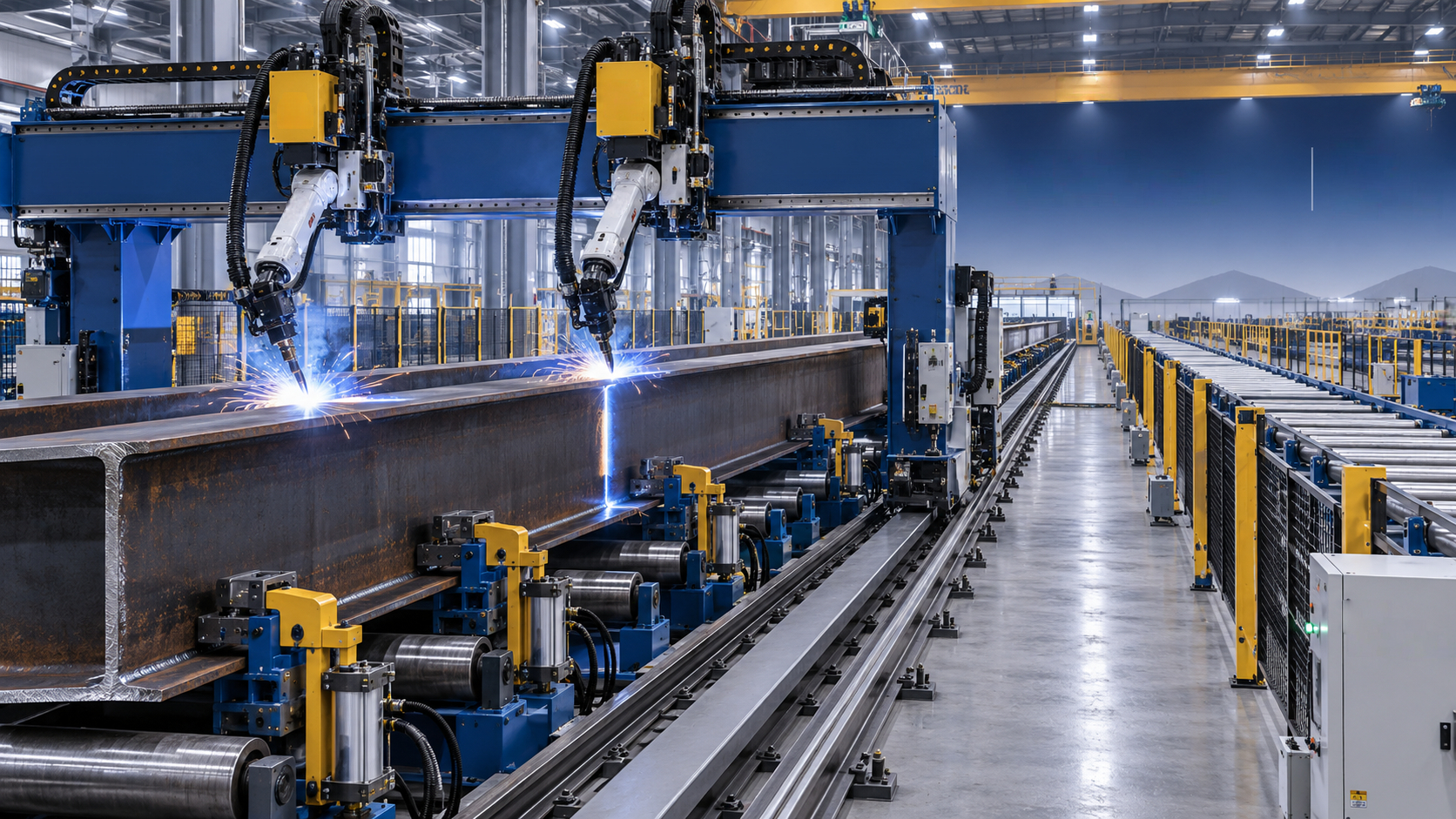
For long steel beams with variable sizes and repeated weld paths, a rail-mounted gantry welding robot is usually the most versatile configuration. The robot travels beside or above the beam.
The system combines a six-axis welding robot with a long linear track. This seventh axis extends working reach without requiring operators to reposition heavy beams repeatedly.
A gantry structure can support one robot, two synchronized robots, or robots working on opposite sides. This allows simultaneous welding of paired seams and improves cycle-time performance substantially.
For H-beams, robots can travel along the web-flange connection while maintaining torch angle, stick-out, and travel speed. Consistent parameters are particularly valuable on long continuous fillet welds.
The main advantage is flexibility. Beam length can be increased by extending the rail, while programs can be adjusted for different profiles, stiffeners, brackets, and production schedules.
This configuration is especially suitable for fabricators handling beams from six to twenty meters or more, provided the facility has sufficient floor length and dependable loading arrangements.
When a Dedicated H-Beam Welding Line Is Better
A dedicated H-beam production line is often the better choice when the factory mainly manufactures standard welded H-beams in high volume with relatively predictable dimensions and joint designs.
These systems commonly combine web and flange assembly, hydraulic clamping, automatic centering, tack welding, submerged arc welding, straightening, and conveying in an organized production flow.
Instead of treating welding as an isolated task, the line manages the complete beam-building process. This reduces manual transfer points and prevents alignment errors between upstream and downstream operations.
Submerged arc welding is particularly efficient for long straight seams on thick structural sections. It offers high deposition rates and is well suited to repetitive H-beam fabrication.
However, dedicated lines are less flexible than general-purpose robotic cells. They are most economical when product design, section ranges, and output requirements justify dedicated tooling and floor space.
Companies making standard construction beams, warehouse columns, industrial building members, and repeated steel-frame sections should evaluate this option before purchasing a standalone robot system.
When a Conventional Robot Cell Can Still Work
A conventional fixed-base robotic welding cell can work for shorter beam segments, attachments, end plates, and subassemblies. It is usually not the primary answer for full-length heavy beams.
Its working envelope is limited by robot reach. Extending coverage with a positioner may be practical for compact parts, but rotating a long, heavy beam requires expensive specialized handling equipment.
Fixed cells are valuable when the main welding workload involves repetitive brackets, connection plates, gussets, or stiffener modules that are later attached to larger structural assemblies.
They can also support an incremental automation plan. A company may automate recurring component work first, then add a long-track robot or beam line as demand increases.
The limitation is material flow. If operators must repeatedly crane the beam into multiple positions, expected labor savings and cycle-time improvements may disappear quickly.
For this reason, fixed robotic cells should be assessed as part of a wider fabrication strategy rather than assumed to be the best welding robot configuration for long steel beams.
Choose Single-Robot or Dual-Robot Layouts Carefully
A single robot on a rail is typically sufficient for moderate output, one-sided access, or mixed production. It has lower capital cost and simpler programming, maintenance, and commissioning requirements.
A dual-robot gantry becomes attractive when both sides of a beam need similar welds, or when long seam welding creates a significant bottleneck in the production schedule.
Two robots can weld opposite web-flange joints simultaneously, provided heat input and clamping are controlled. This may nearly halve welding travel time for suitable symmetrical assemblies.
Dual systems do not automatically double output. Loading speed, fixture accuracy, upstream fit-up quality, welding power capacity, and downstream inspection can still limit total production throughput.
They also require more rigorous collision avoidance, coordinated programming, and maintenance planning. The return on investment is strongest when the second robot stays productively utilized across most shifts.
For low-volume custom fabrication, one robot with well-designed rail travel and efficient handling is often more profitable than a larger system operating below its intended capacity.
Beam Positioning Is as Important as Robot Reach
Robotic welding quality depends heavily on how consistently the beam is presented. Even advanced seam tracking cannot fully compensate for poor fit-up, unstable supports, or uncontrolled beam distortion.
Long beams should be supported at calculated intervals to reduce sagging. Support points must accommodate different section sizes while keeping the weld joint within the robot’s programmed working range.
Hydraulic or servo-controlled clamping improves repeatability during assembly and welding. Proper clamping keeps web and flange alignment stable while controlling the effects of welding heat.
Powered roller conveyors are useful for moving standard beams through an automated line. For varied heavy structures, stationary fixtures with robot travel may offer better control and lower handling complexity.
Turnover devices can improve access to multiple faces, but they must be sized for the largest workpiece and installed with appropriate guarding, interlocks, and load-rated safety systems.
When evaluating supplier proposals, ask for a complete handling sequence. A fast robot cannot recover time lost through crane waiting, manual alignment, or difficult part turnover.
Use Sensing Technology for Real Workshop Conditions
Nominal CAD dimensions rarely match every fabricated beam perfectly. Plate variation, tack welds, heat distortion, and inconsistent assembly can shift the weld joint from its programmed location.
Touch sensing is a practical starting point for locating workpiece edges and confirming joint position before welding. It is often sufficient for repeatable beam assemblies with controlled fit-up.
Laser seam tracking provides more adaptive control for variable joint locations. It can detect seam position during welding and adjust torch path, helping maintain weld placement over long distances.
Arc tracking can also correct minor deviations by reading electrical welding signals. Its suitability depends on joint type, welding process, surface condition, and the desired correction accuracy.
Vision and sensing should support good fabrication discipline, not replace it. Better plate preparation, assembly fixtures, and tack-weld consistency often deliver the most cost-effective quality improvement.
For structural steel producers, the best specification typically combines robust mechanical positioning with sensing selected for the actual variability found in daily production.
Select the Welding Process Around the Joint
The robot configuration and welding process must be chosen together. A system optimized for gas metal arc welding may not provide the deposition rate required for thick H-beam seams.
Robotic MIG or MAG welding is flexible and suitable for many fillet welds, stiffeners, brackets, and moderate-thickness structural components. It supports frequent program changes and varied assemblies.
Submerged arc welding is usually preferred for long straight welds on heavy H-beams. Its high deposition rate can significantly improve productivity in standardized beam manufacturing operations.
For thick plates, multi-pass welding may still be necessary. The system should manage pass sequences, interpass cleaning requirements, heat input, and distortion control across the beam length.
Welding power sources should provide stable communication with the robot controller. Parameter recipes must be saved by material grade, thickness, wire diameter, shielding gas, and joint configuration.
Ask suppliers to demonstrate weld quality on representative samples. A successful demonstration should include actual steel grade, realistic fit-up gaps, required weld size, and inspection criteria.
Calculate ROI Beyond Labor Savings
Labor reduction is important, but it is not the only benefit of robotic beam welding. The strongest business case includes higher arc-on time, predictable output, reduced rework, and improved delivery reliability.
Manual welding performance varies by shift, operator availability, fatigue, and access conditions. Robots apply repeatable travel speed and torch orientation, which helps stabilize weld quality and production planning.
Calculate current costs using actual cycle times, crane movements, fitting labor, weld repairs, consumable consumption, inspection delays, and production interruptions. Avoid estimates based only on hourly welder wages.
Then model realistic robot utilization. Include loading time, programming changes, preventive maintenance, fixture adjustment, operator supervision, and product changeovers rather than assuming uninterrupted welding operation.
A high-output system may not be justified for a workshop producing only occasional long beams. Conversely, under-sizing a system can create another bottleneck as customer demand expands.
Consider phased investment where appropriate. A rail-mounted robot, modular conveyors, and expandable control architecture can provide a practical route toward larger automated beam production later.
Plan for Safety, Installation, and Service
Long-beam robotic welding systems need a clear safety concept. Risks include moving gantries, robot travel, suspended loads, rotating positioners, welding arc exposure, fumes, and hot finished components.
Install perimeter guarding, interlocked access points, emergency stops, warning indicators, and safe loading zones. The layout should separate crane operations from automatic welding movements wherever possible.
Fume extraction must be designed for the welding process and station size. Effective extraction protects personnel, improves visibility, and prevents contamination from affecting sensors and mechanical components.
Service access matters over the equipment’s full life cycle. Rails, cable carriers, torches, wire feeders, sensors, reducers, and welding power sources should remain accessible for inspection and replacement.
Confirm local electrical standards, CE requirements where applicable, compressed-air needs, foundation conditions, and installation responsibilities before signing a purchase agreement. These details affect project timing and total cost.
A capable supplier should provide layout drawings, technical specifications, operator training, commissioning support, spare-parts planning, and clear acceptance criteria based on the buyer’s actual production requirements.
Make the Configuration Decision With a Practical Matrix
Choose a rail-mounted gantry robot when beam sizes vary, different weld patterns are common, and the factory needs flexible automation across lengthy structural components.
Choose a dedicated H-beam welding line when output is high, product dimensions are relatively standardized, and long web-flange seams dominate the workload every day.
Choose a conventional robot cell when the main opportunity lies in smaller subassemblies, attachments, and repetitive fabricated parts rather than complete long beams.
Choose dual robots when simulation and production data show that welding time remains the main constraint after material handling, fit-up, clamping, and downstream inspection are properly organized.
In every case, specify the robot together with rails, fixtures, conveyors, sensors, welding power sources, safety equipment, and software. The integrated system determines the actual result.
The best welding robot configuration for long steel beams is therefore the one that matches real part geometry and production flow, not simply the system with the largest robot or longest specification list.
Conclusion
For most manufacturers welding long steel beams, a rail-mounted gantry robot offers the best combination of reach, flexibility, weld consistency, and future scalability.
For standardized, high-volume welded H-beam production, a dedicated assembly and welding line with submerged arc capability can provide higher throughput and stronger unit-cost performance.
Make the decision using real beam data, actual handling steps, expected output, welding requirements, and service capability. A properly engineered automated system can improve both quality and operational control.