




China vs Europe Shearing Machine Prices: What Buyers Should Know
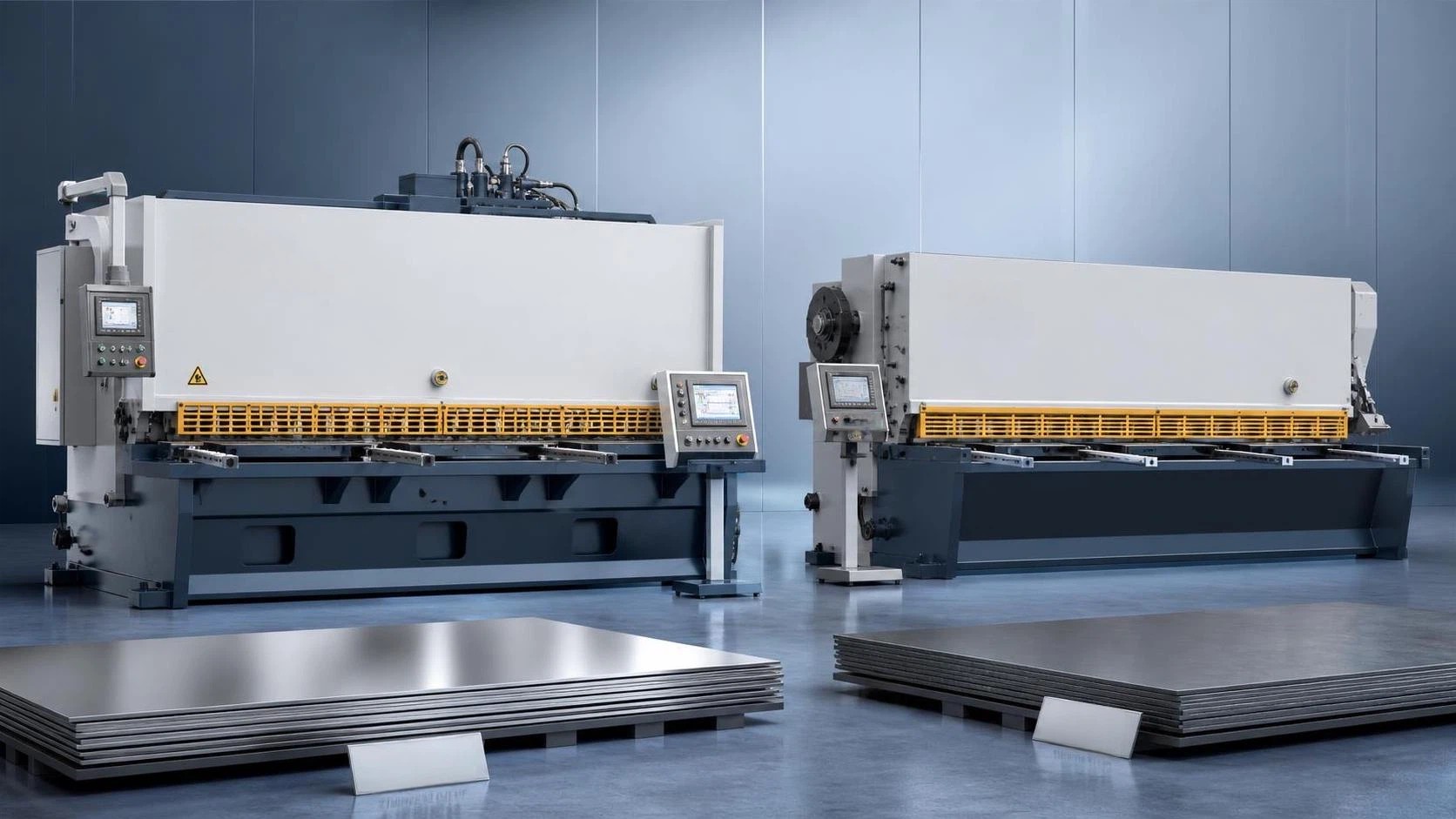
Price gaps between Chinese and European shearing machines usually come from specification detail rather than geography alone. Two machines may both be described as hydraulic guillotine shears or swing beam shears, yet their frames, blade arrangements, backgauge accuracy, hydraulic components, electrical layout, guarding, and factory test standards can differ enough to change the quote substantially. A useful shearing machine price comparison China vs Europe manufacturer discussion starts by stripping away the catalog label and looking at the exact machine configuration.
Machine type is the first source of variation. A small gap between a basic swing beam shear from China and a more fully equipped European hydraulic guillotine may look like a regional price issue when it is actually a design issue. Swing beam structures are often simpler and can be suitable for general mild steel work, but guillotine shears are often preferred where cut quality, reduced blade clearance variation, and better performance across different thicknesses matter. Once sheet thickness increases, or when stainless steel and harder materials are processed regularly, differences in machine structure become easier to see in both performance and final cost.
Frame construction changes the price before any options are added
One of the least visible cost drivers is the main frame. On paper, two machines may share the same nominal cutting length and thickness rating. In practice, the frame plate grade, weld design, stress relief process, machining accuracy on critical mounting faces, and assembly tolerances all affect rigidity. A heavier and better machined frame usually adds cost, but it can also reduce twisting under load, improve blade life, and keep the cut more consistent from one side of the table to the other.
European machines are often quoted with more detail around frame machining, hydraulic manifold integration, and beam guidance. Chinese machines can also be built to a high standard, but the quote may depend heavily on whether the machine is a standard export model or a more customized build with tighter tolerances and upgraded structural treatment. This is why a low opening quote can expand once options such as improved backgauge drives, higher-grade seals, or more precise blade carriers are added.
Quoted cutting capacity often hides important assumptions
A declared capacity such as 6 mm by 3200 mm is not always enough to compare machines fairly. Some listings are based on mild steel with a certain tensile strength under ideal blade condition and reduced duty cycle. Another machine may be rated more conservatively. When stainless steel, high-tensile plate, aluminum, or coated sheet is involved, the practical cutting range may change. Price comparisons become distorted if one machine is quoted against maximum theoretical capacity and the other against a more continuous working condition.
Blade material and blade geometry matter as well. A machine supplied with standard blades may be adequate for carbon steel but wear faster on stainless steel or leave edge deformation that becomes a problem in downstream bending or welding. Buyers often focus on the main machine price while underestimating how blade replacement frequency affects real operating cost.
Backgauge and control systems create large pricing spread
The difference between a manual or simple motorized backgauge and a CNC-controlled multi-axis backgauge is significant. A basic machine with coarse positioning may suit rough fabrication, but repeat jobs with narrow tolerance windows usually need smoother ball screw movement, reliable linear guides, servo control, and stable repeatability over the full stroke. European machines are often priced with more advanced control packages as standard, while Chinese quotations may separate the base machine from optional CNC upgrades.
This matters because the usable value of a shear depends on the whole cutting process, not only on whether the blade can pass through the sheet. If the backgauge drifts, if retract timing is poor, or if the operator spends too much time correcting dimensions, the machine may be cheap to purchase but expensive to run in labor hours and scrap.
Control interface also affects support cost later. A sophisticated controller can store programs, control rake angle or blade gap adjustment, and simplify repetitive jobs. At the same time, more electronics can mean higher replacement cost if parts are proprietary or if local technicians are unfamiliar with the system. In a China vs Europe shearing machine prices comparison, this can be one of the hidden balances: lower acquisition cost versus easier local familiarity with certain control brands or wiring standards.
Hydraulic and electrical components are not interchangeable in value
Many quotations look similar until the component list is opened. Hydraulic pumps, valves, seals, cylinders, and motors can vary widely in service life and stability. Electrical cabinets may differ in layout discipline, cable marking, heat management, and ease of troubleshooting. Two shears that look nearly identical from outside may behave very differently after long production shifts, especially in hot workshops, dusty plate-processing lines, or plants with unstable power conditions.
European machines are often associated with tighter documentation and more standardized electrical practices. Chinese machines may offer a broader range, from economical standard builds to highly specified export versions. A low-cost machine sometimes omits details that are only noticed during installation: limited cable labeling, less accessible hydraulic service points, or a simpler lubrication arrangement. None of these automatically make the machine unsuitable, but they should be treated as real cost variables rather than minor finishing details.
Safety and compliance can shift the comparison
In cross-border purchasing, guarding and compliance expectations can change the machine specification more than expected. Finger protection, light curtains, side and rear guarding, emergency stop layout, electrical interlocks, warning labeling, and documentation quality may all be configured differently depending on destination requirements. When a quote from China seems much lower than one from Europe, it is worth checking whether the safety package is truly equivalent.
Even small additions can affect layout and price: a pneumatic sheet support system, front support arms with scale stops, scrap chutes, shadow line lighting, or hold-down arrangements for thinner sheet. A machine intended for high-mix sheet metal fabrication may need these details, while a simpler plate-cutting workshop may not. If the use case is not matched carefully, comparison by headline price alone can be misleading.
Shipping cost is only part of landed cost
Transport from China often receives the most attention, but landed cost has more layers than freight. Crating method, machine footprint, oil drainage requirements, customs classification, inland transport, unloading equipment, and final positioning at site all add practical cost. A large shear may require careful lifting points and floor load review, especially when the machine bed is long and heavy.
European supply can reduce transit time in some regions and may simplify communication during pre-delivery inspection, but that does not automatically mean lower total project cost. If the destination workshop needs electrical conversion, local guarding modifications, or software localization, those expenses can narrow the difference. On the Chinese side, a well-packed machine with complete manuals, spare seals, blade adjustment instructions, and remote commissioning support may arrive with fewer startup delays than expected. The opposite can also happen if documentation is sparse.
Installation and commissioning affect the real value of a lower quote
Shearing machines appear straightforward compared with more complex CNC systems, yet installation quality still matters. Leveling the machine, checking hydraulic oil grade, adjusting blade clearance, setting rake angle where applicable, calibrating backgauge position, verifying squareness, and testing under actual material load all determine whether the machine performs to its rated standard. A quote that excludes commissioning support can create uncertainty later, especially if the workshop processes multiple material grades and thicknesses.
One common misunderstanding is assuming that cutting test samples at the factory guarantee production stability after installation. Floor condition, power quality, operator setup habits, and material flatness all influence cut results. Thin stainless sheet can show burr or twist if blade gap and hold-down pressure are not tuned correctly. Thicker carbon steel may expose frame deflection or gauge inconsistency that was not obvious during acceptance of simple sample cuts.
Lead time and customization are often priced differently
Chinese manufacturers are often more flexible when non-standard throat depth, special voltage, front feeding support, conveyor integration, or custom backgauge travel is requested. That flexibility can be commercially attractive, but it also means the quote needs careful reading. A customized machine may no longer reflect the base price usually associated with Chinese equipment. Added engineering time, special procurement of components, and extra factory testing can narrow the gap with European offers.
European machines may carry a higher initial quote but include mature option packages with clearer documentation and more predictable integration into automated lines. When a shear must work alongside feeding tables, stacking devices, or upstream decoiling systems, interface details such as signal exchange, cycle timing, and safety zoning matter. These engineering details have a direct price impact even though they are not visible in the machine silhouette.
Service access is more important than brochure wording
Spare parts planning is one of the most practical points in any shearing machine price comparison China vs Europe manufacturer review. Blades, seals, solenoid coils, sensors, relays, and controller parts need realistic availability. Some machines use widely available industrial components; others rely on less common items that may lengthen downtime. Service manuals should ideally include hydraulic schematics, electrical drawings, wear part references, blade alignment procedures, and fault descriptions that are usable on the shop floor.
A lower purchase price can remain attractive if the machine uses common hydraulic and electrical parts and if wear items are documented clearly. A more expensive machine can still be justified where local support is strong, technical files are complete, and downtime cost is high. The comparison only becomes meaningful when serviceability is treated as part of the machine itself.
Material mix and production rhythm should shape the comparison
The same machine can be a good value in one workshop and a poor fit in another. Short runs of mild steel blanks place different demands on a shear than frequent stainless jobs, narrow strip cutting, or long sheets that must feed accurately into bending operations. Thin sheet work may require attention to hold-down marking, squareness arm usability, and support for preventing sheet droop. Heavier plate work shifts attention toward frame rigidity, cylinder stability, blade wear, and motor reserve.
Production rhythm matters too. Intermittent cutting allows a simpler hydraulic package to rest between cycles. Repetitive high-volume cutting highlights oil temperature behavior, return speed consistency, and backgauge durability. If a quote is built around occasional use but the actual application involves long runs, the apparent saving may disappear in maintenance interruptions and adjustment time.
Common misreadings in price comparisons
- A lower quote may exclude blades for stainless steel, front sheet supports, oil, commissioning, or electrical adaptation.
- Nominal thickness rating can be based on a material strength that does not match the intended work.
- Backgauge travel and repeatability are sometimes assumed rather than stated clearly.
- Photos can show optioned machines while the quotation covers a simpler standard version.
- Factory acceptance may be done on narrow test strips instead of the full working width.
Another frequent mistake is comparing only the machine body and ignoring the surrounding process. If cut parts move directly to press brake forming, welding, or automated sorting, inconsistencies in edge quality and dimension control can cause delays downstream. In that setting, a more expensive shear may reduce rework even if the cutting action itself seems similar during a short demonstration.
China versus Europe is therefore a useful starting frame, but it should not be the final one. The better comparison is between two fully specified shearing machines aimed at the same material range, same duty cycle, same control expectation, and same installation condition. Once that alignment is done, the price difference usually becomes easier to explain. Sometimes the lower quote remains the better fit. Sometimes the extra cost reflects features that will actually be used. The answer sits in the details of the machine, not in the region printed on the quotation.
search
Products Navigation
Send Us A Message