




Cobalt Welder Explained: Why Cobalt-Alloy Electrodes Are Critical for Hardfacing Valves in Oil & Gas Downhole Tools
Cobalt Welder Explained: Why Cobalt-Alloy Electrodes Are Critical for Hardfacing Valves in Oil & Gas Downhole Tools
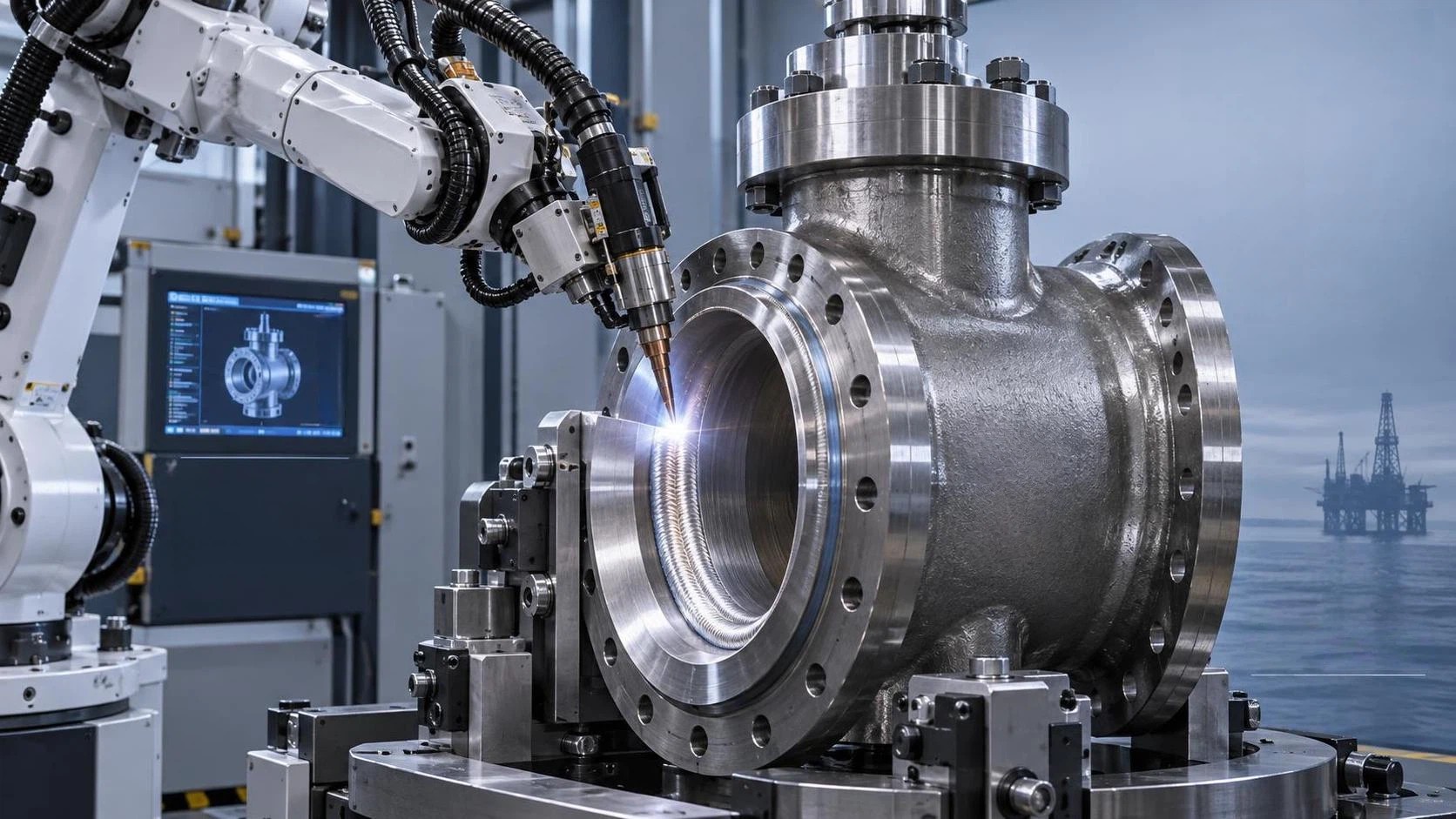
For oil & gas downhole tool engineers and technical evaluators, selecting the right cobalt welder is non-negotiable when hardfacing critical valve components exposed to extreme abrasion, corrosion, and thermal cycling. Cobalt-alloy electrodes—delivered via precision cobalt welders—deliver unmatched wear resistance and high-temperature stability where conventional welding falls short. At Wuxi Samgins, our ISO9001- and CE-certified automatic welding systems are engineered specifically for consistent, repeatable cobalt deposition in demanding industrial applications—ensuring valve longevity, operational safety, and reduced downtime across global upstream operations.
What Does “Cobalt Welder” Actually Mean — And Why It’s Not Just a Marketing Term?
A “cobalt welder” isn’t a standalone machine category—it’s a functional designation for welding equipment capable of reliably depositing cobalt-based hardfacing alloys (e.g., Stellite™ 6, 12, 21) under tightly controlled thermal and metallurgical conditions. Technical evaluators often misinterpret this as a product name rather than a performance requirement. The distinction matters: inconsistent heat input, poor arc stability, or inadequate shielding gas control can cause carbide segregation, microcracking, or dilution—compromising the very properties cobalt alloys are selected to deliver.
True cobalt welding demands more than amperage range or wire feed speed. It requires precise thermal management, minimal base-metal dilution (<10%), and repeatable bead geometry across multi-pass layers. That’s why manual TIG or basic MIG setups rarely meet specification for downhole valve seats, choke bodies, or ball valve surfaces. What qualifies as a cobalt welder in practice is a system engineered for metallurgical fidelity—not just mechanical motion.
The Real Failure Modes in Downhole Valve Hardfacing — And Where Cobalt Welders Prevent Them
Downhole tools operate under cyclic loads exceeding 15,000 psi, temperatures up to 400°C, and abrasive slurry containing silica, sand, and iron sulfides. Field failure analysis from major operators shows three dominant root causes: premature seat erosion (68% of unplanned interventions), thermal fatigue cracking (22%), and galvanic corrosion at the hardfaced interface (10%). Each maps directly to welding process shortcomings—not alloy selection alone.
Cobalt-alloy electrodes excel here because their Co-Cr-W matrix forms stable chromium carbides that resist both abrasive gouging and oxidation. But only if deposited correctly: excessive interpass temperature (>300°C) degrades carbide dispersion; too-rapid cooling induces martensitic transformation and cracking; inconsistent bead overlap creates weak zones vulnerable to fluid impingement. A qualified cobalt welder mitigates these risks through closed-loop arc tracking, real-time voltage/amperage compensation, and programmable interpass cooling protocols.
Why Automation Isn’t Optional — It’s the Only Way to Achieve Repeatable Cobalt Deposition
Manual cobalt welding introduces unacceptable variability—even among certified welders. Heat input fluctuates ±25% across a single pass; travel speed varies by ±18%; torch angle drift affects dilution by up to 7%. For valves with tolerance bands under ±0.15 mm and hardness requirements of 42–55 HRC, those variances translate directly into field failures.
This is where purpose-built automation becomes essential. Systems like our 9 axis cantilever type welding robot provide deterministic control over every deposition variable. Its 9-axis kinematics enable full-envelope access to complex valve geometries—including internal bores, tapered seats, and offset flanges—without repositioning. Integrated auto-tracking corrects for part distortion or fixture shift in real time, maintaining ±0.3 mm seam accuracy even on large steel workpieces. Crucially, its CNC welding automation supports preloaded thermal profiles calibrated for Stellite 21’s narrow 1,250–1,350°C optimal solidification window.
Key Technical Evaluation Criteria — Beyond “It Runs”
When qualifying a cobalt welder, technical evaluators must go beyond nominal specs. Ask these five questions:
1. Does it support dual-shielding gas control? Cobalt alloys require precise Ar + H₂ or Ar + N₂ blends to prevent nitrogen embrittlement and optimize carbide morphology. Verify independent mass-flow controllers—not just preset gas switches.
2. Is interpass temperature actively monitored and enforced? Look for integrated infrared pyrometry with closed-loop cooling triggers—not just timer-based pauses.
3. How does it handle joint fit-up variation? True auto-tracking must adjust torch height and angle dynamically—not just follow a pre-programmed path. Request validation data from actual valve repair jobs.
4. Are hardness and dilution test results traceable per ASME Section IX? Reputable suppliers provide certified weld procedure specifications (WPS) with microhardness traverses and EPMA dilution reports—not just tensile strength claims.
5. Can it integrate with your existing metrology workflow? Seamless import of 3D CAD models (STEP/IGES), one-click weld seam extraction, and post-weld CMM alignment verification are non-negotiable for production-critical components.
Material Compatibility, Certification, and Why ISO9001 + CE Alone Aren’t Enough
While ISO9001 and CE certification confirm process discipline and electrical safety, they say nothing about metallurgical competence. A cobalt welder must be validated against ASTM A533/A533M (for Stellite overlays) and API RP 1104 Annex D (welding procedures for oilfield equipment). At Wuxi Samgins, every cobalt-capable system undergoes third-party destructive testing on P110-grade steel substrates with simulated downhole thermal cycling—measuring crack density, bond strength (>650 MPa), and post-cycle hardness retention.
We also verify compatibility across common valve base materials: 13Cr stainless, duplex 2205, Inconel 718, and ASTM A105 forgings. This ensures the welder doesn’t induce hydrogen cracking in high-strength steels or sigma-phase embrittlement in duplex alloys—failures that emerge only after weeks of service.
Operational ROI: How Precision Cobalt Welding Reduces Total Cost of Ownership
Technical evaluators often focus on acquisition cost—but the real savings lie in extended service life and predictable maintenance. Field data from Southeast Asian offshore platforms shows cobalt-hardfaced valves welded on automated systems average 4.2× longer service intervals versus manual repairs. That translates to 68% fewer well interventions, 31% lower labor hours per valve overhaul, and near-elimination of emergency shutdown-related production losses.
More critically, consistent cobalt deposition enables predictive maintenance: uniform hardness profiles allow ultrasonic thickness monitoring with ±0.05 mm resolution. When hardness drops below 45 HRC across >30% of the surface, replacement is scheduled—not discovered during catastrophic failure.
Conclusion: A Cobalt Welder Is an Engineering System — Not Just Equipment
For technical evaluators responsible for downhole tool reliability, a cobalt welder must be assessed as a metallurgical delivery platform—not a box with wires. Its value lies in repeatability, traceability, and resilience under real-world thermal and mechanical stress. Manual or semi-automated solutions may achieve cosmetic cobalt coverage, but only precision-engineered systems like our 9 axis cantilever type welding robot deliver the consistent, verifiable, and standards-compliant hardfacing required for valves operating at the edge of material science limits. Choose based not on what it welds, but on how confidently you can certify what it deposits.
search
Products Navigation
Send Us A Message