




Does ISO 3834-2 certification apply directly to the welding process executed by an automatic space frame welding machine?
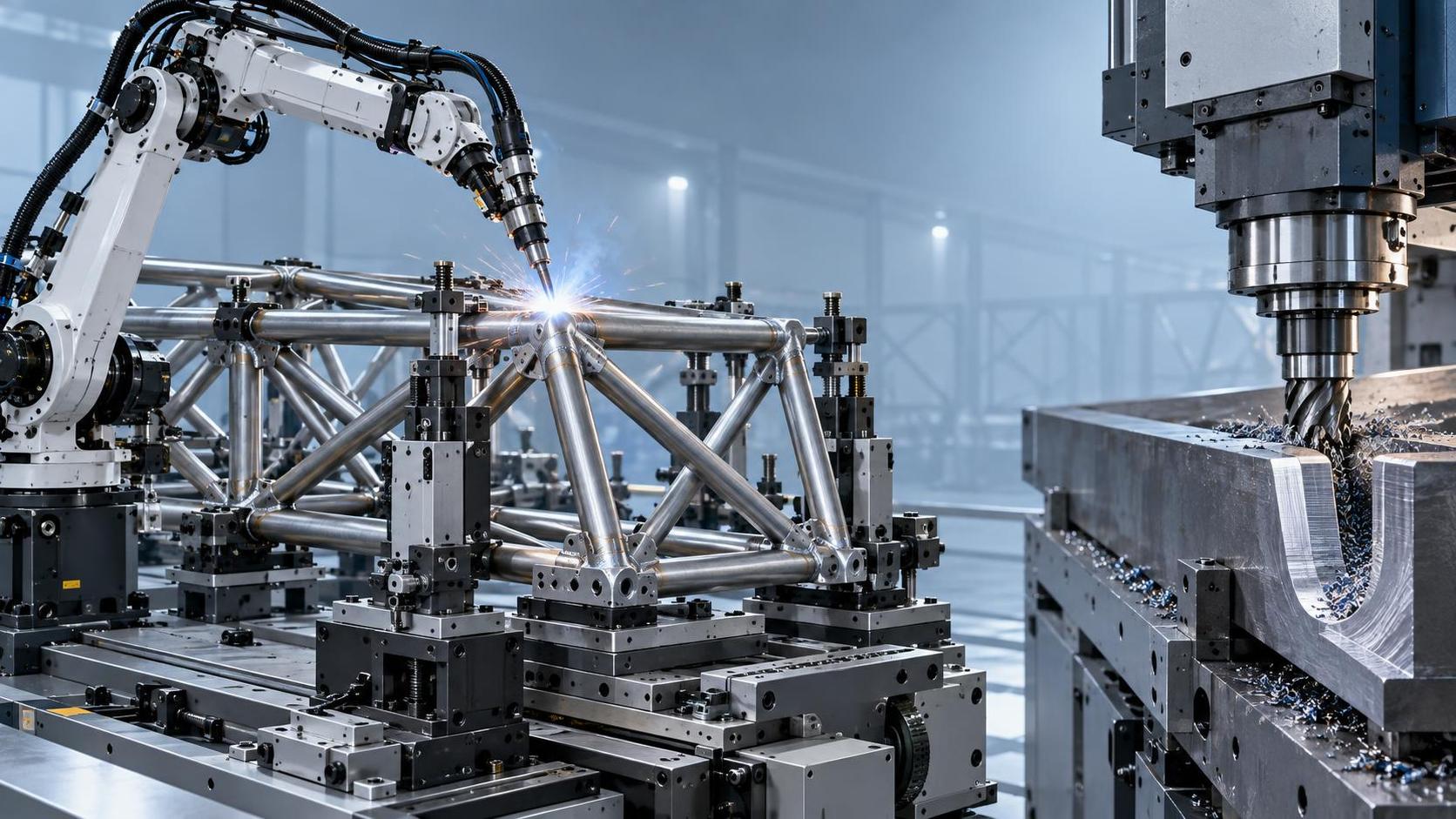
Does ISO 3834-2 Certification Apply Directly to the Welding Process Executed by an Automatic Space Frame Welding Machine?
Short answer: No — ISO 3834-2 does not certify the machine itself, nor does it “apply directly” to the welding process *as executed by* an automatic space frame welding machine. Instead, it certifies the *organization’s capability* to consistently produce welds meeting defined quality requirements — and that capability must be demonstrated *through* how the machine is qualified, programmed, monitored, and integrated into a controlled welding management system. For technical evaluators assessing structural integrity in rail, aerospace, or heavy machinery fabrication, confusing machine capability with organizational certification is a critical oversight — one that can compromise audit readiness, traceability, and contractual compliance.
Why This Distinction Matters for Technical Evaluators
Technical evaluators don’t assess machines in isolation — they assess whether a manufacturer’s entire welding operation meets the rigor demanded by ISO 3834-2:2021 (Welding — Quality requirements for fusion welding of metallic materials — Part 2: Comprehensive quality requirements). Your evaluation hinges on evidence: documented WPS (Welding Procedure Specifications), WPQ (Welder Performance Qualifications), equipment calibration records, interpass temperature logs, non-destructive testing (NDT) reports, and real-time process monitoring data — all traceable to the automatic space frame welding machine’s execution. The machine is a tool; ISO 3834-2 governs how that tool is *managed*, *validated*, and *controlled* as part of a certified quality system.
Where the Automatic Space Frame Welding Machine Fits In
An automatic space frame welding machine — such as those supplied by Wuxi Samgins — delivers repeatability, precision, and high deposition rates essential for complex 3D lattice structures. But its mere presence doesn’t satisfy ISO 3834-2. To comply, the machine must be part of a validated welding procedure: its parameters (voltage, current, travel speed, wire feed rate, shielding gas flow) must be defined in a WPS qualified per ISO 15614-1; its arc tracking, seam recognition, and adaptive control functions must be verified under production-like conditions; and its software version, firmware updates, and sensor calibration must be formally controlled and recorded.
Crucially, the machine’s output must be auditable — meaning every weld pass should be timestamped, parameter-logged, and linked to a specific joint, drawing revision, and operator (or robot program ID). Without this level of digital traceability — which our 7 axis railway type welding robot supports via integrated CNC synchronization and real-time arc tracking — ISO 3834-2 compliance remains theoretical, not demonstrable.
The Role of Organizational Competence & Process Control
ISO 3834-2 mandates documented responsibilities for welding coordination, including a designated Welding Coordinator (Level B or C per ISO 14731). This person oversees WPS development, personnel qualification, equipment maintenance, and deviation management. For automated systems, their role expands: they must approve robotic path planning, validate offline programming against physical test welds, and ensure that any “one-key weld selection” feature — like that used in our 7 axis railway type welding robot — is backed by prior qualification and change control.
Process control isn’t just about setting parameters — it’s about detecting and reacting to drift. An automatic space frame welding machine may run flawlessly for 100 joints, then deviate due to nozzle wear, torch misalignment, or ambient humidity affecting gas coverage. ISO 3834-2 requires detection mechanisms (e.g., voltage/current monitoring, arc stability algorithms) and defined response protocols — not just alarms, but documented corrective actions and requalification steps.
What Technical Evaluators Should Verify During Assessment
Don’t ask, “Is the machine ISO 3834-2 certified?” Ask instead:
- Has the WPS used with the automatic space frame welding machine been qualified per ISO 15614-1 *for the exact material grades, thicknesses, joint configurations, and positions* being produced?
- Are weld parameters logged per joint — not just per shift or batch — with tamper-resistant timestamps and user authentication?
- Is there evidence of periodic revalidation (e.g., every 6–12 months or after major hardware/software changes)?
- Are NDT results (RT, UT, PT) cross-referenced to weld IDs generated by the machine’s control system — enabling full traceability from drawing to radiograph?
- Does the organization maintain records of sensor calibration (laser seam trackers, thermal cameras), torch consumable life cycles, and preventive maintenance schedules tied to weld count or runtime?
How Wuxi Samgins Supports ISO 3834-2 Compliance
Our automatic space frame welding machines — engineered for structural steel, aluminum space frames, and modular rail components — are built for compliance, not just performance. All units operate under ISO 9001-certified design and manufacturing processes and meet EU CE safety directives. More importantly, they integrate seamlessly with ISO 3834-2 requirements: programmable parameter limits, real-time arc tracking with auto-correction, multi-level alarm status indicators (red/yellow/green), and native support for weld data export to ERP or QMS platforms. The 7 axis railway type welding robot, for instance, enables zone-based welding across 12-meter workpieces while maintaining full parameter logging and joint-level traceability — a key enabler for auditors verifying Clause 6.2 (Welding Personnel) and Clause 7.4 (Welding Equipment).
We also provide documentation packages aligned with ISO 3834-2 Annex A: pre-configured WPS templates, machine validation reports, and interface specifications for integrating with customer MES/QMS systems — reducing your internal qualification burden without compromising rigor.
Conclusion: Certification Is About System, Not Hardware
For technical evaluators, the bottom line is clear: ISO 3834-2 certification never applies “directly” to an automatic space frame welding machine — it applies to the organization’s ability to use that machine *within a controlled, documented, and auditable welding management system*. Your assessment must focus on evidence — not equipment brochures. Look for live parameter logging, WPS-to-joint traceability, welder/robot program qualification records, and documented responses to process deviations. When sourced from a supplier like Wuxi Samgins — whose ISO 9001 framework and engineering-first approach embed compliance at the design stage — the automatic space frame welding machine becomes a reliable, verifiable node in your certified welding system — not a compliance risk, but a compliance accelerator.
search
Products Navigation
Send Us A Message