




How does the total cost of ownership compare between a new automatic space frame welding machine and upgrading legacy equipment?
TCO Isn’t Just About the Price Tag—It’s About Where Your Money Actually Goes
When finance leaders at structural fabrication shops or heavy equipment manufacturers review capital requests for an Automatic space frame welding machine, the first question isn’t “How much does it cost?” It’s “What will this *really* cost us over five years—and what happens if we don’t do it?” That distinction matters. Upgrading legacy welding cells often looks cheaper on paper—until you factor in unplanned downtime, overtime labor to compensate for inconsistent weld quality, or the hidden cost of rework due to thermal distortion in large space frames.
Wuxi Samgins International Trade Co., Ltd—based in Wuxi City, Jiangsu Province, just 30 minutes from Shanghai by high-speed rail—has supported over a decade of manufacturing upgrades across Southeast Asia, Europe, and the Americas. Our experience shows that TCO decisions hinge less on upfront quotes and more on how well a system integrates into real production rhythm: cycle consistency, operator dependency, energy behavior under load, and service life under sustained thermal cycling. ISO9001-certified design and EU CE compliance aren’t checkboxes—they’re guardrails against costly field failures and warranty disputes that erode ROI before year two.
Five-Year TCO Breakdown: What Moves the Needle
Let’s compare two realistic scenarios for a mid-size structural shop producing architectural trusses and modular chassis frames:
- Option A: Refurbish a 2012-era gantry-based welding cell with new torches, updated PLC logic, and recalibrated seam tracking.
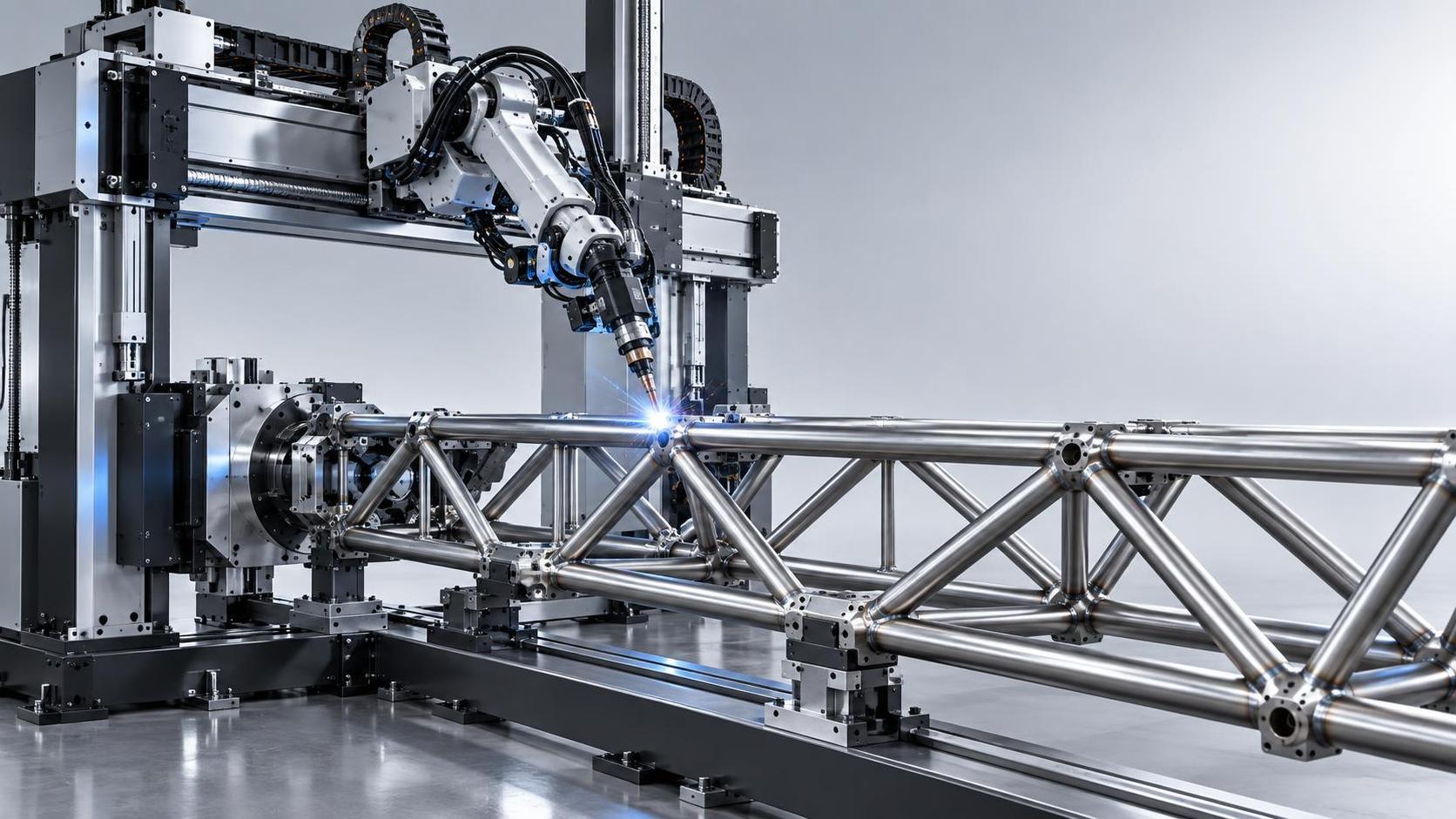
- Option B: Install a new, fully integrated Automatic space frame welding machine, designed for multi-axis robotic positioning, adaptive arc control, and offline programming compatibility.
Neither option is “free.” But their cost profiles diverge sharply after Year 1:
Acquisition & Commissioning: Option A may require 40–60% less initial CAPEX—but adds 2–3 weeks of production interruption for integration, plus $15k–$25k in third-party engineering support to bridge legacy I/O protocols. Option B includes full factory commissioning, weld procedure qualification (WPQ) support, and operator upskilling—often bundled, not billed separately.
Labor & Throughput: Legacy systems demand constant operator intervention—manual part alignment, post-weld visual inspection, and manual correction of misaligned jigs. New automation reduces direct labor per frame by 35–50%, but more importantly, cuts indirect labor spent on troubleshooting and rework. One European client reported a 22% reduction in total labor hours per shift—not because fewer people worked, but because fewer hours were spent fixing avoidable errors.
Maintenance & Downtime: Older systems rely on mechanical limit switches, analog feedback loops, and non-standard hydraulics—parts that are increasingly scarce or require custom machining. Mean time between failure (MTBF) drops below 85 hours after year seven. In contrast, modern Automatic space frame welding machines use sealed servo drives, predictive thermal monitoring, and modular power supplies—extending MTBF to 350+ hours. Maintenance spend falls 20–30% annually, and unscheduled downtime drops from ~11% to under 2%.
Energy & Consumables: Arc stability directly impacts energy efficiency. Older inverters operate at 78–82% efficiency under variable load; newer units maintain >92% across 30–100% duty cycles. Combined with optimized wire feed algorithms and reduced spatter, consumable waste drops 18–25%. That’s measurable—not theoretical—in quarterly utility and MRO budgets.
Where Thread Rolling Fits In—And Why It Matters for TCO Clarity
Welding isn’t isolated. It’s one node in a value stream that includes material prep, fastener forming, surface finishing, and final assembly. That’s why shops evaluating welding automation also reassess adjacent processes—like thread production for anchor bolts or structural tie rods. Cutting threads wastes 15–30% of bar stock; traditional rolling machines often lack repeatability at larger pitches or alloy steels.
The Z28-1000 thread rolling machine, for example, handles radial cold roll forming of external threads up to Φ110mm diameter and Φ12mm pitch—common specs for high-strength anchor assemblies used in space frame foundations. Its 500KN rolling pressure and precision roller geometry (Φ190–240mm) ensure consistent cold work hardening across carbon steel, alloy steel, and non-ferrous materials—directly improving fatigue life without secondary heat treatment. Because it’s chipless and uses water-soluble coolant, energy use stays low (<15kW), and there’s no cutting oil disposal cost or contamination risk near weld zones.
That’s not just a spec sheet advantage—it’s a TCO multiplier. When thread rolling and space frame welding share the same production line, synchronized scheduling reduces WIP inventory, floor space, and cross-process QA overhead. Shops that align these investments see faster payback than those treating them as separate line-item approvals.
The Real Risk Isn’t Cost—It’s Delayed Decision-Making
Finance teams sometimes stall on automation because they’re waiting for “perfect data.” But perfect data doesn’t exist when comparing a refurbished 2012 system to a 2024 platform—the variables are too dynamic: labor inflation rates, local energy tariffs, scrap tolerance thresholds, and even regional availability of certified welders.
What *is* knowable—and actionable—is the baseline: your current weld rejection rate, average maintenance cost per hour, and labor hours per completed frame. With those three numbers, even a conservative five-year model reveals whether deferred investment is truly saving money—or quietly subsidizing inefficiency.
At Wuxi Samgins, we don’t build proposals—we build comparative analyses. Every quote includes side-by-side TCO assumptions, not just pricing. We map your existing workflow, identify where legacy bottlenecks compound costs, and clarify which parameters matter most for your specific frame geometry, material mix, and throughput targets. Because the goal isn’t to sell a machine. It’s to help you justify the right decision—with numbers that hold up in budget review, not just in sales meetings.
If your next capital cycle includes welding, threading, or any high-precision metal forming process—start with the numbers you already track. Then ask: what changes when consistency becomes predictable, not aspirational?
search
Products Navigation
Send Us A Message