




Heavy-Duty Handling Robots in Foundry Environments: Dust Resistance, IP67 Sealing, and 150°C Ambient Tolerance Explained
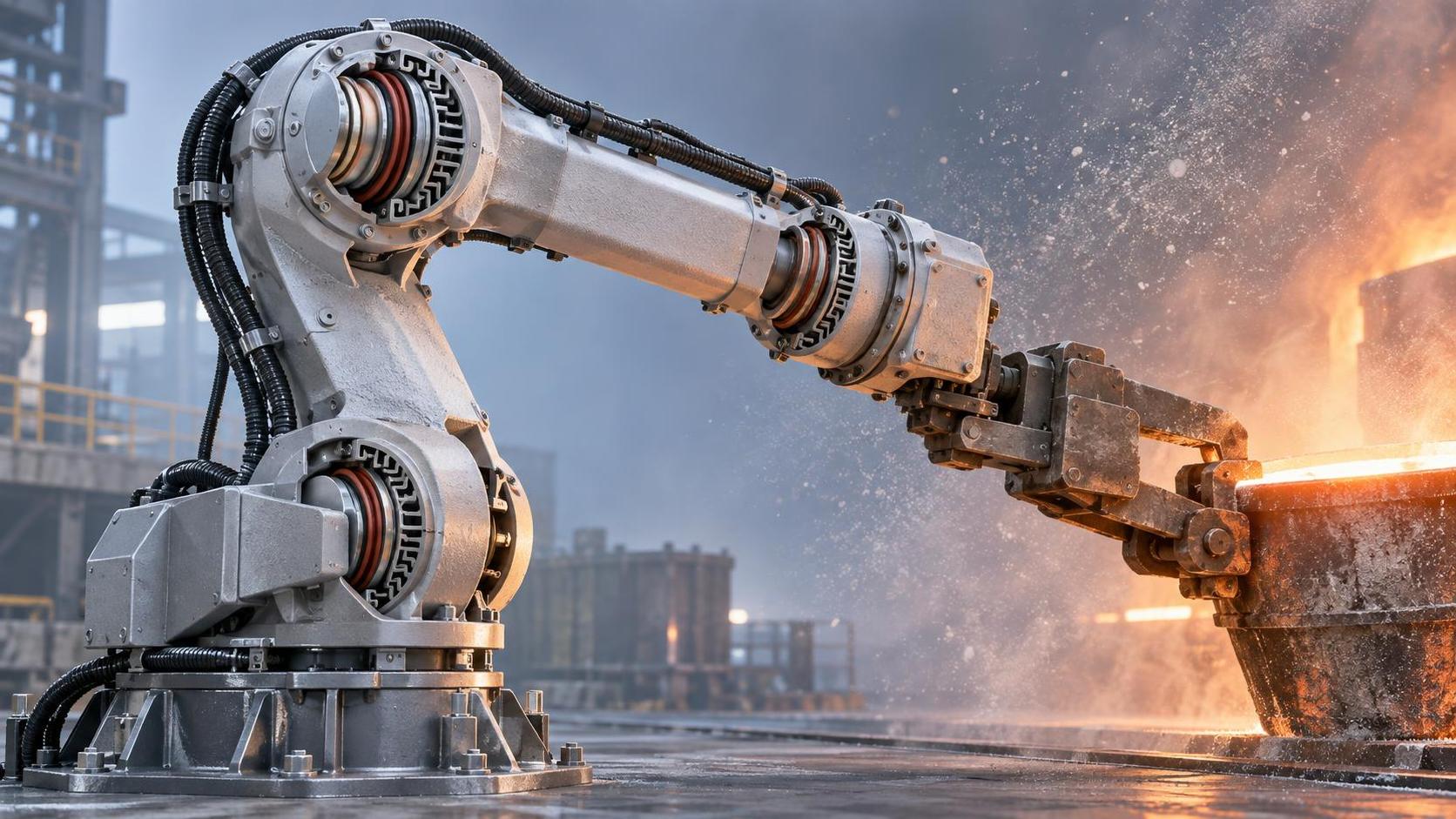
Why IP67 and 150°C Ambient Tolerance Aren’t Just Marketing Claims—They’re Operational Thresholds
When evaluating heavy-duty handling robots for foundry use, technical assessors don’t need another definition of “IP67” or a rehash of ISO standards. They need to know: What breaks first when dust settles at 130°C—and does this robot’s sealing hold up after 18 months of shift-based thermal cycling? The answer lies not in datasheet specs alone, but in how those specs map to real-world failure modes: condensation ingress during cool-down cycles, abrasive particle migration into harmonic drive housings, and long-term degradation of cable jacketing under radiant heat.
IP67 Isn’t Enough—It’s the Starting Point for Dust Management
IP67 guarantees protection against temporary immersion and total dust ingress—but in foundries, it’s the *type* and *behavior* of dust that matters more than the rating itself. Casting environments generate fine, angular silica particles (often sub-50μm) that behave like grinding paste under vibration and thermal expansion. A robot rated IP67 may pass lab testing with talcum powder, yet fail field validation if its joint seals lack secondary labyrinth geometry or if its motor enclosures lack positive-pressure purge capability.
True dust resilience requires layered mitigation: sealed servo motors with dual-lip shaft seals, air-tight cable glands with silicone-filled strain relief, and control cabinets with filtered forced-air cooling—where airflow is maintained even during furnace door openings. Critically, IP67 must be verified on *every actuated axis*, not just the base unit. Many vendors certify only the main body, leaving wrist joints and end-effector interfaces as weak points. If your robot handles green sand molds or core boxes, verify seal integrity at all six degrees of freedom—not just the IP67 label on the nameplate.
150°C Ambient Tolerance: It’s Not About Continuous Operation—It’s About Thermal Cycling Survival
Ambient temperature ratings are often misread. A robot rated for “150°C ambient” doesn’t mean it runs continuously at that temperature—it means its components retain functional integrity *during exposure* to that environment for defined durations, typically per IEC 60068-2-2. More importantly, it must survive repeated thermal transients: from 150°C near a pouring station down to 40°C in a cooling zone within minutes. That cycle stresses solder joints, accelerates insulation aging, and causes differential expansion between aluminum housings and steel gear trains.
The real test isn’t peak temperature—it’s thermal hysteresis. Look for evidence of component-level derating: servo drives with oversized heatsinks and high-temp electrolytic capacitors (rated ≥105°C), cables with ETFE or polyimide jackets (not standard PVC or PUR), and gearmotor lubricants specified for continuous operation above 120°C. If the vendor can’t provide thermal imaging data from a 3-month accelerated life test—including infrared scans of joint bearings and encoder housings—treat the 150°C claim as theoretical, not operational.
Where Sealing and Heat Resistance Converge: The Critical Interface Zone
The most frequent point of failure isn’t the robot arm itself—it’s the interface between robot and peripheral equipment. Consider a heavy-duty handling robot feeding castings into a shot-blasting line. At the transfer point, the robot’s wrist passes through a blast curtain where abrasive media meets hot part surfaces. Even with IP67-rated joints, unsealed pneumatic lines, unshielded encoder cables, or non-hermetic tooling mounts become entry paths for dust and moisture.
This is where design discipline separates field-proven systems from lab-certified ones. Robust implementations use fully sealed quick-change tooling with integrated air purge channels, shielded M12 connectors with nickel-plated brass housings (not zinc), and fiber-optic position feedback instead of exposed potentiometers. If your application involves direct contact with molten metal splash zones—even intermittently—demand proof of ceramic-coated mounting flanges and refractory-grade gasketing at all static interfaces.
Real-World Validation Over Certification Alone
CE and ISO9001 compliance confirms process adherence—not environmental endurance. A CE-marked robot may meet EMC and low-voltage directives but still suffer premature encoder drift in a dusty, high-EMI foundry. Similarly, ISO9001 certifies that the manufacturer has a quality system; it says nothing about whether their thermal modeling accounts for radiant heat reflection off furnace linings.
Ask for field validation reports—not internal test logs—from installations with comparable thermal profiles and dust loads. Specifically request: (1) maintenance logs showing seal replacement frequency over 12+ months, (2) thermal imaging time-series of critical joints across multiple heating/cooling cycles, and (3) failure mode analysis for any downtime exceeding 30 minutes in the first year. If the vendor cites “no failures reported,” probe further: Was uptime tracked? Were minor seal leaks logged as “acceptable wear”? Without granular, time-stamped operational data, certification remains a baseline—not a guarantee.
Application Context Matters More Than Spec Sheets
Not every foundry task demands full-spec resilience. Handling pre-heated molds before pouring may require 150°C tolerance, but post-shakeout casting sorting often operates below 80°C—making IP65 with enhanced bearing seals sufficient and more cost-effective. Likewise, robotic pipe handling for boiler fabrication—a common downstream application—faces different stressors: mechanical shock from heavy pipe slinging, not thermal cycling. In such cases, structural rigidity and hydraulic damping matter more than ambient temperature rating. For example, the NC hydraulic pipe bending machine leverages high-hardness tooling (HRC50+) and slow mandrel retraction precisely to manage impact-induced deformation—traits rarely highlighted in robot spec sheets but critical in integrated material flow lines.
Before committing to a “heavy-duty handling robot,” map your actual duty cycle: maximum dwell time near heat sources, average particulate concentration (measured in mg/m³, not visual assessment), and frequency of thermal transients. Then match—not max out—the robot’s validated capabilities to that profile. Over-specifying invites unnecessary cost and complexity; under-specifying guarantees unscheduled downtime.
search
Products Navigation
Send Us A Message