




High-Payload Handling Robots for Steel Coil Transfer: Why 200+ kg Capacity Requires Dual-Redundant Braking & Thermal Monitoring
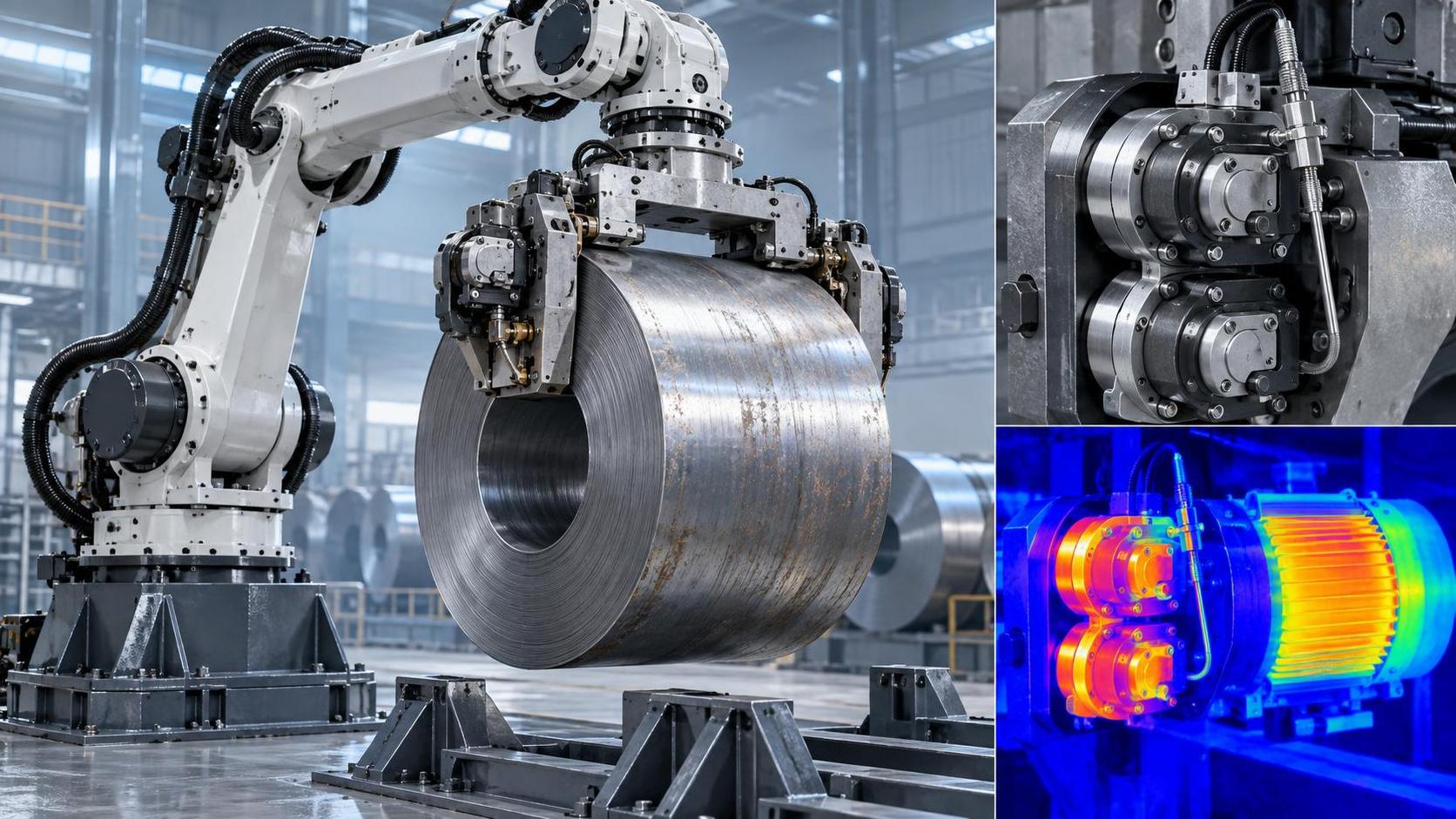
For project managers overseeing heavy-duty steel coil transfer operations, selecting a high payload handling robot isn’t just about lifting capacity—it’s about mission-critical safety and uptime. When payloads exceed 200+ kg, single-point braking systems and passive thermal management pose unacceptable risks of slippage, overheating, or unplanned downtime. This isn’t theoretical: in continuous shift operations—especially where hot-rolled coils sit at ambient temperatures above 40°C before transfer—brake fade and motor temperature drift can accumulate across cycles, degrading repeatability and triggering emergency stops. The result? Lost production time, recalibration delays, and increased risk of load drop during deceleration or hold phases.
Why 200+ kg Demands Dual-Redundant Braking
A single electromagnetic brake on a high-payload axis may meet nominal static holding torque specs on paper—but real-world conditions erode margin fast. Steel coils often carry residual heat, oil film, or surface oxidation that reduces friction coefficient between gripper and coil surface. More critically, repeated dynamic braking generates heat in the brake coil itself, reducing magnetic pull force over successive cycles. A dual-redundant system—typically combining an active servo-motor brake with a mechanical spring-applied fail-safe brake—ensures that even if one path degrades (e.g., due to voltage fluctuation or coil thermal expansion), the second remains fully functional under full load. This redundancy is not a luxury; it’s how CE-compliant robotic cells maintain Category 3 / PL e performance per ISO 13849-1 in load-holding applications.
This requirement directly impacts structural integration. Robot bases must be rated for combined inertial and gravitational loads during emergency stop events—not just steady-state operation. For example, a 250 kg coil swinging at 0.8 m/s carries ~80 J of kinetic energy. Dissipating that safely demands both high-torque braking *and* rigid mounting to prevent base flexure-induced positional drift. That’s why manufacturers specifying >200 kg payload robots routinely require reinforced concrete foundations or bolt-down steel plates anchored to building columns—not standard floor-mounting kits.
Thermal Monitoring Isn’t Optional—It’s Predictive Control
Passive cooling (e.g., finned housings or ambient convection) fails under sustained duty cycles common in coil staging lines. Motors and gearboxes operating near thermal limits experience accelerated bearing wear, lubricant breakdown, and encoder signal noise. Unmonitored, this leads to gradual loss of repeatability—±0.08 mm precision becomes ±0.15 mm after 8 hours of continuous operation—not enough to trigger alarms, but enough to cause weld seam misalignment downstream.
Real-time thermal monitoring means embedded PT100 sensors in motor windings, gearbox oil sumps, and brake coil housings, feeding data into the motion controller. When temperature thresholds are approached, the system doesn’t just shut down—it proactively adjusts cycle timing: extending dwell times, reducing acceleration ramps, or shifting load distribution across axes. This preserves throughput while enforcing thermal budgets. Crucially, these adjustments are logged and traceable—enabling root-cause analysis when thermal events cluster around specific shifts or coil batches.
Where Welding Robots Fit Into the Broader Material Flow
While dedicated coil-handling robots dominate transfer stations, welding automation often interfaces directly with those same coils—especially in structural steel fabrication. Consider a workflow where a 200+ kg H-beam section is uncoiled, cut, prepped, and moved to a welding station. A 6 Axis 1800mm ArmSpan MlG Industrial Welding Robot may handle the final joining step—but only if upstream handling maintains part position within ±0.3 mm across multiple transfers. That tolerance window collapses rapidly without redundant braking and thermal control upstream. In practice, project managers find that inconsistent coil positioning forces manual re-alignment before welding, negating ROI from robotic welding cells.
The 6 Axis 1800mm ArmSpan MlG Industrial Welding Robot exemplifies how precision cascades across processes: its ±0.08 mm repeatability assumes stable, vibration-free mounting and consistent part presentation. If coil-handling robots introduce 0.2 mm of positional variance due to thermal drift or brake slip, the welding robot spends more time compensating than welding. That’s why integrated system validation—including thermal soak testing across 72-hour cycles—is non-negotiable for projects where coil transfer feeds directly into automated welding lines.
Design Verification Steps You Can’t Skip
Before finalizing specifications, verify these three items with your supplier:
- Brake redundancy architecture: Request schematics showing independent power paths and physical separation between primary and secondary brakes—not just “dual brakes” as a marketing term.
- Thermal sensor placement: Confirm sensors are located inside motor windings (not just on housing surfaces) and that readings feed into the motion controller—not just a separate HMI display.
- Duty cycle validation report: Ask for test logs showing temperature rise, brake torque retention, and positional drift across ≥1000 cycles at rated payload and max speed—not just single-cycle lab measurements.
ISO 9001-certified suppliers document these tests as part of their design verification process. If reports reference only ambient-temperature bench tests—not operational profiles matching your coil weight, transfer distance, and cycle frequency—treat the spec as incomplete.
Operational Realities That Change the Math
Two factors consistently undermine theoretical payload ratings in the field: coil surface condition and ambient humidity. Oxidized or mill-scale-coated coils reduce grip reliability, forcing operators to derate payload by 15–20% to avoid slippage during vertical lift. High humidity (>75% RH) accelerates brake coil corrosion and degrades insulation resistance—especially in coastal facilities. Neither factor appears in datasheets, yet both directly impact required braking redundancy and thermal management headroom.
That’s why experienced project managers specify robots with IP65-equivalent sealing—not just for dust resistance, but because the same gasketing and conformal coating that block particulates also inhibit moisture ingress into brake assemblies. The 6 Axis 1800mm ArmSpan MlG Industrial Welding Robot , for instance, meets equivalent IP65 protection, allowing deployment in workshops where condensation forms on cold coils brought in from outdoor storage—conditions that would degrade unprotected brake components within weeks.
Ultimately, 200+ kg payload capability isn’t defined by a number on a spec sheet. It’s validated through thermal stability across shifts, brake integrity after 10,000 cycles, and positional consistency when ambient conditions fluctuate. Project managers who treat dual-redundant braking and real-time thermal monitoring as baseline engineering requirements—not optional upgrades—avoid costly retrofits, unplanned downtime, and safety incidents before commissioning begins.
search
Products Navigation
Send Us A Message