




Six-Axis Handling Robot Selection Guide: Payload, Reach, and Repeatability Trade-Offs for Metal Fabrication Lines
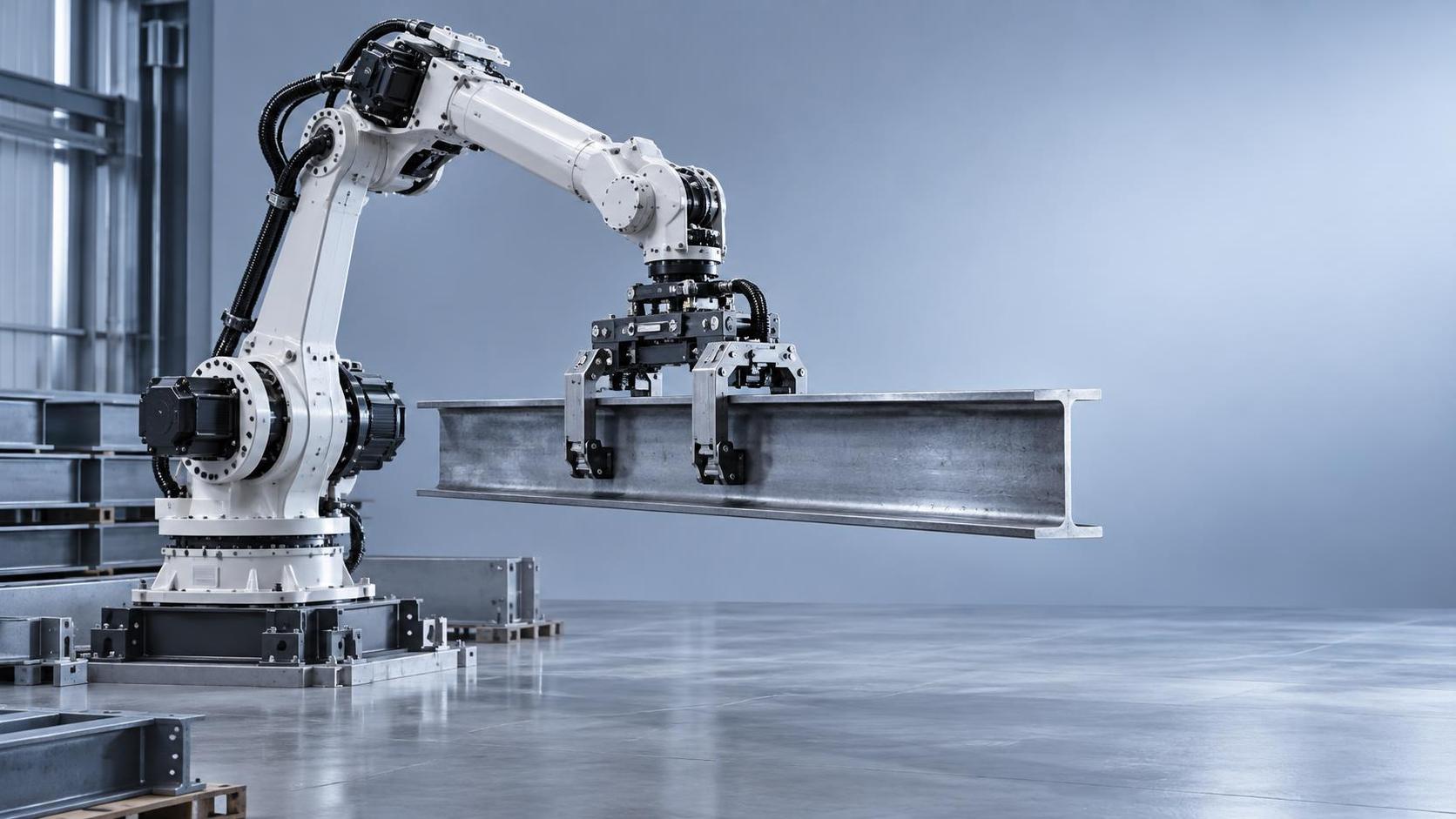
Selecting the right six-axis handling robot for a metal fabrication line isn’t about chasing the highest spec sheet number—it’s about matching mechanical behavior to real-world constraints. Technical evaluators often get stuck comparing robots side-by-side on paper, only to discover later that the unit with 25 kg payload can’t reliably position a 16 kg workpiece at full reach *while maintaining ±0.08 mm repeatability* across a 12-hour shift. That gap between catalog data and shop-floor performance is where decisions go sideways.
Payload Isn’t Static—It’s a Function of Pose and Motion Profile
Manufacturers list “maximum payload” assuming ideal conditions: robot upright, wrist fully extended, no acceleration, ambient temperature, zero vibration. In practice, your six-axis handling robot rarely operates under those conditions. When loading a 1200 mm H-beam into a CNC milling station, the robot may need to hold the part at a 45° angle while rotating its wrist to clear a guardrail. That posture increases torque on joints J2 and J3—and reduces effective payload by 25–40%, depending on kinematic design.
What matters more than peak payload is *sustained usable payload*: the heaviest load the robot can handle at your required working envelope corners, under your cycle time, without overheating motors or triggering joint limit warnings. For example, in automated welding cells where robots shuttle parts between fixturing stations and laser welders, sustained payload drops further when high-speed acceleration is needed to keep up with line pace. A 20 kg-rated robot may only deliver consistent 14–15 kg capability in those dynamic scenarios—especially after 6 months of continuous operation and minor bearing wear.
Reach Must Be Validated at Critical Work Zones—Not Just at the Tip
“Working reach” is often quoted as a single radial distance from base center. But metal fabrication lines require precise positioning in 3D space—not just distance. Consider an H-beam production line where the robot must pick a 5.2 m long beam from a conveyor, rotate it 90°, and place it onto a vertical alignment fixture with ±1.5 mm positional tolerance. The robot’s nominal 2.7 m reach might cover the pickup point—but does it maintain stiffness and repeatability at the far end of that stroke, with the arm fully extended and wrist rotated?
Real-world validation means mapping *actual repeatability across the entire working envelope*, not just at the center or tip. Many evaluators skip this step and assume uniform performance. They don’t realize that repeatability degrades fastest along the Z-axis (vertical) when the arm is near full extension—and that degradation isn’t linear. It can jump from ±0.05 mm at mid-reach to ±0.18 mm at maximum horizontal reach, especially under thermal load from repeated cycles.
Repeatability Is Meaningless Without Context—Load, Speed, and Thermal State
ISO 9283 defines repeatability as “the ability of the robot to return repeatedly to a given position.” But that test assumes no payload, no acceleration, and stable ambient temperature. In metal fabrication, repeatability is a moving target: it tightens under light loads and slow motion, but loosens significantly under heavy payloads, high accelerations, or after 4+ hours of continuous operation.
A robot rated at ±0.06 mm may hold ±0.07 mm during first-shift operation—but drift to ±0.11 mm by third shift due to motor and gearbox heating. That variation matters critically when integrating with vision-guided part placement or robotic arc welding, where even 0.05 mm misalignment can cause fit-up gaps exceeding 2 mm in thick-section steel assemblies. If your process requires repeatable positioning within ±0.10 mm *across all shifts*, you need to specify thermal compensation features—or select a model with proven stability under thermal cycling, not just a low initial repeatability number.
The Three-Way Trade-Off in Practice
Payload, reach, and repeatability don’t scale independently—they pull against each other. Increasing payload usually demands heavier arms and larger actuators, which reduce max speed and increase inertia—hurting both dynamic repeatability and effective reach. Extending reach often means longer links, which reduce torsional rigidity and widen repeatability bands at the wrist. Tightening repeatability specs frequently requires higher-cost encoders, stiffer gearboxes, and active thermal management—raising cost and complexity.
This trade-off becomes concrete in applications like automated truss welding. A Space frame welding machine handling tubular steel members (42–180 mm diameter, up to 5.5 m long) must position welding torches with sub-millimeter consistency while managing significant inertial loads during rapid repositioning. Here, a robot with moderate 12 kg payload but exceptional wrist stiffness and thermal stability often outperforms a 25 kg unit with looser joint tolerances—even if the latter looks stronger on paper.
What to Test—Not Just What to Specify
Before finalizing a six-axis handling robot, run these practical checks:
- Corner-load repeatability test: Program the robot to move to three critical points in your working envelope (e.g., far left, far right, topmost), each with your actual payload and typical orientation. Run 50 cycles per point and measure deviation—not just at the tool center point, but at the contact surface where the part interfaces with fixtures.
- Thermal soak test: Operate the robot continuously at 75% of max cycle speed for 4 hours. Then measure repeatability again. Compare drift to your process tolerance. If repeatability widens beyond acceptable limits, ask the supplier whether the model includes thermal compensation algorithms—and verify they’re enabled and calibrated for your environment.
- Fixture interference check: Simulate full-motion paths—including approach angles, part rotation, and clearance around guards, conveyors, and adjacent machines. Don’t rely on CAD envelopes alone. Use physical mock-ups or validated digital twins that include joint friction models and servo response lag.
Integration Reality Check: It’s Not Just the Robot
A six-axis handling robot doesn’t operate in isolation. Its performance depends heavily on end-of-arm tooling (EOAT) mass and center of gravity, mounting rigidity, controller tuning, and how well the motion path avoids singularities. A lightweight vacuum gripper may let you use a smaller robot—but if it adds 150 mm of offset to the tool center point, you’ve effectively shrunk your usable reach and degraded wrist repeatability. Likewise, mounting the robot on a flexible mezzanine floor instead of a reinforced concrete pad introduces micro-vibrations that widen repeatability bands by 30–50%.
Wuxi Samgins’ field experience across Southeast Asia, Europe, and the Americas shows that over 60% of integration delays stem not from robot selection errors—but from underestimating how EOAT, mounting, and path planning interact with the three core parameters. The most reliable installations treat the robot, tooling, and motion logic as a single system—not separate components to be optimized in sequence.
Final Guidance for Technical Evaluators
Start with your narrowest constraint—not your biggest wish. If your largest part weighs 14.2 kg and must be placed within ±0.09 mm at a point 2.3 m from the base, then prioritize robots proven to deliver that combination—not ones rated for 25 kg or ±0.05 mm in isolation. Cross-check manufacturer claims against ISO 9283-compliant test reports—not marketing brochures. And insist on seeing repeatability data logged under thermal load, not just at startup.
Remember: In metal fabrication, consistency beats peak numbers. A six-axis handling robot that delivers 13.5 kg at 2.4 m with ±0.08 mm repeatability—every shift, every week—is worth more than one that hits 20 kg on paper but can’t hold tolerance past hour three. Your ROI comes from uptime, part quality, and reduced rework—not headline specs.
search
Products Navigation
Send Us A Message