




Palletizing Handling Robot ROI Calculator: How Fast Payback Occurs When Labor Costs Exceed $28/hour and Line Speed > 30 Cycles/min
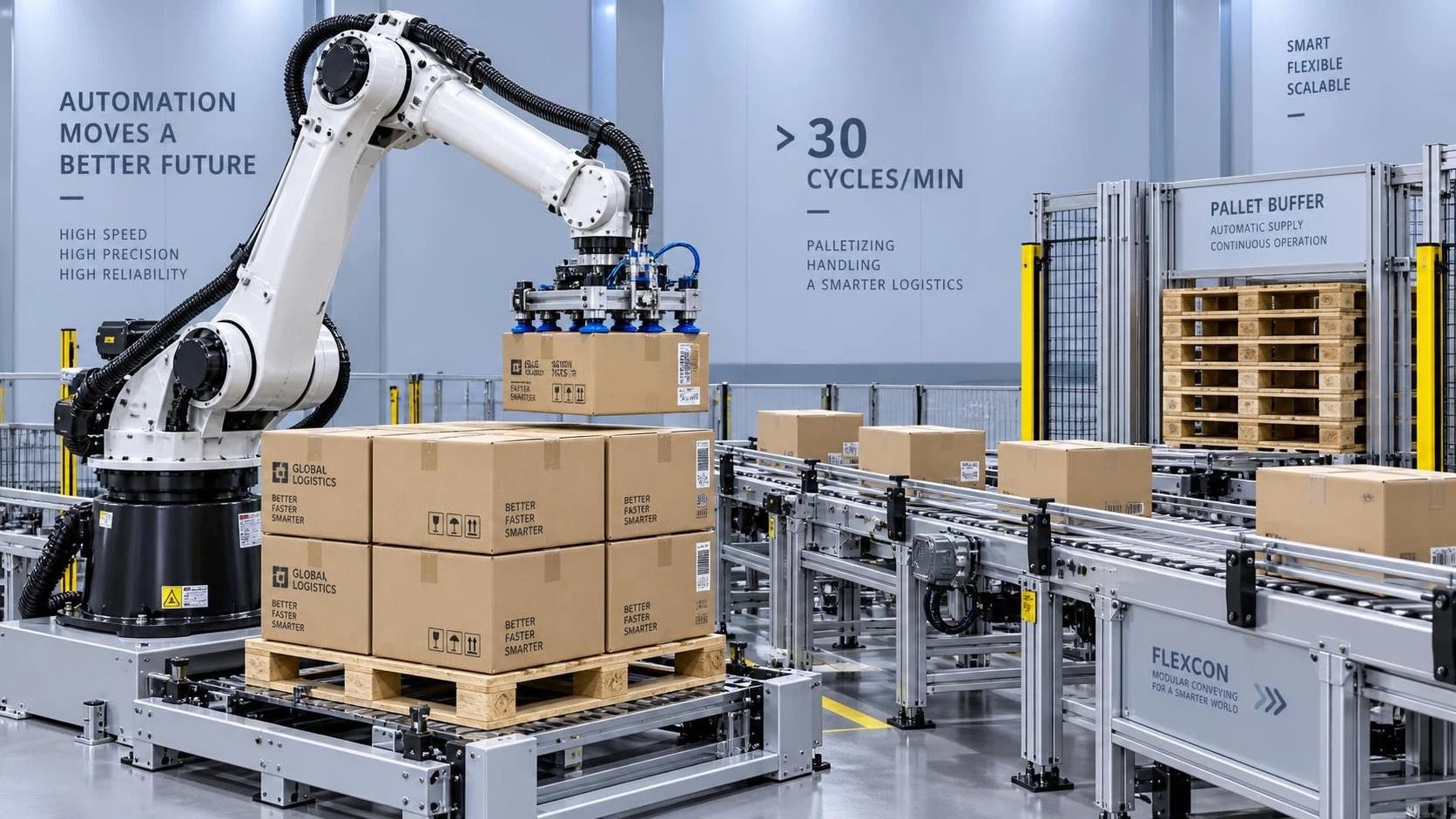
When labor costs exceed $28/hour and line speed consistently surpasses 30 cycles per minute, the financial case for palletizing handling robot automation shifts from long-term strategy to urgent operational necessity. This isn’t a theoretical threshold—it reflects the point where manual palletizing begins generating measurable net losses in throughput, consistency, and labor-related overhead. At this inflection, ROI isn’t measured in years; it compresses into months, sometimes weeks, depending on three tightly coupled variables: cycle time stability, labor continuity, and material handling complexity.
Why $28/hour and 30 cycles/minute form a decisive boundary
The $28/hour benchmark accounts for more than base wage. It includes employer-paid social insurance, overtime premiums (common in high-cycle environments), recruitment fees for replacement staff, and the hidden cost of fatigue-induced errors—such as misaligned layers, dropped loads, or incorrect SKU placement—that trigger downstream rework or shipping delays. When line speed exceeds 30 cycles/minute, human operators face physiological limits: sustained visual tracking, repetitive motion fatigue, and reaction latency begin degrading accuracy faster than output increases. A single missed cycle at 32 cpm means over 1,900 units unstacked per shift—enough to stall downstream packaging or delay truck loading.
This isn’t about replacing people; it’s about reallocating them. Operators shifted from palletizing stations often transition to higher-value tasks—machine tending oversight, quality verification, or preventive maintenance coordination—where their judgment and adaptability remain irreplaceable. The robot handles the physically constrained, rhythmically precise work; humans manage variability, exceptions, and system-level optimization.
How the calculator isolates true breakeven
A reliable ROI calculator for palletizing handling robots must go beyond simple labor-cost subtraction. It models five interdependent factors:
- Effective uptime differential: Manual lines typically operate at 82–87% availability due to breaks, shift changes, and unplanned pauses. Robotic cells with integrated vision guidance and predictive maintenance routines sustain 94–96% uptime—even across 24/7 operation—without degradation in layer integrity.
- Pallet pattern yield: Human stacking often sacrifices density for speed, resulting in 5–8% underutilized pallet volume. Robots execute repeatable, optimized patterns that maximize cube utilization—directly reducing freight cost per unit shipped.
- Changeover time compression: Switching between SKUs or pallet configurations takes 8–12 minutes manually. With preloaded programs and servo-controlled gripper tooling, robotic systems reduce this to under 90 seconds—critical when production runs are short and SKU variety is high.
- Maintenance predictability: Unlike mechanical conveyors or pneumatic stackers, modern palletizing robots use sealed gearmotors and condition-monitored bearings. Mean time between failures exceeds 12,000 operating hours, and scheduled service intervals align with planned production downtime—not emergency stoppages.
- Integration friction cost: The calculator deducts integration effort not as a flat fee, but as a function of existing line architecture. Lines with standardized PLC communication protocols (e.g., EtherNet/IP or PROFINET) and modular conveyor interfaces require ≤3 days of commissioning. Legacy analog-only lines may need signal conditioning hardware and additional I/O mapping—adding up to 10 days and affecting start-up timing.
Where application context overrides headline specs
Line speed alone doesn’t determine suitability. A 35-cpm line handling lightweight cartons behaves fundamentally differently than one moving 25-kg steel enclosures. Payload weight, center-of-gravity variance, and surface coefficient of friction directly affect end-effector selection, acceleration profiles, and cycle time feasibility. For instance, a robot rated for 40 cpm with 5-kg payloads may only achieve 28 cpm when handling irregularly shaped, oil-coated metal housings—due to required deceleration before placement to prevent slippage.
Similarly, labor cost isn’t static across roles. A $28/hour rate may apply to trained line supervisors—but temporary agency workers filling palletizing positions might cost $22/hour *plus* a 15% staffing markup and $3.20/hour in mandated rest breaks. The calculator adjusts for these layered costs, not just nominal wage rates.
Material flow geometry matters too. If palletizing occurs after CNC machining, where parts exit hot and require cooling trays before stacking, the robot must coordinate with thermal sensors and buffer conveyors—not just count cycles. That adds logic layers but eliminates manual heat-handling risks and improves part traceability.
Real-world constraints that shape payback
Three non-obvious conditions accelerate or delay breakeven:
- Warehouse floor tolerance: Uneven concrete slabs or insufficient anchoring points force custom mounting frames, adding $8,000–$15,000 to installation. The calculator flags this when facility drawings indicate sub-3mm/m flatness deviation.
- Load variation frequency: Lines switching between 12 SKUs daily benefit more from robotic flexibility than those running one SKU for weeks. But if SKU changes require physical end-effector swaps (not just program reloads), the time saved diminishes—making quick-change tooling a necessary capital add-on.
- Regulatory adjacency: In food-grade or pharmaceutical environments, stainless-steel construction and IP67-rated components increase initial cost by 18–22%, yet eliminate annual sanitation validation cycles that consume 37 labor-hours per line. The calculator amortizes this over five years, revealing faster net ROI despite higher capex.
For manufacturers integrating palletizing robots alongside other processing equipment—such as welding cells or sheet metal fabrication lines—the synchronization logic becomes critical. A robot that waits for a CNC lathe’s completion signal via hardwired interlock responds faster and more reliably than one polling a database every 500ms. The calculator weights communication method (hardwired vs. fieldbus vs. OPC UA) against expected latency and fault recovery time.
In facilities where pipe bending forms part of the upstream process—for example, producing structural supports for automated assembly lines—the precision and repeatability of an NC hydraulic pipe bending machine ensures consistent part geometry entering the palletizing cell. Bent pipes with tight angular tolerances and smooth mandrel-retracted surfaces stack more predictably, reducing robotic path correction cycles and extending gripper life. Its PLC control and servo-driven rotation allow direct parameter handoff to the palletizing system’s motion planner—eliminating manual data re-entry and associated error risk.
What breakeven timing actually implies
A 14-month payback doesn’t mean “wait 14 months to see value.” It means cumulative net savings equal total investment—including equipment, integration, training, and contingency—by month 14. From month 1 onward, the system generates positive cash flow: reduced overtime spend, lower injury claims, fewer damaged goods, and avoided agency fees. The calculator outputs a monthly cash flow projection, not just a single breakeven date—allowing finance teams to model impact on quarterly P&L statements.
Most importantly, it treats labor cost escalation as compounding—not linear. If wages rise 4.2% annually (the 2023–2024 U.S. manufacturing average), the breakeven window narrows by 1.8 months for every 1% increase above $28/hour. At $32/hour, median payback drops to 9.3 months. That sensitivity underscores why delaying automation beyond this threshold isn’t conservatism—it’s incremental cost accrual.
Automation ROI isn’t abstract. It’s the difference between absorbing rising labor costs or converting them into throughput capacity, quality consistency, and operational resilience. When the math converges at $28/hour and 30 cpm, the decision isn’t whether to automate—it’s how quickly you can integrate without disrupting production continuity.
search
Products Navigation
Send Us A Message