




How Does a Programmable Handling Robot Adapt to Changing Production Tasks?
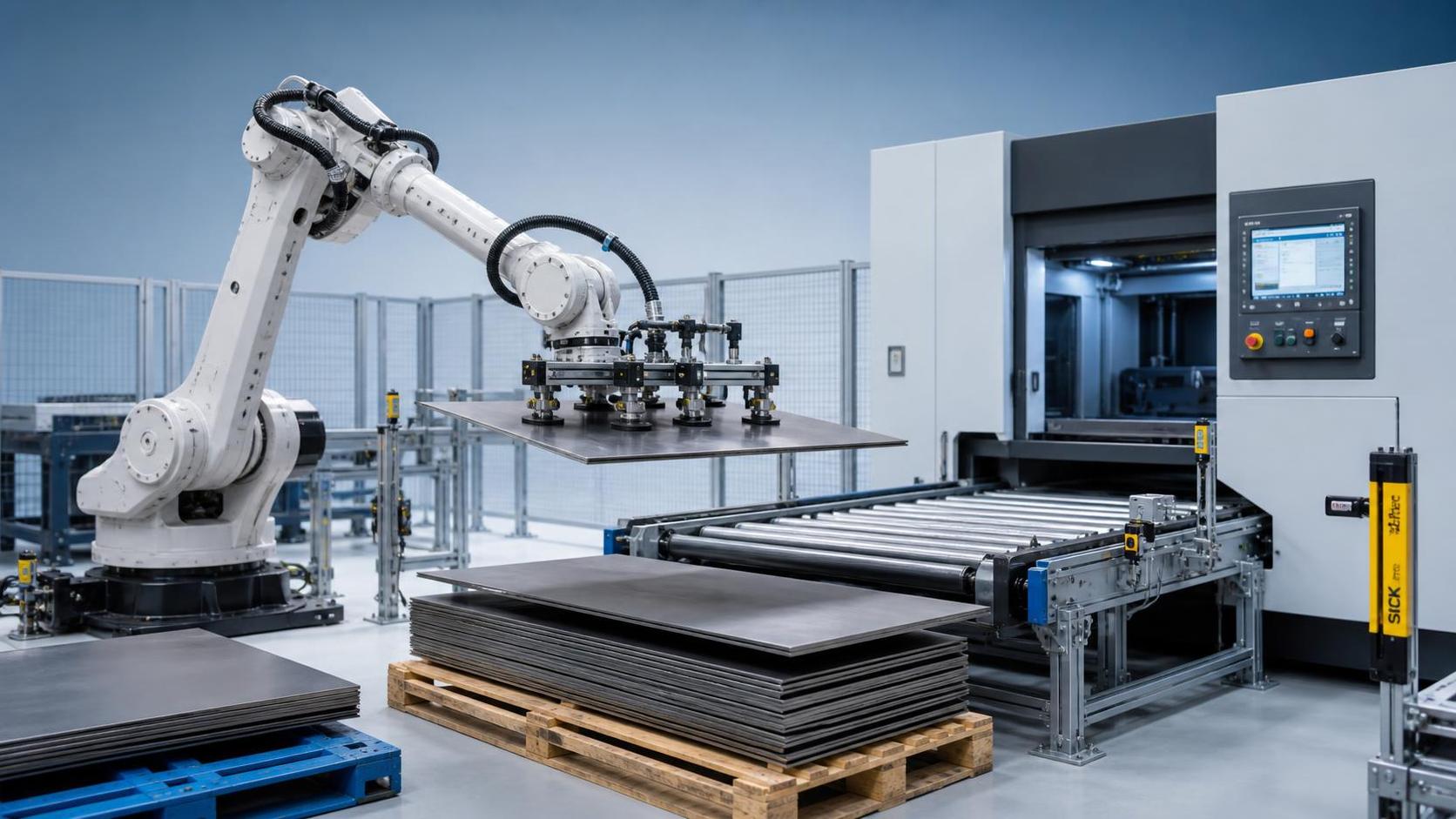
A production cell may run one steel plate size in the morning, switch to a different thickness after lunch, and then require a changed pallet pattern before the next shift. In that situation, a handling robot is only useful if the change can be made without rebuilding the cell, rewriting every motion from scratch, or creating new collision risks. The practical answer is that a programmable handling robot adapts through configurable robot programs, reusable motion templates, adjustable gripping, sensor feedback, and a control architecture that exchanges the correct job data with upstream and downstream equipment.
For technical evaluation, the most important point is not whether the robot can execute a new path once. Nearly any industrial robot can be reprogrammed. The real question is how reliably it can change workpiece type, orientation, process sequence, handling location, and production rate while maintaining repeatability, safe clearance, and traceable operating logic. Adaptability is therefore a system property rather than a robot-arm specification alone.
Adaptation begins with a defined changeover model
A programmable handling robot should be evaluated according to the kinds of changes the production environment actually requires. A cell that only alternates between two pallet positions has very different needs from a system handling mixed steel plates, formed parts, weldments, or machined components with irregular geometry.
Before selecting hardware or reviewing a proposed automation layout, separate expected changes into practical categories:
- Part variation: length, width, thickness, mass, surface condition, hole pattern, and center of gravity.
- Orientation variation: parts may arrive flat, vertical, nested, rotated, or offset on a conveyor or pallet.
- Process variation: the robot may need to load a machine, turn a part, transfer it between stations, stack finished parts, or separate good and rejected pieces.
- Volume variation: a low-volume job may justify a manual fixture adjustment, while frequent small batches require automatic recipe selection.
- Layout variation: pallet locations, infeed directions, tool access areas, and downstream stations may be changed during line upgrades.
Without this classification, “flexible programming” can become an imprecise purchasing claim. A robot may be highly flexible in path programming but poorly suited to changing grippers. Another may support multiple end effectors but require lengthy safety validation every time a fixture moves. The evaluation should identify which changes are routine and which require engineering intervention.
Program structure determines whether changes are controlled or improvised
Adaptable cells do not normally rely on a separate, fully independent robot program for every part number. That approach is manageable for a few products, but it becomes difficult to maintain when parts, stack patterns, or process routes increase. A better arrangement uses parameterized routines: the program contains validated motion logic, while job-specific values are stored in recipes or are supplied by the production control system.
A typical recipe may define part dimensions, pick coordinates, approach heights, grip confirmation requirements, machine loading position, release conditions, stack layer pattern, and permitted handling speed. The robot then calls common routines such as “pick from pallet,” “present to machine,” “remove finished part,” or “place on output stack.” The motion sequence remains controlled, while the coordinates and handling conditions change within approved limits.
This distinction matters during troubleshooting. If a new job causes the robot to approach a clamp too closely, engineers should be able to determine whether the issue comes from an incorrect recipe value, a shifted physical reference, a changed fixture, or an unsuitable motion template. When all logic is embedded in a one-off program, that diagnosis is slower and the chance of introducing an unintended change is higher.
Useful programming features for changing tasks
Technical evaluators should look for more than the availability of offline programming software. The following features have direct operational value:
- Named coordinate frames for machines, pallets, fixtures, and inspection points.
- Tool-center-point definitions for each gripper or handling tool.
- Recipe management with access control and revision identification.
- Conditional logic based on sensor signals, part presence, clamp status, and machine-ready signals.
- Recovery routines that allow a controlled restart after a stop without risking double picking or incorrect placement.
- Simulation or reach verification before a new job is released to production.
Changing a coordinate frame is often safer than editing many individual robot points. For example, when a pallet stand is moved by a known distance, an approved base-frame adjustment can preserve the relationship among programmed movements. That does not eliminate the need for validation, but it reduces the number of variables being changed at once.
End-of-arm tooling is often the real limitation
A robot can have sufficient reach and payload yet still fail to adapt because the gripper is too specialized. This is especially common when a cell evolves from handling one stable part family to handling varied plate sizes, profiles, or assemblies. The gripper must match the physical behavior of the material, not merely its nominal weight.
For steel plate handling, vacuum cups may work well on clean, flat material with adequate surface area, but they require attention to oil, scale, plate curvature, leaks, and edge condition. Magnetic grippers can be suitable for ferrous material, yet they must be assessed for residual magnetism, thin material behavior, separation of stacked sheets, and secure release. Mechanical clamps provide positive retention in some applications but can interfere with holes, edges, or finished surfaces.
Adaptability may be achieved through adjustable gripper fingers, independently controlled vacuum zones, multiple magnetic modules, or an automatic tool changer. Each method introduces its own control requirements. A tool changer improves task range, but the robot must confirm tool identity, lock status, utility connections, payload data, and the correct active tool-center point before movement resumes.
Payload calculations should include the gripper, adapters, cables, valves, and the heaviest permitted workpiece. In addition, the robot controller needs the correct center-of-gravity data. A task change that increases the offset load can affect acceleration limits, braking behavior, path accuracy, and the permitted reach envelope even when the part remains below the rated payload.
Sensor feedback allows the robot to deal with real production variation
Fixed coordinates are sufficient only when incoming material is consistently located. Production conditions are rarely that stable. Pallets may be placed with small offsets, parts may shift during transport, stacks may vary in height, and cut or punched components may have slight positional variation. A programmable handling robot becomes more useful when it can verify the actual condition before committing to a motion.
Basic photoelectric sensors can confirm that a pallet or workpiece is present. Vacuum pressure switches, magnetic confirmation signals, and gripper position sensors help verify that a part has been secured. These devices are essential, but they do not always establish orientation or precise location.
Where workpieces can arrive with variable positions, vision guidance, laser profiling, or probing may be justified. The appropriate level depends on the tolerance required by the next process. A robot feeding a broad conveyor zone may only need presence confirmation. A robot loading a plate into a machine with fixed reference edges may need more accurate location correction or a mechanical centering method. Vision should not be added simply because part variation exists; it should be selected when the expected variation cannot be economically controlled by pallets, locators, guides, or datum stops.
The sensor strategy should also include fault handling. If the robot detects no part, a double sheet, an incomplete grip, or an unexpected orientation, it should move to a safe state and report a meaningful condition to the cell controller. Repeated blind retries can damage material, create a collision, or conceal an upstream problem.
Integration with machine controls changes the robot from a mover into a production resource
Handling tasks usually depend on machine state. A robot loading a punching, cutting, welding, or machining station must know whether the station is ready, whether clamps are open, whether a completed part can be removed, and whether a selected job matches the material presented. Simple start-and-stop signals are often insufficient for cells that change jobs frequently.
A more reliable interface exchanges defined status information: active recipe, machine-ready condition, cycle permission, fault code, part-complete signal, and reset state. The robot should not assume that a machine is available merely because it is powered. Likewise, the machine should not begin a cycle solely because a robot has entered a loading area.
A plate-processing cell illustrates the requirement. When handling material for a CNC Punching And Marking Machine For Steel Plates, the robot or associated transfer equipment must align its recipe with the plate dimensions, loading datum, processing status, and unloading sequence. The machine’s CNC capability can support job changes through CAD- or lofting-software-derived data, while the handling side must still establish that the correct plate is presented safely and repeatably. Automated positioning inside the machine does not remove the need for reliable external material referencing.
For equipment designed for steel plates up to 1500 × 800 mm, with punching thicknesses in the 5–25 mm range, material handling design must be reviewed against actual plate mass, sheet stiffness, edge clearance, and station access. A robot may be only one element of the solution; roller tables, centering devices, buffer stations, and discharge supports may be necessary to keep the robotic task within a stable and safe operating window.
Safety must remain valid after a task change
The most overlooked part of robot adaptability is safety validation. A robot path that is safe for a small blank may not be safe for a larger plate with overhang. A new gripper may create a different pinch point. A revised stack height can bring the load closer to fencing, light curtains, or overhead equipment. Each change should be considered against the actual safeguarded space, not only the robot’s bare-arm reach.
Technical reviews should confirm how the cell handles reduced-speed setup, manual recovery, access to loading zones, and restart after a protective stop. The safety logic should prevent the robot from entering a machine area until machine motion, clamping, and access conditions are in the approved state. Where personnel load mixed materials or replenish pallets, the boundary between automated and manual work must be clear.
Risk assessment also needs to consider dropped loads and retained energy. Vacuum loss, magnet release, unstable stacks, sharp edges, and gripper failure modes are relevant in plate handling. A gripping method that works in a demonstration can be unsuitable for unattended production if it has no dependable confirmation signal or safe response to loss of holding force.
How to evaluate changeover performance
Changeover time should not be measured only from the moment the robot starts moving on the next job. A realistic evaluation includes recipe selection, gripper adjustment or exchange, fixture changes, coordinate confirmation, test movement, first-part verification, and restart authorization. Some cells can change automatically between validated part families; others require an operator to confirm tooling or material identity. Both approaches can be appropriate if their limits are defined.
It is also useful to ask whether a new task falls within the original cell design or requires a new engineering review. A change from one plate size to another may only require a recipe. A move from flat plate to bent assemblies may require a different gripper, revised collision model, altered safety distances, and new transfer fixtures. Treating both changes as equivalent is a common source of under-scoped automation projects.
Where adaptability has practical limits
Programmability does not compensate for poor part presentation, unstable material flow, or a process with no reliable datum. If parts arrive randomly tangled, heavily warped, or with unpredictable surface contamination, the handling challenge may require separation equipment, dedicated fixturing, or a different automation concept. Similarly, a robot cannot safely absorb unlimited product variation merely by lowering speed or adding more code.
The most effective approach is to define a controlled family of tasks: known material properties, allowable dimensional range, accepted loading positions, approved end effectors, and validated recipes. Within that envelope, the robot can switch efficiently and with predictable performance. Outside it, the cell should require a deliberate review rather than an informal program edit on the shop floor.
That disciplined boundary is what makes a programmable handling robot genuinely adaptable. Its value comes from making routine production changes repeatable, observable, and safe—not from claiming that any future task can be handled without changes to tooling, controls, or process design.
search
Products Navigation
Send Us A Message