




How Can a Handling Robot Arm for Laser Cutting Improve Sheet Metal Throughput?
For a project manager, sheet metal throughput is rarely limited by laser power alone. A cutting machine may complete a nest quickly, yet still spend valuable time waiting for material, waiting for an operator to remove finished sheets, or waiting for parts to be sorted before the next process can begin. Those interruptions are easy to underestimate during planning, but they accumulate across every shift.
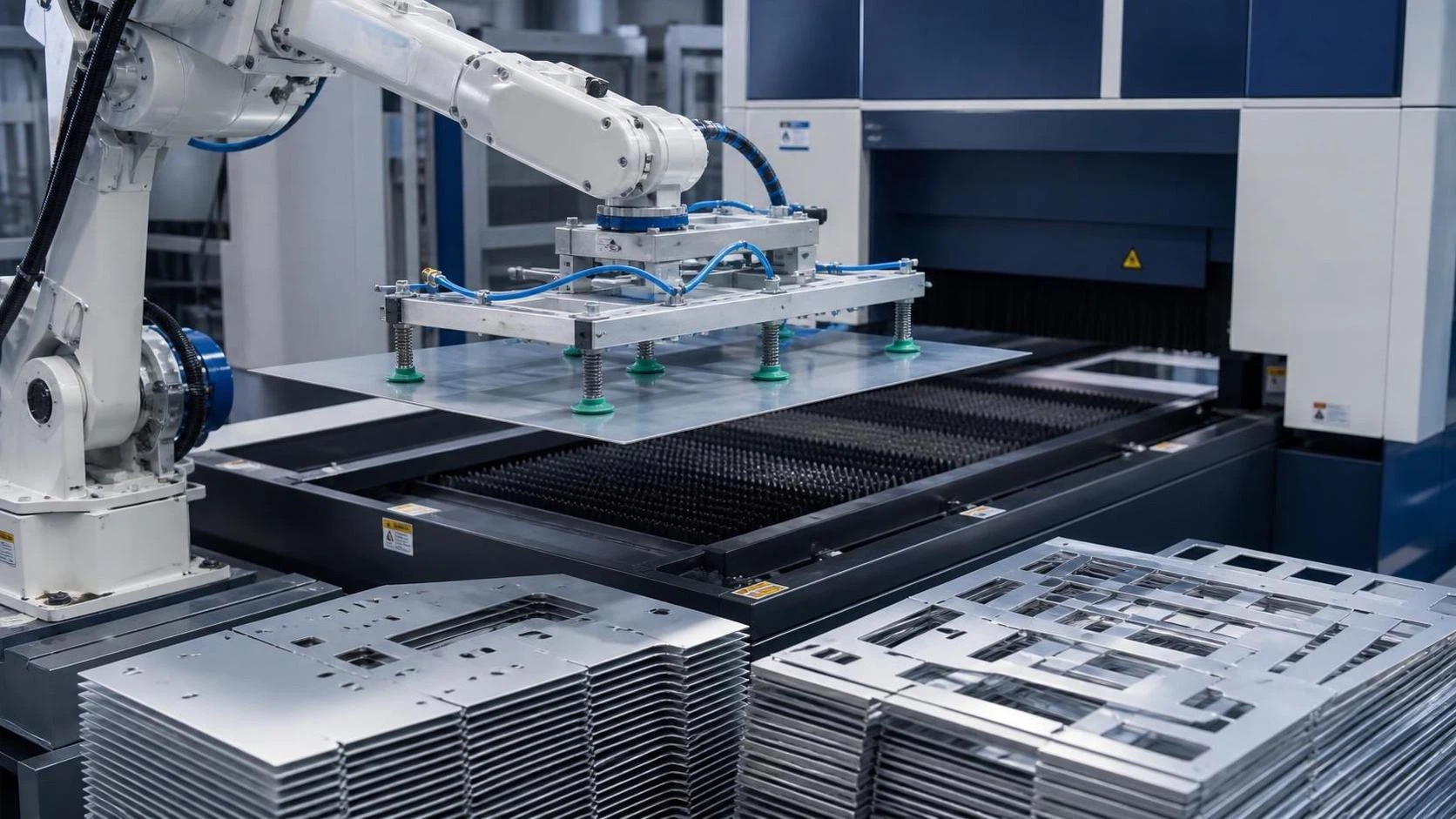
A handling robot arm for laser cutting addresses the less visible side of production: material movement. By automatically loading raw sheets, unloading skeletons, stacking cut blanks, and directing parts toward bending, welding, or inspection, the robot keeps the laser cell supplied and moving. For projects with tight delivery dates, variable order mixes, or growing labor constraints, that continuity can be as important as the cutting speed itself.
The goal is not simply to replace a person at the loading table. A well-planned robotic handling system creates a more predictable flow from incoming sheet stock to downstream fabrication. That predictability makes scheduling easier, helps protect cut-part quality, and gives managers a clearer basis for quoting capacity.
The hidden throughput loss happens between cutting cycles
In a manually operated laser cutting area, a typical cycle includes more than cutting. An operator must select the correct material, position the sheet, confirm placement, wait for the cycle to finish, remove parts and scrap, and prepare the next sheet. If parts need to be separated by work order, the operator may also be making decisions under time pressure while the laser is idle.
None of these individual actions appears dramatic. However, when a machine processes many nests per day, short pauses become a significant source of lost available cutting time. This is particularly common in facilities producing brackets, cabinets, frames, enclosures, machine guards, and mixed batches of custom components.
A handling robot arm for laser cutting reduces these gaps by taking responsibility for repeatable physical tasks. Depending on the cell design, it may use vacuum cups, magnetic grippers, fork-style tooling, or a combination of end effectors to handle sheets and finished parts. The laser operator can then focus more attention on nesting strategy, process verification, material planning, and exceptions that genuinely require human judgment.
What a robotic laser handling cell actually changes
The strongest applications do not treat the robot as an isolated add-on. They design the robot, sheet storage, laser cutter, conveyor, and production software as one material-flow system. The result is a sequence that can continue with far fewer manual touchpoints.
- Automatic sheet loading: The robot identifies or receives instructions for the required sheet type, picks it from a storage location, and places it onto the laser cutting table.
- Finished-sheet unloading: After cutting, the system removes the processed sheet or transfers parts to an unloading station without requiring an operator to stand by the machine.
- Skeleton and scrap handling: Remnant skeletons can be moved to designated disposal or recovery areas, reducing clutter around the cutting cell.
- Part sorting and stacking: Where the part geometry and automation concept allow it, cut components can be separated into bins, pallets, or process-specific locations.
- Downstream transfer: Parts can be delivered in an organized way to bending, deburring, welding, or assembly operations.
This does not mean that every part can be fully sorted automatically. Small pieces, delicate surfaces, micro-joints, nested components, and highly variable jobs may require different handling logic or manual intervention. The practical advantage is that repetitive, stable production work can be automated while people deal with the exceptions.
Higher laser utilization is only the first gain
The most obvious benefit of robotic loading and unloading is that the laser can spend more of its scheduled time cutting rather than waiting. Yet project managers usually see the wider value in how the system affects the rest of the job.
A more reliable production schedule
When manual loading depends on a particular operator being available at the exact moment a nest finishes, production timing becomes fragile. Breaks, shift changes, competing tasks, and fatigue can all affect flow. Robotic handling makes the cycle more consistent, especially during longer runs or unattended periods where permitted by the facility’s safety and operating procedures.
Consistency matters when several departments are linked. If the press brake team receives parts in irregular waves, bending queues grow. If welders receive incomplete sets, work-in-process increases. A steadier laser output makes it easier to synchronize downstream labor and equipment.
Less damage and fewer avoidable mix-ups
Sheet metal parts can be scratched, bent, dropped, or mixed with another order during manual unloading and stacking. This risk rises with thin-gauge material, coated sheets, stainless steel finishes, large panels, and complex nests containing many part numbers.
A robot follows programmed travel paths and placement positions. With suitable grippers, support points, and stack-management rules, it can handle material in a repeatable way. That does not eliminate the need for quality inspection, but it reduces variation caused by hurried handling. Better part identification at the unloading stage can also help prevent a simple sorting error from becoming a costly assembly delay.
Improved safety around heavy or awkward sheets
Large sheets can be difficult to move safely, particularly when material edges are sharp, surfaces are oily, or frequent loading creates repetitive strain. A robotic system keeps workers away from many of the lifting and reaching motions associated with sheet transfer. The safety value is not just about compliance; it can also help retain skilled operators by making their work less physically punishing.
Still, safety must be engineered, not assumed. Guarding, interlocks, emergency stops, safe robot zones, load monitoring, and clear recovery procedures are essential. The best automation cells make normal production easier without making fault recovery confusing or hazardous.
Where the business case is strongest
Not every laser cutting operation needs the same level of automation. A small shop producing one-off prototypes may benefit more from flexible manual handling than from a large robotic cell. The case becomes stronger when production includes repeated material handling, multiple shifts, a high volume of standard nests, or recurring delays caused by limited operator availability.
Consider a robotic handling solution seriously when one or more of the following conditions applies:
- The laser cutter is frequently idle while operators load sheets or clear finished work.
- Material weights or sheet sizes create recurring ergonomic concerns.
- Orders include repeat parts with stable dimensions and predictable routing.
- The operation runs long shifts and needs more dependable off-peak production.
- Labor is being diverted from skilled fabrication work to routine material movement.
- Traceability, part separation, and controlled staging are important to project delivery.
- Downstream bending or welding often waits for laser-cut components.
The right question is not, “Can a robot move this sheet?” It is, “Which delays in our current process are preventing the whole project from moving?” That distinction prevents companies from investing in automation that looks impressive but does not resolve the real bottleneck.
Start with the material flow, not the robot specification
It is tempting to compare robot payload, reach, and cycle time before mapping the process. Those specifications matter, but they should follow a practical workflow review. Project leaders should observe how material enters the facility, where it is stored, how it reaches the laser, how finished parts are labeled, and where they wait before the next operation.
Several details deserve early attention:
- Material variety: Identify sheet sizes, thickness ranges, grades, surface conditions, and protective films. The handling method for carbon steel may not suit aluminum or polished stainless steel.
- Part geometry: Small blanks, narrow strips, perforated parts, and warped cut sheets may need different separation and gripping approaches.
- Remnant management: Decide whether usable remnants will be returned to storage, tracked for future nests, or treated as scrap.
- Changeover expectations: A high-mix environment needs an automation concept that can switch materials and programs without excessive setup time.
- Floor space: Storage towers, robot travel envelopes, safety fencing, unloading tables, and forklift routes must be considered together.
- Data connection: Job information should move reliably between nesting software, the laser controller, robot controls, and the factory’s production-management process.
A good supplier will ask these questions before recommending a configuration. The answer may be a compact loading/unloading unit for one laser, a robotic cell with automatic storage, or a phased system that begins with loading and expands to sorting later.
Sorting is often the difficult part
Automatic loading is relatively straightforward because raw sheets have predictable dimensions. Unloading and sorting are more complicated. Parts may be held in the nest by tabs, may shift after cut completion, or may be too small for reliable vacuum pickup. Mixed nests can also require different destinations for different components.
For this reason, managers should be cautious about evaluating a system based only on an ideal demonstration with large, simple parts. Ask how the handling robot arm for laser cutting will deal with the actual parts that dominate your production schedule. Request a review of representative nests, including thin material, high part density, complex contours, and surface-sensitive components.
Sometimes the most productive approach is not to automate every separation task. A system may unload full sheets or organized groups of parts to a staging area, where an operator performs final sorting while the laser continues with the next job. This hybrid arrangement can still remove the largest source of idle time without forcing unrealistic automation requirements.
Plan the handoff to bending, deburring, and welding
Laser cutting is often the opening operation in a longer fabrication route. If robotic handling only increases the number of cut parts sitting on pallets, the bottleneck may simply move downstream. The implementation plan should therefore include the next process.
For example, cut blanks may need edge finishing before forming, or bent pieces may move into welded assemblies. In facilities that also fabricate pipe components, it can be useful to coordinate equipment investments across separate but connected workstreams. A pipe-welding solution such as the PPCW16 heavy duty Chuck Pipe Welding Station serves a different application from laser sheet handling, but it illustrates the same operational principle: stable clamping, controlled motion, and programmed sequences can reduce variability in repetitive fabrication work.
For mixed metal projects involving sheet metal frames, cut plates, and pipe assemblies, the management benefit comes from balancing these stages. There is little value in accelerating one department if the next department cannot receive, identify, and process the output in an orderly manner.
Implementation questions that avoid expensive surprises
Before approving a robotic laser handling project, create a short acceptance plan. Define what materials and part families the system must handle, what cycle conditions will be measured, and how the cell will recover from common interruptions. Include operators and maintenance personnel in these discussions; they often identify practical issues that are not visible in layout drawings.
Useful questions include:
- What happens if two sheets are picked together, or if a sheet is slightly bowed?
- How does the system confirm material type and thickness before loading?
- Can operators safely access the cutting table for cleaning, setup, and troubleshooting?
- Which parts require manual removal, and how will that work be scheduled?
- What preventive maintenance is required for grippers, vacuum systems, sensors, rails, and safety devices?
- Can the system accommodate future laser upgrades, extra storage positions, or a second shift?
- How will production teams measure improvement: laser uptime, parts per shift, lead time, labor hours, or work-in-process?
Clear answers turn automation from a capital purchase into an operating solution. They also help managers compare proposals fairly, since the lowest initial equipment price may not include the tooling, integration, training, or support needed to achieve stable production.
A practical path to more dependable sheet metal output
A handling robot arm for laser cutting improves throughput because it removes the stop-start rhythm that often surrounds an otherwise fast machine. It keeps material moving, makes production timing more repeatable, reduces unnecessary manual lifting, and creates a stronger connection between cutting and downstream fabrication.
The most successful projects begin with a realistic view of current constraints. Map the delays, identify the part families that are best suited to automation, and define how material will move after cutting—not just into the laser. With the right cell design and disciplined process planning, robotic handling can help sheet metal operations deliver more predictable capacity without sacrificing the flexibility that custom fabrication demands.
search
Products Navigation
Send Us A Message