




How Much Does a Wuxi Samgins Welding Robot Cost?
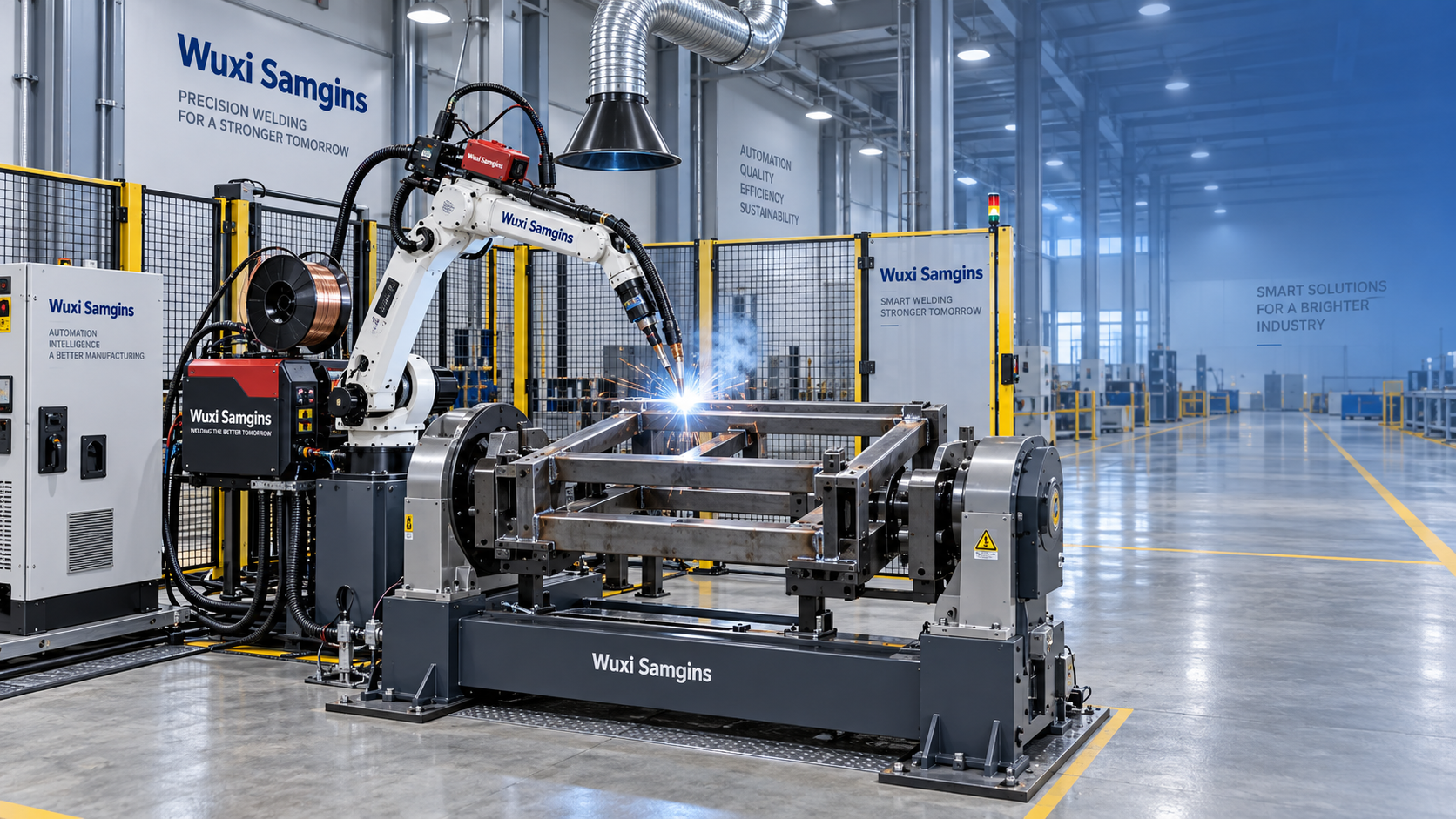
A Wuxi Samgins welding robot does not have a single defensible “standard price.” The cost depends less on the robot arm alone than on the complete welding cell: the welding power source, positioner, safety enclosure, tooling, workpiece handling, programming scope, and commissioning requirements. A request for a robot-and-torch price can therefore look economical while omitting the equipment needed to produce repeatable welds on the factory floor.
For a meaningful budget comparison, buyers should separate the robot package price from the installed system cost. The first may cover an industrial robot, controller, torch, wire feeder, and basic welding package. The second includes the engineering work that makes the cell usable for a particular part family. In many fabrication projects, that distinction determines whether automation delivers a stable production improvement or becomes an underused capital asset.
What is included in the quoted price?
The most important question is not simply “How much is the welding robot?” but “What exactly is the supplier pricing?” A Wuxi Samgins quotation may be configured around a standard robotic welding package or around a more complete automated cell. These are materially different purchases.
A basic package may include:
- Industrial robot arm and controller;
- Robot teach pendant and standard cabling;
- MIG/MAG, TIG, or other specified welding power source;
- Robot welding torch, wire feeder, and torch mounting hardware;
- Basic software functions and initial parameter setup;
- Limited factory testing before shipment.
A production-ready cell may additionally require a safety fence or enclosed guarding, safety interlocks, fume extraction interfaces, part fixtures, a single-axis or multi-axis positioner, a wire cleaning or torch reaming station, workpiece loading provisions, electrical distribution, offline programming, and on-site commissioning. Depending on the workpiece, the positioner and fixtures can add more practical value than upgrading the nominal payload of the robot.
Price comparisons become unreliable when one supplier quotes only the robot package while another includes the positioner, safety system, tooling, installation support, and weld trials. A lower headline number does not necessarily represent a lower investment.
Which factors have the largest effect on cost?
Robot payload and reach affect price, but they should be specified from the real process requirement rather than estimated from the part weight alone. The robot carries the torch, cable package, mounting hardware, and sometimes a sensor package. Reach must also accommodate the fixture, weld location, and required torch angles. A robot with insufficient reach can create awkward weld paths and restrict access; an oversized robot raises capital cost and may not improve cycle time.
Welding process selection is equally important. Standard MIG/MAG robotic welding is often the starting point for carbon-steel fabrications, but the required power source and process features depend on material, thickness, weld position, spatter tolerance, and quality expectations. Aluminum, stainless steel, thin sheet, high-deposition fillet welds, and demanding root-pass applications can require different wire-feeding arrangements, pulse capability, cooling, or process control. These choices change both the equipment price and the technical effort needed for successful commissioning.
Part handling is frequently the hidden cost driver. A simple component that can be clamped in one orientation may only need a fixed fixture. A large fabricated frame, cylindrical vessel, or multi-sided assembly may need turning rolls, a headstock-tailstock positioner, a two-axis manipulator, or coordinated robot-positioner control. The purpose is not merely convenience: positioning the weld in a favourable orientation can reduce defects, improve bead consistency, and avoid difficult out-of-position welding.
Automation level changes the project from a welding cell into a handling system. Manual loading with a safeguarded operator station is different from a cell with automatic part transfer, conveyors, pallet systems, barcode identification, seam tracking, and production data collection. These functions can be justified for stable, high-volume part families, but they should not be added solely because they appear in a demonstration video.
Safety engineering should be treated as a core cost, not an optional accessory. Robotic welding involves moving equipment, arc radiation, hot parts, fumes, wire hazards, and pinch points around positioners. The required safeguarding depends on the risk assessment, local legal requirements, loading method, and machine layout. For export projects, buyers should clarify the destination-country requirements before finalizing the configuration. A CE-marked component does not automatically mean that a complete integrated cell satisfies every obligation applicable in its final installation environment.
Why a robot-only price can be misleading
A robot arm cannot compensate for variable upstream fabrication. Robotic welding performs best when joint preparation, component dimensions, tack-weld location, fixture positioning, and part presentation are controlled. If incoming parts vary beyond the process tolerance, the system may need seam-finding, touch sensing, laser sensing, adaptive programming, or more robust fixture design. Each option has a cost, and none removes the need for reasonable control of the fabricated parts.
This is particularly relevant in low-volume or high-mix production. A robot may be technically capable of welding many product types, but each new part requires fixture design, program creation, weld parameter development, trial production, and operator instruction. The economic case is strongest when the same joints recur often enough for that engineering effort to be recovered through reduced manual welding time, improved consistency, or higher output.
Buyers should therefore ask for the quote to identify exclusions clearly. Freight, export packing, import duty, destination taxes, unloading, site electrical work, gas distribution, extraction ducting, foundation work, installation labour, local safety validation, and operator training may all sit outside the equipment price. These are not minor administrative details; they are part of the real capital requirement.
How should a buyer request a comparable quotation?
A useful request for quotation begins with the workpiece, not the robot model. Provide drawings, material grades, thickness ranges, photographs of the current assembly, annual or monthly volume expectations, target cycle time, weld symbols, required inspection method, and the available floor layout. If the part includes long seams, internal corners, variable gaps, or restricted torch access, those conditions should be shown early.
The quotation should state, in plain commercial terms:
- Robot make, model, payload, reach, controller generation, and warranty scope;
- Welding power source brand and model, process capability, cooling method, and wire-feeding configuration;
- Whether a positioner is included, its load capacity, rotation range, and synchronization method;
- Fixture responsibility, including whether the supplier provides design only, manufacture, or neither;
- Safety package contents, including fencing, doors, interlocks, emergency stops, and safety control components;
- Included programming, sample weld trials, factory acceptance criteria, and commissioning boundaries;
- Documentation language, electrical standards, spare-parts list, and remote or on-site support arrangements;
- Incoterms, packing, lead time, payment milestones, and installation exclusions.
It is also worth defining the acceptance standard before placing an order. “Good weld quality” is too vague for a factory acceptance test. The parties should agree on representative materials, joint types, visual acceptance criteria, dimensional requirements, and any required destructive or non-destructive testing. If the final fixtures or production parts will only be available at the buyer’s site, the limits of factory testing should be acknowledged in the contract.
Does a higher-priced welding cell necessarily offer better value?
Not necessarily. Value depends on how closely the system matches the job. A highly automated cell may be inefficient for irregular repair work, frequently changing fabricated assemblies, or small batches with no fixture discipline. Conversely, a low-cost standard package can be a poor investment when it lacks the reach, access, safety design, positioning capacity, or process support required for the actual part.
The more useful calculation is the lifecycle cost per acceptable welded assembly. This includes labour required for loading, unloading, tacking, touch-up welding, fixture adjustment, programming, consumables, maintenance, rework, downtime, and quality inspection. A cell that produces fast welds but requires frequent manual correction may not improve total throughput. A slower but stable process can be commercially preferable if it reduces variation and protects delivery commitments.
Consumable and service availability deserve attention in cross-border procurement. A buyer should identify the exact torch consumables, contact tips, liners, nozzles, wire-feeder components, controller batteries, cables, and power-source wear items needed for routine operation. Proprietary items are not automatically a problem, but their availability, lead time, and local substitute options should be understood before purchase.
What should be checked in Ltd welding robot reviews?
Searches for “Ltd welding robot reviews” often produce company-directory listings, marketplace comments, generic product descriptions, or feedback that is not tied to the exact cell configuration under consideration. Such material can help identify recurring concerns, but it should not be treated as proof of welding performance, delivery reliability, or after-sales capability.
More useful evidence is specific and verifiable: sample weld videos or photographs on comparable joints, the bill of materials for the proposed system, controller and welder model numbers, factory test procedures, export documentation examples, warranty terms, and a clear support process. A review that says a machine is “good quality” offers little decision value unless it identifies the application, material, welding process, and time in service.
When comparing supplier claims, distinguish between equipment manufacturing, trading, system integration, and local service responsibilities. A company may supply a complete solution through a network of equipment manufacturers and integrators. That can be entirely workable, but the buyer needs to know who is accountable for programming, fault diagnosis, warranty response, replacement parts, and final cell performance.
When is a Wuxi Samgins welding robot likely to be a sensible investment?
The investment becomes easier to justify where assemblies have repeatable weld paths, manageable part variation, sufficient production repetition, and a clear method of fixturing and loading. Common examples include structural steel components, frames, brackets, tanks, pipe assemblies, and fabricated machine parts, provided that joint access and handling have been properly reviewed.
It is less straightforward when the operation depends on highly variable fit-up, frequent one-off jobs, unstable incoming components, or parts that cannot be presented consistently to the torch. In those situations, improving cutting accuracy, tack fixtures, welding procedures, material flow, or semi-automatic welding stations may produce a better first return than purchasing a full robotic cell.
The right question is therefore not whether the equipment is inexpensive relative to another robot. It is whether the quoted configuration can repeatedly weld the intended parts, within the required quality standard, at a cost that remains favourable after installation, training, support, consumables, and production changeovers are included. A detailed, application-specific quotation is more valuable than a low robot-only price because it exposes the real scope of the investment before the purchase order is issued.
search
Products Navigation
Send Us A Message