




How to assess a welding robot supplier's service capability
Service Capability Is Part of the Robot System, Not an Add-On
A welding robot can meet the required payload, reach, repeatability, and welding-process specifications yet still become an expensive underperforming asset if the supplier cannot support commissioning, fault recovery, programming changes, and spare-parts replacement. The relevant question is not whether a supplier offers “after-sales service.” It is whether its service organization can restore and sustain the intended production process under the buyer’s actual operating conditions.
For a business evaluation, service capability should be assessed as a measurable delivery risk. It affects the time between shipment and productive output, the probability that a minor fault becomes extended downtime, the cost of future product changes, and the degree to which the buyer remains dependent on an external integrator. The best welding robot supplier is therefore not necessarily the company with the lowest quoted cell price or the longest generic warranty statement. It is the one whose technical, operational, and commercial commitments can be verified before the purchase order is issued.
Separate Robot Supply From Automation-Service Responsibility
Many evaluation errors begin with treating “welding robot supplier” as a single category. In practice, the company offering a robot cell may be a robot manufacturer, a welding-equipment maker, a trading company, a system integrator, or a combination of these roles. Their ability to provide service varies considerably.
A robot manufacturer may have strong controller knowledge but limited responsibility for fixtures, safety circuits, positioners, weld power sources, fume extraction, or material handling. An integrator may be capable of delivering the complete production cell but rely on third parties for the robot, welding source, or specialized sensors. A machinery supplier may coordinate export, documentation, and installation support but need to define clearly who performs software troubleshooting or field repair.
The commercial proposal should identify one accountable party for each part of the system:
- Robot arm, controller, teach pendant, cables, and controller software;
- Welding power source, wire feeder, torch, consumables, and welding-process interface;
- Fixtures, positioners, rotators, tracks, safety fencing, scanners, and interlocks;
- PLC logic, industrial communications, remote-access arrangements, and production data interfaces;
- Installation, calibration, programming, acceptance testing, training, and warranty response;
- Spare-parts stocking, repair authorization, and end-of-life support.
Ambiguity in this responsibility matrix is more significant than a broad promise of “full technical support.” If a weld defect arises from an interaction between torch geometry, positioner speed, robot path, and wire-feed settings, the buyer needs to know who owns diagnosis and corrective action. A supplier that assigns every issue to another component provider is not offering integrated service capability.
Test Pre-Sales Engineering Depth Before Evaluating Post-Sales Claims
Service quality is visible long before the equipment ships. A capable supplier asks for the information required to engineer a stable process: part drawings, material grades, thickness ranges, joint types, tolerances, annual volume, takt-time targets, existing quality requirements, available utilities, factory layout, and expected product variation. A supplier that responds with a standard configuration before obtaining these inputs may be quoting equipment rather than evaluating a workable automation solution.
Particularly important is the supplier’s treatment of variation. Welding automation is most predictable when joint location, fit-up, part geometry, and fixturing are controlled. If incoming components have inconsistent dimensions, gaps, surface condition, or tack-weld positions, a robot program alone cannot guarantee repeatable weld quality. The proposed solution may require more robust fixturing, seam tracking, touch sensing, adaptive programming, pre-weld inspection, or revised part-preparation controls. Each option has implications for capital cost, cycle time, programming complexity, and maintenance.
A technically credible proposal should explain what assumptions it makes. These may include maximum workpiece weight, allowable dimensional deviation, weld-position requirements, cycle-time basis, duty cycle, wire type, shielding gas, and operator involvement. The buyer should distinguish between guaranteed performance and performance that depends on conditions not yet validated.
Ask for a written description of the process boundary. For example, does the supplier’s scope include loading and unloading, tack welding, joint cleaning, root-pass inspection, rework handling, consumable changes, and post-weld part transfer? A cell can achieve an attractive arc-on-time calculation while delivering a disappointing overall throughput if manual activities outside the robot envelope were excluded.
Commissioning Capability Should Be Evaluated as a Controlled Project
Installation support is not merely a travel commitment. It is a sequence of technical tasks that should lead from mechanical placement to safe and repeatable production. The supplier should be able to define the commissioning stages, required site conditions, buyer responsibilities, and acceptance criteria.
A practical commissioning plan normally addresses foundation and anchoring requirements, electrical supply, grounding, compressed air, shielding-gas supply, network access, safety-zone validation, fixture alignment, robot mastering or calibration, welding-parameter development, dry-run tests, and production trials. The depth of this plan matters because each omitted interface can create delay after delivery.
Site readiness is often underestimated in international machinery purchases. A supplier may be ready to dispatch technicians, while the customer site lacks final power connections, appropriate lifting equipment, workpiece samples, gas lines, or cleared installation space. The resulting delay can lead to disputes over travel costs and warranty start dates. Contract terms should state when installation is considered ready to begin and what happens if site conditions prevent commissioning.
Factory acceptance testing and site acceptance testing should not be treated as interchangeable. A factory acceptance test can confirm the basic operation of the supplied system and, where representative parts are available, demonstrate programmed motions and welding performance under controlled conditions. Site acceptance is more relevant to production because it tests installation quality, utilities, actual operators, local workpieces, and real operating rhythm.
The acceptance protocol should specify the parts to be tested, sampling conditions, quality criteria, cycle-time definition, safety checks, required documentation, and remedy if criteria are not achieved. “Machine runs normally” is too vague to be commercially useful. If weld appearance, penetration, distortion, or dimensional control matters, the method for evaluating those outcomes should be agreed with the relevant quality standard and the buyer’s internal requirements.
Assess Remote Support by Its Limits, Not Just Its Availability
Remote support can shorten diagnosis time for controller alarms, parameter errors, program issues, and some communication faults. Its value depends on the supplier having qualified personnel, a clear escalation route, secure access arrangements, and enough documentation to understand the delivered configuration. A claim that engineers can provide online support is incomplete without a defined response model.
Useful questions include:
- What support channels are available: email, telephone, video call, remote controller access, or local service partner?
- What response time applies to production-stopping faults, and during which time zones or business hours?
- Who is authorized to make program, parameter, or safety-related changes remotely?
- How are software backups, robot programs, PLC files, and welding parameters stored and version-controlled?
- Which failures cannot be resolved remotely and require an on-site visit?
- Are cybersecurity approval, VPN configuration, and customer IT involvement required before remote access can be used?
Remote diagnosis cannot replace local mechanical competence. Damaged torch dress packs, worn wire-feed components, failed reducers, fixture misalignment, leaking gas lines, or damaged safety devices may require physical inspection and replacement. A supplier should state its field-service coverage honestly rather than presenting remote access as a universal solution.
Spare Parts Reveal Whether Support Is Designed for Uptime
Welding cells contain components with very different failure profiles. Consumables such as contact tips, nozzles, liners, and anti-spatter materials must be managed routinely. Wear items such as torch cables, drive rolls, seals, wheels, bearings, and cable carriers need planned replacement. Controllers, servo drives, motors, sensors, welding-source boards, and safety components may fail less frequently but can cause substantial downtime when unavailable.
A supplier’s spare-parts proposal should therefore be reviewed at three levels: start-up stock held on site, recommended critical spares for the first operating period, and the supplier’s replenishment capability. The proposal should identify part numbers, compatible alternatives, expected replacement difficulty, storage requirements, and whether items are proprietary.
For cross-border procurement, shipping speed alone does not define availability. Export controls, customs clearance, battery or electronic-component transport restrictions, local import procedures, and the need for technical verification can all delay a part. Buyers should ask where critical spares are stocked and whether the supplier has a documented route for emergency shipments. If local service partners are named, their authorization, inventory, and technical scope should be confirmed.
Long-term service also depends on obsolescence management. Controllers, industrial PCs, communication modules, and software versions can change during the expected life of a cell. The supplier should explain how it handles discontinued components, software compatibility, and migration options. A low initial price can lose its advantage if the system depends on electronics that become difficult to source or modify.
Training Must Transfer Operating Control, Not Only Teach Pendant Basics
Training has a direct effect on availability because many stoppages do not require specialist intervention if operators and maintenance staff can identify the cause safely. Basic robot jogging is not enough for a production environment. The training scope should reflect the roles that will actually use and maintain the cell.
Operators need safe start-up and shutdown procedures, alarm recognition, consumable replacement, basic recovery after a normal interruption, and rules for when not to restart equipment. Programmers or production engineers need program backup, approved editing procedures, coordinate-system awareness, touch-up limits, welding-parameter management, and change-control discipline. Maintenance personnel need preventive-maintenance routines, lubrication requirements, cable and torch inspection, electrical fault isolation, safety-device checks, and criteria for escalation.
The quality of training can be assessed through its deliverables. These should include operating manuals in an agreed language, electrical and pneumatic diagrams, robot and PLC backups, maintenance schedules, spare-parts lists, safety documentation, and records of the final installed configuration. If the buyer cannot access the latest program and parameter files after handover, dependence on the supplier remains unnecessarily high.
Service Capability Matters More When the Robot Cell Includes Positioning Equipment
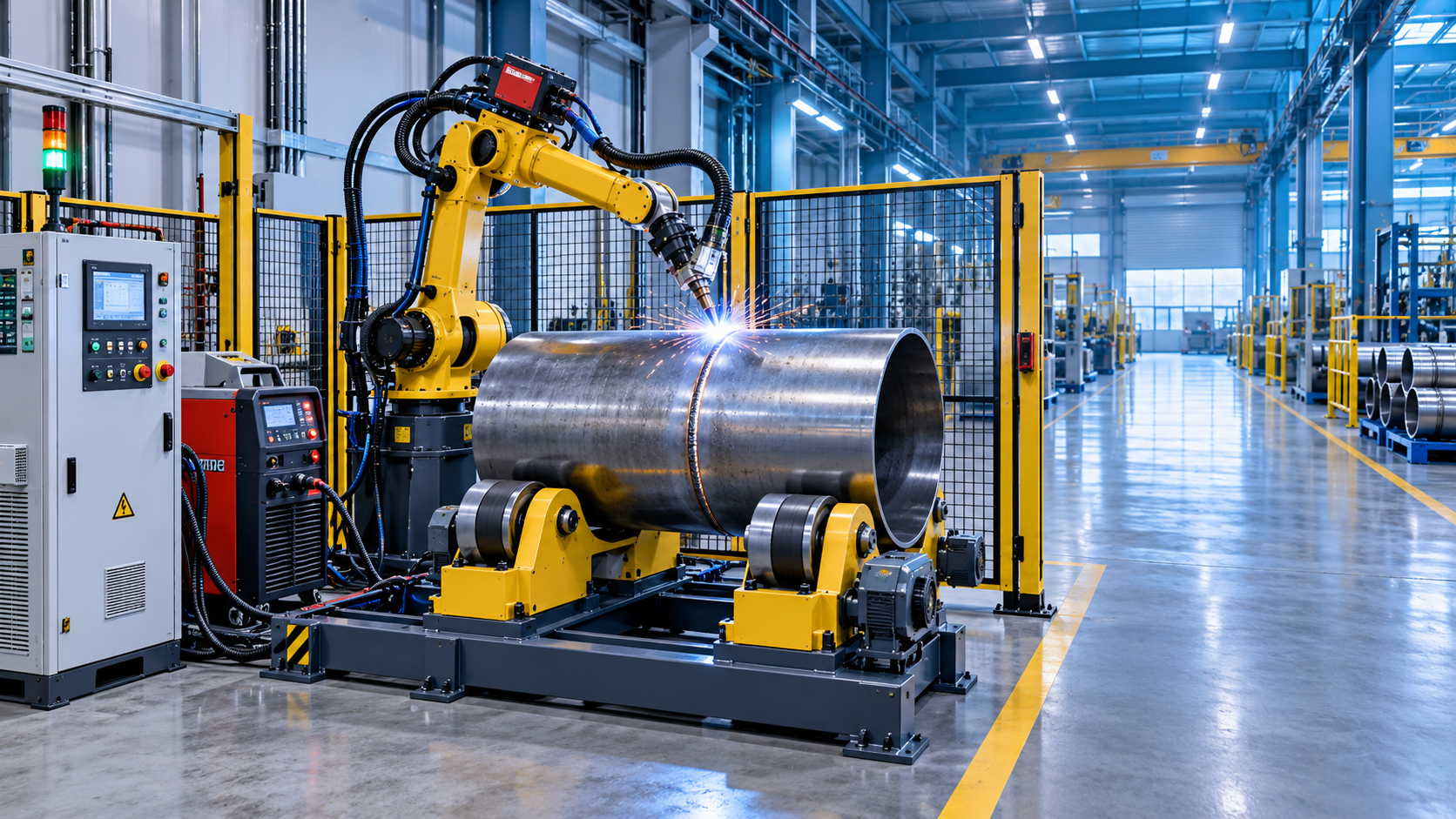
Complexity rises when the robot must coordinate with external axes such as positioners, tracks, or welding rotators. These devices affect weld access, torch orientation, travel speed, part stability, and safety logic. They also create additional interfaces between mechanical design, variable-frequency drives, robot synchronization, and fixture engineering.
For cylindrical fabrication, the supplier should be able to address how workpiece rotation is controlled, how the workpiece is centered, how speed is coordinated with welding parameters, and how emergency stops affect both the robot and rotating equipment. A bolt-adjusting rotator may be appropriate where workpiece diameters vary and positional adjustment is needed, but its suitability depends on load distribution, shell geometry, wheel selection, workpiece rigidity, and the required welding sequence.
Equipment such as a Bolt adjusting welding rotator can cover rated load classes from small cylindrical workpieces to heavy vessel fabrication, with variable-speed control intended to support controlled rotation. That specification range does not by itself prove automation compatibility. The supplier should show how the rotator’s control interface, speed feedback, rotation direction, safety interlocks, and mechanical adjustment will be incorporated into the complete welding-cell design. This is precisely where service engineering is more valuable than a component catalogue.
Read Warranty Terms for Operational Meaning
A warranty period is only one part of service protection. Its practical value depends on commencement date, exclusions, labor coverage, travel responsibility, response commitments, and the supplier’s authority to determine whether a failure is covered. A warranty that begins on shipment may provide less protection than one tied to successful site acceptance, particularly where installation is complex.
Review whether the warranty distinguishes between robot hardware, welding source, torch consumables, external axes, fixtures, software, and third-party components. Consumables and normal wear items are commonly excluded, but the boundary between normal wear and premature failure should be clear. The buyer should also understand whether corrective action consists of remote advice, shipment of a replacement part, field labor, or a combination of these measures.
Service-level commitments should avoid language that cannot be enforced. “Prompt response,” “lifetime support,” and “professional service” carry little evaluative value without named support channels, escalation responsibilities, response windows, and defined deliverables. A supplier willing to document these conditions is generally easier to manage after delivery than one relying on broad assurances.
Use References and Documentation to Verify Capability
Supplier references are most useful when they resemble the proposed application in process complexity, workpiece type, export destination, and service model. A reference for a simple manual-positioning robot cell does not validate capability for a multi-axis pressure-vessel welding system with integrated sensing and traceability requirements.
Rather than requesting only a list of customer names, request evidence that can be reviewed without breaching confidentiality: sample commissioning schedules, redacted acceptance-test templates, training agendas, preventive-maintenance checklists, sample spare-parts recommendations, documentation indexes, and service escalation diagrams. These materials reveal whether the supplier has repeatable delivery methods or is relying on informal technical knowledge.
Certifications should also be interpreted correctly. CE-related documentation may be relevant where equipment is supplied to the European market, but it does not independently establish that the supplier can commission, maintain, or optimize the installed process. Compliance documentation and service competence are related but separate evaluation areas.
A Better Decision Basis Than Price Comparison
Service capability should be converted into a commercial comparison rather than left as a qualitative impression. Build a supplier evaluation around the expected operating life of the cell: engineering support before order, commissioning resources, acceptance obligations, training outputs, remote response, local intervention options, critical spare-parts strategy, software ownership, upgrade support, and warranty conditions.
Price should then be assessed against the risk retained by the buyer. A lower initial quotation may require the buyer to absorb more integration work, maintain more inventory, rely on overseas troubleshooting, or pay separately for future programming changes. A higher quotation may be justified only when the added service is specific, contractually visible, and relevant to the production risk being purchased.
The decisive evidence is rarely found in a brochure. It appears in the supplier’s engineering questions, the clarity of its scope boundaries, the completeness of its commissioning plan, the accessibility of its technical records, and its willingness to define what happens when the cell does not perform as intended. Those are the indicators that distinguish a machine seller from a supplier capable of supporting reliable welding automation.
search
Products Navigation
Send Us A Message