




What is a plate roller machine used for in metal fabrication?
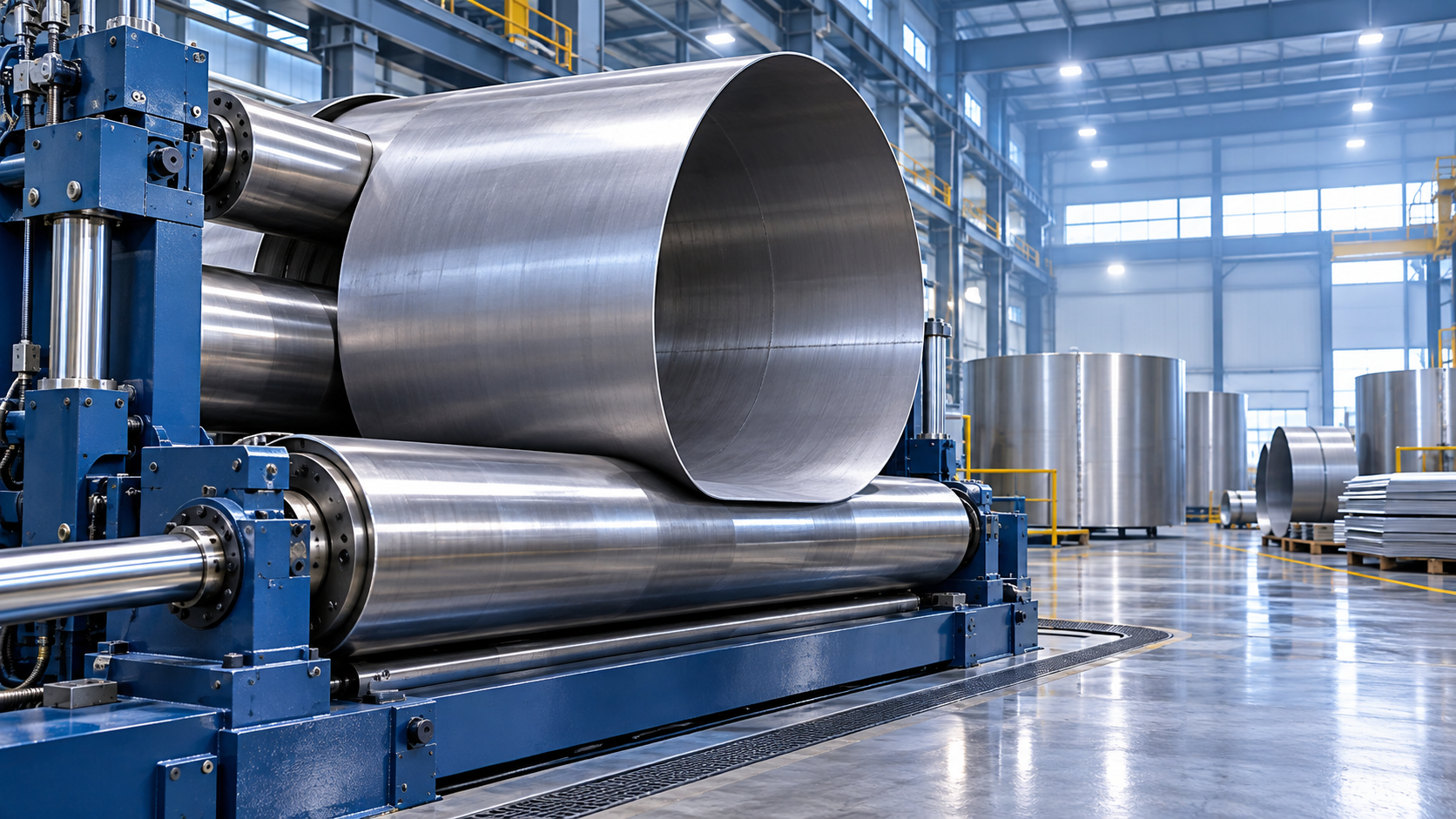
A plate roller machine is used to turn flat metal plate into curved forms such as cylinders, cones, large-radius arcs, and rolled shells. In metal fabrication, it is the machine behind many products that begin as a rectangular sheet but must end as a round or curved component: storage tanks, pipe sections, ducts, pressure-vessel shells, silos, mixers, chimneys, curved structural parts, and custom housings.
The important distinction is that a plate roller works on sheet or plate material, not on finished pipe. It applies controlled pressure through rotating rolls, gradually bending the workpiece along its length. A fabricator can therefore create a diameter that suits the required component instead of buying a standard pipe size and trying to adapt it later.
What a plate roller machine actually does
A typical plate rolling machine has three or four powered and adjustable rolls. The plate passes between them while one or more rolls move to create a bend. Repeated rolling increases the curvature until the plate reaches the target diameter or radius.
For a simple cylinder, the operator pre-bends both plate ends, rolls the central area into a curve, aligns the edges, and sends the formed shell to welding. For a cone, the plate is usually cut into a sector shape before rolling, and the machine setup must account for the changing diameter from one end to the other.
This process is different from press-brake bending. A press brake makes individual bends along straight lines, producing angles, channels, boxes, and faceted shapes. A plate roller creates a continuous curve. If a tank shell were made with several press-brake hits, it could look rounded from a distance but would still have flat facets. Where roundness, weld fit-up, or smooth flow matters, rolling is usually the more suitable process.
Common uses in metal fabrication
The most familiar application is making cylindrical shells. A flat steel plate can be rolled into the body of a fuel tank, water tank, processing vessel, hopper, ventilation duct, or large pipe section. The seam is then welded, and end caps, flanges, nozzles, supports, or stiffening rings may be added in later operations.
Plate rolling is also used for conical components. Cones appear in reducers, hoppers, cyclone separators, transition sections, and certain vessel heads. Cone rolling requires more setup discipline than ordinary cylinder rolling because the material does not travel through the machine in the same way across its full width. The result depends heavily on correct blank development, roll positioning, and operator control.
Another use is forming curved structural parts. Fabricators may roll broad-radius sections for architectural cladding, bridge-related assemblies, curved frames, machine guards, spiral equipment, or decorative metalwork. In these jobs, the goal may not be a closed cylinder at all. It may be a partial arc that must match a drawing, a template, or an existing structure.
Some fabricators use rolling machines to make large-diameter pipe from plate. This is practical when the diameter, wall thickness, material grade, or length is outside the range of standard purchased tube. The rolling operation creates the shell; welding, seam finishing, and inspection determine whether the finished assembly is suitable for its intended service.
Why fabricators use rolling instead of buying ready-made tube
Standard pipe is efficient when standard sizes fit the design. It becomes less useful when a project requires an unusual diameter, a short large-diameter section, a tapered transition, or a material that is not readily available as tube. Rolling plate provides greater freedom over the final geometry.
It also allows a workshop to control the joint location. For a fabricated cylinder, the longitudinal seam can often be placed where it is easiest to weld, inspect, or keep away from mounting points. That matters when internal attachments, external supports, or openings would interfere with a convenient seam position.
For larger components, transporting a finished cylinder may be less practical than rolling plate near the assembly area. A fabricator can produce shell sections, weld them into longer bodies, and complete the equipment in manageable stages. This is common logic for large tanks, ducts, and process equipment, though the preferred approach still depends on the project layout and handling capacity.
The workpiece determines whether rolling is a good fit
A plate roller machine is not chosen simply because a part is curved. The material and the required geometry determine whether the process is appropriate. Thickness, width, yield strength, surface condition, bending direction, and finished diameter all affect the machine requirement.
Thicker material requires more force. Wider material places greater demand on the rolls and frame because the machine must bend the full width consistently. Stronger steels generally resist bending more than mild steel of the same thickness. A machine that can roll a certain thickness of mild steel may not produce the same result in higher-strength material.
Diameter is equally important. Tight diameters are more demanding than broad curves. The smaller the desired rolled diameter, the greater the strain imposed on the plate. A machine may be capable of bending a plate thickness in general terms but still be unable to achieve the required small diameter at that thickness.
The direction of the plate grain can also affect results, particularly when material is demanding, a tight radius is required, or surface appearance is important. A sensible fabrication review considers the plate specification and blank orientation before production begins, rather than treating all sheets as interchangeable.
The difference between three-roll and four-roll machines
Both three-roll and four-roll designs are used widely, but they suit different operating priorities.
The choice is not simply “three rolls for small work and four rolls for large work.” Either style can be built for different capacities. The more useful question is how often the workshop must repeat a shape, how much pre-bending quality matters, whether one-person handling is realistic, and how much setup variation the work can tolerate.
Pre-bending is where many first evaluations fall short
A plate roller cannot form the very end of a plate as completely as the central area while the plate is entering or leaving the rolls. Without pre-bending, each end retains a flatter section. When the two edges meet, the shell may show a noticeable flat spot or poor alignment at the weld seam.
Pre-bending reduces this issue by forming the leading and trailing edges before the plate is rolled through its full length. It is especially important for cylinders that need a clean seam, a round appearance, or reliable fit-up with flanges and end components. A buyer comparing machines should ask how each machine handles end pre-bending, rather than focusing only on its maximum rolling capacity.
Even with good pre-bending, the finished shell may require checking and adjustment. Rolling is a controlled deformation process, not a one-pass guarantee. Material springback causes the plate to open slightly after pressure is released. Operators compensate by rolling beyond the target curvature and checking the result against the required diameter or template.
What plate rolling does not replace
A plate roller is not a universal bending machine. It does not replace a press brake for sharp bends, a section bender for beams and profiles, or a tube bender for formed pipe and tubing. Using the wrong machine category usually creates avoidable problems in part quality, setup time, and tooling cost.
Tube bending supports hollow round, square, or rectangular sections while forming a bend radius. It is used for handrails, furniture frames, boiler tubing, vehicle parts, ship fittings, and pipe runs. In applications where the material is already tubular and bend appearance is important, a dedicated tube bender is the appropriate equipment. For example, an NC hydraulic pipe bending machine is intended for pipe-bending work and can use programmable control, servo-driven rotation, and mandrel management to help maintain bend shape. That is a different task from rolling flat plate into a welded shell.
Likewise, a plate rolling machine does not perform the welding required to close a cylinder or the cutting needed to prepare a blank. Most fabricated shells move through a sequence: plate cutting, edge preparation where required, rolling, fit-up, welding, finishing, and inspection. A rolling machine is central to that sequence, but it is only one part of the production route.
Common quality problems and what causes them
Uneven diameter can occur when roll settings are not balanced, the plate is fed at an angle, or the operator does not make enough controlled passes. The shell may be more oval than round, which can complicate welding and assembly. Measuring during rolling is more effective than trying to force correction after the shell is complete.
Flat ends usually point to insufficient pre-bending. This is not merely a cosmetic defect. A flat zone at the seam can make alignment more difficult and may require extra correction before welding.
Surface marking can result from damaged rolls, scale, debris, or poor handling. It matters more on stainless steel, aluminum, coated material, and visible architectural work. The machine, lifting equipment, and work area all need to protect the surface; choosing a roller alone does not solve that requirement.
Cracking or poor edge condition may be linked to a tight bend, unsuitable material condition, a problematic edge, or bending across a less favorable direction. If the design calls for a tight diameter in thick or high-strength plate, the feasibility of the formed part should be considered before the blank reaches the machine.
How to evaluate a plate roller machine for a real job
Capacity labels are useful, but they are not enough for a reliable decision. A sound evaluation starts with the jobs that will actually be produced, not with the largest number shown in a catalog.
- Define the material: Identify material type, thickness range, width, and whether surface finish must remain protected.
- Define the smallest required diameter: The tightest cylinder or arc is often more informative than the widest diameter.
- Separate occasional work from routine work: A job completed once with extensive manual adjustment is different from a part that must be produced repeatedly with stable geometry.
- Consider cones and partial arcs: A machine suitable for ordinary cylinders may need different capability, tooling, or operator skill for tapered and asymmetrical forms.
- Review material handling: Large plate is difficult to control manually. Feeding, supporting, removing, and turning a rolled shell should be planned with the same care as the machine itself.
- Check downstream work: Determine how the shell will be welded, measured, moved, and assembled after rolling. A well-formed cylinder still creates delays if it cannot be handled efficiently.
For shops working across cutting, welding, rolling, and finishing, equipment selection is often strongest when the machines are considered as a connected process. Wuxi Samgins International Trade Co., Ltd supplies plate rolling machines alongside CNC cutting, welding, bending, leveling, deburring, and other metalworking equipment. That broader equipment scope is relevant because a plate shell rarely begins and ends at the roller.
A practical way to decide whether you need one
A plate roller machine makes sense when flat metal must become a smooth curved component and the required geometry cannot be achieved economically with standard tube, segmented bending, or purchased formed parts. It is particularly useful for cylindrical shells, conical transitions, large-radius curved panels, and fabricated pipe sections.
Before comparing models, prepare a short list of representative parts: material, thickness, plate width, finished diameter, length, tolerance expectations, and annual quantity. Include the smallest target diameter and any cone work. Those details reveal far more about the right rolling solution than a general request for a machine that can “roll steel plate.”
search
Products Navigation
Send Us A Message