




Which welding robot safety features matter in a shared workspace?
Which Welding Robot Safety Features Matter in a Shared Workspace?
In a shared workspace, a welding robot is not isolated from the rest of the factory. Operators may load fixtures, quality personnel may inspect joints, material handlers may move parts nearby, and maintenance teams may need access to peripheral equipment. That changes the safety question. The goal is not simply to stop people from reaching a robot; it is to control every foreseeable interaction between people, moving machinery, welding energy, fumes, workpieces, and automated material flow.
For quality and safety managers, the strongest welding robot safety arrangement is usually a coordinated system rather than one feature. Physical guarding, interlocked access doors, emergency-stop circuits, safety-rated motion control, presence sensing, clearly defined operating zones, and disciplined procedures all have different jobs. A gap in one layer can undermine the others.
This matters especially in fabrication shops where a robotic cell sits close to bending, rolling, cutting, grinding, or assembly operations. The robot may be predictable during normal production, but hazards often increase during part changeover, weld inspection, fault recovery, fixture adjustment, and cleaning. Those are the moments a safety review should examine most closely.
Start with the actual shared-workspace risk
A welding robot creates more than a robot-motion hazard. Its arm, torch, cable package, positioner, gripper, and workpiece can all move. A long fabricated part may sweep beyond the apparent reach of the robot. A positioner can rotate a heavy assembly unexpectedly if the control sequence is misunderstood. Hot spatter, arc radiation, welding fume, compressed gas, and sharp edges add further exposure.
The correct safety boundary should therefore be based on the complete cell envelope, not the robot base alone. During risk assessment, teams should consider the maximum reach of each axis, the motion of external axes, the loaded and unloaded workpiece condition, dropped-part possibilities, cable movement, and access required for normal work. The review should also include adjacent traffic routes. A forklift lane or a manual inspection bench close to a cell can turn a technically safe robot installation into an operationally risky one.
Relevant requirements vary by market and project. ISO 10218 is widely referenced for industrial robot and robot-system safety, while ISO 12100 provides a general framework for machinery risk assessment and risk reduction. Functional safety design may also draw on standards such as ISO 13849 or IEC 62061, depending on the machine architecture and applicable requirements. These documents support engineering decisions, but they do not eliminate the need to validate the completed installation, including fixtures and auxiliary equipment.
Guarding is still the primary protective measure
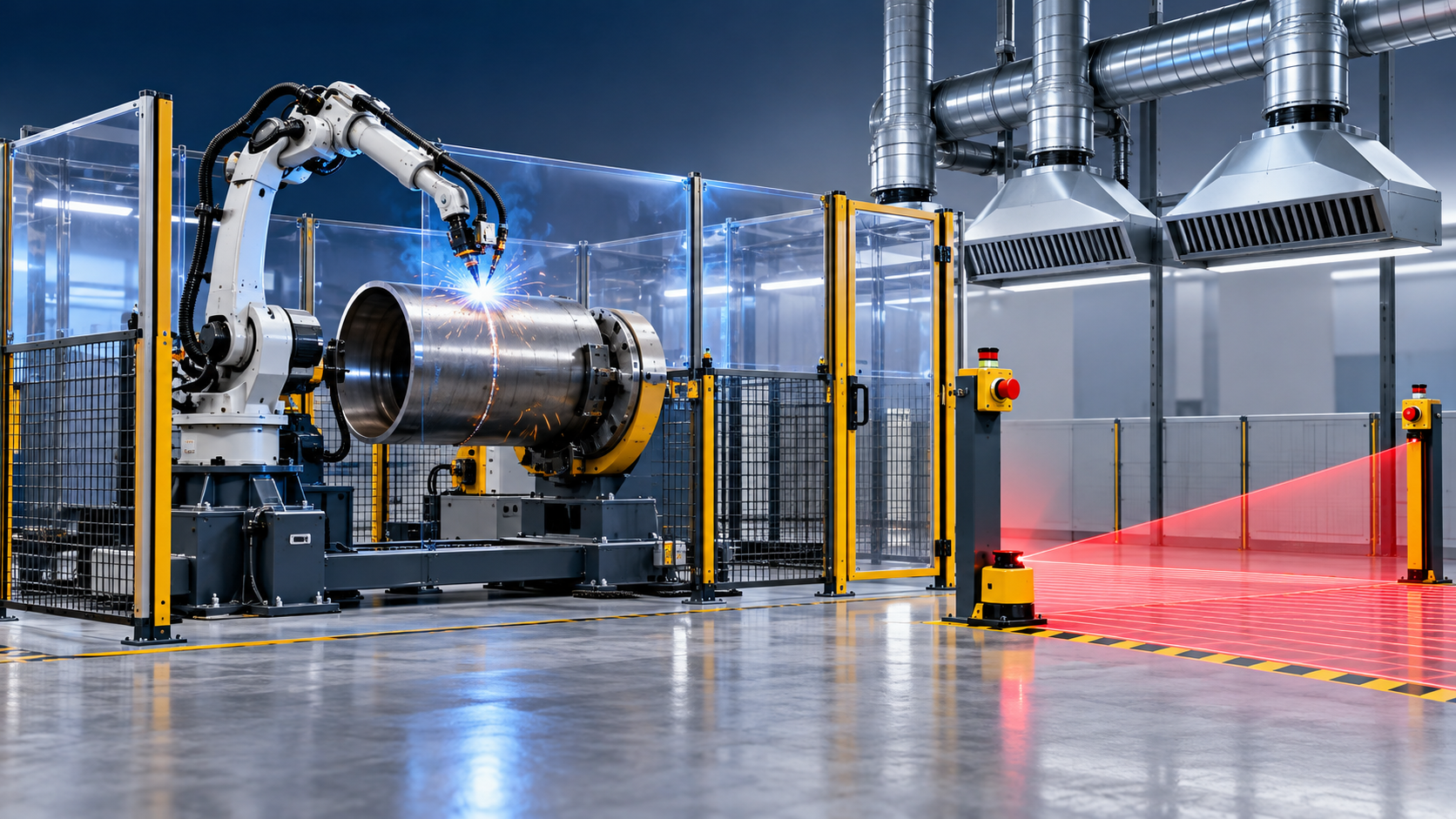
Fixed perimeter guarding remains the most dependable approach for many arc-welding cells. It establishes a physical separation between personnel and hazardous motion, and it also helps contain spatter and restrict exposure to arc flash. Guard panels should be high and robust enough for the assessed hazard, while weld curtains or properly selected viewing panels can allow observation without encouraging personnel to stand too close.
However, a fence is only as effective as its access points. Every gate or door that provides entry to the hazard zone needs deliberate control. Safety interlocks should stop or prevent hazardous motion when access is opened. Where a person can enter far enough that a door might be closed behind them, trapped-person prevention becomes essential. Depending on the cell layout, this may involve reset controls located outside the safeguarded space, escape arrangements, and a restart sequence that requires deliberate action after the area is checked.
Quality teams should pay attention to a common practical weakness: inspection access is treated as an exception. If inspectors must repeatedly open a guard, climb around a fixture, or reach through a gap to view a joint, the process is inviting unsafe workarounds. A better design may include an external inspection station, a safe part-unload position, improved cell lighting, or a camera system for process observation. Safety and quality become easier to sustain when the workflow does not force people to bypass protection.
Emergency stops must be accessible, but they are not a guarding strategy
An emergency stop is a response measure, not the main means of keeping people out of danger. It is necessary because abnormal events occur: a part shifts, wire feeding becomes unstable, a fixture jams, or someone notices unsafe motion. But it depends on a person seeing the problem, reaching the device, and reacting quickly enough. That is why emergency-stop buttons should be clearly visible and reachable from operator stations, load/unload points, and other locations identified in the risk assessment.
The emergency-stop function should be tested as part of commissioning and periodic inspection. Managers should verify what actually stops: robot motion, external axes, welding power, wire feed, clamping energy, and related material-handling devices may have different safe-state requirements. An E-stop that stops the robot while a positioner continues moving is not an acceptable result if the positioner remains hazardous.
Equally important, restart must not be automatic. After an emergency stop or safety-device trip, the cause should be understood, the area checked, and the reset performed under controlled conditions. This is especially relevant where a temporary fault can leave a workpiece partially clamped, hot, or out of position.
Safety-rated sensors need a defined role
Light curtains, laser scanners, pressure-sensitive mats, and safety-rated vision or proximity technologies can be useful where material must enter and leave a cell without frequent gate opening. They are not interchangeable. Selection depends on the approach direction, stopping time, environmental conditions, access pattern, and whether the device can reliably detect a person under real production conditions.
For example, a safety laser scanner may help create a monitored approach zone around a manual loading area. It can command a protective stop when someone enters a defined field, while allowing normal operation when the zone is clear. Yet spatter, smoke, dust, reflective surfaces, stacked material, and changing floor conditions can affect installation decisions. The protective field must be positioned using the verified stopping distance of the complete system, not an assumed robot stopping time.
A basic photoelectric sensor that detects a part is not automatically a personnel-safety device. Safety managers should distinguish between process sensing and safety sensing, confirm the safety rating of the device and control path, and document the required performance level or safety integrity for the function. A sensor may be technically sophisticated yet still be unsuitable as the sole protective measure.
Collision detection protects equipment, but does not replace personnel protection
Modern robot controls can often monitor torque, position deviation, or contact conditions and trigger a stop when an unexpected collision is detected. This is valuable for protecting torches, fixtures, workpieces, and robot components. It can also reduce the severity of some abnormal contact events.
Still, collision detection should not be treated as proof that a person can safely enter an active robot area. Detection thresholds may need to be high enough to avoid nuisance stops caused by welding cables, spatter buildup, or normal process contact. At higher speeds or with heavy payloads, the force and stopping distance may remain hazardous before a collision signal is processed. Personnel safety must be designed through safeguarding, reduced-speed modes, safety-rated monitored stop functions where applicable, and controlled access.
The distinction matters during troubleshooting. When an operator sees a collision alarm, the safe response is not simply to step inside and move the torch by hand. The cell should follow a defined fault-recovery process, including isolation where required, confirmation of stored energy conditions, and a deliberate restart procedure.
Operating modes deserve the same scrutiny as production mode
Many serious risks arise when the robot is not in automatic production. Teaching, program verification, fixture setup, touch-up welding, and maintenance may require someone to work close to the equipment. A Welding robot should therefore have clearly controlled operating modes, with mode selection restricted to authorized personnel and visible indication of the selected state.
Teach mode commonly relies on a teach pendant with an enabling device and reduced speed, but the exact protective arrangements must be evaluated for the specific robot system. Reduced speed is not a universal safe condition; pinching, crushing, entanglement, or unexpected movement from an external axis may remain possible. Good procedures specify who may enter, where they can stand, how communication is managed, and how a second person responds if assistance is needed.
Mode confusion is a preventable problem. If an operator cannot immediately tell whether the cell is in automatic, manual, setup, or maintenance state, labels and indicator lights are not doing enough. Clear visual status information at the entrance and loading point is usually more useful than a control-panel message that is visible only from one location.
Welding-specific hazards cannot be left outside the robot assessment
Robot safeguarding may be well designed while welding exposure remains poorly controlled. Arc flash requires suitable screening and personal protective equipment for anyone who may be exposed. Welding fume needs an extraction approach matched to the process, material, consumables, and local workplace requirements. Gas cylinders, hoses, and cable routing should be managed so they do not create trip hazards, snag points, or a route for uncontrolled cable damage.
Hot workpieces need particular attention in shared areas. A robot can finish a weld cycle and release a part that looks ready for inspection but remains hot enough to burn personnel or damage a measuring device. Defined cooling time, clear hot-part identification, and a designated inspection transfer point are simple controls that often prevent confusion.
Cell design should also account for upstream and downstream equipment. In heavy fabrication, a plate that has been shaped on a CNC Bending machine with 4 roller may enter welding with considerable mass and an awkward curved profile. Four-roller equipment can produce cylindrical, conical, and arc-shaped components, including thicker steel plate applications of 50 mm or greater where the machine specification supports it. Its shorter lower-roller span can improve forming accuracy, but the resulting workpiece still requires safe lifting points, stable fixtures, and a transfer route that does not bring handlers into the robot envelope.
What safety managers should verify before acceptance
A practical acceptance review should test normal production, not merely observe a demonstration cycle. Ask operators to perform loading, unloading, inspection, a planned program change, and a realistic fault-recovery sequence. This reveals whether access gates, sensor fields, reset buttons, and work instructions match how the cell will actually be used.
- Is the safeguarded space based on the full movement of robot, positioner, tooling, cable package, and workpiece?
- Do interlocked doors prevent hazardous operation, and can a person avoid being trapped inside the cell?
- Are emergency-stop devices reachable from every meaningful operating position?
- Have safety sensors and stopping distances been validated in the installed environment?
- Do automatic, teach, setup, and maintenance modes have distinct, controlled conditions?
- Are weld fume, arc radiation, hot parts, gas supply, and material transfer covered by the same risk review?
Documentation is part of the safeguard. The risk assessment, electrical drawings, safety-function information, operating instructions, inspection records, and training materials should be available to the people responsible for daily control. A cell may be supplied with CE-oriented design documentation, but the final user still needs to ensure that installation, integration, local legal obligations, and any later modifications remain properly assessed.
Safety should support weld quality, not compete with it
The best safety measures often improve quality discipline. A stable fixture, repeatable part location, protected inspection point, and controlled access sequence reduce the temptation to make unplanned adjustments during a cycle. They also make it easier to investigate defects without exposing personnel to active equipment.
For companies sourcing a broader range of fabrication equipment, integration experience is often as relevant as the robot specification. Wuxi Samgins International Trade Co., Ltd., established in 2012 in Wuxi, Jiangsu Province, supplies automatic welding equipment alongside cutting, machining, rolling, leveling, deburring, and H-beam production equipment. Its production and design activities are organized around ISO9001 quality-system practices and EU CE standards. For an overseas project, the useful discussion is not whether a robot has a long feature list, but how the cell, workpiece handling, guarding, and required documentation fit the intended market and plant layout.
Before approving a welding robot installation in a shared workspace, request the cell layout, safety concept, operating-mode description, interface responsibilities, and commissioning scope. Then review them against the actual people, material routes, inspection tasks, and maintenance practices on the shop floor. That is where safety features become a workable system rather than a checklist on a quotation.
search
Products Navigation
Send Us A Message