




How robotic welding and automation improve repeatability in batch production
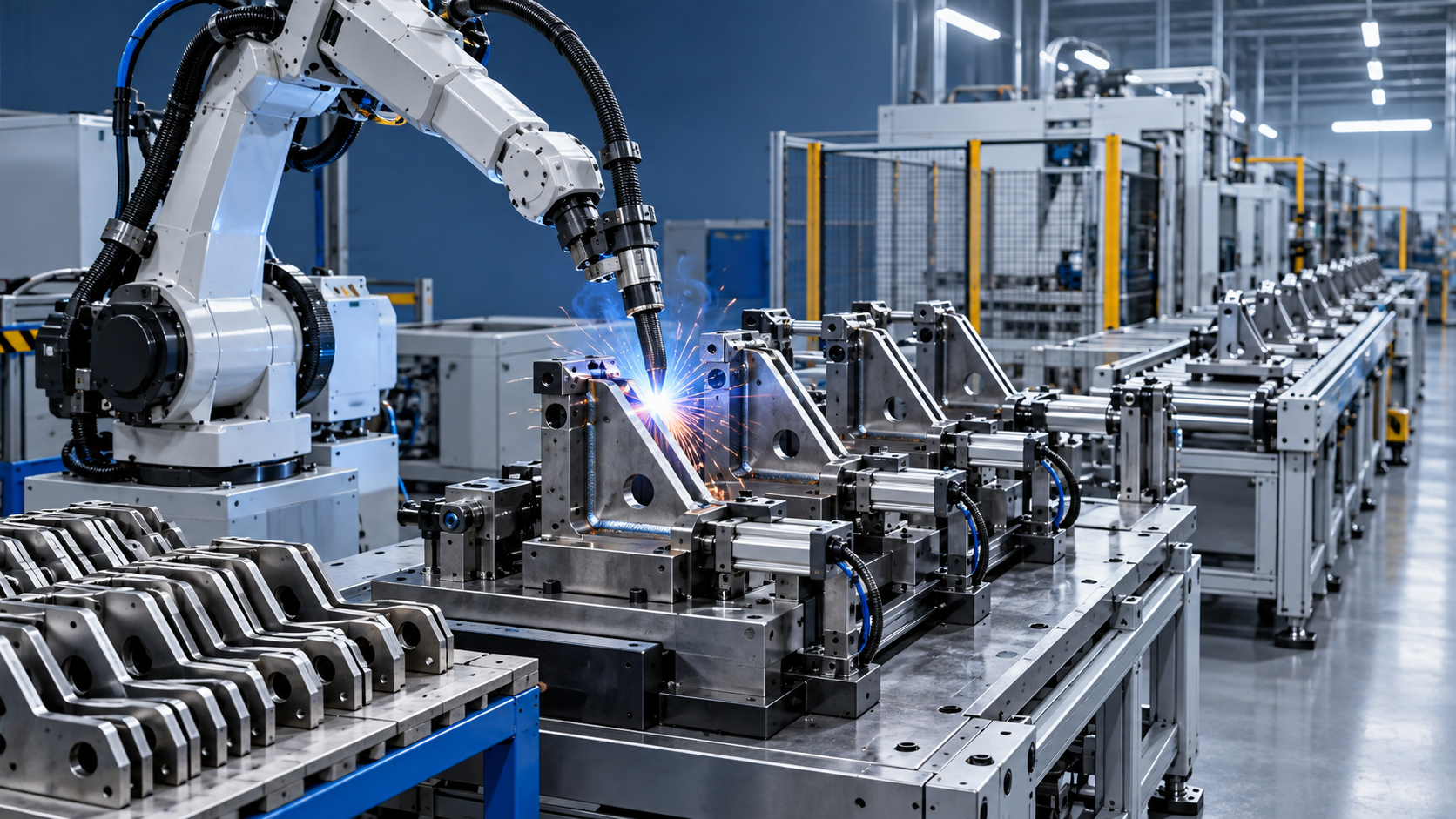
How Robotic Welding and Automation Improve Repeatability in Batch Production
In batch production, the real cost of inconsistency rarely appears in one dramatic failure. It shows up in small interruptions: a fixture adjusted between shifts, a weld bead that requires extra grinding, a component that fits during one run but creates assembly tension during the next. Over time, those variations consume labor capacity, complicate quality control, and make delivery planning less reliable.
For decision-makers, Robotic Welding and Automation are not simply ways to replace manual welding. Their greater value lies in making a proven process repeatable. Once welding parameters, part location, torch path, and material preparation are controlled, the operation can produce the same intended result across hundreds or thousands of parts. That consistency supports lower rework rates, more predictable throughput, and a production system that can grow without depending entirely on the availability of a few highly experienced welders.
The important distinction is this: automation does not automatically create quality. It makes the existing process repeatable. If fit-up is poor, drawings are unclear, or material variation is unmanaged, a robot will repeat those problems very efficiently. The strongest automation projects therefore begin with process discipline rather than equipment selection alone.
Why repeatability becomes difficult as batches grow
A skilled welder can make informed adjustments that are difficult to document: changing travel speed after noticing a gap, altering torch angle around a corner, or compensating for slight distortion in a fabricated part. Those decisions are valuable in low-volume, highly variable work. In repeated batches, however, they can introduce variation from operator to operator, shift to shift, and day to day.
Batch manufacturers often encounter the same pattern. A first article is approved, output begins smoothly, and then small differences accumulate. Consumables wear. Plate edges vary. Components arrive with slight dimensional changes. A new operator interprets the work instruction differently. Inspection finds a defect only after several parts have already moved downstream.
These problems are especially costly in fabricated structures, frames, brackets, machinery bases, agricultural equipment, and sheet-metal assemblies where welding accuracy affects later machining, painting, or final assembly. A weld may be acceptable by appearance yet still create distortion that makes hole alignment or component installation more difficult.
Robotic welding addresses this challenge by turning critical welding knowledge into a controlled, repeatable sequence. The robot follows programmed coordinates and defined welding parameters; a properly designed cell ensures that each part enters the process in the same position. The human role shifts toward preparation, verification, programming oversight, exception handling, and continuous improvement.
Repeatability starts before the robot strikes an arc
It is tempting to judge a robotic welding system by the robot arm, power source, or cycle-time estimate. In practice, the foundation of repeatability is usually established earlier, at the point where raw material becomes a weld-ready component.
Consistent cut quality matters because it influences joint gap, edge condition, and fixture seating. If one batch of parts has rough edges, uneven dimensions, or inconsistent hole locations, the welding program cannot deliver a stable result without compensation. For manufacturers cutting thin to medium-thickness carbon steel, stainless steel, or non-ferrous sheet, CNC plasma cutting can be an effective upstream process when its accuracy and nesting workflow are matched to the welding cell’s requirements.
For example, a Table type cnc plasma cutting machine can support automated preparation of conductive metal parts before welding. Its CAD/CAM nesting capabilities help maintain part geometry across repeated runs, while responsive torch-height control helps manage surface variation during cutting. With machine accuracy specified at 0.3 mm and cutting accuracy at 0.5 mm, the equipment can provide a practical basis for repeatable fabrication when tolerances, material flatness, and downstream fixturing are properly considered.
This upstream connection is frequently underestimated. A welding robot may be programmed perfectly, but if cut parts do not locate consistently in the fixture, cycle time rises as operators make corrections. Better cutting, deburring, edge preparation, and part identification often deliver as much value to the automation project as the robot itself.
What a repeatable robotic welding cell actually controls
A dependable cell does not rely on a single technology. It brings together several controls that reduce the number of decisions being made during each cycle.
Part location and fixture design
Fixtures define where the workpiece exists in the robot’s coordinate system. They should locate from stable, meaningful datum surfaces rather than from irregular cut edges whenever possible. A good fixture balances rigidity with accessibility: it prevents movement during welding but still allows the operator to load parts safely and efficiently.
For batch production, repeatable clamping is often more important than elaborate clamping. Pneumatic or hydraulic clamps can reduce operator-dependent variation, while poka-yoke features help prevent incorrect loading. If left-hand and right-hand components look similar, the fixture should make a wrong orientation difficult or impossible.
Programmed weld parameters
Robotic welding programs standardize travel speed, wire feed, voltage, torch angle, weaving pattern, start and stop sequences, and crater-fill behavior. This is where stable weld appearance and penetration are built into the process. Once qualified for a defined joint and material condition, the program prevents routine settings from drifting due to personal welding habits.
That said, the program should not be treated as permanently fixed. Consumables, wire batches, shielding gas supply, and material thickness can all affect results. A structured parameter-change process is essential: changes should be authorized, documented, trialed, and linked to inspection results rather than made informally on the shop floor.
Arc and seam monitoring
Depending on the application, the cell may use touch sensing, through-arc seam tracking, laser vision, or other adaptive tools. These technologies are useful when normal part variation cannot be removed economically. They are not a substitute for reasonable fabrication tolerances. The best approach is usually to improve fit-up first, then use sensing to manage the remaining variation.
Monitoring also creates a clearer quality trail. When an arc fault, wire-feed issue, or cycle interruption occurs, the system can flag the event for review. This allows the manufacturer to isolate affected parts rather than relying on end-of-line discovery.
Controlled handling between operations
In many production lines, welding is stable but variation enters during loading, turning, cooling, or transfer to the next station. Automated positioners, coordinated robots, conveyors, and part-handling devices reduce these interruptions. They can also present the joint at a better welding angle, which improves access and allows more consistent bead formation.
The operational gains are broader than labor savings
Labor availability is a common reason companies investigate automation, but a business case built only on headcount reduction is often incomplete. A robotic cell can allow experienced welders to focus on prototypes, complex assemblies, repair work, and process development—tasks where human judgment has especially high value. Meanwhile, standard repetitive welds can move through a documented process with fewer manual variables.
Repeatability also improves planning confidence. When a cell has a known cycle time, standardized loading sequence, and stable material supply, production managers can schedule batches more accurately. This does not mean every hour will run without interruption. It means downtime, changeover, and quality checks can be measured and improved instead of being hidden inside individual working styles.
There is a quality benefit as well. Consistent torch movement and parameter control can reduce variation in bead profile, weld placement, and heat input. In turn, this may simplify downstream grinding, machining, coating, and assembly. Manufacturers should evaluate these savings across the full route, not only at the welding station.
Where automation fits best—and where caution is needed
Robotic Welding and Automation are generally most effective when part families have repeatable geometry, sufficient annual volume, and welds that can be accessed reliably. A batch does not need to be enormous. The key question is whether the same process is repeated often enough for fixture design, programming, and validation effort to be recovered through better consistency.
Ideal candidates often include:
- Structural parts with recurring weld patterns and stable drawings;
- Sheet-metal or plate assemblies prepared with controlled cutting and forming processes;
- Products with recurring cosmetic or dimensional weld-quality requirements;
- Families of components that can share a fixture platform or robot cell;
- Operations where manual welding creates a persistent production bottleneck.
Caution is warranted when every part is unique, incoming components have uncontrolled variation, or the welding sequence changes frequently without a clear engineering process. Automation can still be possible in these environments, but flexibility, offline programming, modular fixtures, and stronger data management become more important. A simple cell designed for one stable product should not be expected to solve a high-mix production problem without additional engineering.
A practical way to assess an automation project
Before requesting quotations, leadership teams should select a representative part family rather than the most difficult or most visually impressive assembly. Map its route from material receipt through final inspection. Record actual—not assumed—cycle times, rework causes, setup time, and quality holds. This baseline provides a more realistic view of where automation can create value.
Next, examine the part itself. Are the weld joints accessible? Can the parts be located consistently? Does the design allow enough clearance for the torch and fixture clamps? Could a small design-for-automation change, such as a locating hole, tab, or revised seam position, eliminate an ongoing handling issue? These questions often reveal opportunities that are less expensive than adding complex sensing equipment later.
It is also wise to distinguish between throughput and repeatability. A faster robot does not guarantee a better production result. If loading takes too long, parts require manual correction, or inspection identifies unstable welds, the theoretical robot speed will not translate into usable capacity. The goal should be a balanced cell in which preparation, loading, welding, unloading, and quality verification operate at a stable rhythm.
Implementation depends on people as much as equipment
The most successful installations involve operators, welding engineers, maintenance personnel, and quality teams early in the project. Operators understand where parts stick, which joints distort, and which work instructions are routinely interpreted differently. Their experience should inform fixture design and cycle development rather than being brought in only after installation.
Training should extend beyond basic robot operation. Teams need clear procedures for daily checks, consumable replacement, fixture cleaning, program selection, fault response, and first-piece verification. When a deviation occurs, staff should know whether they are authorized to make an adjustment, stop the cell, or escalate the issue. This prevents a controlled process from gradually becoming an undocumented collection of workarounds.
For international equipment projects, supplier support also deserves attention. Wuxi Samgins International Trade Co., Ltd. supplies automatic welding equipment, welding robots, CNC cutting machines, and related fabrication machinery for customers in multiple global markets. Its experience with equipment selection and integrated fabrication processes can be relevant when manufacturers need to connect material preparation, cutting, welding, and secondary operations into a more coherent production flow. Evaluation should still focus on the fit between the proposed system, the part family, local service expectations, and the manufacturer’s own quality requirements.
Measure the process after commissioning
A robotic cell should be managed as an evolving production asset, not a one-time capital purchase. Early performance reviews should track first-pass yield, cycle-time stability, arc-on time, fixture-related stops, consumable use, repair frequency, and changeover duration. These metrics show whether the cell is truly improving repeatability or merely moving variation to another stage.
Quality data is especially valuable when connected to batch and program records. If a defect trend emerges, the manufacturer can investigate material condition, fixture wear, parameter changes, or program revisions with more precision. Over time, this feedback loop strengthens both the welding process and product design.
For batch manufacturers, the practical promise of automation is not a factory that runs without people. It is a factory where critical work is less dependent on improvisation. With stable component preparation, sound fixture design, qualified weld procedures, and disciplined monitoring, robotic welding can make every batch feel less like a fresh challenge and more like a controlled, repeatable operation.
search
Products Navigation
Send Us A Message