




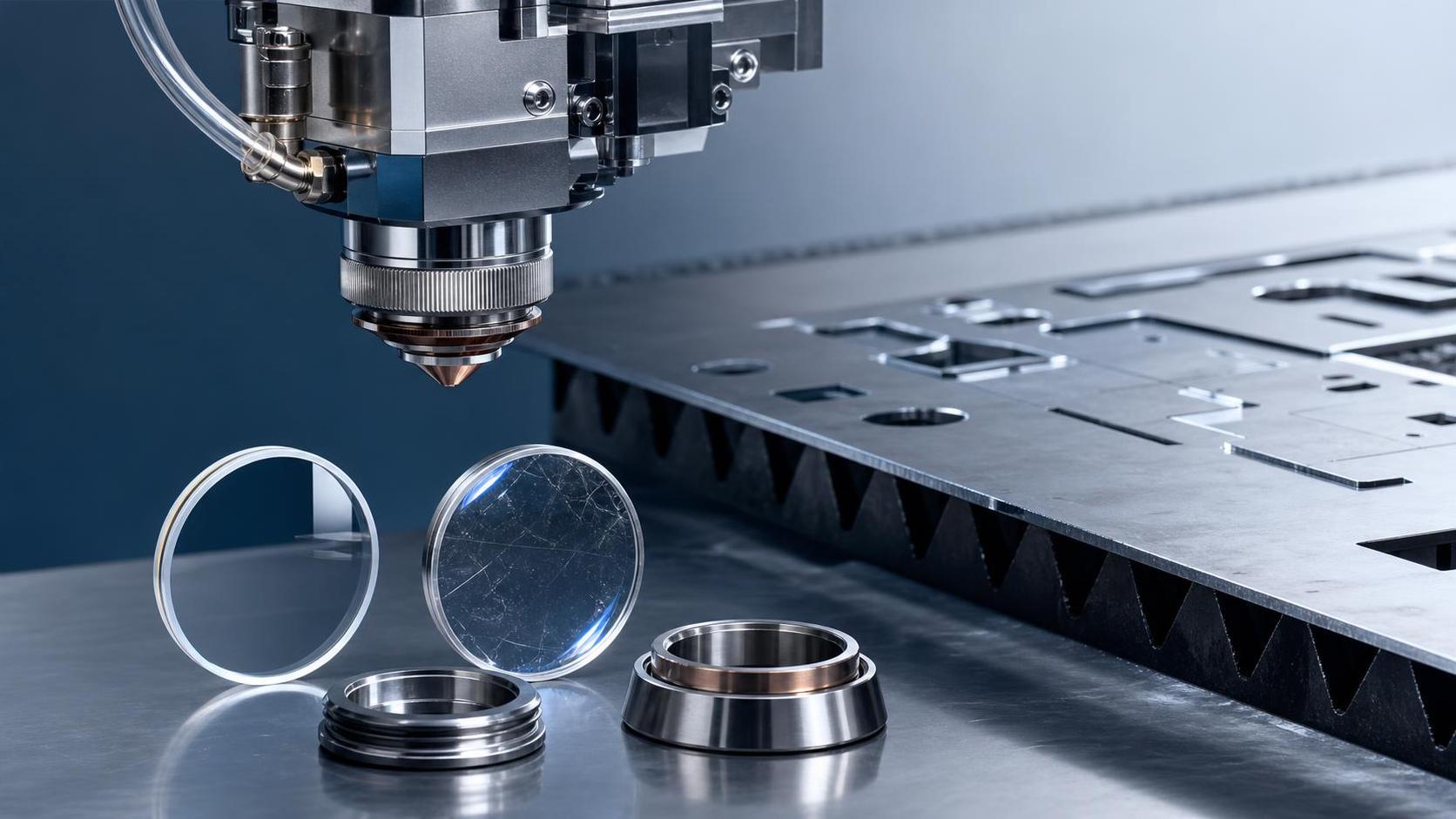
Laser cutting machine lenses are replaced when their optical condition can no longer support stable beam transmission, not according to a single calendar interval. In industrial use, some lenses may stay serviceable for a long period under clean air, dry material, and disciplined maintenance, while others degrade much sooner when processing reflective metals, thick plate, coated sheets, or dusty stock. The practical answer to “How often should laser cutting machine lenses be replaced in industrial use?” is therefore tied to wear symptoms, process drift, and inspection results rather than a fixed number of days.
The most reliable approach is to treat the lens as a monitored consumable with an uncertain life span. A shop running thin mild steel with stable assist gas and regular nozzle cleaning may keep the same lens far longer than a line cutting film-covered sheet, oxidized plate, or material that throws heavy spatter back toward the cutting head. Heat load matters as much as contamination. Even a lens that looks acceptable at first glance can begin absorbing more energy after a coating defect or a small burn mark forms, and once that happens, damage often accelerates.
What usually determines replacement timing
Three things drive lens life more than anything else: contamination, thermal stress, and handling quality. Dust from the environment, vaporized metal from the cut, and smoke residue can settle on the protective surface. If that contamination is allowed to bake onto the optic, cleaning becomes less effective and the coating may be scratched or etched during removal. Thermal stress develops when the beam passes through a lens that is no longer optically clean or when cooling and gas conditions are unstable. Handling quality matters because fingerprints, improper wipes, reused swabs, or a lens placed on a hard surface can shorten life before the machine is even restarted.
Material choice changes the picture. Stainless steel, carbon steel, aluminum, galvanized sheet, brass, and copper do not burden the optics in the same way. Reflective and highly conductive materials can create more demanding cutting conditions. Coated or painted stock may release residues that contaminate the protective lens faster than bare sheet. Thicker material often requires longer dwell at the pierce point and more thermal load near the head, which can raise the risk of deposit buildup if parameters are not well balanced.
Machine condition also influences replacement frequency. A damaged nozzle, poor centering, unstable gas pressure, leaking seals, or dirty protective windows upstream can all reduce lens life. In that situation, replacing the lens alone may restore cut quality only briefly, because the root cause remains in the head or gas path.
Signs that replacement is closer than cleaning
Many lenses are changed too late because the first symptoms are mistaken for programming or material issues. If edges become rough without a corresponding change in feed rate or gas supply, if burr appears on cuts that were previously clean, or if piercing becomes inconsistent, the lens should be inspected early. Another warning sign is that the same job starts requiring small parameter corrections to maintain quality. A gradual increase in focus sensitivity often suggests that the optical path is changing.
Visual inspection is still important, but it has limits. Obvious defects include burn spots, cloudiness, pitting, scratches, haze, or coating discoloration. A lens with a perfectly round contamination mark near the beam path usually indicates that residue was heated repeatedly in service. Fine scratches outside the central beam area may not cause immediate failure, but they still justify closer observation because debris can migrate and heat distribution can change during long production runs.
Less visible symptoms matter too. If the cutting head begins running hotter than usual, if alarm frequency increases after several hours of continuous cutting, or if nozzle changes no longer restore stability, the lens may already be losing transmission. Waiting for complete failure is costly because the machine may continue producing parts with marginal edge quality before anyone notices a full breakdown.
Protective lens and focusing lens are not the same decision
In many machines, the protective lens is replaced far more often than the focusing lens or collimating optics. That distinction is important. The protective lens sits closer to contamination sources and is intended to shield more expensive optics from fumes and spatter. If replacement policy does not separate these components, maintenance can become either too expensive or too slow to react. A dirty protective lens should never be treated as evidence that deeper optics are also at end of life, but it should trigger inspection of the full optical path.
The focusing lens generally lasts longer when the protective lens is changed promptly and seals remain intact. Once contamination passes beyond the protective barrier, repair becomes more involved and machine downtime usually increases because the head may need a more careful disassembly, cleaning, alignment check, and test cut sequence before production can resume.
How to judge replacement in a working production environment
A practical method is to combine routine inspection with process comparison. Instead of asking whether the lens has reached a standard age, compare current performance with a known stable cutting condition. Use the same material grade, thickness, nozzle type, assist gas, and program geometry that previously produced clean edges. If the machine now needs unusual focus offset, pierce adjustment, or speed reduction to achieve similar output, the lens should move high on the inspection list.
Keeping a simple service record helps more than broad assumptions about lifespan. Record the installation date, material mix since installation, any contamination found during cleaning, and the reason for replacement. Over time, patterns emerge. A lens that repeatedly fails after cutting a certain coated material or after long shifts with heavy piercing is giving process information, not just maintenance information.
Replacement is justified when one or more of the following are true:
- The lens has visible coating damage, haze, or burn marks that remain after proper cleaning.
- Cut quality has drifted and cannot be restored by normal nozzle, gas, and parameter corrections.
- The machine becomes unusually sensitive to focus or pierce settings on material that was previously routine.
- There is reason to suspect thermal damage from a severe crash, prolonged spatter event, or gas fault.
That list is intentionally narrower than a general maintenance checklist. Frequent unnecessary replacement adds cost and introduces handling risk. Delayed replacement invites unstable production and possible damage to adjacent optics.
Cleaning can extend life, but only under the right conditions
A lens should be cleaned only when the contamination is light and the surface is otherwise intact. Dry compressed shop air is not a safe shortcut unless it is properly filtered and oil-free. Blowing contaminated air onto optics often creates new scratches or deposits. The usual method is to inspect under good lighting, remove loose particles with approved non-contact means where applicable, and wipe with suitable optical materials and solvent in one direction without reusing the contaminated surface of the wipe.
Repeated cleaning is not harmless. Every cleaning event carries some abrasion risk, even when done carefully. If residue is baked onto the coating, aggressive rubbing may turn a salvageable protective lens into a damaged one. That is why many production teams replace a low-cost protective lens once contamination reaches a certain point instead of trying to recover it repeatedly. The decision is less about saving the component and more about protecting beam quality and avoiding longer downtime later in the shift.
Common misjudgments that shorten lens life
One of the most common mistakes is blaming the lens for every cut defect. Poor gas purity, nozzle eccentricity, unstable sheet flatness, dirty rails, incorrect focal settings, and inconsistent material surface condition can all resemble optical wear. Replacing the lens without checking these basics may waste parts and time. The opposite mistake is just as common: assuming a parameter issue can be tuned away indefinitely. Once a damaged lens begins absorbing heat, compensation tends to narrow the process window until quality becomes unpredictable.
Another frequent problem appears during installation. A lens that is touched at the center, inserted with contamination on the seat, or tightened into a holder with debris trapped around the edge can fail prematurely. Seals and retaining parts should also be checked. If the sealing face is damaged, fumes may bypass the protective path and contaminate internal optics even when the protective lens itself is changed on schedule.
Storage conditions matter more than they sometimes seem. Lenses left unsealed near grinding dust, coolant mist, or humid air can pick up contamination before they are used. Optical components should remain in clean packaging until installation, and any lens removed for inspection should be placed in a proper container rather than on a bench, machine cover, or paperwork.
Replacement timing often changes with the job mix
Industrial use is rarely uniform. A line cutting mostly thin sheet may have long intervals between lens changes, then suddenly require much closer attention after a production switch to thicker plate, frequent piercing, or material with surface film. Long unattended runs can also change the maintenance rhythm because there is less opportunity to notice early quality drift. In those cases, inspecting the protective lens at planned pauses is often more effective than waiting for the next formal maintenance window.
If a shop processes mixed materials through the same head, lens history should be judged by the harshest recent workload, not by average machine age. A few difficult jobs can place more stress on the optics than many routine runs. That is why fixed replacement intervals often fail in real production: they ignore what the lens has actually experienced.
So, how often should laser cutting machine lenses be replaced? In industrial use, replace them when inspection shows irreversible contamination or coating damage, when process stability declines beyond normal correction, or when a severe event makes thermal damage likely. Clean them when contamination is light and the optic remains intact. Review them more often when the material mix becomes dirtier, thicker, more reflective, or more demanding on piercing. That approach keeps replacement decisions tied to machine behavior and optical condition, which is the only basis that remains dependable across different cutting environments.