




Reducing Rework on Variable Parts With Teach-Free Intelligent Welding Robots
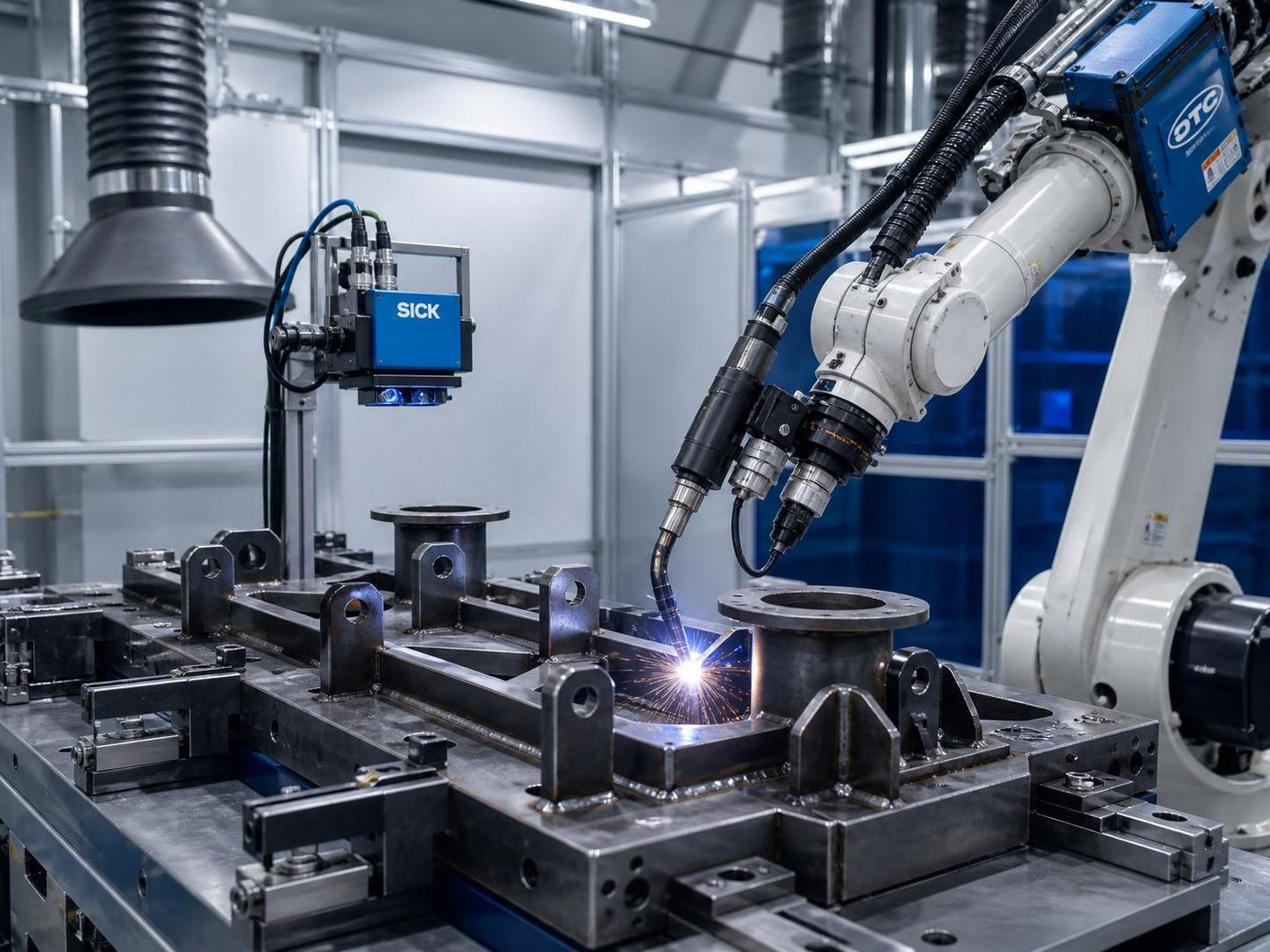
For quality control and safety managers, rework on variable parts is rarely “just a welding issue.” It can begin with a flange that arrived slightly out of position, a fabricated assembly with heat distortion, a fixture that no longer holds a revised component correctly, or a batch containing small dimensional differences that are difficult to see until welding has already started. The result is familiar: more inspection holds, more grinding and repair, unpredictable cycle times, and greater exposure to welding fumes, arc radiation, and hot-work risks.
A Teach-free Intelligent Welding Robot is designed for this reality. Rather than depending on a worker to manually teach every weld path for every part variation, the system uses intelligent recognition and adaptive path planning to identify joint locations and perform welding with a more consistent process. For operations handling mixed models, low-to-medium volumes, changing fabrication drawings, or parts with normal production tolerances, this approach can reduce the rework burden without asking the team to choose between flexibility and control.
Why variable parts create a rework loop
Traditional robotic welding works well when parts, fixtures, and joints repeat with very little variation. Once the workpiece shifts, the seam changes, or a new part revision enters production, the original taught program may no longer match the actual joint. A robot can then miss the seam, produce poor bead placement, create incomplete fusion, or stop for intervention. Even when a skilled operator corrects the program, the time spent teaching, trial welding, inspecting, and adjusting can erase much of the expected automation benefit.
Manual welding may seem more forgiving because an experienced welder can visually respond to variation. Yet manual correction carries its own quality risk. Different operators can interpret joint condition, travel speed, torch angle, and fill requirements differently. During urgent production periods, repairs may be made under pressure, and the final result can become harder to trace and standardize.
For a quality manager, this creates a difficult pattern: the same defect may appear under different labels—undersized fillet, off-center bead, excessive spatter, missed segment, distortion, or failed visual inspection—but its root cause is often poor alignment between the programmed welding path and the real part.
For a safety manager, repeated correction work matters just as much. Every unexpected manual touch-up can mean more grinding, more handling of hot material, additional fume exposure, and workers entering areas that were intended to be automated. Rework is therefore not only a cost indicator; it is also a signal that process stability needs attention.
What “teach-free” should mean on the shop floor
The term teach-free is sometimes misunderstood as meaning that no setup, verification, or human oversight is needed. In a responsible manufacturing environment, that is not the goal. A practical Teach-free Intelligent Welding Robot reduces dependence on repeated point-by-point teaching. It should recognize relevant weld features, determine or adjust the path based on the actual workpiece, and execute a controlled welding sequence within defined process limits.
In other words, it changes the operator’s role. Instead of spending much of the shift guiding a robot through every new seam, the operator can focus on part loading, fixture condition, parameter confirmation, first-piece approval, consumable checks, and exception handling. This is a more useful allocation of skilled labor, especially where experienced welders are needed for complex judgment rather than repetitive programming tasks.
Recognition technology does not remove the need for sound fabrication practices. A robot cannot compensate indefinitely for excessive joint gaps, contaminated surfaces, inconsistent tack welds, severe deformation, or components loaded in the wrong orientation. What it can do is make normal, manageable variation less disruptive and make abnormal variation easier to identify before it becomes a batch-wide quality issue.
Where intelligent welding delivers the clearest reduction in rework
Not every welding task has the same automation profile. The strongest candidates tend to have recurring weld types but changing workpiece geometry, placement, or orientation. This may include structural brackets, frames, fabricated enclosures, pipe supports, steel plate assemblies, machinery guards, flanged components, and multi-part weldments produced in mixed batches.
Consider a fabrication cell making several similar assemblies. The joints are conceptually the same, but hole positions, reinforcing pieces, edge conditions, and dimensions differ between orders. With a conventional robot, each change may require fixture adjustment and program editing. With intelligent path recognition, the cell can be configured around the actual joint condition rather than a single fixed coordinate set. The value is not merely faster changeover. It is the ability to maintain a repeatable inspection standard as product variety increases.
This is particularly relevant when upstream machining influences downstream fit-up. Hole patterns, plate dimensions, and machined edges should be controlled before fabrication begins. For steel plate processing that requires drilling, tapping, and milling, a machine such as the High Speed CNC Drilling Milling Machine for Steel Plates can support accurate preparation of plates, flanges, tube sheets, and related components. Its automated positioning, internal and external cooling options, and automatic chip removal are useful examples of how upstream consistency can reduce downstream fitting and welding variation.
That connection is often overlooked. Welding automation becomes far more reliable when the incoming parts are produced with controlled reference features. A robot with seam recognition can adapt to reasonable variation; it should not be treated as a substitute for poor dimensional control upstream.
Build the quality plan around prevention, not final repair
A successful implementation starts with defining what “acceptable variation” actually means. Quality teams should avoid relying only on final visual inspection. Instead, create a control plan that follows the part through preparation, fit-up, welding, and verification.
- Define critical joint features. Identify seam location, gap range, root condition, overlap, tack placement, and component orientation that affect weld acceptance.
- Separate normal variation from process escape. The robot may adapt to part-to-part differences within an approved range. Parts outside that range should trigger a hold, alarm, or manual review—not automatic welding at any cost.
- Approve the first piece for each meaningful change. New material thickness, joint design, wire batch, shielding gas condition, fixture change, or revised part geometry can justify a documented first-piece check.
- Link weld records to part identity. Where production requirements call for traceability, connect the part number, program or recognition recipe, welding parameters, operator confirmation, and inspection result.
- Monitor trends rather than isolated failures. A gradual increase in seam correction, arc starts, porosity, or touch-up time may reveal fixture wear, consumable issues, or upstream dimensional drift before a major defect occurs.
The best result is not a robot that simply completes more welds. It is a process that makes deviations visible early enough for the team to act. When exceptions are recorded consistently, quality managers can distinguish between a one-off handling issue and a recurring design, material, or machining problem.
Safety gains depend on cell design and disciplined recovery procedures
Reducing manual welding exposure is one of the most compelling reasons to introduce robotic welding, but a robot cell introduces its own hazards. Risk assessment should cover movement envelopes, pinch points, arc flash, fume extraction, workpiece loading, wire feeding, torch cleaning, hot surfaces, and maintenance access. Guards, interlocks, emergency stops, safety-rated controls, and clearly defined access zones are fundamental—not optional accessories.
The highest-risk moments are often not during normal automatic welding. They occur during recovery: a part is misloaded, a seam is not recognized, wire feeding becomes unstable, or an operator enters the cell to inspect a torch or reposition a component. Clear recovery instructions prevent improvised behavior. Operators need to know who can reset alarms, when lockout/tagout is required, how to confirm that residual motion has stopped, and when a damaged fixture must be removed from service.
Fume control also deserves close attention. Automated welding can raise arc-on consistency, which may improve productivity, but sustained operation can also concentrate emissions if extraction is poorly designed. Capture should be evaluated at the actual welding location, including workpiece orientations that place joints inside corners or behind structural members. Safety managers should verify extraction performance after changes to fixtures, parts, or cell layout.
Questions to ask before selecting a Teach-free Intelligent Welding Robot
Buying decisions should not be based only on a demonstration with ideal samples. Ask suppliers to evaluate representative production parts, including normal tolerances, common weld positions, and the surface conditions the factory actually sees. A robust solution should be judged by how it handles variation, not only how it performs on one perfectly prepared component.
Useful evaluation questions include:
- Which joint types and surface conditions can the recognition system identify reliably?
- What dimensional variation can be accommodated, and what conditions produce a reject or alarm?
- How are welding parameters managed when material thickness or joint geometry changes?
- Can the system support mixed-model production without lengthy reteaching?
- What information can be retained for quality review and preventive maintenance?
- How are fixtures designed to provide repeatable loading while still allowing the robot to access the joint?
- What training is needed for operators, maintenance personnel, quality inspectors, and safety representatives?
It is also worth examining the wider production route. If a part begins as steel plate and includes drilled or milled features, the machining process should support the datum strategy used in assembly. Models in a CNC drilling and milling range may accommodate workpieces from 1000 × 1000 mm up to 4000 × 1600 mm, with drilling capacity up to 50 mm and plate thickness up to 100 mm, depending on configuration. Matching these capabilities to fabrication requirements can improve the consistency of locating features before welding begins.
A realistic rollout: start with the parts that expose the problem
Many factories make the mistake of piloting automation on their easiest, most stable part. While this can produce a quick success, it may not prove whether the solution can reduce the rework that is consuming management attention. A better pilot group includes recurring parts with manageable but meaningful variation: assemblies that require frequent touch-up, consume excessive inspection time, or force repeated program changes.
Document the existing condition before installation. Record common defect categories, repair hours, reprogramming time, first-pass acceptance, unplanned stops, and safety observations related to manual intervention. The purpose is not to create an unrealistic return-on-investment calculation. It is to establish a baseline that lets the team see whether the new process is genuinely reducing instability.
During commissioning, involve quality and safety personnel early. Quality teams should participate in defining acceptance criteria and escalation rules. Safety teams should review loading ergonomics, guarding, emergency procedures, and extraction performance before routine production starts. Operators should be encouraged to report recognition failures and awkward handling conditions without being blamed; those observations are often the fastest route to improving the cell.
Consistency is the real output
A Teach-free Intelligent Welding Robot is not simply a faster welding tool. For manufacturers dealing with variable parts, its central value is consistency under changing conditions. By aligning intelligent seam recognition with controlled welding parameters, capable fixtures, stable upstream machining, and a disciplined quality plan, manufacturers can reduce the cycle of weld-repair-inspect-repeat.
For quality managers, that means clearer process data, more predictable acceptance, and fewer defects that appear only after labor has already been spent. For safety managers, it means fewer unplanned manual interventions in hot, fume-intensive work and a stronger basis for controlled automated operations. The technology works best when treated as part of a connected production system—one that begins with accurate part preparation and ends with weld quality that is repeatable enough to trust.
search
Products Navigation
Send Us A Message