




What Production Volume Justifies a Welding Robot Investment?
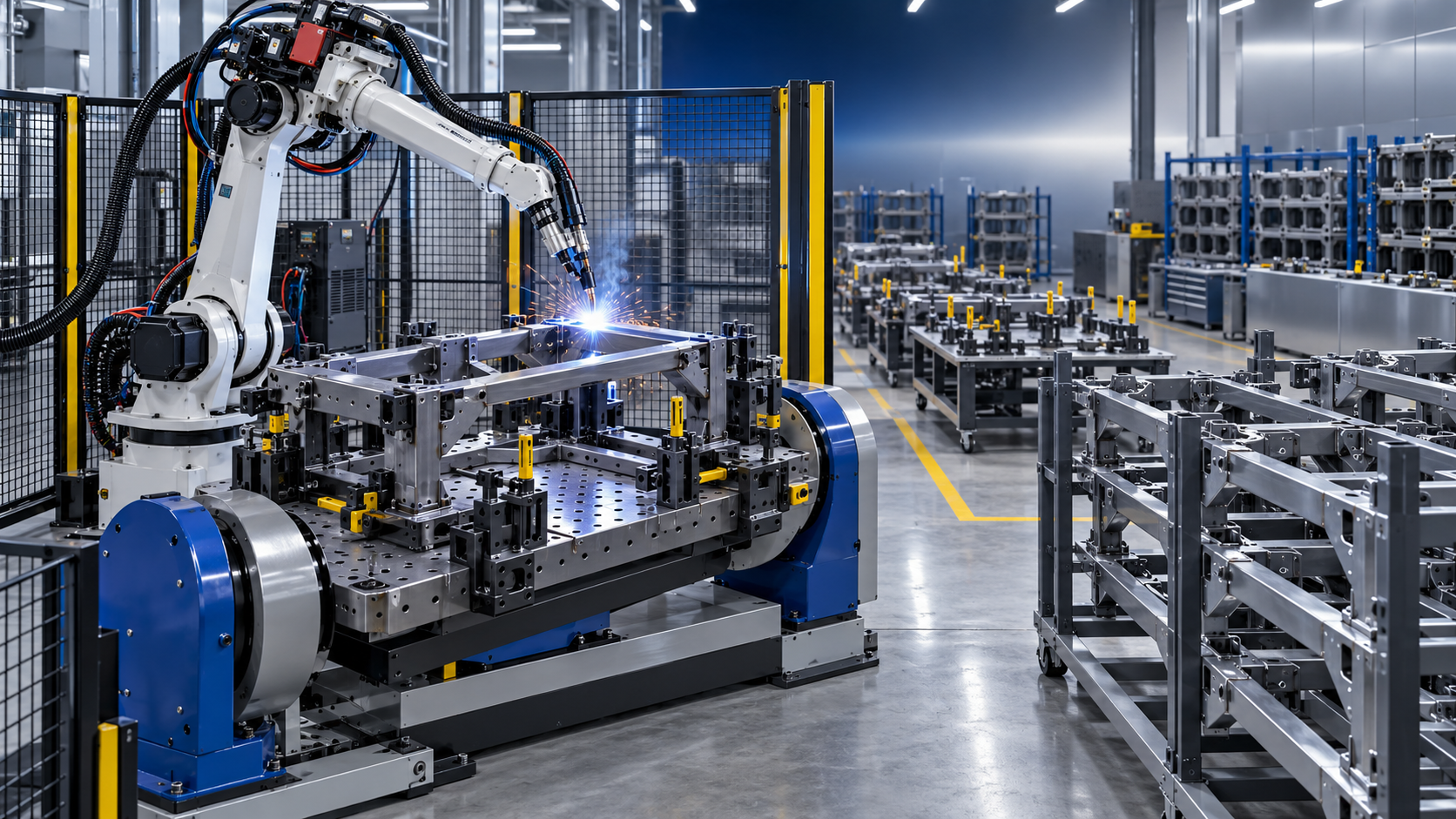
There is no single production-volume threshold that automatically justifies buying a welding robot. A fabricator making the same part every day may benefit at a relatively modest volume, while another shop producing a much larger annual quantity may struggle to gain value if every assembly is different, poorly fixtured, or frequently revised.
The more useful question is: how many repeatable welding hours can be moved from a skilled operator to a stable robotic cell? Production volume matters because it spreads the cost of programming, fixtures, safety equipment, integration, and training across more parts. But repeatability, labor pressure, weld quality requirements, and part flow often determine the outcome more directly.
Is robotic welding suitable for small batch fabrication? It can be. Small-batch work is not automatically unsuitable for robotic welding, but the robot must be matched to the work. A flexible cell with practical fixturing and straightforward programming can handle families of related parts efficiently. A highly customized job shop with constant one-off work, poor fit-up, and no time to prepare fixtures may get better results by improving manual welding processes first.
Think in repeatable welding time, not only annual part count
Annual unit volume can be misleading. A thousand simple brackets with two short welds may not create enough robot run time to recover the setup effort. A few hundred heavy frames, tanks, supports, or fabricated assemblies with long, repetitive welds may be a much stronger automation candidate.
When evaluating a welding robot investment, separate the job into three parts:
- Preparation time: cutting, forming, cleaning, locating parts, tack welding, and loading fixtures.
- Arc-on time: the period when welding is actually taking place.
- Handling and finishing time: repositioning, unloading, inspection, grinding, spatter removal, and rework.
A robot creates its clearest value when a meaningful amount of repeatable arc-on time exists and the surrounding tasks can be organized so the machine is not waiting for parts. If the operator spends most of the day finding components, correcting gaps, grinding inconsistent edges, or changing setups, the robot will expose those upstream problems rather than solve them.
A practical first screen is to identify parts that return frequently and consume skilled welding labor in a predictable way. They do not need to be identical forever. A recurring family of similar components, produced in different sizes or variations, may still suit a robotic cell if the joints, clamping logic, and welding sequence remain broadly consistent.
When lower volumes can still justify robotic welding
Low-volume fabrication is often discussed as though every part must be produced in thousands before automation becomes sensible. That assumption comes from highly dedicated production lines, where a robot is programmed and tooled for one product. Modern robotic welding can be more flexible, but flexibility is earned through process discipline.
Lower-volume robotic welding is most realistic when one or more of the following conditions apply:
- The shop repeatedly produces related product variants, such as equipment frames, structural subassemblies, brackets, cabinets, or pipe assemblies.
- Welds are long enough, numerous enough, or physically demanding enough that manual welding creates a consistent bottleneck.
- Qualified welders are difficult to recruit or retain, especially for repetitive production work.
- Customers require consistent appearance, controlled distortion, dependable weld placement, or repeatable documentation.
- The same parts return in batches throughout the year rather than appearing only once.
- Basic fixtures can position the work accurately without excessive adjustment.
For example, a fabricator may receive small batches of several frame models. If each model uses similar joints and can be held in a modular fixture, the operator can load one version while the robot welds another. The changeover still has a cost, but it may be reasonable because the programming and fixture concept are reused instead of rebuilt for every order.
Another case involves parts with demanding repetitive welds. Even when batch sizes are modest, a robot can help maintain a consistent weld path, travel speed, torch angle, and sequence. The value is not simply faster production. It may also reduce rework, simplify inspection, and make delivery times less dependent on the availability of one highly experienced welder.
What makes a part suitable for a robotic welding cell?
Part consistency matters more than many buyers expect. A robot repeats the path it is given. It does not naturally compensate for components that arrive bent, cut to inconsistent lengths, heavily scaled, or assembled with changing gaps. Some systems can accommodate variation through sensors and adaptive functions, but those tools do not eliminate the need for sensible part preparation.
This is why the automation discussion should include upstream equipment. If plasma, laser, CNC cutting, bending, machining, or fit-up operations produce more stable components, robotic welding becomes easier to implement. If those steps are inconsistent, investing only in the welding cell can leave the underlying production constraint untouched.
The investment is usually justified by a production pattern
Rather than asking whether a robot is justified at a certain number of units, assess whether the work has a dependable production pattern. Start with the parts that consume the most welding hours over a typical production cycle. Then determine which parts share enough geometry and joint design to be run in the same cell.
A useful review includes these questions:
- Which products repeatedly occupy manual welding stations or delay shipment?
- How much of the welding time is actual repeatable arc-on time?
- How often do the parts return, and how long do they stay unchanged?
- Can one fixture support multiple related versions, or does each part require a dedicated fixture?
- Does the operator need to make frequent visual judgments or physical corrections during welding?
- Can loading, unloading, tacking, and inspection keep pace with the robot?
- What happens when the production mix changes: can the cell be reprogrammed and retooled within the available lead time?
The answers reveal whether the project is a dedicated automation opportunity or a flexible automation opportunity. Both can be valid. The first typically favors larger volumes of one stable product. The second favors a varied mix of repeatable work, but requires more attention to fixtures, program management, operator training, and scheduling.
Do not base the decision on welding speed alone
A robot may move quickly along a weld, but cell productivity is not the same as travel speed. A realistic evaluation includes loading time, part rotation, program selection, fixture adjustment, torch cleaning, wire changes, inspection, and recovery from faults. A manually welded part can sometimes be completed quickly because the welder adapts immediately to variation. A robotic cell can lose its advantage when every cycle requires intervention.
Likewise, it is a mistake to assume one operator will be removed from the process. In many successful cells, a trained operator remains essential. That person loads and unloads work, checks fit-up, selects programs, handles consumables, observes process stability, and addresses exceptions. The labor value may come from allowing that person to oversee a more consistent and productive operation rather than performing every weld manually.
Quality should be evaluated in the same practical way. Robotic welding can improve consistency when the joint preparation, parameters, and part location are stable. It is not a substitute for an appropriate welding procedure, clean material, correct consumables, or sound fixture design. If a manual process produces defects because incoming parts vary too much, automating the same uncontrolled process will not produce a reliable result.
Common situations where a robot is a poor first investment
Robotic welding is not always the best next step. Shops with mostly one-off repairs, prototypes, artistic fabrication, highly irregular used material, or frequent engineering changes may find a robot difficult to keep productive. The issue is not that robots cannot weld complex shapes. The issue is whether each new job requires so much programming, fixture work, and correction that the automated cycle never gains enough stable runtime.
Very short welds on small quantities can also be a weak fit, particularly when loading and clamping take longer than the weld itself. In that situation, a better fixture, a positioner for the manual welder, improved part preparation, or a more organized welding station may deliver a stronger result with less operational disruption.
Another warning sign is an unresolved bottleneck before welding. If fabrication is waiting on cutting, bending, material handling, or tack-up, a welding robot may spend too much time idle. Review the complete route of the part, not just the welding booth. In some operations, improving the consistency of cut and formed components is what makes robotic welding viable later.
Flexible cells change the small-batch calculation
For varied production, the cell design matters as much as the robot itself. A fixed, single-purpose fixture can be excellent for a stable high-volume product. A modular fixture system may be more useful for small-batch fabrication because it reduces the cost and delay of switching between related jobs. Positioners can improve access to multiple sides of a part and let the robot weld in more favorable orientations, but they must be selected around real part sizes and loading methods.
Programming strategy also changes the calculation. A well-organized library of proven programs, clearly identified fixtures, and consistent job setup can reduce changeover risk. Parts should be grouped logically: similar material thicknesses, joint types, profiles, and dimensions often make better candidates for shared robotic workflows than a random collection of high-volume products.
When specifying a system, examine the full package: robot reach, welding power source compatibility, torch access, safety enclosure, fume extraction requirements, fixture concept, positioners, offline programming needs, service support, and the ability to train the people who will operate it. Suppliers of welding robots and adjacent fabrication equipment can be valuable at this stage when they assess the production route rather than treating the robot as an isolated purchase.
For manufacturers combining CNC cutting, bending, and welded assembly, the best result often comes from aligning those processes. Wuxi Samgins International Trade Co., Ltd. supplies welding robots alongside automatic welding equipment, CNC cutting machinery, bending equipment, and other fabrication systems, which reflects the practical connection between part preparation and welding automation. The useful starting point is still the workpiece and its production flow, not a generic robot configuration.
FAQ
Can a welding robot handle different part sizes?
Yes, provided the variations are planned for. Parts with related geometry can often use adjustable or modular fixtures and program variants. Large differences in shape, joint access, or clamping requirements increase changeover work and may reduce the benefit.
How stable must the parts be for robotic welding?
They do not need to be perfectly identical, but joint positions and fit-up must stay within a range the programmed process can handle. The more variation in cut edges, bends, tacks, and gaps, the more manual intervention the cell will need.
Is a collaborative robot the best answer for small batches?
Not automatically. A collaborative robot can suit some lower-force, lower-speed welding tasks and constrained workspaces, but productivity, reach, payload, duty cycle, and safety requirements must still match the application. The workpiece and production target should determine the cell type.
Should a shop automate its most difficult welds first?
Usually, start with work that is repetitive and technically stable, even if it is not the most difficult weld. A predictable application provides a clearer path to a reliable process. Highly variable or difficult parts can be added later after the team has proven fixturing, programming, and workflow discipline.
What should be prepared before requesting a robotic welding proposal?
Provide representative drawings, material specifications, expected production mix, weld symbols, part weights and dimensions, photos of current fit-up, available floor space, and the current manufacturing route. This lets the proposed cell be evaluated against the real work instead of an assumed ideal process.
A welding robot is justified when repeatable welding work is substantial enough to support a stable cell, not merely when an annual unit count reaches an arbitrary number. For small-batch fabrication, the deciding factors are usually fixture flexibility, recurring part families, controlled fit-up, and a production flow that keeps the cell supplied. Begin with a small group of repeatable parts, measure the complete cycle around them, and build the automation decision from that evidence.
search
Products Navigation
Send Us A Message